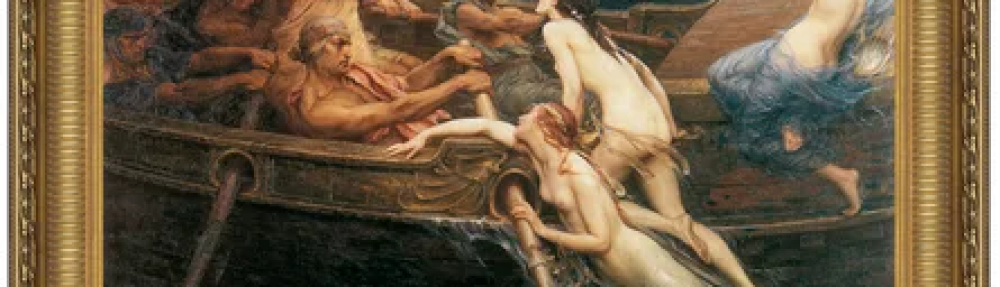
From our previous discussions, we learned about how mermaids (and aquatic creatures in general) existed in medieval times and will continue to exist in the modern age. In The Penguin Book of Mermaids, there is one creature we have encountered/yet to encounter, called the siren.
The siren is a creature in Greek mythology, usually depicted with a mermaid-like tail but with other appendages like wings or feet. As seen in a portion of Homer’s Odyssey, these creatures sing a seductive song in an attempt to lure sailors to their doom. In the stanza below, we see how their songs affect Odysseus:
“Thus the sweet charmers warbled o’er the main;
My soul takes wing to meet the heavenly strain;
I give the sign, and struggle to be free;
Swift row my mates, and shoot along the sea;
New chains they add, and rapid urge the way,
Till, dying off, the distant sounds decay;
hen scudding swiftly from the dangerous ground,
The deafen’d ear unlock’d, the chains unbound.” (12)
These songs have an ability to captivate (paralyze) sailors into listening to their songs, and it is so powerful that it is near impossible to break from the song alone. The siren attempts to lure Odysseus, a knowledgeable man, by promising “new wisdom.”
What can we make from this? A desire to exploit a man’s strength and render them vulnerable by promising what they seek? To feast on knowledge like how vampires are to blood? Since we are given the information that “sirens and mermaids are both symbols of dangerous femininity,” (9) we can see masculinity being reinforced through methods of resisting temptation: Odysseus’ crew stuffed wax into their ears to prevent themselves from hearing the siren’s song. Odysseus himself had to be bound to the mast so he wouldn’t be physically able to approach the siren. We can infer through the crews actions that we should always be mindful of what we seek, and sometimes it is better to resist these urges of knowing the unknowable.
Knowlege isn’t always what we seek.
Great post, Jesmond– insightful reading of the text that pushes towards questions and conversations we can have in class. This is just the kind of blog posts I was hoping to get, and I am grateful that you are here!
Hello Jesmond,
I really like how you are descriptive when describing the siren mermaids and how you go into detail about their characteristics. It is also very important that you mentioned that the whole purpose of the siren mermaids was to “Captivate sailors into into listening to their songs, so that is nearly impossible for them to break free and remain in control of their ships” Like you mentioned, the purpose of the siren mermaids was to be in control of the male sailors, and make them realize that they were not as strong, as powerful, and as in control of the ocean, as they thought they were.
Hi Jesmond! This was such a good post, I loved the questions you have brought up and I hope we get to discuss them in class today! Sirens are such interesting creatures and I am so excited to learn more about their history!!
Hi Jesmond! I really enjoyed your understanding of Odysseus’s pull to the siren. It also made me think of Sirens, and their positions of holding a wisdom and knowledge unknown to man. However, the cost of knowing is death. I will be interested in hearing how you interpret other myths, and perhaps what they have to say about the dangerous and divine feminine knowledge, as well as the fear of man.
I would like to point out that we have similar interceptions with the text where the possible message is to be careful in seeking wisdom. While I can see where you’re coming from with the reinforcement of masculinity with how Sirens are portrayed as beautiful (something they share with Mermaids), their physical appearance ultimately did not matter. As the early design of Sirens while as bird people, the very earliest versions had only the woman’s face be recognizable to man as something human. Ultimately, it wasn’t their physical beauty that attracted sailors, and in particular Odysseus, but truly their beautiful song. That’s how I see it, and its interesting to see someone come to the same idea as me but still have their own version of it.