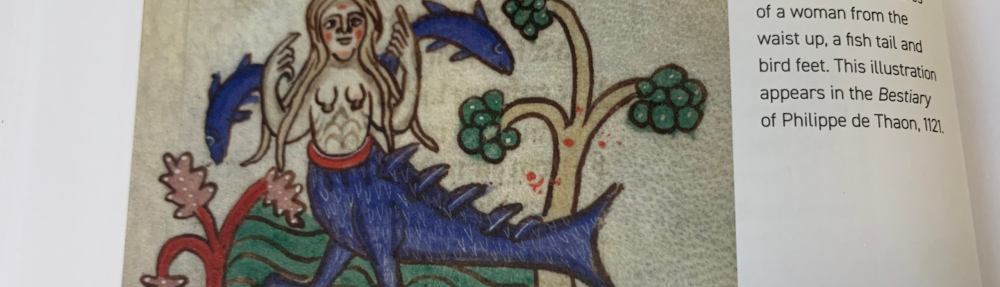
Steve Mentz’s passage, “Deterritorializing Preface,” provides readers with a set of deterritorializing terms to aid in navigating the blue humanities. I wanted to focus particularly on number six, “Distortion,” because of what Mentz had stated about water bending light. Mentz mentioned visual distortion and how “water-thinking makes distortion a baseline condition” (xvii). I read this as distortion not being a physical aspect of water, but a metaphorical one that emphasizes how human perception of the ocean makes them uncomfortable. As we have discussed in class, humans find mermaids unsettling; this “distortion” aspect that Mentz is talking about shows just that. Mermaids are classified as unsettling not only because of their half-human, half-fish nature, but because of the fear that is brought forth by their home, the ocean.
Mentz also stated the “tri-dimensionality of water,” which highlights the comfort of the surface of the sea and the terrifying depths of the undiscovered bottom of the ocean. After reading this, I instantly thought of how it’s similar to the life of mermaids, both being of the surface and depths of the ocean. Emphasizing the idea that mermaids are never entirely of “one world,” which distorts the world’s perception of them. Also, in a literal sense, the distortion of water messes with how oceanic life is perceived, making something small and innocent seem gigantic and terrifying.
This sense of distortion that Mentz talks about can also be compared to how mermaids are scary because they are a reflection of us. They are the water distorted versions of ourselves, and that is what is terrifying to them. We as humans see the ocean through this water-distorted lens, a reminder that what humans fear most in mermaids is what they see in themselves. I like the idea that water bending light distorts, because when you think about it sometimes tends to look creepy underwater, especially if the water is moving. And it’s interesting to think about how we are terrified of the deep ocean because of the mere fact that we cannot approach it without facing the instability within ourselves. The fear of water is the fear of our own self-image; that distorted version of ourselves is our greatest fear.
Study Song of the Week: Falling Stars by A Shell In The Pit
This one is not so much Mermaid core, but it felt very oceanic, and I honestly don’t know how to explain it further.
Hi Hahnnah!
I agree Mentz’s readings were very much based more in oceanic points of views rather than the that of mermaids. Which is why I had a harder time with what to discuss in this weeks blog post. But after having heard Mentz talk and now reading your post I feel I have a better understanding of how water as whole plays into our class discussions. You say that a fear of water is a fear of the self, which blends into what Mentz talked about. That water is everywhere, even in ourselves. Our bodies anatomically contain a lot of water, it is a mirror to us both metaphorically and literally. It is a reflective surface that we can see ourselves in and in turn shows parts of ourselves we may repress. Thank you for your post I found it very enlightening!
I love your study songs of the week so much 😭😭
This one is 100% oceanic. It’s like beams of sunlight playing along the sea floor.. distorted 😳 by the waves. I think there is a big genre of spooky mermaidcore music but I like this peaceful side.
Also just have to shout out: “that distorted version of ourselves is our greatest fear” because its so so so true.