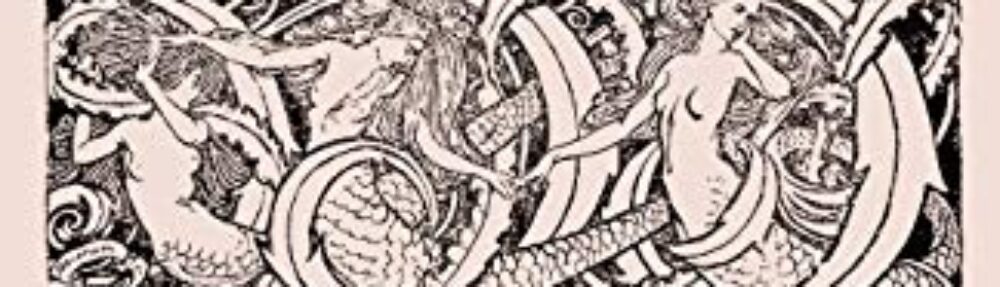
In reading Cristina Bacchilega and Marie Alohalani Brown’s “Introduction: The Stories We Tell about Mermaids and Other Water Spirits” (Penguin, ix-xxii), I found that humans’ never-ending obsession with merfolk and hybrid humanoids comes from our obsession with ourselves. Ancient stories of mermaids and their deadly power may be proof that we feared these aquatic beings because they were mysterious and terrifying monsters, but I think they induced so much fear because we knew humans to have conscious minds. Minds capable of free will to be harmful or evil. A large animal, we can kill with no forethought or deep fear, but a clever mermaid who is just as capable of killing us, that’s what’s scary. Those same human minds and capabilities are also what attract us to merfolk. We can’t help but be curious about what it means to be human to merpeople and to desire connection with them. As much as it entices us, “we humans do not deal well with betwixt or between” (Brown xi). We like our boxes and labels, and having clear lines drawn. We don’t want to mix, or at least we are taught that we don’t want to mix.
Wanting what we cannot have seems to be a timeless and universal trope for us humans. Lacking the ability to live in the ocean and the constant threat of death by drowning make us all the more curious. We crave the knowledge of the seas because we physically can’t experience it. Like the forbidden fruit, we want something even more when we are told we cannot have it. What lies beyond in the unknown, beyond a human-centered world, consistently calls to us.
It is so strange to me how humans are capable of being so fearful yet so enthralled and attracted to something at the same time. Nowadays, we sit at home and watch things like murder mysteries and documentaries in order to feel that fear. We also watch them because we are so intrigued by what we do not know or understand.
Hi Nellie! This is a great observation on the fear we have for mermaids, and by extension, ourselves. This is something that I also noticed in my own reflection. You write, “Ancient stories of mermaids and their deadly power may be proof that we feared these aquatic beings because they were mysterious and terrifying monsters, but I think they induced so much fear because we knew humans to have conscious minds. Minds capable of free will to be harmful or evil.” I couldn’t agree more. I think we fear mermaids not just for their strange hybridity, but because they have the human capability of danger and destruction.
Hi Nellie,
I like your post, especially the point you make about the forbidden fruit of the ocean. We have highlighted the sexual nature of mermaids and their forbidden nature in discussions but not about the oceans. It was and is such a mystery to us that we as humans with these types of lungs can’t access. If it is closed to us as humans it brings fascination and eventual obsession. And as being part human or humanoid, mermaids are easier to expect that they would have the same fascination with us, the forbidden outside of their world.
Hi Nellie, you make a really good point about the idea of mermaids being something we crave because of its sort of elusiveness. There’s this desire for even the horrifying simply because it’s not something we can actually obtain; we want to know things so badly that we’ll search for it regardless of the consequence. Things like the murder documentaries you mentioned that people spend so much time watching, which are a really interesting connection that I didn’t even recognize, are because of how in spite of fear of how these people act, we know their minds of free will like you said and need to discover more about them. Our issue lies in our inability to put action to the information we discover, to actually discovering how we can react to these violent people’s reactions or to the warnings mermaids intend to heed.
This reminds me of attitudes towards extraterrestrial life! I think someone else mentioned the parallels in fiction– how there’s always an element of fear and an element of attraction