The Male Narrative of Femininity: Week 5

After doing this weeks reading something I wanted to take a deep dive into was from chapter 14, “Betrayal”. Specifically where the story states, “He climbed quickly in his eagerness to strike, his heart pumping…there where he had never been before. Neither he, no anyone, except her—and—who else? He believed there must be someone, but without entirely believing it” (Lebey 121). What I thought was interesting was the fact that Raymondin’s first thought about his wife asking to not be bothered in this one day alone, was that she was cheating on him. The dramatics of this scene also show the emotional drama Raymondin is experiencing, which highlights his fear of what Melusine might be doing in that room. The fear and passion that might typically be expressed when a man is met with a woman who is resisting containment. Melusine asking for a moment of solitude, a moment where Raymondin can not control her or have contact with her. Even though her reasoning is because of her snake like form, it still highlights the ruin of femininity from a man/husband figure.

Melusine’s mermaid form embodies lust and danger, the feminism aspect of both life and death. This quote highlights the how women are forced to live within a narrative created by make doubts. How Raymondin only thought she was hiding another lover in the room shows just that. The use of saying that Raymondin believed she was cheating “without entirely believing it” shows the internal battle he is facing. One idea of women through the narrative that has been created by men for many decades and the other being his personal connection and portrayal of Melusine as his wife and lover. Her secret and her identity are being invaded by the failure to live in a narrative built against her in the first place.

I also like the idea that both Raymondin and Melusine were betrayed in this chapter. Melusine in the way that Raymondin broke his promise to her, amd Raymondin in the way that Melusine “lied” to him about her true identity. Seeing how in this quote Raymondin felt betrayed by Melusine, showing the male created narrative women are forced to live in. I liked this quote because of how it highlights how society is out to take away Melusine’s femininity and identity because she doesn’t fit the narrative. Raymondin’s emotions in this quote show how he feels all of his troubles are because of Melusine.

Song of the Week- Bellhart by Christopher Larkin (I liked the drama this song added to the story!)

week 5

As I had read the betrayal chapter it shows clearly that the environment was so important to people and how the environment is so important to people and how they could have consquences.A example of this I saw was in the betrayal chapter was how Raymondin was reading the letter his children had wrote to him and how they both became successful on the adventures and described their alliances and had to note that the sahel empire was successful since they had built their empire under the leo constellation sign and how they note that this difference compared to their alliances allowed them to make it through many hardships.When I thought why they would note the zodiac sign I thought what the zodiac sign represents which is fearlessness and courage which they would need if they wanted to establish their empire in such a difficult environment.Another instance was when raymund was trying to sneek a look at melusine and he discovered rocks that were stars and were “worshipped by the cartridge”.It shows the importance of how people looked to the unknown and tried to find a explanation and not only that showed that their curiosity was focused on that of space at the time and reaching the stars.It not only shows the sciences people focused on it showed that the sciences and how people looked for a justification for the supernatural and showed critical thinking and questioned the importance of credible theories.

A different kind of story

For this post I read The Legend of Melusina” (Penguin, pgs. 85-88)

While I can talk about how the story can be interpreted as power, with Melusine’s incredible power (her wealth and being able to build “the castle of Lusignan”(87)), and or that it is about the trust in relationships (Melusine making her husband promise not to come see her on Saturdays when she’s transformed). I would like to highlight how different this story is from the usual ones of its time and type, where such a secret would have seen Melusine not only shamed and hunted for her curse, but demonized heavily. Which the prelude text highlights that in different tellings, most likely NOT created by the original author, allude to. But rather the husband, Raymondin,“is not horrified but only saddened” (85). This is where I liked the story, because rather than immediately judge Melusine and her condition, showing that he truly only loved her for her looks, he becomes what I interpreted as relief, because he was egged on by someone else, driven by jealously. It wasn’t his words that convinced Melusine to ultimately leave, but Geoffroi, to be honest I would kick him in the shins for calling my wife a “snake and odious serpent” (88).

This also highlights my next interesting point, when Raymondin witnessed Melusine’s hybrid form the text described it as “in a snake, gray and sky-blue, mixed with white”, but this doesn’t actually apply to snakes, but to fish. As the beginning text said, “fish and water hold a redemptive symbolism”, which tells me that possibly Raymondin would’ve accepted Melusine for her curse and redeemed the curse (not her) in her eyes. Considering when their children were born, they were described as deformed, yet for Raymondin, “Raymond’s love for the beauty that ravished both heart and eyes remained unshaken”. Considering how common a trope it is for the husband to blame and scorn the mother if a child ends up with anything undesirable, it proves how much he genuinely loved Melusine. That she found someone accepting of her but another had to go off and ruin it. I can see the story having a message of acceptance as well, but that’s the tragedy.

Week 5: The Cost of Curiosity and Shattering of Enchantment in Melusine

In the reading of Melusine, one moment that really stuck out to me was the scene where it exposed not only a secret about the Melusine’s body, but also a deep anxiety about women’s autonomy in medieval romance (pp.13-18). Raymondin’s decision to spy on her as she bathed was framed as immoral but also as an act of control as he had been told to not disturb her on Saturdays yet his feelings of suspicion caused by gossip pushed him to violate this vital boundary.

What he finds behind the door is described with a lush ambivalence: “[Melusine]…more pale than usual, pearled almost to transparency, combs her hair beside a pool while a ‘great serpent tail’ gleams in the water.” Here, her hybrid form shows the contrast between the wife and monster where she embodies a possibility for women’s agency beyond a fixed role. One of power and secrecy. Yet Raymondin turns this liminality into a threat by forcing her secret out into the open, where he transforms her into a mere spectacle, something to be ridiculed and judged.

Melusine’s response makes it clear that she forgives her husband but insists that his mistrust had “broken the promise made” and condemned her to wander until Judgment Day. This exemplifies the precariousness of female power where she could only exist as a wife only as long as her husband respected the terms and once they were broken, she was stripped of the social position marriage gave her and was reduced to a mythic curiosity. She then soars away as a winged serpent as a refusal to remain under a punitive gaze.

Melusine showcases the familiar gender script where the woman attempts to carve out a private space to retain some selfhood only for the man to betray that trust and violates that privacy out of a perceived betrayal. The romance portrays her departure as one of tragedy but also one of her attempting to retain some dignity. The author underscores the cost of patriarchal curiosity where it not only destroys trust, but also drives powerful women out of the domestic sphere

Week 5: A Curse between Us and Them

The Legend of Melusina is a heartbreaking story about a fairy whose curse, brought on by her mother, has led to a tragedy between us (humans) and them (non-humans). Although the curse can stem from one side, it will often have undesirable effects when the afflicted come in contact with a being from the other side. As seen in Melusina’s curse and her marriage with Raymond, the legend uses the curse as an outside force, whether natural/unnatural or in/outside the person, that can disturb or even devastate both sides of the equation.

Melusina’s rejection comes from her curse–which she cannot control–that turns her into a half-serpent every Saturday, which is lifted under a condition that a man who would marry her should “never [see] her on a Saturday, and should keep his promise.” (Penguin 86) If you know the context, she brought the curse upon herself by planning with her sisters to punish their father (on the “us” side) as “revenge” and confessing what they had done to their mother (on the “them” side). Because she was the one who carried out the plan in the first place, it is no wonder why she had the most severe punishment compared to her sisters. The curse forces her to live outside of society, “in search of the man who was to deliver her.” Raymond, a man who “accidentially” killed his uncle, meets her and swears to not see her on a Saturday.

Despite her curse, she is quite an able and powerful woman, as demonstrated in her ability to build castles and other majestic places “out of her great wealth” for Raymond, as seen in page 87 of the Penguin Book of Mermaids. However, their marriage would quickly crumble when her curse–and destiny–results in “the deformity of the children born of one that was enchanted” and Raymond’s cousin “exciting him to jealousy” and making him believe that his wife is retiring on Saturday. The curse has done more than just curse her body; it has tainted their marriage, and she’s sharing it with Raymond.

In the last parts of the legend, you may be wondering: why was Raymond hiding in Melusina’s room? It’s simple: the curse deceived him. The force from the other side has “afflicted” him, leading to him breaking his promise of never seeing his wife on a Saturday and the curse rubbing it in by making his son murder his brother. These events have led to Raymond seeing Melusina’s cursed form not with horror, but with heartbreak that he broke his promise. And because this curse has led to the death of his son Freimund, he yells at the accursed fairy to get out of his sight while calling her a “pernicious snake and odious serpent! thou contaminator of my race!” (87)

Raymond believes that Melusina was the one responsible for the misfortunes that happened in their marriage, as he is now fully convinced that she has “contaminated” him with the curse that will follow him until his death as a hermit. Melusina had found a man perfect for her to break her curse, but at what cost?

Week 5: Medieval Melusine

“This transformation from a half snake, half woman may be tied to d’Arras’s situating her near water –a fountain and her bath– and to the fact that dragons and serpents have scales just like fish (86).”

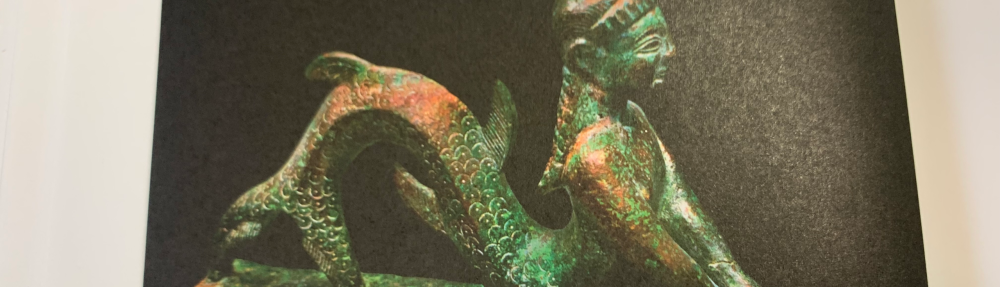
After reading this tale, I set out to look for some art works of this depiction of melusine, as a serpent or dragon. Many modern depictions are mixed between her as a mermaid, sometimes with a serpent’s tail, even sometimes with wings. However, I also was interested in the remains of the castle that she built, whose ruins can be seen today in France. In this 15th-century depiction of the Chateau de Lusignan, Melusine is in the form of a dragon, flying over the castle and perhaps making good on her promise to fly over at the changing of lords.

.Here is googles rundown on the remains of castle Lusignan

This is a link to the Edward Worth Library’s collection of images of Melusine and her different versions of hybridity.

Although the symbolism of water is deeply tied to her myth, she is also punished for her misdeeds, and in some sense, her greed, to forever transform into a serpent hybrid. There are so many different elements in this story which I hope to explore further, such as the curse inflicted by her mother, the multitudes of her hybridity (half fae and human, half woman and serpent), the nature of the curse being carried on to her sons through deformity and cruelness: “Geoffri with the tooth had burned his brother Freimond (p.88).” I’m still at a loss about the relationship between her husband and the conditions of a broken promise. It seems that even as Melusine bestows many gifts upon her husband and their kingdom, her curse afflicts mostly suffering onto her, with her children’s deformity blamed on her curse(or hidden nature), and in the conditions of her curse being discovered resulting in isolation.

Deception Within Marriage

While reading the “Legend of Melusina” from The Penguin Book of Mermaids, I couldn’t help but notice how the theme of transformation was something to note. Melusine has to deal with her shapeshifting nature, even described to be, “… a serpent from the waist downward, till she met a man who would marry her under the condition of never seeing her on a Saturday.” (86) This origin sets her up to be deviant by nature even though she does so much in her power to build him a castle and even go as far as to conceal a murder for him. Her deviant nature is settled in a way. This shows the duality of human vs nature and the duality of women and how they can be perceived by others. Raymond, her husband, agrees to her terms and even has children with the countess. Although Raymond is deeply infatuated with Melusine he eventually breaks the promise and is heartbroken that she hid this from him, even though one of their children resembles her mystical nature. I think her being depicted as a great wife and mother tells a lesson on deception within marriage. Although the deception at hand can be perceived about her not sharing her true form on Saturdays. I think it’s a bigger issue that he broke his promise to her after agreeing to her terms. 

Her story reassures women that stories can be perceived in many ways and also demonstrates the duality of women. Although she can be seen as the one who “deceived” in the marriage first, thus making her inherently the bad guy, on further inspection, it demonstrates how men typically get let off easy in marriage deceptions because of logistics. When in reality, it was Raymond who deceived Melusine first after agreeing to her terms. 

Sacred Serpent: Melusina and The Fall of Man

What caught my attention most after having read Thomas Knightley’s summary of “Legend of Melusinain The Penguin Book of Mermaids was the religiously charged symbols of feminine power and male transgression. The story integrates many aspects of medieval Christianity ambivalence towards female agency and nature. One way this can be seen is from Melusina’s curse of transforming every Saturday into a hybrid snake-woman which highly reflects Christianity’s mistrust in female agency.

Melusina’s hybridity and curse draws many parallels to that of Adam and Eve in the Garden of Eden. Like Eve, Melusina falls short on transgression of obedience. For Eve it was being tempted by Satan (in the form of a serpent) to eat from the Tree of Good and Evil and in turn she and Adam are banished from Paradise. For Melusina, she “took the king[, her father,] and all his wealth, and, by a charm, inclosed him in a high mountain, called Brandelois” for which her mother “condemned Melusina to become every Saturday a serpent from the waist downward” (87). Both Eve and Melusina’s transgression and fates align with medieval Christian conceptions of the Fall of Man as the result of female agency. These parallels of serpent imagery correlate with duplicity and evil. Satan as a serpent in Eden and Melusina’s hybridity being duplicitous. As a liminal figure, Melusina is a representation of religious binaries: God/Satan, man/woman, good/evil. Often in Medieval perspective, hybridity see’s these binaries as dangerous, suggesting a sense of impurity and crossing of boundaries. On top of Melusina being an impure hybrid, her curse is somewhat of a ritual happening every Saturday or Sabbath, something unholy happening on a holy day. This can be seen as female impurity especially in relation to menstruation something natural yet taboo. With that, Raymonds is in violation of “the taboo” and commits a sin of curiosity, much like Adams sin of disobedience.

While Medieval Christianity views her transformation as a mark of shame, I view it as more of breaking of trust on Raymonds part. Much like many men in this time he ventures into and violates lands and people that are not his, under a sense of religious authority. Yet it is her suffering and departure that leave behind, not destruction but, a mark of sanctity. She leaves her footprint in stone (307), and becomes symbolically a martyr of mans ambition and an example of feminine agency. Her Saturday transformation is something sacred that when crossed exposes human kinds desire for dominance over that which they cannot comprehend.

Lines of Succession Know No Boundaries

The only thing that wives and mothers in the story of Melusina ask for is a respect of boundaries. Pressina, Melusina’s mother asked for Saturdays to herself from her husband and when she curses her daughter she sets for her the same boundary. This story embodies the themes in mermaid stories of demonizing the “other” and the female threat to a patriarchal system. Both of those themes play into the subtle political line of succession message in the legend.

The Fay Women found by human men when they were in need of saving are magical creatures. They provide love and success to these mortals in exchange for devotion and promises of letting them keep some part of their power. This power is not over others like it is expected in the patriarchal system of mortals, but in their autonomy to limit the access to their bodies by others. I found it interesting in both of the marriages of mother and daughter, it was a relative that encouraged the husbands of these Fay Women to violate this boundary set forth in the marriage.

In Pressina’s story, it is her male stepchild Nathas and likely heir to the throne of Albania that excited his father to violating the martial pact. It is not explained if Nathas knows of this agreement. Though if he knew about his stepmother giving birth before his father, it is fair to assume Nathas had his finger on the pulse of the activities in the castle. While the birth of three daughters might have not pushed Nathas out of the line of succession, his father’s current wife providing so many additional heirs might have challenged his position. Creating a wedge or a reason to dissolve the marriage might have been in the prince’s best interests.

Later in Melusina’s story it is the cousin of Raymond who had “excited him (Raymond) to jealousy…by malicious suggestions of the purport of the Saturday retirement of the countess” (88). Nathas used joy to break the martial bond, while this cousin used distrust of a wife who would not provide full access of herself to her husband at all times. As a wife Melusina had given Raymond riches and castles he wouldn’t have had otherwise, but she was still an outsider to the world of mortals. Stories and myths often depict how outsiders are always a threat to the accepted system.

The gender and position of the cousin is not depicted in the story, but the relationship of this family member to Raymond reminded me of the only other mention of his family. When we are first introduced to Raymond he has just “accidentally killed” (87) his uncle who is a count. Melusina uses her power (possibly influence) to protect Raymond from the fallout of this killing.

Could this cousin be a child of that uncle?

Could this be a cold dish of revenge by someone whose position was lost from this coupling?

Or was it just Melusina’s ability to maintain some form of power over the societal powerful position of Raymond?

Raymond’s strength is made secure not only through what Melusina built for him but in the children she bore, his heirs. It is only when the sons of Raymond and Melusina are taken out (or at least compromised) of the line of succession that he turns on her. She then becomes a spectre who will haunt the family line when there will be a death in their lineage.

In respecting a boundary, Raymond and the King of Albania were abdicating part of their power given to them by the patriarchal system they were entrusted to maintain. This clearly illustrates the threat the “other” can impose on the sanctity of the established family, teaching how it only brings heartache and ruin for future generations. Underlining how an “outsider” woman who is not is in complete submission to her husband, like the women of the society were conditioned to do, must have flaws and secrets that threaten societal norms.

Fear and Wonder in the Forest 

In chapter one, “ The Great Old Hunter”, the forest isn’t just seen as a setting or a scenery in the background. To me it feels more alive, sort of like a character in the story. The way it’s described shows how medieval people saw the natural world as both familiar and terrifying and also as something that could provide for them but also threaten them. On page 11 the text says, “The forest stretched beyond, menacing and dangerous, full of the unknown, concealing the surprising and the supernatural” this shows how the forest symbolized mystery and fear all at once. 

The people in this story lived right next to the forest so danger was always nearby. Wolves and foxes could sneak into villages and even sometimes drag children away. The text makes a point to say that the weapons were useless against the wild creatures which shows how powerless the people often felt. Even being inside their villages they could never fully escape the dangers of the wild. What really stood out to me was how the forest isn’t just described in physical terms but also in a spiritual way. Villagers often hear clawed feet on the stones and smell sulphur and smoke and this made them think of the devil. This sort of blurs the line between natural threats and supernatural evil. The forest becomes a place where our physical world and the spiritual world overlap. 

At the same time, the forest is also shown as an enchanting place. Lynxes were described as watching with “burning eyes” and bees drop golden honey from the treetops. I’ve always found the forest to be a beautiful place so this mix of beauty and danger is interesting because it truly shows how unpredictable the forest is and that it’s a place where anything could happen. I think that the forest represents both fear and fascination. The forest is a place that humans can’t fully control, where survival is uncertain and where they believed supernatural forces lurked but it’s also a place where they imagined wonder and magic. By making the forest appear so threatening yet mysterious at the same time, the story shows how medieval people lived right on the edge of the wild even though they were never completely safe and the unknown was just a few steps away.