A Story or (His)tory?

After reading the “Legend of Melusina,” I couldn’t help but notice the irony within the story. The idea of husbands betraying or deceiving their wives is very interesting to me because of the notion that they lied first. I get the “conditions” that were in place for them to need a husband to agree to these terms, but it is still ironic. The lying and the deceptions go both ways, as well as the fear behind it all. Both husbands fear losing their wives, but “curiosity killed the cat” is a saying for a reason. The control these women have over the men by getting them to agree to these terms reminds me of why the sirens got the representation they have. Using the weakness of man against them, the lust they are born with, and the fear of ending up alone, which almost every person has.

I liked how the story mentioned, “but destiny, that would have Melusina single, was incensed against her” (85), because it reminded me that Melusina was cursed from the start. The idea that her mother punished Melusina for her “revenge” seeking actions makes me giggle a little. Melusina is gaining a fear of being alone, like the husbands. The world against her love, forever being punished for the revenge she took. I like to think that Melusina is the model for karma. Ran by revenge, only to be forever cursed to be alone, watching over her family. One small deed caused a lifetime of pain, which I feel is spot on for a siren. It almost mirrors everything that sirens are depicted as being: untrustworthy, and deceiving.

I loved reading this story, and it was a very eye-opening story of how sirens came to be. Everyone sees sirens as terrifying creatures, but what if they are this way because of how they’ve been treated? Humans have been untrustworthy and deceitful since the dawn of time. No surprise if the sirens “put up a guard” and were “cursed” for their revenge-seeking thoughts or actions.

Song of the Week: Echo of the Past by Jonathan Geer

Week 4: The Siren’s Song

From our previous discussions, we learned about how mermaids (and aquatic creatures in general) existed in medieval times and will continue to exist in the modern age. In The Penguin Book of Mermaids, there is one creature we have encountered/yet to encounter, called the siren.

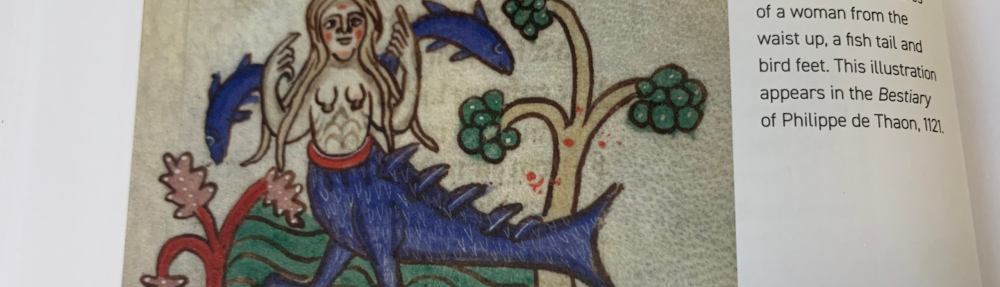
The siren is a creature in Greek mythology, usually depicted with a mermaid-like tail but with other appendages like wings or feet. As seen in a portion of Homer’s Odyssey, these creatures sing a seductive song in an attempt to lure sailors to their doom. In the stanza below, we see how their songs affect Odysseus:

“Thus the sweet charmers warbled o’er the main;
My soul takes wing to meet the heavenly strain;
I give the sign, and struggle to be free;
Swift row my mates, and shoot along the sea;
New chains they add, and rapid urge the way,
Till, dying off, the distant sounds decay;
hen scudding swiftly from the dangerous ground,
The deafen’d ear unlock’d, the chains unbound.” (12)

These songs have an ability to captivate (paralyze) sailors into listening to their songs, and it is so powerful that it is near impossible to break from the song alone. The siren attempts to lure Odysseus, a knowledgeable man, by promising “new wisdom.”

What can we make from this? A desire to exploit a man’s strength and render them vulnerable by promising what they seek? To feast on knowledge like how vampires are to blood? Since we are given the information that “sirens and mermaids are both symbols of dangerous femininity,” (9) we can see masculinity being reinforced through methods of resisting temptation: Odysseus’ crew stuffed wax into their ears to prevent themselves from hearing the siren’s song. Odysseus himself had to be bound to the mast so he wouldn’t be physically able to approach the siren. We can infer through the crews actions that we should always be mindful of what we seek, and sometimes it is better to resist these urges of knowing the unknowable.

Knowlege isn’t always what we seek.

Odyssey and the Sirens

The reading that stood out to me the most this week was in the “The Penguin Book of Mermaids”. The epic poem about Odysseus is famous for its thrilling account of challenges he overcomes throughout his journey, one of them of course, involving his encounter with the Sirens. I was fascinated by the way the Siren was used as a symbol for pleasure in a non-physical way. As stated in the book, “Homer’s sirens sing a song that promises knowledge- a wisdom that bridges worlds-instead of pleasure” (10). I immediately thought about knowledge as temptation and how this has been used throughout time, somehow it seems it’s always been linked to women (ex: Eve). I began to wonder what this says about how we view the two and why they are always intertwined. I think there’s something really odd about this intellectual temptation narrative because It’s not ever explicitly implying that learning is a bad thing. In the reading they literally say, “learn new wisdom from the wise!” (11) maybe not as a form of manipulating him but as an actual invitation to higher knowledge. Reading it from this lens, curiosity then becomes disguised as something negative. It’s important to note that the reason why this matters is because society has a long history of fearing what the knowledge of knowing can do to power structures as it exposes injustice.

Week 4: Deterritorializing is the Key to Harmony

All humans are separated by land: continents, countries, and regions. We came up with this idea of imaginary lines that separate us from wars fought long before many of us can remember. For example, California declared independence from Mexico in 1846, then later became a U.S. State after signing the Treaty of Guadalupe Hidalgo in 1948. All of this to say, land separates us, but the oceans connect us. We are so focused on our disconnection from each other because of imaginary lines that we forget that this planet is 70% ocean, with scientists sometimes calling it the interconnected global ocean. Interconnected. And maybe, as Steve Mentz suggests in his “Deterritorializing Preface,” if we deterritorialize ourselves with terrestrial language, we can become interconnected as well, just like the oceans.

Mentz offers the readers seven different terrestrial words with seven different oceanic replacements: field becomes current, ground becomes water, progress becomes flow, state becomes ship, landscape becomes seascape, clarity becomes distortion, and horizon becomes horizon (Mentz xv-xvii). These are just a few examples in which we can detach ourselves from land-bound vocabulary, but I wonder if taking this a step further (or, as Mentz might suggest, deeper) could help humans stop having such polarizing views ion each other. If humans were to deterritorialize themselves, not just through a means of language, but as a means of differentiation across peoples, could we be one step closer to harmony?

Mentz concludes with this bit of wisdom: “The blue humanities name an ocean-infused way to reframe our shared cultural history. Breaking up the Anthropocene means reimagining the anthropogenic signatures of today’s climactic disasters as a dynamic openings as well as catastrophic ruptures” (xviii). I note how Mentz writes, “shared cultural history,” as if every person on this earth shares cultural history with each other. Which, he’s not wrong—there is one thing that connects us all, no matter what imaginary lines we draw: the ocean. So perhaps, if we take a cue from Mentz, we might finally begin to find a sense of harmony between each other.

Sirens – humanity’s curiosity

When reading ‘Odysseus and the Sirens’, it brings to attention that Sirens and Mermaids were originally separate entities in mythology. While later depictions of mermaids emphasize about their beauty and seductive natures, Sirens were not characterized by the same sexualized traits. Rather it was their powerful songs that define them as noted in the line on page 9, “it is the power of their song and music rather than their appearance that characterizes them across time”. Alongside what the songs held.

In the passage from the poem, the Siren’s song is the main focus, as it can be read Odysseus is curious about the contents.

‘In flowery meads the sportive Sirens play, Touch the soft lyre, and tune the vocal lay; Me, me alone, with fetters firmly bound, The gods allow to hear the dangerous sound. Hear and obey; if freedom I demand, Be every fetter strain’d, be added band to band.’

I believe Sirens may have been a metaphor for the human curiosity that drives some of us to explore the unknown, but also the possible dangers coming with that pursuit. Odysseus wanting his men to restrain him so he could listen to the Siren’s song fully may represent how there must be limits and restraint to avoid being destroyed by it. The song symbolizing new knowledge, which can both enlighten and consume someone if not approached with caution. This could’ve aligned with early sea travel, that the ocean held mysteries able to benefit earlier humans but also held within it dangers that did claim many ships and lives.

Week 4: The poetics of ecological catastrophe

“Whitman’s pale body, and my own, frolicking in the waves, carry on our skin the guilt and violence of ecological catastrophe. I would like to believe, and sometimes I do believe, that inside the chaos of the surf we can derive succor and some pleasure from the buoyancy that poetry creates. But it is hard not to recall the other creatures who depend upon the ocean, the fish and crabs and microscopic plankton, that will pay a harsher price.(150)”

Every summer, the warnings issued through news sources and splashed in front of empty lifeguard shacks tell beachgoers that a sewage spill has contaminated the water, and thus, swimming is not recommended. And so, like Dickinson, we watch from ashore, the untouchable Silver that beckons us with its waves and dirtied water. At least, this is the issue in the South Bay. Miraculously, the sewage-contaminated waters from the Tijuana River plant do not spread beyond Silver Strand(and occasionally Coronado).

Every year, visitors turn away from the contaminated beaches of the South Bay, and find solace in the pristine white sanded beaches of Solana and La Jolla, conveniently located in some of the most affluent areas of San Diego. 

While Blue Humanities focuses on the poetics of planetary water, I can not in my experience separate my view of the ocean from the politics of land and water. The contamination of the beaches and the surrounding wetlands and waters is a constant feature on my mind. Just as Steve Mentz states, “it is hard not to recall the other creatures who depend upon the ocean, the fish and crabs and microscopic plankton, that will pay a harsher price(150),” I too can not seperate my enjoyment of the beach and ocean, from the total devestation of an unsolved ecological crisis happening a few miles down the coastline. As we turn to our beaches in the summer for pleasure and connection, and the surrounding coastal cities benefit from curating their beaches into tourist economies, I think of the way we continually take advantage of the body of the Ocean, the life and solace it provides us, and with which we interact.

I appreciated the broad experience captured in “poetics”, which Mentz expands through “Aristotle’s claim that poetics combines pleasure and pain,” which “seems especially noteworthy for a blue humanities focus on the watery parts of the world that both allure and threaten human bodies. (139)” Even as we remain grounded in our homes and on land, the ocean reminds us of its mistreatment, and it asks us to pay the price. As the issue at the sewage plant worsens with inattention, it rightfully reminds us that even the gorgeous beaches and tanned cliffsides further up the coast can not escape the eventual devastation of human pollution.

Week 4: Rethinking Horizons of Water as Openings to Look Forward

In Steve Mentz’s Ocean: Deterritorialzing Preface, he suggests that we reframe our thinking of how we use language to think about culture and environment by exchanging land-associated metaphors for oceanic ones. In the opening paragraph, Mentz challenges, “What happens to ‘grounded’ metaphors when everything solid becomes liquid? Let’s start by swapping out the old terrestrial language for saltwater terms” (xv). By proposing these seven new words, Mentz asks us to change our perspective of these terms through the medium of water.

One striking passage that stuck with me was under his explanation of the word “distortion (formerly clarity)” where he writes, “Water bends light. Water-thinking makes distortion a baseline condition” (xvii). On land, clarity and stability are things that are highly prized by us humans but water, on the other hand, resists that clarity by refracting images and creating a visual distortion. We cannot hope to understand the ocean if we cling to the idea of perfect transparency.

Later, Mentz turns to the word horizon as a metaphor of possibility, “I imagine horizons as sites of transition, like beaches or coastlines, and also as places where perspectives merge… These are places from which new things become visible” (xvii). This description complicates the standard association of the word horizon which is a clean line where the sky meets land or the sea. The horizon is not a rigid boundary but a living and constantly shifting threshold. This way, the horizon invites us to look outward, to be more aware of what comes into view depends on our perspective and the sea itself.

With these metaphor changes in mind, reading Preface this way highlights how blue humanities thinking unsettles the habits of certainty we tend to enjoy. Each of the seven term trains us to value transition, movement, and rationality. Mentz does not simply describe the ocean, but challenges us to use it as a method and urges us be more open minded.

Week 4 reading

Focusing on poem verse 6 on page 11 of “Odysseus and the Sirens”, the carefully cultivated song (with a rhyming scheme of ABAB) to catch Odysseus attention with his greatest desires and fluffed up ego had worked to the point where his crew mates had to tighten Odysseus binds before he escaped and went towards the sirens. Not a sexually charged lure was used in this scene, instead the offer was about having rich knowledge and becoming a more powerful being.

Odysseus is an arrogant warrior and how did the sirens manage to catch his attention? “O pride of Greece!” (line 1) and “Blest is the man ordain’d our voice to hear,”(line 3) are great hooks that captured Odysseus ear. Who wouldn’t want to play a closer ear to someone complimenting them? The sirens praising him for being the extraordinary warrior he is and acknowledging how lucky he is to be hearing their “lay”(line 2). Odysseus knows that the sirens have bad intentions, hence why he’s bounded to his ship and his crew mates have wax stuffed in their ears. The supernatural beings that sirens are and have access to infinite knowledge helped gain their case for how to lure Odysseus their way.

The “Celestial music warbles from their tongue”(pg.11, verse 5, line 3) has me associating sirens as the harbingers of death. These supernatural creatures have sweet songs that convince humans to end their lives for whatever deep desire they have in their souls that isn’t for safe keeping while you’re around them. They know your vulnerabilities and use them against you.

This scene showcases how often humans are tempted to go the wrong route in life that will bring a heavy hand of pain. Or, fight through those intrusive and compelling thoughts and stay true to oneself. The choice is ours.

The seas and horizons are one in the same, forever forcing us to question our known world.

In Steve Mentz’s passage, “Deterritorializing Preface,” he introduces his audience to a new vocabulary, not only to acquaint his readers with the language of the ocean, but to integrate it into the “land language” (of sorts) that we use every day.

What caught my attention the most out of these seven vocabulary words was Horizon. Every other word introduced had been changed. Water from ground, flow from progress, seascape from landscape, except for horizon “(formerly horizon).”

We have always associated the word horizon with the unknown, and in the case of humans, the unknown has always been and still is the ocean. For much of human history, all we had to tell us of where we were and where we were going were our senses, most importantly, vision. The horizon is the farthest distance our eyes can behold, and we have constantly chased that place. The horizon calls to us even more because it is often associated with the ocean. That stark flat line of blue waters that merges with the sky is enticing because it seems to span forever, and we are just as curious as to what lies beyond it as we are to what lies beneath it. We use phrases like “broaden our horizons” when we refer to bettering ourselves or gaining knowledge, because when we chase horizons, we leave behind the world we know in the hope of discovery. Mentz states, “Can horizon be a metaphor for futurity that spans green pastures and blue seas? I imagine horizons as sites of transition…” (Deterritorializing Preface XVI) Of course, there is no true “place” where the sky meets the sea, but it is attainable through progress, or as Mentz would call it, flow. This transitional space, upon which we chase the sun to the edge of the water, is where we expand our comprehension of the planet we call home.

We look to horizons also for markers or points of new beginnings or of memories. “Early modern
European sailors heading into the Atlantic spent days looking out for the unmistakable silhouette of Tenerife’s volcano, which signaled impending arrival at the Canary Islands” (Deterritorializing Preface XVI.) The landmarks that jet out in contrast to the vast sea are signs of hope and life. On a canvas of mysterious waters that make up most of this earth, land on the horizon not only gives us bearing, but the promise of a habitable place.

Week: 4, Oceanic Distortion

Steve Mentz’s passage, “Deterritorializing Preface,” provides readers with a set of deterritorializing terms to aid in navigating the blue humanities. I wanted to focus particularly on number six, “Distortion,” because of what Mentz had stated about water bending light. Mentz mentioned visual distortion and how “water-thinking makes distortion a baseline condition” (xvii). I read this as distortion not being a physical aspect of water, but a metaphorical one that emphasizes how human perception of the ocean makes them uncomfortable. As we have discussed in class, humans find mermaids unsettling; this “distortion” aspect that Mentz is talking about shows just that. Mermaids are classified as unsettling not only because of their half-human, half-fish nature, but because of the fear that is brought forth by their home, the ocean.

Mentz also stated the “tri-dimensionality of water,” which highlights the comfort of the surface of the sea and the terrifying depths of the undiscovered bottom of the ocean. After reading this, I instantly thought of how it’s similar to the life of mermaids, both being of the surface and depths of the ocean. Emphasizing the idea that mermaids are never entirely of “one world,” which distorts the world’s perception of them. Also, in a literal sense, the distortion of water messes with how oceanic life is perceived, making something small and innocent seem gigantic and terrifying.

This sense of distortion that Mentz talks about can also be compared to how mermaids are scary because they are a reflection of us. They are the water distorted versions of ourselves, and that is what is terrifying to them. We as humans see the ocean through this water-distorted lens, a reminder that what humans fear most in mermaids is what they see in themselves. I like the idea that water bending light distorts, because when you think about it sometimes tends to look creepy underwater, especially if the water is moving. And it’s interesting to think about how we are terrified of the deep ocean because of the mere fact that we cannot approach it without facing the instability within ourselves. The fear of water is the fear of our own self-image; that distorted version of ourselves is our greatest fear.

Study Song of the Week: Falling Stars by A Shell In The Pit

This one is not so much Mermaid core, but it felt very oceanic, and I honestly don’t know how to explain it further.