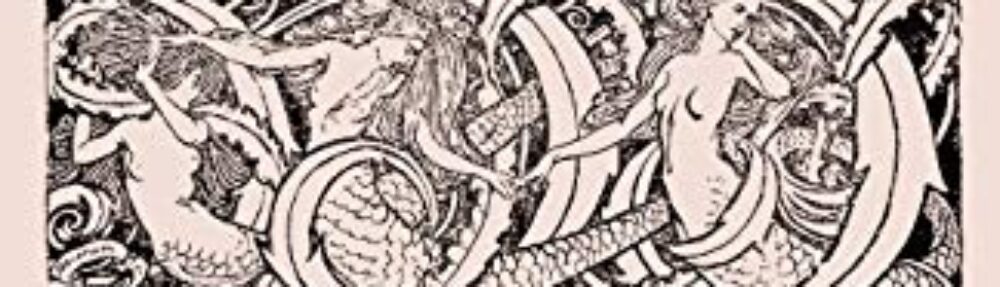
From the very start of the introduction, Scribner draws his readers in with quite an unorthodox observation: “Merpeople are everywhere” (Scribner 7). Typically, you don’t think merpeople are “everywhere,” after all, we are land-dwelling creatures, which would deprive a mermaid of living ability. And yet, Scribner notes various forms in which mermaids are seen daily: the mascot of a coffee chain, TV shows, and even “Mermaid University” programs.
This interest in mermaids isn’t new, Scribner notes, saying that this interest has always been present in humans. I find it interesting that Scribner goes on to say that “[T]hese hybrid creatures represented danger as much as hope, wonder as much as horror” (8), which makes me wonder—what is it about hybridity that humans tend to obsess over? What is it about the blending of two things we are so obsessed with? Perhaps I have a different perspective on this because I grew up in a mixed-race household—my mom being Filipino and my dad being Italian-American—but I can’t count the number of times I’ve received strange comments about my lineage: “So, what are you?” “Wow, so exotic!” “That’s so interesting.” I don’t exactly take offense to it, but there is a little bit of a sting when people (usually from older generations) have this sort of intrigued yet fascinated look when I tell them I am mixed. But the human interest in mixed things doesn’t stop at these mixed children like myself; we see it in cultural/regional fusion dishes, domesticated dog breeds (most dogs nowadays are hardly ever pure-bred), even academic disciplines (Interdisciplinary Studies?), and many more I can’t think of off the top of my head. I think humans are naturally drawn to this mashing up of two different things because we crave uniqueness and originality, with the mermaid and other hybrid mythical creatures satisfying this craving thousands of years ago to today. Scribner goes on to solidify this, writing, “Monster theory and hybrid studies are imperative for Merpeople: A Human History, especially in their ability to reveal the humanity in such seemingly foreign, incongruous manifestations of the natural world” (8).
The last thing I noted while reading this introduction was Scribner’s observations that “[W]hile mermen found their origins in a Greek God, mermaids largely originated from hideous beasts who only intended to bring man to destruction through his own lust for sex and power” (11). I find it quite interesting that this evolution—man from God, woman from beast—is likely from patriarchal structures that prevail throughout time and is reflected in our own society today. Women being placed below men on the pedestal because “Eve committed original sin.” Women being told they are too emotional to lead. Women are being told they are weaker and, thus, inferior. I don’t think these examples hailed from the mermaid coming from hideous beasts, but it is definitely related. It is yet another example of women getting the short end of the stick and often being the “root cause” of men’s problems (e.g., being the reason they get led to their doom, even though they craved sex and power). This Introduction sets up a brilliant framework for how mermaids have shaped modern society today.