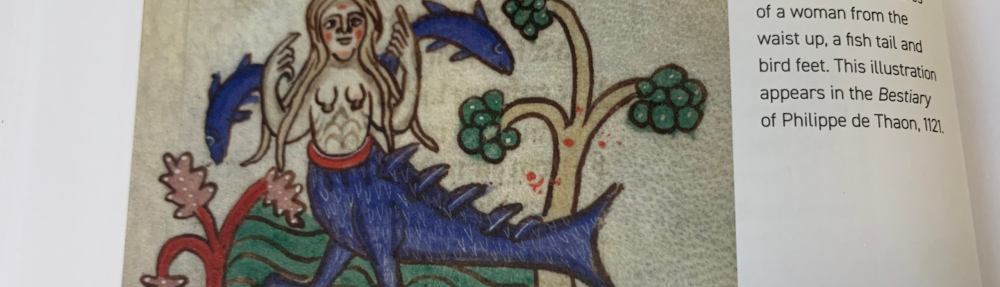
Medieval Western depictions of mermaids have been used as a means to exert control over women. “Church leaders needed a feminine, dangerous, and lustful counterpart to their upstanding men. This is where mermaids came in.” (Scribner Ch.1) Christianity sculpted femininity as harmful to faith and devastator of mankind. “Their ultimate goal remained tethered to decentering the feminine.” (Scribner Ch.1) In contradiction to this tradition, Gabrielle Tesfaye’s short film “The Water Will Carry Us Home” illustrates mermaids as bearers of life. Employing an African perspective, Tesfaye challenges Western traditional operation of mermaids by using them to continue life rather than destroy it. By re-imagining the death of those killed at the hands of White Western oppressors, “The Water Will Carry Us Home” not only reclaims History, it reclaims mermaids.


A key component to presenting an African perspective is the framing of the animation with Yoruban and other African ritual. The film begins with clips of Tesfaye performing living ritual. Among the many images presented, Tesfaye is found mapping stars (0:53) and baring her stretched ears (0:55). These two images hold importance because they ground non-conformational history. African astrology dates back to ancient civilizations of Africa. Modern astrology gained its foundation from African astrology. By representing astrology in the form of star mapping, Tesfaye is recognizing contributions from early African civilizations. This confirms the fact that Africans were not lacking in educational cultivation. Contrary to what conquerors of African communities have attempted to illustrate, these cultures were not obtuse or primitive. Tesfaye’s stretched ears characterize a long-held African tradition that symbolizes wisdom and status. This tradition was not only practiced among Africans. It was a widespread custom, transcending cultures globally such as: Aztecs, Mayans, Ancient Greeks, Buddhists, among others. Westerns view stretched ears as a marker for savages. In baring her stretched ears, Tesfaye persuades her audience to recognize the cultural significance. A practice that transcends cultures globally and symbolizes knowledge and power. These first notable images not only begin to ground an African perspective, but they reinstate African history and culture as universally significant.


Furthering an African perspective, Tesfaye presents Yoruban Gods; or Orishas in her animation. The Orishas, Yemaya and Shango, a mother and son pair, are protecting the captured Africans. Yemaya is the Orisha of the sea, motherhood, and femininity. (4:20) She gives and protects life. Shango is the Orisha of thunder and lightning, he is a source of fertility and embodies masculinity. He uses his powers to hinder the progress of the ship. (2:48) Watching these two Gods, man and women, working together to hinder the slave ship, upends Christianity’s use for mermaids. The church’s mermaid depictions strove to reduce women in order to uplift men (as reiterated by Vaughn Scribner). Presenting the god of femininity and the god of masculinity in harmony, working together to protect their people, subverts the values of the Christian God. Unlike the reborn mermaids in the film, Yemaya is illustrated with a split tail. (4:50) The Christian church utilized a split tail to represent “feminine lust and danger” (Scribner). Illustrating the Orisha Yemaya, protector of women and renewer of life, with a split tail positively represents women’s sexuality as bearers of life. In explicitly giving a god a split tail, Tesfaye is reclaiming mermaids as a positive representation of women and their sexuality.


“The Water Will Carry Us Home” re-imagines the brutal end that White western oppressors intended for pregnant women aboard their ship. (4:06) She re-gifts them life twice: by rendering them as mermaids (4:32) and by telling their stories. Reimagining their savage death with the formation of mermaids reclaims History by undermining their erasure. Closer examination of the mermaids after their rebirth shows that they all have a third eye. (4:40) In Yoruban culture, the third eye is the eye of the ancestors. Restoring these women as ancestors means they spawn descendants. Their genes and their stories are passed on. The dialogue of the atrocities of the Middle Passage is silenced because it is not something that society wants in conversation. It is common to cover up cruelty, especially in the case of mainstream society being the hand of that cruelty. Recreating these women as ancestors ceases the attempted erasure at the hands of the oppressor and reclaims History.


Throughout the film, real newspaper clippings are used to ground the animation in history. (3:05), (2:59) Tesfaye wants the audience to bear in mind that this is a historical narrative. In addition to the newspaper clippings, Tesfaye uses her ritual framings to ground the story in authenticity. At the end of the animation the Orisha Yemaya is clutching a white flower. (4:58) Then, cut to Tesfaye, throwing white flowers into the ocean. (5:20) Showing Yemaya interacting with one of the flowers that the living Tesfaye is throwing into the ocean further establishes the re-imagining into reality. Grounding the notion that this Orisha is out there as well as the emancipated mermaids. In addition, her ritual settles the account into reality when she is within the locked door. (5:45) In the beginning the live action is shown before the story is unlocked. Afterwards, Tesfaye is locked into the narrative, (5:57) suggesting the story’s reality, grounding the narrative, reclaiming history.


Telling the story of the Middle Passage in a digestible way operates to preserve the ancestry of people who were intended for an unrecoverable death. Lineage is continued when those thrown overboard are re-gifted with life during their mermaid transformation. Reclaiming life in turn reclaims History and narrative. Illustrating mermaids as bearers of life rather than destroyers of it upends the church’s aim to decenter the feminine. Tesfaye presents a positive representation of female sexuality with her mother mermaids. Reclamation of mermaids through an African perspective confutes the White western oppression of erasure.


