The Web of Life/ Hope

I have two distinct topics to address this week, which I wasn’t able to connect.

1

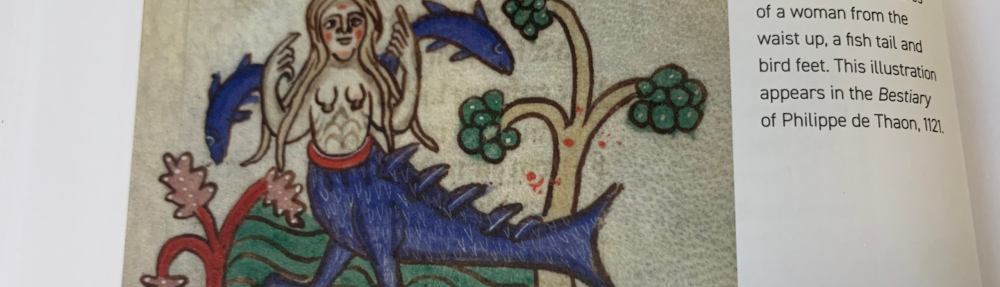
Eames’/Barnum’s mermaid specimen was exhibited in 1945, and by 1950 newspapers (according to Scribner) had moved on from wonder to scorn– publicly, officially, mermaids were a hoax. In 1959, Charles Darwin published his Origin of Species, one of the most important works in Natural History since Linnaeus’s Systema Naturae 100 years earlier. I was fascinated by a paragraph from the newspaper article based on one of Barnum’s staged letters, reproduced in Penguin p. 241 (“The Mermaid“). The third paragraph provides support for the plausibility of mermaids by presenting similar examples of recently discovered “hybrid” animals; the orangutan (“ourang outang”) “linking” animals and humans; bats and flying squirrels “linking” quadrupeds and birds, the flying fish “linking” aquatic animals and birds. I wonder how much this editorial reflects actual scientific thought at the time, and how much it is a layman’s interpretation, a fundamentally distorted perception of scientific consensus, the way popular science news is even today. Either way, it seems to represent an interpretation of the diversity of life somewhere between Linnaeus’s mostly arbitrary groupings (he was far better with plants than he was with animals) and Darwin’s “tree” of life. This idea of distinct groups of animals being connected by hybrids, or “links”, brings to mind a diagram not like a tree– but a web.

2

One line of Scribner’s chapter on Mermaids in the 19th century stuck with me

“… belief in merpeople still held stock in certain areas, as did the lingering hope that these creatures might exist.” (128)

This chapter discusses the movement of mermaids in Western culture from a frontier of scientific exploration (held equal in plausibility to the recently discovered platypuses and dinosaurs) to a debunked myth, but Scribner maintains the thread of human interest in mermaids, whether they believed in them or not. This line stood out to me especially because it expresses something I believe to be true– whether we accept or argue about the existence of mermaids– or, I’d posit, the modern equivalent, extraterrestrial life– there exist many of us who have a personal emotional stake in their existence. My theory? It has something to do with us not wanting to be alone.

Mermaids are Trans

A certain line from the introduction of the Penguin Book of Mermaids clung to me like seagrass tangled in hair today.

“At stake in these stories is the female merbeing’s existence between worlds… …her ability to cross the threshold into the world of humans and “pass” there as human while never fully belonging.” Penguin Book of Mermaids, Introduction (p xviii)

I will root my appreciation of this line in Embodied Practice and personal life history– specifically, my thoughts today snorkeling in La Jolla Cove, and my existence as a transgender man.

I feel that the transformation becomes more complete every time I enter the water. I feel the rubber fins become more a part of my body; either I am shaping to them or they to me– my feet no longer chafe, my calves no longer cramp. I feel my skin adapting as well– adjusting to the salt, no longer drying. I feel my ears grow more adept at shedding or accepting water, or air, my sinuses equalizing with less and less effort. In a light wetsuit in warm, sunlit water, I am completely unaware of my body temperature, or the energy I am expending to maintain it– I wonder if it is possible to experience homeostasy as cold-bloodedness (a misleading name; ectotherms have warm blood as often as cold, they just don’t control it).
A part of me feels painfully aware that I am experiencing only a shadow of the aquatic state. My fins are only prosthetic; when I take them off to lend them to a friend I feel amputated, halved. Though I’m adept now at expending very little energy in the ocean, I realize that without my snorkel I would tire quickly, the two hours I spent today might have been quartered.
As advanced as I am in my transition, no surgery can change my chromosomes. I will always be a hybrid.

“We humans do not deal well with betwixt and between- liminality makes us
anxious,”
Penguin Book of Mermaids, p xi

Still, I am transfixed by the damning assessment of a proto-avian dinosaur fossil in a short story I read last week–
“What a thing, half bird, half lizard, part one thing, part another, trapped forever between more perfect states” Mkondo, Anthony Doerr

At first I asked myself– is it truly so terrible to be not a man and not a woman. To be in the water but not a fish. Then I asked myself– is it truly a natural state? To be un-hybrid. I feel myself, like the dinosaur, between the initial embryonic femaleness of every human and the eventual maleness of some of them. Between the aquatic past of tetrapods and the eventual aquatic present of some mammals.

Mermaids may be a construct, but hybridity is not. Being of two worlds– that is the natural state. The idea that there are dichotomous, segregated, discreet “perfect” states of existence– that is a construct as well.