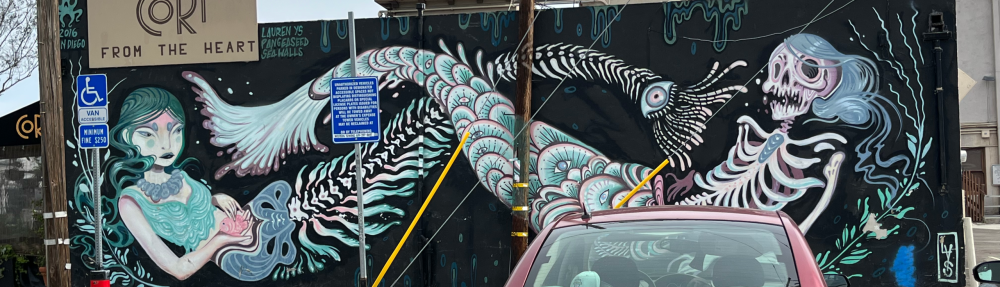
“Siren! … or woman? What does it matter?”

I enjoyed our reading last week so much that I spend 13.45 US Dollars on shipping to buy a copy of Knight’s translation directly from the publisher. My post last week was a reading of LeBey’s character through his writing; before I start this week, I want to pay more respect to the beautiful translation by Gareth Knight. Did you know that Gareth Knight (who passed in 2022) was a blogger? Or that he was a practicing occultist? After only a brief foray into his personal and academic history, I am forced to credit a significant portion of my enjoyment of this translation to the translator.
Knight was a scholar of Christian mysticism, Arthurian Legend, Celtic Myth, and Tolkein. His work on Melusine is some of his later work. His research into the topic began in 20011, and he wrote two other books on the topic– Melusine of Lusignan and the Cult of the Faery Woman, and The Book of Melusine of Lusignan in History, Legend and Romance (including translations of two other French versions!) as well as the translation we’re reading now (published in 2010). Information about him and his writings proved difficult to detangle– in my mind, signs of a mad genius at work.
Also, a brief aside; I discovered in my reading that although the famous d’Arras text, one of the earliest transcriptions of Melusine, was published in 1393, Lebey wrote this retelling exactly 100 years ago– in 1925! I’m sure there is more to extract from the knowledge that this story came both on the heels of the industrial revolution and World War I. I don’t know enough about the sociocultural climate of France in this era to draw conclusions!

Abstract
This week I’m exploring the assertion made by the quote I used as my title. What really is the difference between a woman and a siren? My theory is that the existence of mermaids in Western mythology is a reflection of the fact that men refuse to see women as members of their own species. A man looks at a woman and sees something so indecipherable, so foreign to himself that she might as well be a fish. At the end I’d like to touch on the other side of this coin. Men see women as mermaids because they’re alien and foreign; why are women– and especially girls– drawn to mermaids? What do we see of ourselves in them?2

I’m sure many of us were drawn to the first use of the word “siren” in the text we read.

“And so she accepts, just like a woman, that which is but should never be! … Ah Siren! … or woman? What does it matter? Women do not know, know nothing of what we call Honour!” (Lebey, trans. Knight, 138)


What a damning line… for Raymondin! I want to dissect my interpretations of this passage.
Context: Melusine has attempted to comfort her husband after one of their sons has killed another. Raymondin, already poised in suspicion and jealousy, poisoned by his brother’s intimations, can receive no comfort from her, as he has positioned her in his mind as someone who’s already betrayed him.
Melusine’s attempts to comfort backfire– Raymondin can see only the worst in her now– her acceptance of their son’s death is another betrayal to him.
CRITICALLY, in the same breath as rejecting her offered reassurance, he attributes her faults to her femininity. There is hardly a single word that allows us to transition from his perception of Melusine as a person and confidant, to a perception of her as a woman. And Raymondin reveals, when he attributes her (ascribed) worst qualities to her womanhood, how little he thinks of women. This makes me think– has Melusine ever been a person to him? When he loved her, was it in spite of her being a woman? Is this what love is, in this time, in this place– infatuation with something you don’t respect and don’t trust? Doesn’t that sound familiar? Women have an irresistible draw– but conceal myriad dangers? Isn’t this man’s relationship to the ocean (as we have read it so far)?
The next part of the line sets itself up. Siren… or woman. What does it matter? To Raymondin, they are the same. In fact, to Men, they are the same. As has been reinforced by the Christian church by the very use of mermaids, women are beautiful but dangerous, and most importantly, they are other, they are alien.
I want to inspect the last part of this quote for one, specific, tiny word that reinforces the point of women being alien– “Women… …know nothing of what we call Honour”.
We. They… and we. “We”, here, to Raymondin, is humanity. Honor is a human trait. It is one of those shining godly qualities that separates humans from the supernatural, the animal, the forest, the sea3. And humans… does not include women. Women are they, women are supernatural, women are animals, women are the forest, women are the sea.
Conclusion
Even today, as far as feminism has come in the last hundred years, I see this attitude towards women everywhere– I see it in male friends, in self described feminists, in men who make significant effort to treat women respectfully but seem unable to accept that men and women are part of the same species. In fact, humanity, in the Western world, has almost speciated by gender, and Maleness is still the dominant cultural group, which means that even if we have progressed beyond treating women as property, or children, they are still not “human”, because “human” is man.
Where this leads me– how do women see themselves? And critically for our Class— how do women see mermaids? It’s the topic of a longer work, but I want to note in case I haven’t already that after the first two chapters of Scribner’s Mermaids: A Human History, he presents imaginative narratives from the perspectives of men in different historical settings encountering mermaids. Certainly, the male gaze and the male perception of femininity through mermaids is important, and we have a lot to learn from it– but the next step of this inquiry for me is to examine the female perception of mermaids

  1. Interview on Knight’s blog from July 4 2011, in which he mentions that he’s been researching Melusine for ten years. ↩︎
  2. I appreciate your grace letting me fluidly interpolate my life experience as a woman with my current existence as a man. I think of myself as a girl who grew up into a man, and I still see my inner child as a girl 🙂 ↩︎
  3. I know this claim could use further support! ↩︎

Humanity in Femininity

Melusine’s story reflects so much of life from its introduction: discussions of the fluid nature of opposing concepts, patriarchal structures and their implementation within relationships, and of course, the need to hide deep secrets from those we love in order to protect ourselves. This then spills over into one of the most realistic parts of the story in my opinion: the use of mermaids as a vessel for fate, and how that plays a role in romantic ideology for women.

Emotionally, it’s made incredibly apparent how his betrayal of her boundaries, a concept all too well fated to modern societies and relationships, becomes a point of vulnerability for her. The moment her image of their love seems to unravel, she crumbles: “the fate that was now imposed on her, she felt everything uncertain, herself, her future, as if her heart was breaking, and she fell to the ground as if she were dead” (Lebey, 140). Emphasis on fate, how this was inevitable, begins this narrative of how love stories are considered written as a part of our lives. Life as we know it in the 21st century often means marriage, the nuclear family; it is destined regardless of women’s desires for their future. In Melusine’s, her one explicit desire only lies in being loved, and seen as more than the curse she’s been fated to. She truly represents how destiny plays a role in women’s reality, how escaping the circumstances placed upon them is something they so deeply crave, and that is often found in love in literature. His respect of her boundaries for so long implied reality in these desires finally being fulfilled, in this escape of her unfortunate through the power of a soul-crushing love that’s so often depicted to women, making his betrayal so impactful.

Seeing it from a holistic perspective, it’s apparent how being betrayed by someone she loved shatters her world view beyond love. It resonates deeply with those who’ve experienced that first major love heartbreak, to consume yourself so completely within another human being only to be so earth shatteringly devastated at their disappearance, and faced with the reality that you and this other are not intertwined forever. Mermaids being seen as these powerful and divine creatures that build upon womanhood’s principles, only for Melusina to become so distraught by the loss of a man shows how integrally incorporated love becomes as a part of womanhood. Despite being a figure of supposed vanity, and caught in a moment of “narcissism”, his betrayal wrecks her so deeply, it feels like a death of such a major piece of her. It humanizes her, equating the way so many girls and women react to losing a partner they invest themselves within to her, as well as paints how in a patriarchal society, natural state, hers being a mermaid, ties women to the inevitability of whatever their situation may be.

Lines of Succession Know No Boundaries

The only thing that wives and mothers in the story of Melusina ask for is a respect of boundaries. Pressina, Melusina’s mother asked for Saturdays to herself from her husband and when she curses her daughter she sets for her the same boundary. This story embodies the themes in mermaid stories of demonizing the “other” and the female threat to a patriarchal system. Both of those themes play into the subtle political line of succession message in the legend.

The Fay Women found by human men when they were in need of saving are magical creatures. They provide love and success to these mortals in exchange for devotion and promises of letting them keep some part of their power. This power is not over others like it is expected in the patriarchal system of mortals, but in their autonomy to limit the access to their bodies by others. I found it interesting in both of the marriages of mother and daughter, it was a relative that encouraged the husbands of these Fay Women to violate this boundary set forth in the marriage.

In Pressina’s story, it is her male stepchild Nathas and likely heir to the throne of Albania that excited his father to violating the martial pact. It is not explained if Nathas knows of this agreement. Though if he knew about his stepmother giving birth before his father, it is fair to assume Nathas had his finger on the pulse of the activities in the castle. While the birth of three daughters might have not pushed Nathas out of the line of succession, his father’s current wife providing so many additional heirs might have challenged his position. Creating a wedge or a reason to dissolve the marriage might have been in the prince’s best interests.

Later in Melusina’s story it is the cousin of Raymond who had “excited him (Raymond) to jealousy…by malicious suggestions of the purport of the Saturday retirement of the countess” (88). Nathas used joy to break the martial bond, while this cousin used distrust of a wife who would not provide full access of herself to her husband at all times. As a wife Melusina had given Raymond riches and castles he wouldn’t have had otherwise, but she was still an outsider to the world of mortals. Stories and myths often depict how outsiders are always a threat to the accepted system.

The gender and position of the cousin is not depicted in the story, but the relationship of this family member to Raymond reminded me of the only other mention of his family. When we are first introduced to Raymond he has just “accidentally killed” (87) his uncle who is a count. Melusina uses her power (possibly influence) to protect Raymond from the fallout of this killing.

Could this cousin be a child of that uncle?

Could this be a cold dish of revenge by someone whose position was lost from this coupling?

Or was it just Melusina’s ability to maintain some form of power over the societal powerful position of Raymond?

Raymond’s strength is made secure not only through what Melusina built for him but in the children she bore, his heirs. It is only when the sons of Raymond and Melusina are taken out (or at least compromised) of the line of succession that he turns on her. She then becomes a spectre who will haunt the family line when there will be a death in their lineage.

In respecting a boundary, Raymond and the King of Albania were abdicating part of their power given to them by the patriarchal system they were entrusted to maintain. This clearly illustrates the threat the “other” can impose on the sanctity of the established family, teaching how it only brings heartache and ruin for future generations. Underlining how an “outsider” woman who is not is in complete submission to her husband, like the women of the society were conditioned to do, must have flaws and secrets that threaten societal norms.