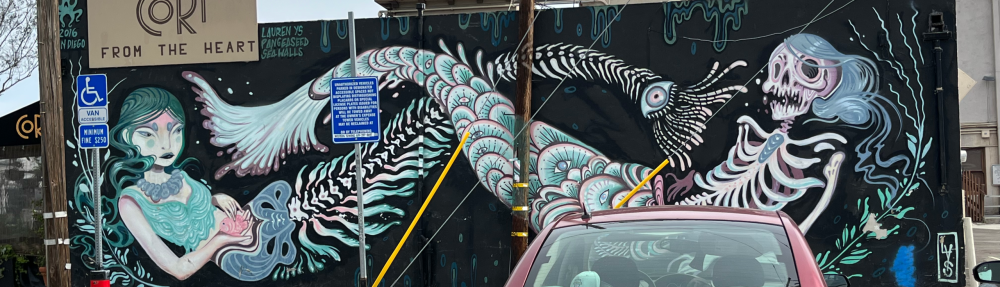
I will admit that my complete knowledge of mermaids before taking this class consisted of Ariel and her underwater fish friends; I don’t even know what the true plot is. But using this, my understanding of mermaids has mainly been that they are all just pretty girls with nice hair who want to know what it’s like to be human. Contrary to this previous belief, it has come to me that mermaids/merpeople are historically considered extremely vain, evil, and vicious by many. In the Penguin Book of Mermaids, these beliefs are further elaborated, as it is stated that the framework of the belief in merpeople is “strongly patriarchal, and in some, it is also heavily Christianized, so that the (water) serpent is reduced to a demonic symbol of evil” (xix). The consideration of merpeople or even just ocean hybrid creatures being evil further pushed through the use of the siren luring traveling men in to torture or kill them. As this evil is the traditional thought within many European spaces, it is common for the stories of the merpeople to either get lost or not ever be created at all as no one cares to consider the stories of evil/monstrous beings. Although these common beliefs tend to paint a horrific picture in peoples minds, an aquatic Hawaiin water character by the name of Mo’o may help repair the disdain people harbor towards hybrid ocean beings.
The Mo’o is a reptilian water deity in Hawaiian mythology, commonly depicted through encounters with human men. While this is still a patriarchal creation of ideas, it is a much more positive one. It is more positive in the way that it completely counters the common notion of “sirens and mermaids being notorious for their seductive songs that drive sailors mad with longing”, but instead “mo’o are renowned for their loveliness” (xix). So, as these creatures are revered as being lovely and free from domestication, the underlying sense of misogyny in other stories is completely absent in tales of mo’o. Europeans even adopted tales of mo’o filled with lessons of self-control, respect, and divinity. Stories of mo’o are not used to scare audiences, but instead are used to make them aware of supernatural beauty and feminine powers, making it known that these creatures are not ones than can be nor should ever be captured/domesticated. I feel hybrid water beings are made much more approachable through the sharing of mo’o as there isn’t the inherited sense of fear or danger present with many stories of evil mermaids/sirens. So far, the introduction to the Penguin Book of Mermaids has me hooked, and already thinking of the infinite new ways to think about these intricate hybrid beings of water. I can’t wait!