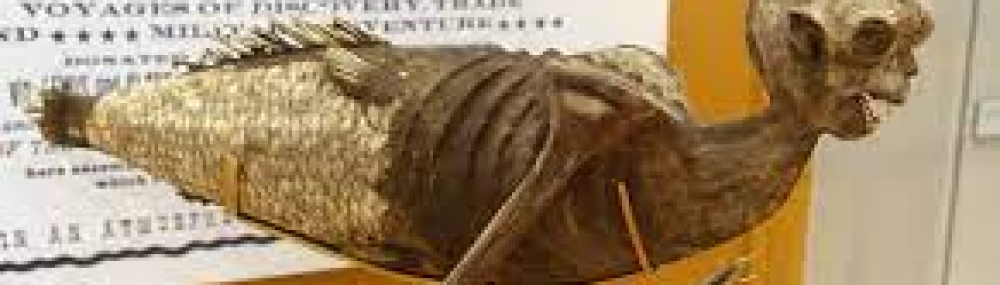
Mermaids and the Enviorment: A Reflection

In my first introduction to this class, I was skeptical in regards to how a “mythical” creature such as a mermaid could teach students about the environment. I quickly realized I had underestimated their teachings. Mermaids have shown me how much of an effect humans have on the environment when we ignore its warnings. The Ocean itself – so vast and limitless – contains resources that have sustained human beings since the creation of our kind. Our selfish habits have had negative impacts with not only the Ocean, but also climate, land, and other organisms. Using mermaids as a lens for retrospective thinking, we can see how our choices affect others’ homes. Our actions shape our future. What will become of us if we do not limit our exploitation of Earth’s resources?

Mermaids not only allow us to view the environment in a different way, but they also have shown me how humans form relationships with their environment and people. Mermaids are connected with the water in a way modern humans have forgotten. We first evolved through water, we traveled by water, we are water. It is the mermaids who reminded me and I’m sure many others of our unique history as a people, filled with unique cultures and identities, connected by Ocean. Mermaids represent the unknown, what is yet to be discovered. Their thirst for knowledge and journey, to a world they have never known, is a direct representation of humans seeking out what they cannot possess. Why should we as modern humans claim ownership of an Ocean, when mermaids do not claim ownership of unknown land? 

Mermaids have given me such a strong reflection on human exploitation and the boundaries created by others meant to be restrictive. Why must we abandon our Ocean history for a “superior” form of knowledge? Why do we focus on what we can gain, rather than give respect to what has been provided? How can we, as modern humans, reshape our beliefs and language to allow Ocean back into our everyday lives? What other mermaid history and knowledge is out there, waiting to be taught to modern humans?

Essay 2

Emilija Škarnulytė’s short film Sirenomelia, captures a mermaid in an area that was once a NATO base. The film captures different angles of not only the area but also of the water, satellite and the mermaid herself. The audio is listed as “white noise”, that’s it. No additives. Just white noise. Implying that that is the sound for the whole film. Interestingly enough there is a moment in which the mermaid is in frame that the audio sounds like sirens— just like a siren/mermaid sound would sound like. The inclusion of the siren sound into the natural noises that make up white noise is an example of the inclusion for non-human beings, thus resembling the disruption of non-human beings into the world of humans and vice versa. 

For definition, white noise is defined as audible frequencies played at equal intensity and is made up of natural sounds. Sounds are often used as a form of communication, words from a human voice and non verbal sounds like that of a different being communicating to other beings of the same kind. In Sirenomelia, there is a change in audio as soon as the camera is underwater  (TIME 3:10), there is an audible siren coming from underwater coming from a different being, a non human. This moment is the introduction to what viewers later realize in a mermaid or siren. 

Once the mermaid is present (TIME 3:54), the siren sound is more audible. From the moments of sounds from the air, the emptiness is audible, up until the camera is underwater and the mermaid comes into camera. The audio does not change to just sounds of water but it allows the audio of the mermaid to go through. It is an inclusive moment that does not conceal the unknown from life in water. It invites questions and interest beyond what humans know already about the water. Had it been covered up by just the noise of water, it would lack authenticity. The natural world is authentic and when it is unaltered by humans, there comes sounds and creation beyond humans knowledge and understanding. 

Moving onto another disruption in audio (TIME 4:10), there is a sound of static and radio—quite out of the normality that would be classified as “natural sounds.” At this moment the mermaid has her head above water and is directly at the camera. This moment is symbolic as a mesh between two distinct lives on the same land. Humans and non human beings are in the moment looking right at each other, the mermaid is looking right at the viewer. Almost haunting when the unimaginable is right in front of view, just as mermaids are beings that humans don’t understand and know much about. Humans are the strange beings in the mind of a mermaid, humans are the beings that are out of the ordinary, which is amplified through the static. 

Even though this world is a shared space with human beings and the non-human beings, Sirenomelia shows the reality where both species mesh together and what it would sound like through the frequency of white noise.