Humans: The Truest Aquatic Mammalian Species

Steve Mentz takes a really interesting perspective on establishing a clear relationship between the ocean beyond its existence just being something we enjoy; he recognizes it is embedded in our nature in more ways than one. He references the popular oceanic centric book we often discuss, Moby Dick: “One of the most widely quoted phrases from the novel holds that ‘meditation and water are wedded for ever.’4” (Mentz, 139). The word meditation is what truly defines this, considering how it’s perceived and utilized within modern society. Meditation’s connotation of peace and relaxation begin to flesh out how water belongs to “nature”, in the sense of relaxation’s connection to being stationary, to being at rest.

Without trying, water finds itself resting within us, our genetic makeups, and connecting to it allows almost this greater connection and grounding to ourselves. Minor habits like needing to drink water when we want to stop tears from coming, or splashing cold water when we become so consumed by anger, we need a snap back to reality. It is literally married to our ideals of breaking calamity, our need for stability because of its connection to the natural world around us. The life it takes on, the movement of its own, to run and crash the way we could, to dance and shine the way fire can, draws us to spiritually connect with it as something of solitude, as it juxtaposes flame’s intensity.

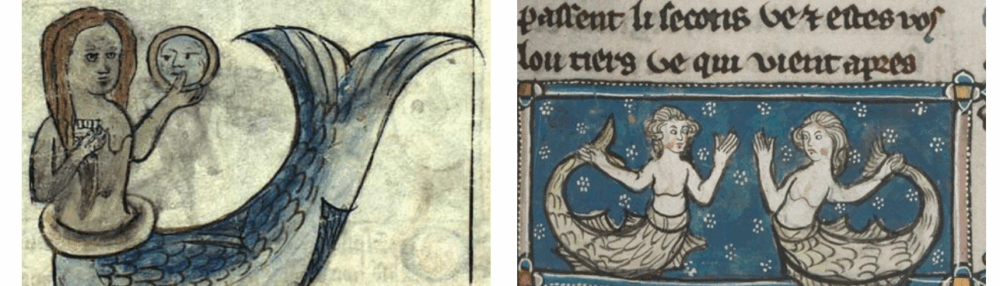
His insight on this intertwined reality ties back to our focus on mermaids specifically when he addresses the ocean’s connection to us: “A poetics that emerges from an encounter with alienating water always relates itself to the awkward relationship of humans and water; we depend upon it and love it, but it cannot be our home” (140). This peace found within it, combined with an inability to ever truly be immersed in it totally seems to have almost driven the need to create mermaids. Desire to be and feel human cognition, but be able to survive as aquatic beings describes them so exactly, and reflects how their existence forces us to recognize how the peace can be disrupted. So long as the world deteriorates at the rate it does, our creatures that depend on it for sustenance, and not just a moment of grounding, suffer and thereby push attention on its decline. It gives us a way to holistically appreciate it, and in trying times, a way to recognize faults.

The Poetics of Planetary Water: Blue Humanities, Poetics, and Striving for Change

In Steve Mentz’s work, “A poetics of planetary water: The blue humanities after John Gillis”, Mentz writes, “A poetics of planetary water aims to clarify the relationships between humans and water in all its forms and phases” (Mentz 139). He also adds, “The intimacy between humans and water, an element that surrounds our planet and permeates our bodies, provides a rich reservoir for ideas about change, resilience and the possibilities for new ways of thinking an living” (Mentz 152).

These statements are important because they encapsulate the chief intellectual and philosophical purpose of the article: Blue humanities consider the ocean not as one big abstract space but water in all forms-liquid, ice, vapor-than can associate closely and materially with human bodies, cultures, and histories. Through the various states of planetary water, the article argues that literary, cultural, and poetic approaches shed light on how water’s presence in collective imagination and lived experience allows the accommodation of present environmental catastrophes and ongoing climate change.

Poetics of planetary water are of essence because they imply accepting the interdependent relation between human beings and the more-than-human environment. Where scientific discourse measures, records, and explains, the poetic framework places feelings, ambiguity, and multiplicity upfront. This proves especially important in environmental crises that happen to be rapid in transition, not clearly defined, and that require resiliences and adapting instead of trying to maintain everything. The article argues rightly that such a framework could cut disciplinary boundaries and scales-from global systems down to the personal and sensory encounters at the shore, according to Mentz’s findings in Whitman and Dickinson’s works (Mentz 138).

Moreover, poetics allow blue humanities scholars to gather together representation, materiality, and imaginative possibility, as they stress dynamics and transition on the three water phases. It is more than simply theoretical; it is a call to accept that our ways of thinking, writing, or living must mirror the very substance that defines and sustains life. These are powerful and timely ideas when seas rise, ice melts, and atmospheres become unstable.

The Flow of Language: Perception Sets the Seascape

Perception is how we see the world, how we understand it, how we explain it –– but it’s also how we create our world. In Steve Mentz’s “Deterritorializing Preface” for Ocean, he calls for the reader to adapt their territorializing perceptions with adjusting the language we use. Mentz offers seven words to adjust, one I found particularly interesting was flow instead of progress. Mentz states, “thinking in terms of cyclical flows rather than linear progress makes historical narratives messier, more confusing, and less familiar. These are good things” (xvi). I find with changing language to flow there is less emphasis on an outcome than progress, reframing expectations and allowing for developments outside of the perimeters of anticipated progress.

Here’s why I think it matters, words carry weight and word choice frames perception. How we perceive the world is limited within the words we choose. If the attributes of a word are rigid we will accept what is being described as being rigid and incapable of flexibility. This might and often is not true, but the language and habit of that language limits the approach and the ability to change it.

For example, in the Westerner perception a term that is used often when describing non-white people is “minority”. This frames the Western perception (and dare I say myth) of a white majority. While it may be true in some areas it is not an encompassing truth and should not be passed off as one. Adding to that in our political and cultural understanding a majority is the “leading” group, this sets a dangerous precedent that influences behavior and opinions. What of instead of minority we used the term global majority? The frame of reference changes when considering the entirety of the planet and not just one corner or current of it.

As Mentz points out with his word adjustment, it changes the narrative. In the context of a minority and majority, understanding humans only inhabit a small portion or minority of the planet it reframes our perception of humans’ place on it. This awareness and could influence the decisions we make as a territorial minority to the seascape. As we could breach into uncharted waters that reframe our approach and attitudes, perhaps there will be more caution and discernment. Perhaps there will not be one understanding but an acceptance of how we are all in common water. Maybe then we can create our world not in the rigidity of territories and borders, but in the flow of the environment we exist in.