For The Best… Or Not

After Raymondin was finally able to enter the sacred room for Melusina and had seen her in her truest form, he was sure that whatever he was going to find behind that door couldn’t be what he imagined and it wasn’t! This should have been the best possible outcome for him, isn’t this what he hoped for? Except this was the worst outcome. His relationship with her was broken the moment he entertained his obsession with the pursuit of finding out what he didn’t know and he acknowledged this stating, “So it was he alone who was culpable! It had come to that! He was sure of her now, but too late!” (P.124) He could not go back how things were and the consequences of his actions were yet to come. It would have been better if his assumptions would have been right and his obsession that was slowly consuming his every thought was going to be worth it, except it wasn’t.

Leading up to this part of the story, I noticed the amount of times that the revelation of Melusinas secret was almost stopped which I thought was pretty interesting. From his inner feelings of doubt, the blade of his knife getting stuck and breaking off, to forgetting his lamp and wishing to go back to retrieve it. This all wasn’t enough to hold him back from finding out what he wanted to know. Like an itch that he could not resist to scratch, he would not have been satisfied until he found out what was behind those doors.

Nature v. Nurture: Melusine’s “Cursed Womb”

What interested me during this week’s reading, was that despite the unfortunate separation between Raymondin and Melusine, there was an underlying discussion of nature versus nurture. Melusine entered into a marriage, knowing that Raymondin had murdered his uncle. She assisted him through marriage in rising through the ranks, and becoming a wealthy noble. She acknowledges the crimes of her soon to be husband, and later of her son, but does not judge them harshly and instead focuses on what good can come from our sins. Her attempt to reason with her husband, is that their son only acted through his pride and sense of honour, instilled by his father: “He has only sinned through too much zeal, for the service and glory of your line, by too much obedience to his nature, which comes from you. He has too much spirit, and a very fine spirit. As for you, you cannot blame him.(138)”

However, Raymondin can not look beyond his wife, and child’s monstrous nature, and blames Melusine for the disfigurement, and murderous behavior, of their children: “False serpent,’ he whispered, avowing and breaking out with all that she could even pretend, from now on, not to know, or to doubt. ‘You are only a phantom, and so is your fruit! None of those who have come from your cursed womb know how to come to a good end, because of the sign of reprobation with which you have marked them by your sins(139).” However, only a few pages before he discovers her secret, he is plagued by memories of his own murderous sins. At the point of his discovery, the only sin he is knowledgeable about Melusine committing, is the secret he agreed to keep, her serpentine nature, of which she had no control over.

The narrative acknowledges Raymondin’s error in not controlling his “cursed curiosity(142)” and breaking the pact of trust with his wife. In this tale, Raymondin’s humanity is regarded as fallible, despite not being cursed with hybridity. His jealousy and rage is passed on to his son, and carried on through his lineage, outlined by Melusine’s departing words: “After you, my Raymondin, no man will be able to hold this country in peace as we have seen and as it is held at present.” By betraying her trust, his lineage is cursed by his actions, rather than her inherent nature and “cursed womb.”

The Male Narrative of Femininity: Week 5

After doing this weeks reading something I wanted to take a deep dive into was from chapter 14, “Betrayal”. Specifically where the story states, “He climbed quickly in his eagerness to strike, his heart pumping…there where he had never been before. Neither he, no anyone, except her—and—who else? He believed there must be someone, but without entirely believing it” (Lebey 121). What I thought was interesting was the fact that Raymondin’s first thought about his wife asking to not be bothered in this one day alone, was that she was cheating on him. The dramatics of this scene also show the emotional drama Raymondin is experiencing, which highlights his fear of what Melusine might be doing in that room. The fear and passion that might typically be expressed when a man is met with a woman who is resisting containment. Melusine asking for a moment of solitude, a moment where Raymondin can not control her or have contact with her. Even though her reasoning is because of her snake like form, it still highlights the ruin of femininity from a man/husband figure.

Melusine’s mermaid form embodies lust and danger, the feminism aspect of both life and death. This quote highlights the how women are forced to live within a narrative created by make doubts. How Raymondin only thought she was hiding another lover in the room shows just that. The use of saying that Raymondin believed she was cheating “without entirely believing it” shows the internal battle he is facing. One idea of women through the narrative that has been created by men for many decades and the other being his personal connection and portrayal of Melusine as his wife and lover. Her secret and her identity are being invaded by the failure to live in a narrative built against her in the first place.

I also like the idea that both Raymondin and Melusine were betrayed in this chapter. Melusine in the way that Raymondin broke his promise to her, amd Raymondin in the way that Melusine “lied” to him about her true identity. Seeing how in this quote Raymondin felt betrayed by Melusine, showing the male created narrative women are forced to live in. I liked this quote because of how it highlights how society is out to take away Melusine’s femininity and identity because she doesn’t fit the narrative. Raymondin’s emotions in this quote show how he feels all of his troubles are because of Melusine.

Song of the Week- Bellhart by Christopher Larkin (I liked the drama this song added to the story!)

“Siren! … or woman? What does it matter?”

I enjoyed our reading last week so much that I spend 13.45 US Dollars on shipping to buy a copy of Knight’s translation directly from the publisher. My post last week was a reading of LeBey’s character through his writing; before I start this week, I want to pay more respect to the beautiful translation by Gareth Knight. Did you know that Gareth Knight (who passed in 2022) was a blogger? Or that he was a practicing occultist? After only a brief foray into his personal and academic history, I am forced to credit a significant portion of my enjoyment of this translation to the translator.
Knight was a scholar of Christian mysticism, Arthurian Legend, Celtic Myth, and Tolkein. His work on Melusine is some of his later work. His research into the topic began in 20011, and he wrote two other books on the topic– Melusine of Lusignan and the Cult of the Faery Woman, and The Book of Melusine of Lusignan in History, Legend and Romance (including translations of two other French versions!) as well as the translation we’re reading now (published in 2010). Information about him and his writings proved difficult to detangle– in my mind, signs of a mad genius at work.
Also, a brief aside; I discovered in my reading that although the famous d’Arras text, one of the earliest transcriptions of Melusine, was published in 1393, Lebey wrote this retelling exactly 100 years ago– in 1925! I’m sure there is more to extract from the knowledge that this story came both on the heels of the industrial revolution and World War I. I don’t know enough about the sociocultural climate of France in this era to draw conclusions!

Abstract
This week I’m exploring the assertion made by the quote I used as my title. What really is the difference between a woman and a siren? My theory is that the existence of mermaids in Western mythology is a reflection of the fact that men refuse to see women as members of their own species. A man looks at a woman and sees something so indecipherable, so foreign to himself that she might as well be a fish. At the end I’d like to touch on the other side of this coin. Men see women as mermaids because they’re alien and foreign; why are women– and especially girls– drawn to mermaids? What do we see of ourselves in them?2

I’m sure many of us were drawn to the first use of the word “siren” in the text we read.

“And so she accepts, just like a woman, that which is but should never be! … Ah Siren! … or woman? What does it matter? Women do not know, know nothing of what we call Honour!” (Lebey, trans. Knight, 138)


What a damning line… for Raymondin! I want to dissect my interpretations of this passage.
Context: Melusine has attempted to comfort her husband after one of their sons has killed another. Raymondin, already poised in suspicion and jealousy, poisoned by his brother’s intimations, can receive no comfort from her, as he has positioned her in his mind as someone who’s already betrayed him.
Melusine’s attempts to comfort backfire– Raymondin can see only the worst in her now– her acceptance of their son’s death is another betrayal to him.
CRITICALLY, in the same breath as rejecting her offered reassurance, he attributes her faults to her femininity. There is hardly a single word that allows us to transition from his perception of Melusine as a person and confidant, to a perception of her as a woman. And Raymondin reveals, when he attributes her (ascribed) worst qualities to her womanhood, how little he thinks of women. This makes me think– has Melusine ever been a person to him? When he loved her, was it in spite of her being a woman? Is this what love is, in this time, in this place– infatuation with something you don’t respect and don’t trust? Doesn’t that sound familiar? Women have an irresistible draw– but conceal myriad dangers? Isn’t this man’s relationship to the ocean (as we have read it so far)?
The next part of the line sets itself up. Siren… or woman. What does it matter? To Raymondin, they are the same. In fact, to Men, they are the same. As has been reinforced by the Christian church by the very use of mermaids, women are beautiful but dangerous, and most importantly, they are other, they are alien.
I want to inspect the last part of this quote for one, specific, tiny word that reinforces the point of women being alien– “Women… …know nothing of what we call Honour”.
We. They… and we. “We”, here, to Raymondin, is humanity. Honor is a human trait. It is one of those shining godly qualities that separates humans from the supernatural, the animal, the forest, the sea3. And humans… does not include women. Women are they, women are supernatural, women are animals, women are the forest, women are the sea.
Conclusion
Even today, as far as feminism has come in the last hundred years, I see this attitude towards women everywhere– I see it in male friends, in self described feminists, in men who make significant effort to treat women respectfully but seem unable to accept that men and women are part of the same species. In fact, humanity, in the Western world, has almost speciated by gender, and Maleness is still the dominant cultural group, which means that even if we have progressed beyond treating women as property, or children, they are still not “human”, because “human” is man.
Where this leads me– how do women see themselves? And critically for our Class— how do women see mermaids? It’s the topic of a longer work, but I want to note in case I haven’t already that after the first two chapters of Scribner’s Mermaids: A Human History, he presents imaginative narratives from the perspectives of men in different historical settings encountering mermaids. Certainly, the male gaze and the male perception of femininity through mermaids is important, and we have a lot to learn from it– but the next step of this inquiry for me is to examine the female perception of mermaids
  1. Interview on Knight’s blog from July 4 2011, in which he mentions that he’s been researching Melusine for ten years. ↩︎
  2. I appreciate your grace letting me fluidly interpolate my life experience as a woman with my current existence as a man. I think of myself as a girl who grew up into a man, and I still see my inner child as a girl 🙂 ↩︎
  3. I know this claim could use further support! ↩︎

Time to Call the Arborist

In the readings from The Romance of the Faery Melusine from when Raymondin breaches the confines of Melusine’s Saturday quarters there are implications of sexual impropriety made by Melusine by the symbolism of the objects and environment around her. Even with her motivations for privacy not relating to an extramarital affair, her conduct is coded within the tale of still being a violation to her marital obligations.

Beginning with Raymondin arming himself with “one of the short swords…passed under his belt”, finding this weapon to be inadequate he also brings “a well tempered spike, a round dagger…a way to deal with whoever had ravished his honour” (119). I believe these items to have a phallic connotation as he is a husband who believes his wife is compromising his standing by limiting access to her. His short sword and dagger being the means in which he gains access to her, implies the tools are righteous in their ability to violate her boundary.

In the description of the environment around Melusine there is a plume of trees “..cypresses appeared like the tines of an enormous comb” (122). The comb is a common symbol associated with the Christian depiction of mermaids and as discussed last class of masturbation. Raymondin finally noticing these trees and wondering how they grew so tall as well as his comparison of the comb, implies perhaps a sexual negligence or impotency towards Melusine that he, encouraged by the words of his brother, must remedy. After he sees her in her hybrid form he notices a “thick fine cypress, immobile except almost at the end of it fine points, climbed toward the starry sky. A natural cupola that seemed to break into the mysterious beauty of this extra-terrestrial place” (125).

Having damaged his tools from gaining access to her rooms, the sight of this particular cypress with its organic state having a phallic resemblance may imply that his vitality has returned as now he has discovered his wife’s transgression against her marital obligations. Her violation of implied masturbation as oppose to infidelity does not compromise the legacy of their union, but it does bring into question her devotion to Christian doctrine and her husband being to her the only source of life and pleasure. It is still a violation to him because she has a power that he thinks is exclusively his domain and right. It’s fair to say Raymondin felt threatened by this ability to reserve this time and power for herself, it threatens not only his emotional stability but the societal emphasis on the power of man (male/husband) over women and the terrain they occupy.

When Raymondin wonders where his trust in Melusine had gone his mind goes to “that they were the same and ever one flesh, each becoming the other to form a single being…and this making themselves one, including their sons, their lands…At one with the earth with its trees and flowers, its meadows and woods, its sweet and fruitful soil…without limit…boundaries or edges. At one with the whole orb that God the Father holds…” (121). Raymondin thinks of the terrestrial power he holds, but later he finds his wife in water, a part of the globe he does not consider when musing about the things they have achieved together. As he believes them to be one, he could believe anything done alone to violate her marital vows and compromise his standing. Without this standard of man’s dominance over others and land it calls the system of society into question and could allow for other ways of thinking that do not hold men as supreme.

The Power of the Leap

In chapter 22 of “The Romance of the Faery Melusine”, Melusine leaps from a window showing how betrayal destroyed her relationship with Raymondin and she is now forced to choose between two worlds. After begging Raymondin for forgiveness and him refusing she knows she has to make a super tough decision and choose between her two worlds. The text says “Meluine looked out over the green meadows, and added in a voice so sad that everyone renewed their tears: Sweet and beautiful county, I must now leave you as well! I hope however to live until my end in loving you and admiring you, and being loved and admired by all myself …and she wept again at these last words. Farewell, farewell, each and everyone of you…Then tearing herself away, scratched and grazed by the frightful  violence that she did to herself, she threw herself straight out of the window in the form of a winged serpent, about 15 feet long” (144). This specific scene shows that exact moment where love and identity collide. 

In this story, the window represents so much more than just a part of a house. It represents the line between Melusine’s human life with her marriage, family and children and the supernatural world she comes from. When Melusine chooses to jump she crosses that line forever. The “green meadows” show a life of stability that she’s leaving behind while her serpent form shows the side of herself she doesn’t have to hide anymore. The window acts as a symbol of choice and once she goes through it, there’s no going back. 

When Melusine decides to take the leap this brings up the power of  identity.  Melusine has been torn between living a normal life as a wife and hiding her true self from the people she loves. By taking the jump, Melusine accepts her true serpent self even though it means losing the life she currently has. The sadness in her words shows us that this isn’t what she wants but at the same time it’s freeing because she no longer has to live in disguise. This proves to us how acts of betrayal can sometimes be irreversible. Raymondin was unable to forgive Melusine and so she was forced to make a decision. Her choice to jump means that she is choosing herself over anything else and it’s a way to take control back over her life  

Overall, I think the leap can be seen as both tragic and powerful. At this moment Melusine’s two worlds are split apart for good and everything she’s ever known has been torn away. The idea of her disappearing into the air as a serpent really sticks with me because it shows that love will never survive without trust and hiding who you truly are will always come with a cost. 

The Power Within Feminity – Sirens of the Ages

Over the course of our class and readings, we have discussed the control Sirens have been said to have over mankind, the power that creates sin and abandonment of morale. In the story of Melusine, after Raymondin’s betrayal, he says to her, “Yes, serpent always…you are only a phantom, and so is your fruit…you have dragged me down in your fall and I am lost.” (The Romance of the Faery Melusine, pg. 139) Raymondin blames Melusine for his transgressions and fall from his faith, the kingdom of God, yet he himself is to blame for his own actions, betraying her trust and seeking her out when she had asked him not to. Melusine is blamed for an outcome she did not cause, simply because of her nature being unwillingly discovered.

In many other forms of Siren/Mermaida media, a man’s temptation or fall from grace is placed purely on the shoulders of the woman figurehead. It is within their femininity and lustfulness that men are to be captured and deceived. The time period of this story reflects these views withheld by the church, the siren used as weaponry over manhood’s relation to God.

Melusine reflects the struggle faced by the woman of her time, the past, and even present day. The woman is portrayed as a beast, a negative power given too much liberty over herself, causing destruction and chaos if allowed to live within her own identity. Her deceitfulness caused such anguish and hurt within her marriage, demonstrating the downfall of femininity in control. Yet – it was Raymondin who decided to force ahead with his suspicions and desires. He is the one who broke the trust and sacredness in their marriage. The audience was made to feel sorry for him, empathetic towards the loss of his love.

The story of Melusine is not just a simple tale about the betrayal and mistrust between a man and wife. A husband and his serpent lover. It describes the wickedness possessed by secrecy and false fruitfulness of womanhood. The dangers these “monsters” impose upon good men of faith, being held responsible for mankind’s regrettable decisions. And yet – Melusine was the one forced to forgive Raymondin’s anger, no right placed upon her to fault him in his breach of oath he entrusted to her.  

Maybe Eve bit the Apple, but Adam was the Snake

Lebey is extremely playful in his interpretation of the story of Melusine. As Raymondin is approaching his wife during the culmination of his betrayal, Lebey describes “He slid slowly forward… And in the moonlight that made his coat of mail glisten, he had the appearance of a strange serpent with iron scales.” How ironic, this image of Raymondin, serpent-like, slithering towards his own despair. Here, our author coils around the infamous, biblical origin story of human sin. Maybe Eve bit the apple, but Adam was the snake. Lebey continues to meander this inverted narrative in the next chapter. First with the reversal of the typical mermaid narrative: “Deceived, as women are and always will be, by your handsome body, your honest face, your sweet appearance, I did not suppose you capable of treason…” Contrary to mermaid lore that focuses on the human’s narration, Melusine’s point of view upends the lure of the beauty of the hybrid. To Melusine it is Raymondin who lured her in with his stoic stature, his handsome innocence. Digging deeper, giving a voice to Melusine not only upends the typical mermaid lore, but transposes the legend of Adam and Eve. “If you had not broken your word” Melusine tells Raymondin “I could have remained in this world and been saved from torment and misery in the other.” The notion of women blaming men for eternal damnation is a role reversal of sin. Lebey’s reimagination of the story of Melusine is an upheaval of man’s dominion. The depiction of unruly nature, the serpentine likeness of Raymondin, the sensual luring of Melusine, the interpretation of betrayal. All contribute to dislodge the concept of man’s supremacy. Lebey plays with the contortion of societal narrative. After all, this is a time for social reform. The Parisian lost generation of the post-war 1920s, struggling to find their footing on a war-torn continent. Lebey takes a story used to assert the lordship of men and instead tears down their dominion.

A different kind of story

For this post I read The Legend of Melusina” (Penguin, pgs. 85-88)

While I can talk about how the story can be interpreted as power, with Melusine’s incredible power (her wealth and being able to build “the castle of Lusignan”(87)), and or that it is about the trust in relationships (Melusine making her husband promise not to come see her on Saturdays when she’s transformed). I would like to highlight how different this story is from the usual ones of its time and type, where such a secret would have seen Melusine not only shamed and hunted for her curse, but demonized heavily. Which the prelude text highlights that in different tellings, most likely NOT created by the original author, allude to. But rather the husband, Raymondin,“is not horrified but only saddened” (85). This is where I liked the story, because rather than immediately judge Melusine and her condition, showing that he truly only loved her for her looks, he becomes what I interpreted as relief, because he was egged on by someone else, driven by jealously. It wasn’t his words that convinced Melusine to ultimately leave, but Geoffroi, to be honest I would kick him in the shins for calling my wife a “snake and odious serpent” (88).

This also highlights my next interesting point, when Raymondin witnessed Melusine’s hybrid form the text described it as “in a snake, gray and sky-blue, mixed with white”, but this doesn’t actually apply to snakes, but to fish. As the beginning text said, “fish and water hold a redemptive symbolism”, which tells me that possibly Raymondin would’ve accepted Melusine for her curse and redeemed the curse (not her) in her eyes. Considering when their children were born, they were described as deformed, yet for Raymondin, “Raymond’s love for the beauty that ravished both heart and eyes remained unshaken”. Considering how common a trope it is for the husband to blame and scorn the mother if a child ends up with anything undesirable, it proves how much he genuinely loved Melusine. That she found someone accepting of her but another had to go off and ruin it. I can see the story having a message of acceptance as well, but that’s the tragedy.

Week 5: Medieval Melusine

“This transformation from a half snake, half woman may be tied to d’Arras’s situating her near water –a fountain and her bath– and to the fact that dragons and serpents have scales just like fish (86).”

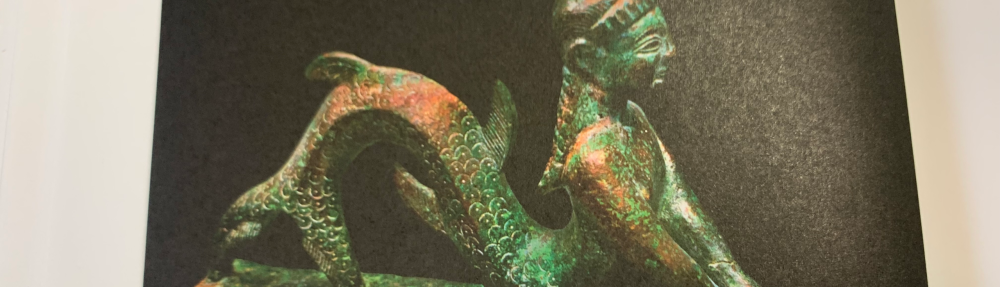
After reading this tale, I set out to look for some art works of this depiction of melusine, as a serpent or dragon. Many modern depictions are mixed between her as a mermaid, sometimes with a serpent’s tail, even sometimes with wings. However, I also was interested in the remains of the castle that she built, whose ruins can be seen today in France. In this 15th-century depiction of the Chateau de Lusignan, Melusine is in the form of a dragon, flying over the castle and perhaps making good on her promise to fly over at the changing of lords.

.Here is googles rundown on the remains of castle Lusignan

This is a link to the Edward Worth Library’s collection of images of Melusine and her different versions of hybridity.

Although the symbolism of water is deeply tied to her myth, she is also punished for her misdeeds, and in some sense, her greed, to forever transform into a serpent hybrid. There are so many different elements in this story which I hope to explore further, such as the curse inflicted by her mother, the multitudes of her hybridity (half fae and human, half woman and serpent), the nature of the curse being carried on to her sons through deformity and cruelness: “Geoffri with the tooth had burned his brother Freimond (p.88).” I’m still at a loss about the relationship between her husband and the conditions of a broken promise. It seems that even as Melusine bestows many gifts upon her husband and their kingdom, her curse afflicts mostly suffering onto her, with her children’s deformity blamed on her curse(or hidden nature), and in the conditions of her curse being discovered resulting in isolation.