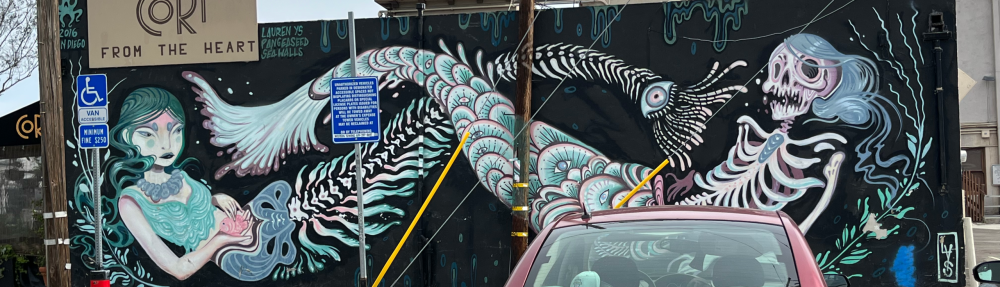
On The Topic of Pain

In Hans Christian Anderson’s fairy tale The Little Mermaid there are multiple references of pain below and above the water. This story is clearly meant to be shared with children and like most fairy tales there is a concurrent of morality and coming of age allegory, in when and how pain is felt for this young mermaid.

When it is time for the the Little Mermaid to visit the surface, to break through the barrier of her world to enter into a broader and more complicated world, adornments of oyster shells are fastened to her tail by her grandmother. These shells symbolize her rank are so painful that the Little Mermaid voices this discomfort. Her grandmother’s response is “pride must suffer pain” (Penguin, 113). This statement has endless connotations such as religious implications, monarcharical responsibility, the mermaid symbolism of pride, or the mermaid’s ascension into womanhood. The story tells us early on that the Grandmother wears a dozen oyster shells in reverence to her noble birth, but not until the Little Mermaid is gifted the symbol do we know how painful they are. This means that the Grandmother has endured this pain as matriarch for a significant part of her life, without complaint because the Little Mermaid did not know it would be painful.

This has been a common denial in history, this discomfort of body in those who menstruate and birth, many times being categorized as a natural occurrence one must just endure. That there is goodness and purity in this endurance. The Little Mermaid is in some ways a 1800s child-appropriate way to explain to those who menstruate what their experience will be in their adult body. What pain is natural and unnatural in these bodies and how one of the most unnatural things to do is to disobey a parents’ wishes.

The pain of the shells is not mentioned again, it is a brief discomfort that the Little Mermaid adjusts to, a pain of the responsibility and pride she has being part of her family. But when she is in an unnatural state the pain is constant. When the Little Mermaid receives her legs, in rebellion of her family and position every step is painful. She experiences this pain all to be near someone who will never rebel against his title or family and who treats her (in my opinion) like a pet. A condition of the Little Mermaid’s task is convincing the Prince to forget about his parents, putting the Little Mermaid first. With the pair both having royal obligations, not listening to their the parent/family is more than a private rebellion it is a political rebellion with larger implications for their court and country. One must be obedient to the greater good. Making the lesson of the tale about how one will only experience pain when betraying your familial obligation, is not only a way to prove parents know best but to covertly imply it is against nature to do so.

Pretty Little Children of Nature

In the story of Undine there is an undercurrent of belief that humans have superiority over natural elements, based on the assertion that only humans have a soul, unlike nature. This belief reflects the on and off again thought that nature is a force outside of humans to be controlled for human prosperity, without concern for the impact this has on nature’s designs. This subjection of nature and the creatures within it makes it easier for humans to take what they need from it, without letting their souls feel the guilt of taking from another entity. When humans argue for their superiority over nature and other humans, their first tactic is to dehumanize. Instead of looking to the similarities nature and humans have with each other they create the image of “other” and infantilize it so their position seems more experienced and all-knowing.

Undine explains to her new husband about her and other elementals with this dehumanizing language, even though she states prior to this that the elementals do identify as human beings. She says, “hence we have no soul; the element moves us, and is often obedient to us while we live, though it scatters us to dust when we die; and we are merry…merry as the nightingales and little gold-fishes and other pretty children of nature. But all beings aspire to be higher than they are” (Penguin,105). Characterizing the power in nature as being like children makes it a less consequential part of the human world, one that needs help and guidance. Only participating in the human world and obtaining a soul made the elemental more than they are on their own, making the human world the superior entity.

Conveniently in the human world there are those designated to award souls and personhood. In the case of this story it does this through marriage by a religious figure who one must be humble towards. This release of power for human theology and methodology is portrayed as a reasonable trade while power is still wielded in the human world over each other, but only by the few. Relinquishing power is the price of admission to be part of the human world because the human world only thrives on its assertion of its own control, not its inherent ability to do so.

Framing the elementals as being powerful in this Earth-bound world but reduced to nothing because there is not something to grieve them, also removes responsibility from humans for caring about anything outside of themselves and their interests. Asserting that there is a temporary power of nature but humans (having anointed themselves with the idea of a continuing spirit) in their existence will be forever. It prioritizes the human experience over the natural world, not considering how the two are intertwined in the same existence.

Time to Call the Arborist

In the readings from The Romance of the Faery Melusine from when Raymondin breaches the confines of Melusine’s Saturday quarters there are implications of sexual impropriety made by Melusine by the symbolism of the objects and environment around her. Even with her motivations for privacy not relating to an extramarital affair, her conduct is coded within the tale of still being a violation to her marital obligations.

Beginning with Raymondin arming himself with “one of the short swords…passed under his belt”, finding this weapon to be inadequate he also brings “a well tempered spike, a round dagger…a way to deal with whoever had ravished his honour” (119). I believe these items to have a phallic connotation as he is a husband who believes his wife is compromising his standing by limiting access to her. His short sword and dagger being the means in which he gains access to her, implies the tools are righteous in their ability to violate her boundary.

In the description of the environment around Melusine there is a plume of trees “..cypresses appeared like the tines of an enormous comb” (122). The comb is a common symbol associated with the Christian depiction of mermaids and as discussed last class of masturbation. Raymondin finally noticing these trees and wondering how they grew so tall as well as his comparison of the comb, implies perhaps a sexual negligence or impotency towards Melusine that he, encouraged by the words of his brother, must remedy. After he sees her in her hybrid form he notices a “thick fine cypress, immobile except almost at the end of it fine points, climbed toward the starry sky. A natural cupola that seemed to break into the mysterious beauty of this extra-terrestrial place” (125).

Having damaged his tools from gaining access to her rooms, the sight of this particular cypress with its organic state having a phallic resemblance may imply that his vitality has returned as now he has discovered his wife’s transgression against her marital obligations. Her violation of implied masturbation as oppose to infidelity does not compromise the legacy of their union, but it does bring into question her devotion to Christian doctrine and her husband being to her the only source of life and pleasure. It is still a violation to him because she has a power that he thinks is exclusively his domain and right. It’s fair to say Raymondin felt threatened by this ability to reserve this time and power for herself, it threatens not only his emotional stability but the societal emphasis on the power of man (male/husband) over women and the terrain they occupy.

When Raymondin wonders where his trust in Melusine had gone his mind goes to “that they were the same and ever one flesh, each becoming the other to form a single being…and this making themselves one, including their sons, their lands…At one with the earth with its trees and flowers, its meadows and woods, its sweet and fruitful soil…without limit…boundaries or edges. At one with the whole orb that God the Father holds…” (121). Raymondin thinks of the terrestrial power he holds, but later he finds his wife in water, a part of the globe he does not consider when musing about the things they have achieved together. As he believes them to be one, he could believe anything done alone to violate her marital vows and compromise his standing. Without this standard of man’s dominance over others and land it calls the system of society into question and could allow for other ways of thinking that do not hold men as supreme.

Lines of Succession Know No Boundaries

The only thing that wives and mothers in the story of Melusina ask for is a respect of boundaries. Pressina, Melusina’s mother asked for Saturdays to herself from her husband and when she curses her daughter she sets for her the same boundary. This story embodies the themes in mermaid stories of demonizing the “other” and the female threat to a patriarchal system. Both of those themes play into the subtle political line of succession message in the legend.

The Fay Women found by human men when they were in need of saving are magical creatures. They provide love and success to these mortals in exchange for devotion and promises of letting them keep some part of their power. This power is not over others like it is expected in the patriarchal system of mortals, but in their autonomy to limit the access to their bodies by others. I found it interesting in both of the marriages of mother and daughter, it was a relative that encouraged the husbands of these Fay Women to violate this boundary set forth in the marriage.

In Pressina’s story, it is her male stepchild Nathas and likely heir to the throne of Albania that excited his father to violating the martial pact. It is not explained if Nathas knows of this agreement. Though if he knew about his stepmother giving birth before his father, it is fair to assume Nathas had his finger on the pulse of the activities in the castle. While the birth of three daughters might have not pushed Nathas out of the line of succession, his father’s current wife providing so many additional heirs might have challenged his position. Creating a wedge or a reason to dissolve the marriage might have been in the prince’s best interests.

Later in Melusina’s story it is the cousin of Raymond who had “excited him (Raymond) to jealousy…by malicious suggestions of the purport of the Saturday retirement of the countess” (88). Nathas used joy to break the martial bond, while this cousin used distrust of a wife who would not provide full access of herself to her husband at all times. As a wife Melusina had given Raymond riches and castles he wouldn’t have had otherwise, but she was still an outsider to the world of mortals. Stories and myths often depict how outsiders are always a threat to the accepted system.

The gender and position of the cousin is not depicted in the story, but the relationship of this family member to Raymond reminded me of the only other mention of his family. When we are first introduced to Raymond he has just “accidentally killed” (87) his uncle who is a count. Melusina uses her power (possibly influence) to protect Raymond from the fallout of this killing.

Could this cousin be a child of that uncle?

Could this be a cold dish of revenge by someone whose position was lost from this coupling?

Or was it just Melusina’s ability to maintain some form of power over the societal powerful position of Raymond?

Raymond’s strength is made secure not only through what Melusina built for him but in the children she bore, his heirs. It is only when the sons of Raymond and Melusina are taken out (or at least compromised) of the line of succession that he turns on her. She then becomes a spectre who will haunt the family line when there will be a death in their lineage.

In respecting a boundary, Raymond and the King of Albania were abdicating part of their power given to them by the patriarchal system they were entrusted to maintain. This clearly illustrates the threat the “other” can impose on the sanctity of the established family, teaching how it only brings heartache and ruin for future generations. Underlining how an “outsider” woman who is not is in complete submission to her husband, like the women of the society were conditioned to do, must have flaws and secrets that threaten societal norms.

The Flow of Language: Perception Sets the Seascape

Perception is how we see the world, how we understand it, how we explain it –– but it’s also how we create our world. In Steve Mentz’s “Deterritorializing Preface” for Ocean, he calls for the reader to adapt their territorializing perceptions with adjusting the language we use. Mentz offers seven words to adjust, one I found particularly interesting was flow instead of progress. Mentz states, “thinking in terms of cyclical flows rather than linear progress makes historical narratives messier, more confusing, and less familiar. These are good things” (xvi). I find with changing language to flow there is less emphasis on an outcome than progress, reframing expectations and allowing for developments outside of the perimeters of anticipated progress.

Here’s why I think it matters, words carry weight and word choice frames perception. How we perceive the world is limited within the words we choose. If the attributes of a word are rigid we will accept what is being described as being rigid and incapable of flexibility. This might and often is not true, but the language and habit of that language limits the approach and the ability to change it.

For example, in the Westerner perception a term that is used often when describing non-white people is “minority”. This frames the Western perception (and dare I say myth) of a white majority. While it may be true in some areas it is not an encompassing truth and should not be passed off as one. Adding to that in our political and cultural understanding a majority is the “leading” group, this sets a dangerous precedent that influences behavior and opinions. What of instead of minority we used the term global majority? The frame of reference changes when considering the entirety of the planet and not just one corner or current of it.

As Mentz points out with his word adjustment, it changes the narrative. In the context of a minority and majority, understanding humans only inhabit a small portion or minority of the planet it reframes our perception of humans’ place on it. This awareness and could influence the decisions we make as a territorial minority to the seascape. As we could breach into uncharted waters that reframe our approach and attitudes, perhaps there will be more caution and discernment. Perhaps there will not be one understanding but an acceptance of how we are all in common water. Maybe then we can create our world not in the rigidity of territories and borders, but in the flow of the environment we exist in.

The Illusion of Control in Nature & Lore

Man is not an animal, at least so the stories of man tell us. The hybridity of a human with an animal in stories is often depicted as unnatural and threatening. Outside the interspecies dating element, it challenges the belief instilled in humans of a superiority on Earth compared to the other creatures that inhabit it. Reinforced within mermaid lore, the animal hybridity with humans is to be avoided or at least conquered to support this human superiority. In the introduction section of The Penguin Book of Mermaids, it is often in stories of mermaids that the human society is characterized as the ideal—being far removed the wilds of nature. This concept is a denial of humans’ own position as an animal on Earth and their part in nature, not a ruler of it.

A line from the reading that caught my attention about the distinction of animal from man is, in referencing mer-marriages, “when the wife is instead an ‘animal bride’ transformed fully into a human, the marriage fails because her domestication as a human wife and mother does not succeed in eradicating her ties with her water kin, or her desire to be in her own skin and element” (xix). To be part of the human society described in mermaid myth means to leave the natural world behind, to deny the animalistic parts of our nature that religion and social norms forbid. Any desire to stay connected to this natural world outside of society will only lead to disappointment, so it is best to avoid those who embrace the parts of themselves outside the alleged morality and ideals of man.

Mermaid Engagement Photo, credit: Del Sol Photography

Attraction to this animal nature in others, that is personified in the mermaid, is not a transgression against the society on its own. Only when this desire is not reformed into human societal ways does the human admit their subservience to nature’s power. Part of humans’ development over thousands of years is to block humanity from the power of nature, but with that protection comes obligations of compliance and denial of what some think as animalistic behavior. The chaos humans interpret from their environment frames their idea that the nature of humans is capable of control over all things, that their order will withstand the power of the natural world.

The Duality & Double Duty of Mermaids

I was not familiar with the presence of mermaids in the Christian Church’s imagery before reading the Introduction chapter of Vaughn Scribner’s Merpeople: A Human History. In his book Scribner links the hybridity of merpeople with the hybridity the Christian Church used by carrying over Pagan symbols to convert more people into Christianity. With the emphasis of Christian scripture concentrating on the historical presence of a supreme being and their disciples, I had assumed that mythical creatures would have always been excluded in Christian religious teachings. Adopting other religious practices to a new religion has been an effective method of reaching and appealing to more congregants. The mermaid image kept familiarity in new spiritual ground. The predominance of images helped when literacy was not as common, so an image intertwining the spiritual worlds would make a stronger impression than words.

The familiarity which the Pagans had with mermaids might have helped with converting congregants, but the similarity ended with the Christian Church’s interpretation of them. The Christian Church used the image of the non-monstrous looking mermaid to convey warnings of deviating from the church’s teachings. Mermaids were used as an embodiment of sin, luring (particularly men) towards a life away from the Christian Church. The vanity and power in the mermaid feminine form was not to be trusted, this teaching extended to human feminine forms too.

Perhaps the more recent resurgence of mermaid depictions does stem from a desire to reclaim feminine power in present day. Policy changes and attitudes towards women have reverted to beliefs that are becoming more present in cultural conversation. Coupling this with the threat of global warming and ocean biological collapse, the mermaid seems to be a fitting figure for the movement to aid in repairing both these social and biological threats.

Hello, I’m Melissa

I am an English and Comparative Literature major in my senior year. I was born and raised in San Diego and spent most of my life here, but lived in North Carolina for almost seven years. While I missed California almost the entire time, living there made me understand so much about the country and its history. For a while I planned to major in Political Science when I returned to school in 2022, but the call of Literature won out in the end. I am what some call a “non-traditional” student, meaning I am older, but I actually feel very lucky to have the access to an education I wouldn’t have had if I had gone to college right out of high school.

I have wanted to be a writer since I was a kid, but put it aside for more practical pursuits. Now I am a writer, but I want to take it to the next step and be a published author. I have written several novels in different genres (Women’s Fiction, (Sub)urban Fantasy, Mystery), but I have only gone through the querying process with one of them. I also write poetry.

I’m really looking forward to learning about the lore of mermaids outside of the Disney interpretation and exploring their historical context with all of you!

My husband and me at Birch Aquarium Oceans at Night