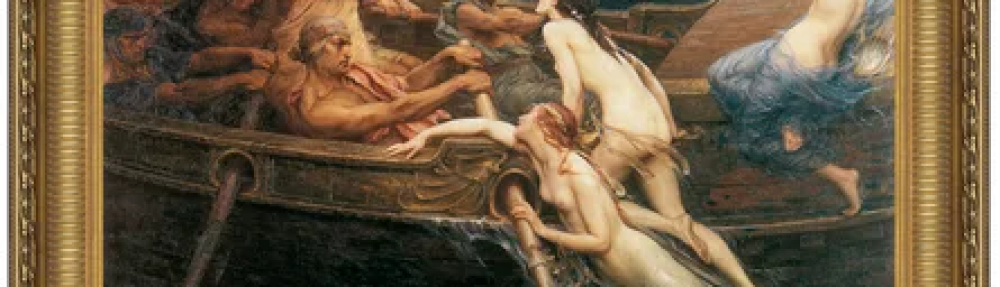
In Undine, Fouqué contrasts soulless elemental beings with soul-bearing humans, since the elements are “obedient to [the elements] while they live,” yet humans’ disconnection from the environment causes some elements to “rarely allow themselves to become visible to [humans].” By showcasing the effortless harmony elemental beings have with nature and the subsequent lack of connection humans have, “Hence we have also no soul; the element moves us” (Penguin, 105). This story serves as an allegory about the corruption of the human soul, demonstrating how soul-bearing humans will always have a fractured relationship with nature than the soulless elementals, because of human innate soulful dedication to leave a legacy.
In the chapter “The Day after the Wedding,” Undine by Fouqué, Undine reveals she is a water spirit, a being a nature with no human soul. Undine opens herself vulnerably to her husband, recalling to him her life as an elemental spirit and her journey of acquiring a soul through their love. Undine begins her confession by stating her lack of a human soul, “Hence we have also no soul,” demonstrating that elemental beings are naturally separate, but nature itself does not possess them. The elemental spirit guides them. There is no definitive ‘bible’ for the elemental way to live; there are no ‘rights’ or ‘wrongs’. They do not have the consciousness to feel guilt or judgment. Undine’s element of water is the giver of her life: “The element moves us, and is often obedient to us while we live, though it scatters to us when we die.” Undine’s element is clearly water, which sustains her life, although her relationship with it does not embody loyalty over death, unlike human religion or marriage. There is no single all-powerful being or creator of all elementals, and when an elemental dies, its body is returned to the environment. There is, in fact, no afterlife for the elementals. Their bodies are “scattering to dust,” emphasizing that Undine has never had to put pressure on her death; when she passes, there is no hope for a “heaven”, there is no conscious idea of lifelong judgment of a higher power, or the importance of a legacy one leaves behind on earth. Undine will not have to face her creator and have her fate decided. For Undine, life was meant to be lived simply, not to seek a purpose until she found love. Her life before marriage, “ we merry, without aught to grieve us – merry as the nightingales and little goldfish and other pretty children of nature.” Undine highlights her past life of innocence, comparing the nature of nightingales and goldfish, creatures that do not experience complex feelings of grief and love, suggesting that before gaining a soul, she did have the emotional capacity for despair. This comparison demonstrates that acquiring a human soul through love has now awakened these feelings of suffering. This moment is an emotional and spiritual turning point for Undine as she reminisces on her old life and commits to the mortal world. Undine is no longer a “pretty child of nature”, she is a woman, vulnerable, soulful, and capable of deep happiness and suffering.
The idea that nature was “often obedient” to Undine shows that her relationship with her element is a mutual one, where both respond and listen to each other, rather than one trying to dominate the other There is a natural rhythm between them, as there is no open space for betrayal between Undine and the water, no grief, soul, or moral burden. This demonstrates the idealized natural state where humans can be part of the ecosystem rather than the master over it, living a balanced life. Humans want a simple relationship with the environment, but their self-awareness complicates harmony because their own motives become their worst enemies. Undine explains to her lover that the elementals do not feel safety or a sense of connection to humans, stating, “in the elements which almost appear like mortals, and which rarely allow themselves to become visible to your race” (Penguin,104). This demonstrates how nature has to adapt to human life. Humans become so involved in their own devotion to purifying their souls to reach salvation that they do not take the time to comprehend the environment as a world of its own. In the rise of industrialization, humans became obsessed with creating innovations that would improve human livelihood. Humans began to see themselves as superior to the environment and became devoted to their own kind, neglecting a thought for a life outside of their own. In the afterlife, “mortals hereafter awake to a purer life,” meanwhile, the elementals return to the earth, showcasing the lack of urgency humans have to protect the environment, as nature does not serve them in the end to their salvation. The environment does not ‘collect’ or ‘save’ their soul, so to humans this serves nothing to their legacy. The pressures of having a soul bring selfishness to a person who cannot conceptualize a life without their presence. The ‘eternalness’ of a soul creates a hierarchy, leaving everyone or anything at the bottom to be used for their moral gain.
Undine’s transformation of acquiring her soul through love mirrors the separation humans gain by their consciousness. These complexities of despair disconnect them from the natural world, and the sense of solidarity dissolves into selfish actions. Undine becomes more disconnected from her element as civilization distances her from her natural rhythm and environment. To maintain a sliver of her elemental life, she must hide herself away to indulge in her elemental form. She goes back and forth on the idea of revealing herself to her lover, because of her observation and discretion of the elemental life towards humans. Though, as Undine assimilates to the mortal world of humans, her desire for a soul increases, because of the emphasis of power placed upon the ‘soul bearing’. The cycle of life and death of the elemental showcases the dual role of the environment, the nurturing and indifferent. As “the element moves us…though it scatters us to dust when we die..” illuminates that when the elementals are alive, nature nurtures and obeys, but in death, it reclaims and dissolves, once again demonstrating this rhythm, the elemental creatures live within the environment. The soulless elementals do not need to establish their presence in nature to feel accomplished or worthy. In terms of humans, this cycle only emphasizes their lack of control over the environment. So, humans find a way to conquer by making the environment ‘livable’ to their needs. Fouqué showcases that nature will always outlast and outpower humans; time is always fleeting for the ‘soul-bearing,’ so their sense of urgency to conquer and leave a legacy only becomes fuel to their destruction.
This story of Undines demonstrates that the ‘soul bearing’ human leads to an imbalance and tension within the relationship to the environment. Ultimately, it serves as an allegory about the corruption of the human soul, fueling egotistical ideation of superiority over the environment, causing the shattering of their relationship with the environment. When humans reject what they cannot control, this leads to destruction. With the story of Undine, Fouqué showcases how humans cannot live meaningfully with a soul while still honoring and remaining in harmony with the natural world.