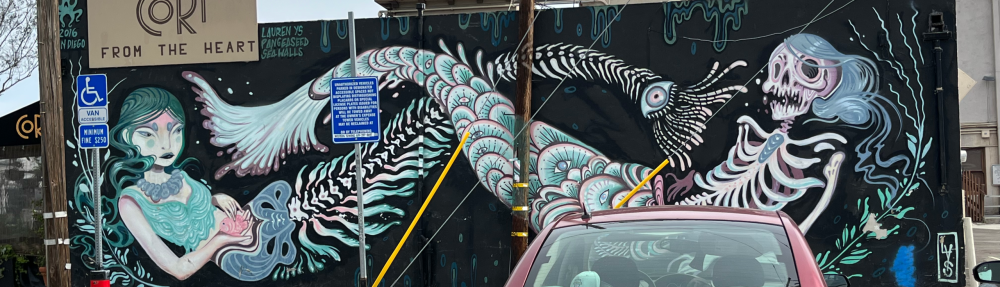
Every other page of these first two chapters of Scribner, I found something I HAD to make a post about. My mind is going off in twenty directions already. See at end of post1 a list of things I had to leave behind, but would love for someone else to pick up, if you didn’t have any particularly juicy catches of your own.
I’m deciding to focus on all the art we saw in this chapter: the early illustrations of mermaids from illuminated manuscripts. What strikes me is actually how consistent mermaids have remained; my idea of them today is not so different from the earliest depictions.
I have always loved drawing mermaids and I know I’m not alone. Possessing a long and sinuous tail, as well as often long hair unbound by gravity, and an often nude torso, makes them a really appealing subject for an artist. There are so many opportunities for creative, fluid compositions, there is the human torso for the anatomists among us to dig into, there is the deep symbolism surrounding them as closely as water surrounds them. Now, my mermaid art has been further informed by the aesthetics of illuminated manuscripts, by the Green Men, motifs which occur ubiquitously (like mermaids) and have murky origins– but unlike mermaids, do not continue to capture modern consciousness.


My pursuits, academic, creative, spiritual, professional, exist not in a single field but in an infinitely dense lattice of braided rivers and streams, and I feel that now, in my life, the undercurrent of Mermaids– a spring which arose early in my personal history– the undercurrent of Mermaids is now spreading, slowing, flowing under everything I do, informing other rivulets.

- – Thank you Hahnnah for bringing up music: Where are the English and Irish Ballads about Mermaids? Surface level searching returned only Child 289 , “The Mermaid”. I liked this version on spotify.
– p8 It not a coincidence that medieval bestiaries represented real animals as “hybrid monsters”– they were drawn based on descriptions, and those descriptions could only function by referencing things people already knew (elephants having a snake on their face, rhinocerouses plated with armor, platypus with ducks bills and beavers’ tails). It’s not possible for us to comprehend anything without points of reference, things to connect them to
– Amphitrite- I checked etymonline, and was surprised to find that they don’t attribute “-trite” to simply “triton”. Amphitrite was a bridge, in between, double-aspect (like amphibian or amphoteric or ambivalent or ambidextrous) of Triton. Being female… gave her the power… to leave the sea??
– p 27 “To be human is to be hybrid”. Nuff said.
– p 32-33 Note the sculpture of jonah being swallowed by the whale– the whale itself is a hybrid!
– Scribner kind of dangerously oversimplifies the origins of Anglo Christianity in Ireland. I recommend further reading.
– Excellent line from Thomas Cobham quoted on p 43 “Lord created different creatures… not only for sustenance… but for instruction” <- represents two crucial elements of the human relationship to the natural world in one sentence!
– Melusine was the first transforming mermaid? Perhaps the mermaid canon I grew up with does not have origins as recent as I thought. (See also: The Orford Merman, p 55, on mermaids in captivity)
– A line from a short story I recently read- Mkondo by Anthony Doerr- describing a fossil of an early proto-bird, which I think reflects the narrator’s unnatural dichotomous worldviews: “What a thing, half bird, half lizard, part one thing, part another, trapped forever between more perfect states”. ↩︎