The Rise and the Collapse of Mermaid Belief in Chapter 4: “Freakshows and Fantasies”

A significant statement from Chapter 4, “Freakshows and Fantasies” that stood out to me is when Scribner writes, “Just as Eades’s and Barnum’s mermaids brought the Western merpeople craze to fever pitch (in London and America, respectively), so too did they implode it.” The moment that a widely accepted belief and a communal sense of wonder turn into disbelief and ridicule represents a pivotal moment in the negotiated game of truth, spectacle, and cultural imagination in society.

The unraveling of the mermaid craze after Barnum’s Feejee Mermaid illuminated a key contradiction in the modernity of the nineteenth-century Western world: While scientific rationalism and mass media were increasing, the desire and demand for spectacle and sensationalism were growing too: Revelations of hoaxes would pivot popular excitement from sincerity to ironic attachments, while the mermaid would have a permanent place in cultural memory.

Barnum’s Feejee Mermaid was not in the least a curiosity which any scientist would have given a second thought. It was a marvel of its time, not because of any serious scientific claim, but because it was a perfectly constructed piece of “humbuggery.” This mermaid was the hybrid product of a monkey and a fish that was fervently marketed and unflinchingly defended by an elaborate publicity machine. The willingness of the public to believe, or at least put aside believing signifies a culture still deeply committed to wonders and the chance of their possible manufacture. Advancements in science and discoveries such as the platypus and the kangaroo were already eroding the line of what was reasonable and what was impossible, and the existence of the mermaid was only slightly less unbelievable than yesterday’s impossibility.

Still, the same media that fostered this wonderment were responsible for its demise. Gradually, scientific examination and exposé reporting revealed the truths behind the Feejee Mermaid and other fabricated stories. While discrediting the historical and cultural relevance of mermaids, they became objects of ridicule and symbols of credulity, and became a new topic of satire in the political arena.

roIn the nineteenth century, the surge in newspapers and periodicals facilitated the extension of, and ultimately, the erosion of belief in mermaids. Before 1845, stories about sightings of mermaids and similar tales were published with some credulity, excitement, and even with a willingness to be precise in scientific inquiry into the mermaids. However, when the hoaxes were revealed, we see newspapers have now shifted to mockery, not only of the myths themselves, but of the people who “believed” in those myths. This mockery does not remove mermaids form the public domain or remove belief either; it shows the transition from sincere belief to the thrill of disbelief. This displays how the media can go from inspiring curiosity to nullifying it (yet still keeping the topic alive in the public, albeit with some discredit).

The shift of mermaids from potential objects of wonder to objects of fraud and satire represents a larger trend in nineteenth-century Western culture. As science allegedly “banished” superstition, the same social processes – capitalism, mass media, and the hunger for spectacle – ensured the survival of the very figures they mocked. The mermaid, then, persists not as an object of belief but as a cultural icon that reminds us that even in a so-called age of reason, the distinctions between knowledge, entertainment, and belief are not clearly distinguished.

The Power of Fate and Human Agency in The Romance of the Faery Melusine

After reading The Romance of the Faery Melusine, one statement that the author wrote that stood out to me was this: “But fate, for all that, is Fate. We can only control a part of it by our actions or the consequences that come from them. We have to take what is offered when it is to our advantage” (Lebey 25).

This statement is important, because it expresses the conflict of fate vs. free will that haunts all the critical moments of this story. It appears in the middle of a significant exchange when Melusine, a faery who exists in the dual world of the supernatural and the deeply human (material), informs Raymondin that even though she knows his secrets, and could, in some sense, guide him and make him “free,” the possibilities open to the characters are ultimately controlled by fate. The idea that human beings “can only control a part” of fate immediately contradicts the typical heroic expectation of total control of one’s fate. This is both a personal tragedy for Raymondin and Melusine but also a common human dilemma reflected in myths, romances, and real life.

The structure and the pacing of the story are dependent on this outlook: Choices and vows made by Raymondin, Melusine’s supernatural contracts and penalties, and even the rise and fall of their heirs, works beyond our full understanding or control. The romance returns again and again to various moments in which characters are granted opportunities such as blessings, interventions, and magical objects– but they must inevitably face the limitations of their agency. Nonetheless, Raymondin’s vow, and his violation of it, instigates events that are irreversible, demonstrating the limitations of human agency. Those limitations are not exact: There is agency, there is an action, there is taking “what is offered”. Still, the chance of true happiness, restoration, or forgiveness is restricted by fate’s “laws and the perils that threatened him, of which the least were exile and death” (Lebey 26).

The statement ultimately matters because it addresses the existential drama around which the narrative revolves–a drama familiar in human experience across time and within varied cultural constructs. The narrative’s continual return to fate and limited agency is relatable to its central characters and amplifies the pain they are experiencing. Although the medieval romance combines aspects of Christian theology, local mythology, and psychological nuance, the idea that “we have only control over a part” of fate resonates. Human ambition is both lifted and reduced by this notion, urging individuals to accept what one can change and what cannot be changed. Thus, Melusine’s ultimate transformation into her supernatrual form and banishment, and Raymondin’s despair, are not only punishments, but instead symbolize the larger tragedy of existence: the conflict of wishing for perfect happiness alongside reality and the limitations it brings.

Thus, this principle forms the backbone not only of the dramatic arc but of the text’s philosophical legacy. It is a reminder to “take what is offered when it is due to our advantage,” to act where we can, and to accept our fate when we need to. It is a message to aspire to abandon oneself to fate in either timely ways in life or literature.

The Poetics of Planetary Water: Blue Humanities, Poetics, and Striving for Change

In Steve Mentz’s work, “A poetics of planetary water: The blue humanities after John Gillis”, Mentz writes, “A poetics of planetary water aims to clarify the relationships between humans and water in all its forms and phases” (Mentz 139). He also adds, “The intimacy between humans and water, an element that surrounds our planet and permeates our bodies, provides a rich reservoir for ideas about change, resilience and the possibilities for new ways of thinking an living” (Mentz 152).

These statements are important because they encapsulate the chief intellectual and philosophical purpose of the article: Blue humanities consider the ocean not as one big abstract space but water in all forms-liquid, ice, vapor-than can associate closely and materially with human bodies, cultures, and histories. Through the various states of planetary water, the article argues that literary, cultural, and poetic approaches shed light on how water’s presence in collective imagination and lived experience allows the accommodation of present environmental catastrophes and ongoing climate change.

Poetics of planetary water are of essence because they imply accepting the interdependent relation between human beings and the more-than-human environment. Where scientific discourse measures, records, and explains, the poetic framework places feelings, ambiguity, and multiplicity upfront. This proves especially important in environmental crises that happen to be rapid in transition, not clearly defined, and that require resiliences and adapting instead of trying to maintain everything. The article argues rightly that such a framework could cut disciplinary boundaries and scales-from global systems down to the personal and sensory encounters at the shore, according to Mentz’s findings in Whitman and Dickinson’s works (Mentz 138).

Moreover, poetics allow blue humanities scholars to gather together representation, materiality, and imaginative possibility, as they stress dynamics and transition on the three water phases. It is more than simply theoretical; it is a call to accept that our ways of thinking, writing, or living must mirror the very substance that defines and sustains life. These are powerful and timely ideas when seas rise, ice melts, and atmospheres become unstable.

How Aquatic Humanoids Challenge Our Boundaries as Humans

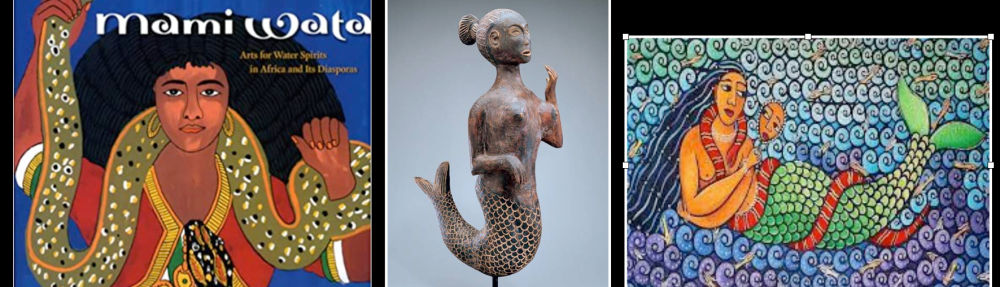
After reading “Introduction: The Stories We Tell about Mermaids and other Water Spirits”, one of the things that stood out to me when reading is when the authors said the following: “There is something deeply unsettling about a being whose form merges the human with the nonhuman. Whether they dwell in flesh or salt water, aquatic humanoids raise questions about what it is to be human and what lies beyond a human centered world” (xi).

It uneases us when aquatic humanoids, real or imagined, suspend between the human and the nonhuman. Through their very suspense, stranger like entities challenge us to reconsider the very concept of human existence. By expressing characteristics of the familiar-human faces, voices, gestures-and the aquatic traits such as scales, fins, or tails, they destabilize fixed categories such as nature and culture, human and animal, and land and sea. This ambiguity becomes crucial for there is, in fact, no way to confront the limitations of a human-centered worldview.

Aquatic creatures in tales or movies often confuse our sense of belonging and difference. By defining themselves against the opposites of civilization versus wilderness, body versus environment, and self versus other, humans create these distinctions. A mermaid or sea spirit dismantles these distinctions by existing in both realms and refusing to be neatly categorized. In this manner, with their existence, they point to our dependency on simplifications that might oversimplify the genuine complexity of being. If something can be both human and not human, then what marks the boundary of humanism itself? This question settles with immense power in an age of ecological crisis, wherein human survival is interdependent with the nonhuman world.

The image of the sea only further intensifies the presence of aquatic humanoids. Unlike the somewhat steadfast land, the ocean represents fluidity, instability, and unknowability. It diminishes the idea that humans are always in control. Aquatic humanoids living in that represents uncertainty in itself. They embody the notion of a lure into the abyss and a refusal of human-centered control. Their hybridity conveys distinctive meanings: that identity and existence require relationships that breach perceived barriers-between bodies, species, and environments.

In a wider sense, these aquatic humanoids are not just mythical creatures of fascinating creatures, they also remind us to realize the limits we have as humans.

These aquatic humanoids remind us that we humans are not the center of everything and that contemplating a life full of possibilities beyond ourselves is a consideration of a more intertwined and interdependent world.

What Distinguishes Merpeople from Humans?

The question about what distinguishes us as humans has puzzled many scholars throughout the history of mankind. When talking about the history of merpeople, the question of what is a human and what is an animal is often worried about. In addition, mermaids and mermen are hybrids that stand between animal and human. More than even hybrid mermaids, they stand between what is normal compared to what is monstrous. This idea of human is an important matter in what we classify hybrid studies and in monster theory- human, they reveal how we define ourselves by facing the new.

The idea of what it is to be human is a question that has also been discussed throughout the ages. In the Introduction chapter of Merpeople: A Human History, author Vaughn Scribner references a historian Erica Fudge who says the following: “Reading about animals is always reading through humans … paradoxically, humans need animals in order to be human.” Scribner writes about another historian, Harriet Ritvo, who made a statement about how when establishing the definition of humanity, the individuals who make the determination matter more than the subject, based on who or what carries out the assessment. When we view the perspective of those who inhabit the combination of having human-like and inherent sea and water qualities, we are better able to understand that the myths, stories, and divisions that have been built around this group to represent deeper human concerns and issues.

Monstrous entities within Western culture such as merpeople have challenged the way human-animal boundary is perceived. While merpeople are partly human, do they contain all the essential qualities that make humans who they are? These include, reason, dignity, and even spirituality. Or, were their animal traits socially lower on the “natural order,” and due to this their human superiority is reinforced? All these questions have made people reconsider what it truly means to be a human, and the way natural order actually is supposed to work.

The study of merpeople shows how the dividing lines of what dictates humanity are continually uncertain. Our sense of human identity purely relies on what we define as human, nonhuman, civilized, or wild, and that the human domination of nature is not absolute.

Hello Everyone,

My name is Gavin and I am a sophomore majoring in Journalism. Ever since I was a kid I have always been obsessed with sports (particularly basketball, football, and soccer). When I applied for college back in late 2023, I was unsure what I wanted to pursue for a future career. Then I realized I could combine my knowledge and love for sports with my passion for writing and telling stories. One fun fact about me is that I have also been collecting a large number of sports cards for over 13 years that I hope to one day be able to sell. My dream job is to be able to one day work for ESPN as a sports broadcaster or sports reporter, and get to travel to various locations around the world to cover games. I am excited to take this class and learn more about the deeper meaning of certain texts and writing, and also how to dissect and understand different perspectives of the environment and literature.

I am looking forward to having engaging conversations in class and to learn new things about literature and environment that I do not already know.