Final Essay

If we take a look at the ocean as an archive, The Deep by Rivers Solomon, The Water Will Carry Us Home by Gabriella Tesfaye’s, and the rise of Blue Humanities all collectively challenge history by arguing that the memories of the voiceless persist in water itself. This matters because it exposes how our traditional understanding of what history is has always allowed for the erasure of the marginalized. These histories have survived through resilience, collective memory, and cultural expression. History, especially in the West, has traditionally revolved around the documentation of set experiences that enslaved or colonized people have been deliberately excluded from. The Ocean holds a history that has never been written down, making me raise the essential question “Where does their history exist?!” and how do we determine who gets remembered or who gets erased. 

In Rivers Solomon’s “The Deep” we are taken on a journey of imagining a world where history is physically located in the water. Instead of records as proof of a shared history, the Ocean and its selected historian, Yetum, carry the heavy weight of a history rarely told, enslaved people during the Atlantic trade.The quote, “Without answers there is only a hole. A hole where a history should be that takes the shape of an endless longing. We are cavities” (pg.8) gave me chills as it perfectly captures the feeling of how having a history that is denied from or inaccessible to you creates this hollow feeling of nothingness. By looking at the Ocean as an archive we challenge how history is defined while also recognizing the effects of generational trauma. Not only does Solomon argue that history doesn’t have to be written down to be authentic and real, but also that erased histories of people still persist.

🎥@GabrielleTesfaye- Youtube

Similarly, Gabriella Tesfaye’s short film “The Water Will Carry Us Home”, connects African peoples back to a history of their ancestors. The frame above is an image of a scrapbook-like journal where we are physically shown what it looks like to create a history for people who are often erased. In both, water holds their history. This is extremely powerful because to have to create your own history means you are living proof of the aftermath that is this something incredibly uncomfortable, displacement. The scrapbook feel adds to the emotional weight of having to scrap fragments of a history that was silenced. The film also challenges this idea that history must be written to be real by creating a visual representation of ritual and connection to the natural world as part of their history. 

In the article “The Blue Humanities” by John Gillis he brings up an excellent example of why these questions exist, what the rise of Blue Humanities is working to undo. The quote, “All that lay beneath the surface- The Deep -was thought to be an unfathomable abyss, impenetrable and unknowable, a dark dead zone that trapped all that sank below the surface, never revealing its secrets” (pg.5) gives us another explanation as to why the concept of the Ocean as a history has been traditionally ignored. He explains that the Ocean had previously only been studied from a land-centered perspective. Meaning, that traditional archives are not completely accurate. Which also means that if the history of oppressed peoples lives in water, then forgetting to include them in written history is erasure. The Blue Humanities challenges the idea that a history has to be written down to be true because there is no way “a dark dead zone” is ever really “dead”. This can not be true considering, the Ocean is home to thousands of thriving organisms and spices. This again, reaffirms that although it has been ignored, the history of the Ocean exists.

📸@eadem.co- Instagram

The images above are of a facial setting mist by one of the most popular brands in the beauty industry. The campaign connects the past erasure with a rescue healing mist told through the story of Mami Wata, a water deity/spirit we discussed in our reading of African mermaids and water spirits readings. I decided to include this finding as it relates to my essay because it’s proof that these histories are not dead. This history hidden in the archive of the Ocean is still being told today.

Works Cited:

“Eadem on Instagram: ‘Repair and Revive with Mami Wata Ultra Calming Mist.’” Instagram, Eadem.co, www.instagram.com/reel/DEiEhuWP3wC/?igsh=NTc4MTIwNjQ2YQ. Accessed 19 Dec. 2025. 

Gillis, John R., et al. “The Blue Humanities.” National Endowment for the Humanities, www.neh.gov/humanities/2013/mayjune/feature/the-blue-humanities. Accessed 19 Dec. 2025. 

Solomon, Rivers, et al. The Deep. Saga Press, 2020. 

Tesfaye, Gabrielle. “The Water Will Carry Us Home.” YouTube, youtu.be/dGlhXhIiax8?si=IzsFRoyJuGS_x4Uj. Accessed 19 Dec. 2025. 

Final Essay Project

The entity of the Ocean is responsible for knowledge, language, and humanity itself being spread across the continents. All land and creatures came from the Ocean, its entire being the life force of earth and its inhabitants. Yet, we have turned our eyes from its being, its presence. In our advancements as society, we have forgotten the waters from which we came from.

  Through the works of Rooda, Mentz, and Walcott, exposes modern humans to the Ocean as the bases for modern human language and the relationship between all humans across the seas. In our reflection, we connect back to our Oceanic and mythical roots that set the foundation for the modern human race. 

The Ocean has never just been a place we name. It is a nation, a state – caring for millions of lifeforms, ecosystems, and knowledge. As Rooda explains to modern audiences an ideology rarely brought to the forefront of our education. “Ocean” being capitalized as one would a “country or continent.” Roorda’s comparison shows modern humans that instead of viewing the Ocean as a “thing” – an object for humans to use – we recognize it for the geographical individuality and statehood sovereignty it possesses. The idea of nationhood in itself is a man made conception only established in a modern age. Before humans had speech – the Ocean sat encasing this Earth. It held the species, the lifeforms, the beginning of human DNA. It was the first of its kind to maintain ownership over its subjects. Calling a state by its individual and capitalized name shows recognition of ownership to that nation, a sign that we as a separate nation respect your right to rule and interact with your nation as you see fit. Modern humans recognize Ocean as a state ruling without our guidance. Ocean takes care of its beings – it is its will. Capitaling Ocean is the beginning of an evolution in human relationship with the Ocean and the rights it contains over itself, not the rights modern humans believe assigned to themselves.

Lack of capitalization “infantilizes” the Ocean in a way. To modern humans, we see it as a resource for our needs, which then becomes exploited by a race of humans, which then needs conservation by those same races of humans. The Ocean does not need us to govern its tides. The Ocean does not need our generation of humans to tell it how to care for its creatures and environment. The Ocean has never needed human influence in how it governs. It has total control on the regulation of its waves, its currents, its foam. For all of documented History, the Ocean is responsible for the carrying of knowledge. It has brought creatures across the globe to new lands, stretching biodiversity and evolution across the Earth. It has carried messages from one country to another. It has exchanged goods, people, technology, all for the benefit of humanity. Ocean decides where it moves. Ocean decides who leaves and who stays within its waters. Ocean is an individual, with its own systems, rules. It is a nation that for too long has been denied the respect it deserves from humans in regards to its name. Rooted in our written language is the disregard for Ocean vocabulary, viewing it as ours instead of itself. What have we done to prove to Ocean it needs our guidance? Ocean chooses which creatures come on land. Ocean chooses who lives and who will pass beneath its deep, dark waters. Ocean is the ruler, we are its subjects. 

This type of language shift is also discussed by Steve Mentz within Blue Humanities. Mentz encourages modern humans to reshape their language in an”offshore” way to reflect our movement and relationship with Ocean. A natural world we have left behind. One word in particular relates greatly to the work of Roorda, the word being Current. “Currents flow.” Currents are the language of the Ocean itself, carrying the knowledge of Humans across landscapes for a Millenia. It was the Currents who first split the land into separate entities in itself. Currents created the divides across Earth. And it was these same currents who brought human relationship back across. Human ideas flow as a current, in the same way currents are the carriers of the flow of ideas. Without currents, Modern humans would have no knowledge, ideas, or identity. We would be isolated and indifferent to the world around us. Humans traveled across currents – drifting to different regions. Families expanded across the tides, the flow of culture spread across millennia. It is Ocean who is responsible for these journeys. It is the Ocean who connects all humanity. Then why do we not have language to reflect it? Why do we place emphasis on land based speech when the Ocean is responsible for everything our societies have ever come to be? Mentz molds audience thinking, not in a way to be superior – but in a way to give respect and gratitude for the one who has always been there. As Roorda made the point – changing our language is not a creation – but a recognition for what has always been there. 

As modern humans, we are so susceptible to claiming the land as the foundation of our history. Our legacies, our creations, our people rest on the shores. For centuries – humans collectively have ignored the sacred knowledge and history hidden beneath the Oceans surface. A wonderful example shown by that of Walcott is as follows – “the white cowries clustered like manacles of the drowned woman,” “me with eyes heavy as anchors who sank without tombs.” Walcott describes to modern humans the very life that used to walk this earth now residing at the bottom of the sea. Human life – so intertwined with the creation of land and nations – now are buried deep within the oceans surface, their bare bones under the security and will of the Oceans tides. How much of a family legacy was lost to the Oceans will? What great minds of scholars now are at home with the currents? What became of those drowned women from the slave ships of Africa – chained to a new life they had no desire for. It was the Ocean that enveloped them, the Ocean that welcomed these lost souls into its deep and secretive depths, concealing them from the land bound man. It is Ocean who brought them to a new life, a path of hope. They did not face suffering at the hands of their brethren, but instead found refuge in something we deem as dangerous. Why is it that this mysterious entity is seen as harmful to human life, yet provides sanctuary for those destined to pass at the hands of one of their own?

Walcott’s connection to the Ocean as the history and connection of all human kind goes beyond Ocean taking ownership of human beings. The Ocean contains the lost architecture we have removed ourselves from – “these groined caves with barnacles pitted like stone are out cathedrals.” We as modern humans look to architecture from a distant past as a way of reconnecting with our ancestors – a time we never had a place in. But what of the Ocean? What of the caves and trenches that have sat for millions of years, once responsible for housing the first species encased in the water. It is these caves and minerals that have seen the creation of earth’s species, have remained within the Ocean away from human eyes – unable to be touched by our selfish hands. When modern humans see historical structure – they see profit. How can they turn this into a resource? These hidden Oceanic treasures remain what they were always meant to be. Remembrance of a far away past – useful in its structure and that alone. These structures do not need to be seen and admired to have importance? Their being itself represents the strength of the Ocean, the devotion it has to keeping its beings alive. 

Humans move across the Ocean, Humans drown in the Ocean, Humans are here because of the Ocean. The Ocean kept alive all living species responsible for the creation of the first humans. Ocean nurtured and loved this genetic material long enough to be passed on to its descendants. In the same way Ocean gave life to humans first ancestors, Ocean accepts the humans that are brought back to it. Just as Walcott described, humans first homes were Ocean. Ocean provided for us and Ocean saved us. Those carted away across its currents brought them to safety beneath its flowing waters. Ocean understands humans better than we understand ourselves. It cannot comprehend why we would want to hurt one another. Why would one human treat another in such a way. Ocean did not allow this. Ocean took its children back, away from the danger, away from the monsters who walked the land. These monsters did not dwell in the sea – no. It is the ones who have wandered too far across the hills, the plains, the landscape – desperate to claim ownership, desperate to have, those who have forgotten Ocean – who have become the most inhuman. 

Why do we choose to look down upon this rich and vast history? Why is it those who choose to study the dark and murky waters seen as choosing “inferior” knowledge to that of land based “superiority?” Because modern humans are selfish. Modern humans are greedy. Humans ignore the very things that reminded them of who they used to be. The Ocean goes ignored and unwanted because it reminds modern humans of a time before ownership. Ocean has been tried, humans have wanted to take parts of Ocean, but Ocean will not let them. The boundaries humans place on their share of lands are interconnected with all other parts of the sea. It is one body, one movement – just as humans used to be. We once sam in these waters as one community. We once were all inside pools of water, drinking, living, simply existing. But then modern humans wanted. Modern humans were no longer satisfied with its giver – Ocean. Ocean was no longer enough, therefore humans wanted to make history elsewhere. They saw themselves as being above Ocean, allowing no room for Oceanic history. But they forgot how easy it is to uncover the truth. They failed to see new generations of humans who would dive back down to the Oceans depths. Modern humans who would recognize the Ocean for what it is and what it has always been. For too long, humans have ignored what has been surrounding us for generations. Our own history, almost destroyed by our ancestors. But no longer will this knowledge be ignored. It is because of writers such as Rooda, Mentz, and Walcott that modern humans no longer sit naive to the problem of Ocean erasure. We give our gratitude and respect to Ocean as the giver of life. We are beginning to change our language to represent the form that first gave life – as if it is the first giver of humans, why should our language not reflect this? The new generations of humans are ready to explore the depths of our humanity, the creation of human history in itself, and to do that, we must start back to where all life began, the first architecture, ecosystems, and species all developed.

The human history existing beneath the Oceans waters has always been present. It has been here since the creation of planet earth and it will continue to be made until Human civilization is no longer present. Rooda, Mentz, and Walcott each, in unique ways, express to modern humans the importance of recognizing the presence of the Ocean as a part of ourselves and human heritage. It is through the Ocean we find ourselves, humans, and what has connected us for millenia. The strong waves, the vast currents, the nutrient filled waters make up every inch of community, connection, and humanity in itself. The first eyes did not open on land. They opened under water. 

Final Essay: Environmental Memory and Colonial Erasure

Western historiography has long depended on material evidence, documents, monuments, and written records, to authenticate the past. Within this framework, history becomes what can be preserved, displayed, and catalogued, while experiences that resist documentation risk being erased altogether. Derek Walcott’s poem “The Sea Is History” confronts this limitation directly by reimagining the ocean as a non-traditional archive of colonial trauma. Rather than treating the sea as a passive backdrop for historical events, Walcott positions it as an active site of memory, one that holds the submerged histories of enslavement, displacement, and violence that colonial narratives attempt to suppress. Through dense imagery, metaphor, and tonal shifts, Walcott challenges readers to reconsider where history resides and how it must be read. When examined alongside John Gillis’s concept of “blue memory,” which understands oceans as repositories of deep, non-linear histories beyond conventional documentation, Walcott’s poem reveals how environmental spaces themselves can function as corrective forces to colonial erasure.

From its opening lines, “The Sea Is History” rejects the premise that history must be visible or textual to be real. Walcott responds to an implied question posed by Western historical logic: where is Caribbean history located? His answer does not point to archives, libraries, or monuments, but to the ocean itself. This repositioning immediately destabilizes the authority of traditional historiography. Rather than denying history, Walcott critiques the narrow frameworks through which history has been recognized. The poem suggests that colonial violence often escapes official record not because it did not occur, but because the systems responsible for documenting history were themselves complicit in that violence. As a result, the absence of records becomes evidence of erasure rather than proof of historical emptiness.

A key moment early in the poem encapsulates this idea: “the sea has locked them up. The sea is History.” Walcott’s use of the verb “locked” is especially significant. To lock something away implies both preservation and inaccessibility, something is kept safe, yet withheld from view. Walcott suggests that the lives of enslaved Africans lost during the Middle Passage have not disappeared, but remain sealed within the ocean. Their stories are present but inaccessible to conventional historical methods. In this sense, Walcott resists the notion that these histories are irretrievably lost; instead, they are preserved in a form that refuses easy retrieval, challenging readers to confront the inadequacy of Western archives that privilege written evidence over lived experience and environmental trace. This metaphor positions the sea as both a literal grave and a symbolic archive. Walcott’s declaration that “the sea is History” does not suggest that the sea merely contains or reflects history; it asserts equivalence between the two. History is not simply located within the sea it is constituted by it. This collapse of distance between event and environment reframes the past as something embedded within the natural world rather than safely contained in documents. The sea’s movements, its depths, and its capacity to erase physical traces become formal qualities of the history it holds. In this way, Walcott compels readers to adopt a new mode of historical interpretation, one that reads silence, absence, and environmental space as meaningful rather than empty.

Walcott’s emphasis on silence is not incidental but structural to the poem’s critique of colonial historiography. Throughout “The Sea Is History,” the absence of names, dates, and individual identities stands in stark contrast to traditional historical narratives that rely on specificity to assert legitimacy. This lack of detail does not weaken the poem’s historical authority; instead, it exposes the violence inherent in systems that demand legibility as a condition for recognition. By refusing to name the dead, Walcott resists the false comfort of recovery narratives that suggest historical wounds can be neatly healed through documentation. The poem’s rhetorical strategy places the reader in an ethically uncomfortable position. Instead of offering access to the lost voices of the enslaved, Walcott withholds them. This refusal mirrors the reality of colonial archives, which systematically erased Black lives while preserving records of economic exchange and imperial expansion. Silence in the poem thus becomes an ethical stance rather than a narrative gap. It forces readers to confront the limits of their desire for historical clarity and closure. In this way, Walcott challenges the assumption that history must be narratively complete to be meaningful. The sea’s silence becomes a language of its own, one that communicates loss without translating it into digestible form. The poem insists that some histories cannot and should not be fully recovered, because the conditions that produced their erasure are inseparable from the violence they represent.

Walcott further develops this critique of Western historiography through his treatment of imperial artifacts later in the poem, particularly in the images of “rusting cannons” and “broken statues.” These objects traditionally serve as authoritative symbols of history within colonial narratives. Cannons signify military power and conquest, while statues commemorate imperial figures and national achievements. Museums and textbooks rely on such objects to construct coherent stories of empire, progress, and civilization. Yet Walcott submerges these artifacts beneath the sea, where they corrode and decay. Once emblems of dominance, they are reduced to debris, stripped of their symbolic authority. The adjectives “rusting” and “broken” emphasize the instability of these supposed markers of historical truth. Rust suggests slow deterioration over time, while brokenness implies irreparable damage. By allowing imperial monuments to decay underwater, Walcott undermines the idea that history can be fixed or preserved through objects alone. These artifacts lose their meaning once removed from the systems that grant them authority. Their submersion suggests that the narratives they support are equally unstable. In contrast to the decaying symbols of empire, the sea emerges as a more enduring archive, one that preserves memory not through visibility, but through depth and concealment.

The submerged state of these imperial artifacts invites a broader critique of how empires rely on visibility to legitimize power. Statues and cannons function not only as historical evidence but as instruments of ideological reinforcement. Their placement in public spaces asserts permanence, authority, and moral legitimacy. Walcott’s decision to place these objects beneath the sea removes them from their intended context of display, rendering them ineffective as symbols of dominance. This act of submersion can be read as a reversal of colonial spectacle. While empire historically sought to make its power visible through monuments and ceremony, the sea dismantles this visual economy. Beneath the surface, cannons and statues lose narrative coherence, reduced to matter subject to decay. At the same time, the poem suggests that what empire sought to render invisible, the suffering and deaths of enslaved peoples, retains historical force even without material markers. The sea does not monumentalize these lives, but it also does not erase them. Instead, it holds them in suspension, resisting the empire’s attempt to control memory through selective preservation. This inversion challenges readers to reconsider the relationship between power, visibility, and historical truth. What colonial history elevates ultimately deteriorates, while what it suppresses endures.

Walcott’s oceanic archive can also be read through Paul Gilroy’s concept of the “Black Atlantic,” which understands the Atlantic Ocean as a central site of Black cultural formation rather than a boundary between nations. Gilroy argues that the histories of the African diaspora cannot be confined within national frameworks because they are fundamentally shaped by transoceanic movement, displacement, and exchange. The sea, in this model, becomes a space of both rupture and connection, a medium through which memory circulates rather than settles. This framework complements Walcott’s poetic vision by emphasizing the Atlantic as a site of ongoing historical significance rather than a completed past. Through the lens of the Black Atlantic, the Middle Passage is not treated as a closed historical event but as a formative process whose effects continue to shape identity and memory. Walcott’s sea reflects this continuity. Its constant motion mirrors the unfinished nature of colonial history and resists the linear timelines favored by Western historiography. By aligning with Gilroy’s theory, Walcott further destabilizes the idea that history belongs to the nation-state or the archive. Instead, history exists in movement, repetition, and return. The sea becomes a medium through which diasporic memory persists even in the absence of written record.

John Gillis’s work in the blue humanities further clarifies how Walcott’s sea functions as a historical agent rather than a passive container. Gillis argues that oceans “remember” through patterns of circulation, erosion, and accumulation, producing forms of memory that are spatial rather than textual. This conception challenges land-based historiography, which often prioritizes fixed sites and stable evidence. Walcott’s poem exemplifies this oceanic mode of memory. The sea does not present history in chronological order; instead, it holds multiple temporalities at once, allowing past violence to coexist with present motion. Gillis’s concept of blue memory helps explain why Walcott’s archive is necessarily unstable. The sea’s refusal to yield clear evidence is not a limitation but a defining characteristic of its historical function. Environmental witnessing operates differently from human record-keeping. The ocean bears history not by preserving objects intact but by absorbing and transforming them. Memory, in this sense, is not static but dynamic, shaped by movement, erosion, and loss. Together, Walcott and Gillis challenge readers to recognize the legitimacy of non-human archives and to reconsider how history is preserved outside institutional systems.

Walcott’s poem ultimately shifts the responsibility of historical interpretation onto the reader. To accept the sea as history requires a willingness to engage with uncertainty, silence, and absence. The poem resists closure, offering no recovery of the dead it memorializes. Instead, it insists on remembrance without consolation. This refusal mirrors the ethical challenge posed by colonial history itself: there is no restoration that can undo the violence of enslavement, only acknowledgment and reckoning. By positioning the sea as an archive, Walcott expands the boundaries of historical understanding. His poem suggests that environmental spaces can bear memory in ways that challenge human-centered narratives of progress and preservation. When read alongside Gillis’s blue humanities framework and Gilroy’s Black Atlantic theory, “The Sea Is History” reveals how the natural world itself participates in historical meaning making. The ocean does not merely witness colonial violence; it absorbs, preserves, and transforms it into a form of memory that resists erasure. In asserting that “the sea is History,” Walcott compels readers to reconsider how history is constructed and whose experiences it privileges. The poem insists that the most truthful archives are not always the most visible ones. Instead, history may reside in silence, in absence, and in the depths of the natural world, waiting not to be recovered, but to be recognized.

Final Essay: We’ve always been curious about the ocean

For context this an essay that is an expansion of my first discovery alongside close reading on the blue humanities.

Humanity has an obsession with power, and this perception has not changed since people were able to tell stories. It comes in different forms such as control, when early American Christians rewrote the earlier concept of mermaids. From winged humanoids offering knowledge, to sinful temptresses as a way of controlling women. However, mankind has a unique yet complicated relationship with nature and the environment when it comes to power. Nowhere is this more strong than with the ocean. Because they cannot control it, this leads to reverence and fascination. In many cultures, like Greek mythology’s Poseidon, people created these mythical stories to explain natural disasters and phenomena. A modern incarnation of this is the work of Ao Hatesaka’s one-shot manga, ‘Galaxias’. Where dragon attacks are the stand-ins for natural disasters, but more importantly, they are the stand-ins for the human desire to know more about the ocean. This shows even to the modern age people are still trying to make sense of the ocean through human-based understanding. That there was and always has been a burning desire to understand the deep sea. Not just in the modern age. 

Some explanation is in order. In The Ocean Reader: Theory, Culture, Politics, “It has always been difficult for humans to think of the Ocean as a place. Those who have considered the watery majority of the planet on its own terms have often seen it as a changeless space, one without a history. Because the Ocean can’t be plowed, paved, or shaped in ways the eye is able to discern, it has seemed to be a constant, while the land has changed drastically over the centuries” (Roorda 1). 

This comes from human perception in a similar manner to how we determine who is guilty of a crime and who is innocent. Visual evidence. There were limited methods to explore under the surface of the deep sea, and any attempt before the modern age was met with failure. If a tree falls in a forest and no one is around to hear it, does it make a sound? The same applies with the ocean but more so since humans themselves cannot affect it. The reason we’re so focused on land is not solely because the ocean is more dangerous to explore compared to land. Land exploration while ‘mastered’ and mapped out was still difficult and risky for early humans. So why do we have a hard time thinking about the ocean as a place back then? Because humanity wasn’t able to project their power onto the ocean in a way that we understand. More specifically, we couldn’t do anything to change it. Land became divided up and labeled as territories for many countries, people were able to assert their power over others but more importantly over the land. Taking resources, building on top of it, and expanding. They couldn’t do that with the sea until centuries later during the modern age. Territorial waters have only become a concept created by humanity since at least the 17th century. Which was further developed and contextualized in the proceeding centuries (as recent as the Geneva convention and sometime in 1988).  

Expanding on the idea of resources, the sea offered very little in terms of what it could be used to benefit people. On land one would have the wood and rock needed to craft tools, build homes and farms. Mine the metals needed to create weapons for defence and conquest. In a way all of this was more easily accessible on land than anything the ocean could’ve provided besides food. That’s to say if a community happened to be near an ocean. 

In the article “The Blue Humanities” by John R. Gillies, “Before the nineteenth century, attitudes toward the oceans were more utilitarian than aesthetic. The sea was portrayed as dangerous and repellant, ugly and unfit for literary or artistic representation. Oceans were explored as a means to reach distant lands, and little attention was paid to the waters themselves. It has been said that “the deep sea made hardly any impression. . . . Even oceangoing explorers were more land than ocean oriented; they used the sea merely as a highway to get to the next landfall.” This was a discovery more by sea than of the sea”. 

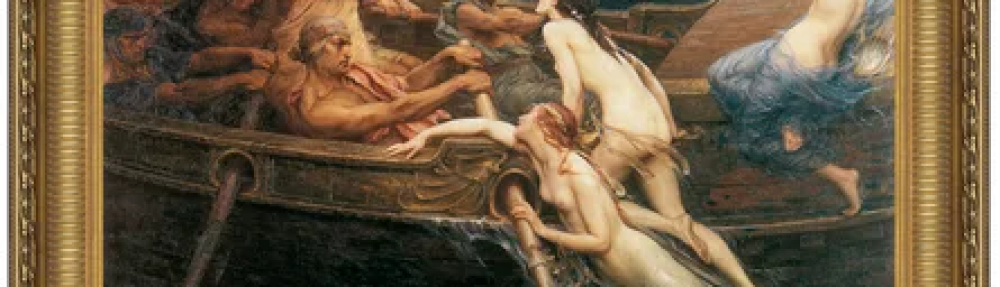
The article continues to push the idea that early humans didn’t think much of the ocean for two main reasons. We couldn’t affect the ocean directly AND it didn’t have much to give in terms of benefits. When a literary author did make their piece about the deep sea, it was in pursuit of unknown knowledge, like in Odysseus and the Sirens. Or written in a way that is still land and human bias, Hans Christain Andersen’s The Little Mermaid for example. However, these stories and myths exist because of a curiosity with the ocean. While back then the ocean was deemed unfit for literary or artistic representation, it did not stop the curiosity and attempts for writers to do so. All of this was based on what understanding they knew about the land. Thus they projected what power of understanding they had onto the ocean to try and make sense of it. Because, all this uncertainty the ocean has over humans is a form of power in of itself. This brought fascination and reverence but also a clear desire to understand that power. In the same article, “Beginning in the late eighteenth century, people began to come back to the sea in search for a quality they felt to be missing in the new industrial environment, that something called wilderness. The desire for an experience of untamed nature originated in the eighteenth century among a small group of European aesthetes, for whom the awesome power of the sea, as witnessed from the safety of land, was a powerful emotional and mental stimulant”. 

Even in the modern age where interest in the ocean has exploded, the ocean’s possible benefits and uses have been greatly expanded upon. From just being seen as a way to get from point A to B. It has become a place where we’re able to learn more about humanity’s ancient past. The environment’s history contained within the vault called the sea, and so much more. The perspective here is now that everything’s been mapped out on land, we can now fully turn our attention to the waters that surround our planet. The ocean has been an untamed environment for centuries. The two stories I’ve mentioned earlier have been small cinders of desire used as kindling for the bigger flame of curiosity that ignited in the modern age. Serving as inspiration for modern incarnations to come into play. 

That these stories may have been human attempts to both satisfy the always present curiosity. They could’ve been a way to cope with the power nature and therefore the ocean has over humanity. Recycled curiosities that we don’t have the answers to but are made again and again to remind us of it. Stories like Ao Hatesaka’s one-shot manga, ‘Galaxias’

GALAXIAS is a Japanese one-shot manga illustrated and written by Hatesaka Ao. It was published in Kodansha’s shōnen manga magazine Weekly Shōnen Magazine on June 22, 2022. The one-shot version of their work follows protagonist Neraid, a recently made orphan who lives on an island nation plagued by commonly occurring dragon attacks. Creatures he has come to loathe for the power they possess. 

The setting of ‘Galaxias’ was inspired by Japanese culture. Within the setting, dragons exist and attack the island nation on which the story takes place regularly. Similarly, tsunamis and earthquakes often hit Japan, where it has become a part of life for the people living there. Like in Japan, the people of Galaxias’s setting have formed countermeasures in dealing with them. Displaying the need for control over this immense force. But also has a way to assert power over this natural force. Humans have reasons for their power as discussed earlier. For the sea? There is no reason it can give us that we as humans can use to understand.

In real life, natural disasters aren’t inherently malicious or target humans specifically. But back then, that wasn’t the mentality; natural disasters were often interpreted as humans somehow angering local deities, spirits, or mythical creatures. This was seen as them being punished for some misgiving. Already showing the desire to know ‘why’. Something about the ocean just invokes this feeling. It may be why as John R. Gillis puts it in his article, “They turned it, as never before, into a place of spiritual and physical recreation”. Paving the way that people project human understood values onto the ocean. Making something like a tsunami: that’s destructive and randomly occurring, have meaning. 

Meaning that will lead to understanding able to satisfy human curiosity. In the above panel, Neraid is angry but displays the desire to know why. He questions the logic behind the attacks. Displaying the reason for stories like this to be created—to make sense of the power difference and imbalance nature possesses. When there’s no true answer. The dragon being represented in this way as an unresponsive, mysterious being that does things with no rhyme or reason perfectly represents how we feel about the ocean. It allows the reader to feel the same way Neraid does, making them also question it. It reminds the reader there is still a ton about the world we still don’t know. But also how humans continue to separate themselves from nature, yet are unable to. All because of a lingering curiosity able to give birth to various interpretations that leaves us fascinated. With the need to know more because the ocean (and by extension the greater ability of nature and the environment) is able to have us reflect on ourselves on a deeper spiritual level. 

Neraid’s statements about the dragons being powerful to the point, logically, they shouldn’t have any need to bother and interfere with humanity. But this couldn’t be any more false. As stated all the way at the beginning of the essay, humans are obsessed with power. Power that is often more or less used in various ways. We want to use and know about nature’s power in some shape or form. Every story and myth, modern and ancient, uses the ocean’s power in some way to create a meaning we’re able to digest and understand what we’re feeling. Neraid is not just angry at the dragon for literally causing him pain and suffering in life. It’s also a representation of how he would’ve used the power the dragon possesses. To not interfere or bother with what he considers ‘bugs’. It’s in a similar manner to how a lot of people don’t bother themselves with actual insects. Unless they become a problem. Again. That ancient reason why various deities, spirits, and monsters are born. To punish humans in some way. To just know why.

Stories like Galaxias still being made are a testament to humanity’s still lingering curiosity. The possible reason why we can’t truly connect ourselves with nature, yet at the same time we can’t separate from it fully. There’s the constant power clash between humans and nature when it comes from our desire to influence and display it against the natural force that helped give birth to us. That humans may be trying to become equal to nature/the ocean.

Sources

Eric Paul Roorda, The Ocean Reader: Theory, Culture, Politics (Duke UP, 2020). ‘Introduction” (pgs. 1-4)

John Gillis, “The Blue Humanities” (Humanities: The Journal of the National Endowment for the Humanities. Web. 2013)

Ao Hatesaka, “GALAXIAS”

Gothic Liminality and Marriage in Undine: Final Essay

In Friedrich de la Motte Fouqué’s gothic fairy-tale novella, Undine, the supernatural in this story isn’t just for decoration, nor does it function as a simple allegory or moral instruction. Instead, it operates as a Gothic aesthetic in which instability, fear, and liminality become visible. Nowhere is this more apparent than in “The Day After the Wedding,” from Undine, a chapter within The Penguin Book of Mermaids, that unsettles the apparent harmony of marriage through nightmares, silence, repetition, and a delayed revelation. While the chapter gestures toward future tragedy, its main function is not straightforward foreshadowing. Rather, it actually exposes the Gothic anxiety produced by proximity to a being who exists between two worlds–human and nonhuman, a familiar and unknowable. This anxiety is seen almost immediately in the chapter’s atmosphere of “wonderful and horrible dreams” (102) and the uneasy quiet that follows the wedding night.

Fouqué’s “The Day After the Wedding” uses the Gothic aesthetics of dream imagery, temporal disruption, monstrous transformation, liminal space, and supernatural knowledge in order to externalize anxieties that can’t be articulated within the rational discourse of marriage or of humanoids as paradigmatic liminal beings. The chapter can be placed within a broader Romantic Gothic tradition. In his text, the supernatural doesn’t explain emotion or stabilize this romantic union, but instead dramatizes the instability that comes with being human and attempting to contain what resists fixed boundaries. This function of the supernatural aligns with what Gothic theorist, Catherine Spooner, identifies as the genre’s defining impulse in “Unsettling Feminism: The Savagery of Gothic,” she explains how Gothic “acts as an unsettling force,” not to resolve contradiction, but to expose the fractures and aporias behind these systems that claim coherence (129).

One of the most striking Gothic strategies in “The Day After the Wedding” is Fouqué’s manipulation of time. The title itself shows that there is a disruption instead of a resolution after this holy unity. Marriage, conventionally imagined to be a moment of culmination and stability, is displaced by what comes after. The phrase “the day after” suggests a belated reckoning, a temporal lag in which consequences emerge indirectly rather than being resolved at the moment of ritual completion. Gothic anxiety is thus located not in the wedding night but in what lingers beyond it. Huldbrand’s terror unfolds in the liminal hours between night and morning. The “fresh light of morning” (102) awakens the newly married couple, yet daylight does not banish his fear. Instead, it reveals what is left of the darkness. Huldbrand’s dreams stay vivid, the images clinging to him as his consciousness returns. The Gothic that is seen here is how it refuses the restorative promise of daylight; fear persists even as the night recedes. This temporal overlap collapses the boundary that is between the unconscious fantasy and waking life, suggesting that the anxieties staged by the dream are not confined to sleep but embedded in the reality that the marriage between Undine and Huldbrand has produced. The displacement aligns with Gothic conventions that put horror not at the moments of climax but in the aftermath. Marriage should prove Undine’s status as a wife and human being, yet the morning after intensifies ambiguity. Stability becomes an illusion when it should have been secure. The Gothic, therefore, comes not as an interruption but as an afterimage, revealing the insufficiency of social rituals to resolve that ontological uncertainty. To be clear, the Gothic is not defined by terror alone, but by its capacity to expose the instability of categories–human and nonhuman, reason and emotion, order and excess–that the social rituals like marriage attempt to secure.

Gothic literature locates its deepest anxieties in liminal bodies, and in Undine, this anxiety is clear about the impossibility of fully domesticating a being that exists between human and elemental worlds. As Cristina Bacchilega observes in The Penguin Book of Mermaids, “we humans do not deal well with betwixt and between–liminality makes us anxious” (xi), and Merepeople: A Human History by Vaughn Scribner also enhances that same argument by saying “hybrid creatures represented danger as much as hope, wonder as much as horror” (8). This insight gives a lens for understanding Undine, whose existence undermines the stability that marriage is meant to guarantee. Undine’s marriage to Huldbrand represents her attempt to resolve her liminality through Christian ritual and being recognized by society. The elemental spirit she is is transformed into a wife, seemingly now as a part of society. Yet Gothic logic resists such containment. The day after their union doesn’t confirm harmony; instead, it introduces disturbance. Huldbrand awakens from his “wonderful and horrible dreams,” haunted by spectres who disguise themselves as beautiful women before suddenly assuming the face and bodies of dragons (102). The nightmare stages this anxiety visually, allowing Huldbrand to project what he cannot consciously acknowledge, since Gothic convention enables the rational subject to cast off its “horrifying and fascinating others in monstrous form” (Spooner 130). Beauty now collapses into monstrosity, exposing the fragility of appearances and the instability behind these social forms. The dream aestheticizes liminality itself. This fear of collapse aligns with Scribner’s observation in Merpeople: A Human History that such hybrid beings were understood as “they were unnatural manifestations of a realm that humans did not fully understand,” capable of drawing humanity into “a strange, disorderly world of confusion and destruction” (8). The supernatural has not been domesticated; it continues to exert pressure upon the social order. Undine’s body, her origin, and relation to humanity remain a mystery, and Huldbrand’s nightmare gives way to this instability to flourish into its grotesque visual form. Marriage attempts to render Undine legible within social order, yet her presence resists such containment, for Gothic hybrids are “disturbing” precisely because their incoherent bodies “resist attempts to include them in any systematic structuration” (Spooner 136).

Dreams occupy a privileged position in Gothic and Romantic literature because they make way for forbidden or unacknowledged fears to surface. In “The Day After the Wedding,” Huldbrand’s nightmare functions as a Gothic disclosure, translating unspoken anxiety into a spectacle. The spectres that haunt him do not appear as overtly supernatural beings, but instead they “grin at him by stealth,” masquerading as beautiful women before revealing their monstrous faces (102). There is this oscillation that is seen between beauty and horror that mirrors Undine’s liminal status and destabilizes the reliability of perception itself in Huldbrand’s view. The dreams that he has, the most disturbing feature isn’t the violence of it all, but it’s the structure of the transformation from a beautiful being to a monster. The spectres are not immediately monstrous; their monstrosity emerges through sudden collapse. The women’s faces become dragons without transition, evoking medieval Christian iconography in which dragons signify deception and spiritual danger. In mermaid traditions, hybridity itself is frequently aligned with the demonic–not because the creature is morally corrupt, but because it resists the fixity required by Christian moral systems. Huldbrand’s dream draws upon this symbolic logic, staging the terror of an unfamiliar being rather than betrayal. Most importantly, the dream does not end upon waking. Pale moonlight floods the room, collapsing the boundary between dream and reality. Huldbrand looks at his wife, Undine, who still lies “in unaltered beauty and grace,” yet terror persists (102). Nothing about her has changed; what has changed is his perception of her. The dream has attached the possibility of monstrosity to Undine’s presence, showing the Gothic fear that beauty conceals monstrosities. 

The transformation of women into monsters within Huldbrand’s dream aligns with a long Gothic tradition in which femininity becomes something of a site for projected anxieties. It is not male bodies that mutate but female ones, reflecting cultural fears surrounding female otherness and autonomy. As Cristina Bacchilega notes, such narratives oftentimes reveal “the discrepancy between men’s longing for a woman unfettered by social mores and their attempt to control her by domesticating her” (xviii). Undine embodies this contradiction. Her difference makes her desirable, yet once bound within marriage, that same difference becomes threatening. Huldbrand’s attempt to master his fear–reproaching himself for doubt and pressing a kiss upon her lips–exposes the tension between rational self-discipline and irrational anxiety. The Gothic does not resolve this tension; it sustains it, revealing the limits of reason in the face of liminality. Undine’s response intensifies uncertainty. She sighs deeply and remains silent, offering no verbal reassurance. In Gothic literature, silence marks the presence of what cannot yet be safely articulated. Her quietness reflects not innocence but opacity, reinforcing the sense that she cannot be fully known or contained. 

Undine’s silence following Huldbrand’s apology is one of the chapter’s most theologically charged moments. She communicates forgiveness through gesture rather than speech, holding out her hand and offering a look of “exquisite fervour” (102). In Gothic terms, silence marks the presence of knowledge that goes beyond what can be fulfilled by a spoken language. The scenes that follow Huldbrand’s apology attempt to reassert social and spiritual order: within himself and his wife. The priest prays inwardly, the foster parents observe Undine attentively, and the household waits for confirmation that the supernatural has been successfully domesticated. Undine appears to fulfill this hope. She performs idealized domestic virtues, becoming “quiet, kind, and attentive, at once a little matron and a tender bashful girl,” yet this very perfection still comes with unease. Those who have known her longest expect at any moment to see some “whimsical vagary” to burst (103). Stability feels unnatural, sustained only through vigilance and restraint. Gothic tension operates here through anticipation rather than action. Domestic order is revealed as performative rather than natural, a fragile illusion rather than a secure resolution.

Gothic anxiety is further reinforced through the repetition and return within the chapter. Huldbrand repeatedly awakens from terror, reassures himself, and falls asleep again, only to be disrupted by new visions. This cyclical pattern undermines the idea that rational correction can dispel fear. Anxiety does not disappear when confronted; it only recurs in an altered form. Spatial repetition mirrors this psychological pattern. When Undine asks Huldbrand to carry her to the island, he recalls that this is the same island from which he first carried her to the fisherman’s cottage. Progress is revealed as circular rather than linear. Marriage does not inaugurate a new beginning but reactivates unresolved tensions rooted in liminal spaces. The island now functions as a Gothic threshold, a place of judgment rather than safety. Undine insists Huldbrand sit opposite her and read his answer in her eyes before his lips speak. Her insistence reflects a Gothic epistemology in which “vision precedes language,” marking a knowledge that cannot yet be safely articulated within humans (Spooner 135). This insistence reflects mermaid past that an interaction with them tests men; in this case, it isn’t through vow but through recognition and whether he can truly see Undine for who she is–a hybrid of both land and sea.

Water imagery saturates “The Day After the Wedding,” functioning as a central metaphor for Gothic instability. The forest stream, once wild and swollen, now flows gently, appearing temporarily subdued. Yet this calmness is explicitly framed as transient. By morning, Undine notes, the stream will be dry, enabling Huldbrand’s departure. Stability is provisional, dependent on fluctuating natural environmental forces. Undine’s ability to glide effortlessly through water contrasts with Huldbrand’s need to carry her, highlighting their ontological difference. Though he carries her body, he cannot contain her essence. Like the transformations of the nightmare, water refuses fixity. It shifts from obstacle to passage, restraint to release. The Gothic emerges not through overt threat but through the constant motion that undermines permanence, revealing marriage itself as a provisional structure rather than a stable resolution of liminality. This instability reflects a broader Gothic tradition in which, as Scribner suggests, “humankind has always grappled, humanity maintains a tenuous balance between wonder and order, civilization and savagery” (9).

Undine’s revelation of her elemental nature shifts the Gothic from implication to articulation. She situates herself within a parallel cosmology of salamanders, gnomes, spirits of air, and water beings, decentering human existence entirely. This knowledge destabilizes Enlightenment assumptions of mastery and hierarchy. Her explanation of soullessness intensifies this disruption that is seen. Elemental beings, she explains, vanish entirely at death, lacking immortal souls. The acquisition of a soul–often treated as a triumph–is framed instead as a burden that brings suffering, fear, and vulnerability. Gothic inversion is at work here because spiritual elevation gives exposure rather than transcendence. Huldbrand’s “strange shudder” and inability to speak register the epistemological shock of this revelation (105). He is confronted not with a monster but with a being whose suffering now depends upon his fidelity. Gothic anxiety arises not from threat but from responsibility.

Although the episode concludes with Huldbrand’s vow never to forsake his wife, Undine, this declaration offers emotional reassurance rather than ontological certainty. The anxieties revealed by the nightmare–fear of transformation, instability, and loss of control–remain unresolved. Fouqué is not merely depicting a husband’s fear of his wife. Rather, he uses Gothic aesthetics to interrogate the limits of social institutions themselves. Marriage, religion, and reason attempt to impose order, yet the supernatural exposes the fragility of that order by embodying what exceeds it. 

“The Day After the Wedding” from Undine uses the Gothic aesthetics of dream imagery, temporal disruption, monstrous transformation, silence, repetition, water imagery, and supernatural revelations to dramatize the instability inherent in attempts to contain liminality within human social structures. Huldbrand’s nightmare is not simple foreshadowing but an aesthetic event that externalizes anxieties surrounding categorization, control, and transformation. When the chapter is read alongside mermaid scholarships, The Penguin Book of Mermaids by Cristina Bacchilega and Marie Alohalani Brown, and Merpeople: A Human History by Vaughn Scribner, the chapter reveals how supernatural female figures function within Gothic literature as sites of cultural and psychological projection. Fouqué’s supernatural does not resolve conflict or explain emotion; it illuminates uncertainty. In doing so, Undine demonstrates the power of the Gothic not to soothe Romantic-era anxieties, but to render them visible and inescapable. In this way, Undine reveals that Gothic literature does not merely reflect anxiety but produces it deliberately, forcing readers to confront the limits of social, religious, and epistemological systems meant to protect them from uncertainty.

Works Cited

Bacchilega, Cristina, and Marie Alohalani Brown. “The Day After the Wedding from Undine.” The Penguin Book of Mermaids. New York, New York, Penguin Books, 2019, pp. 101-106.

Bacchilega, Cristina, and Marie Alohalani Brown. “Their Bodies, Our Anxieties.” The Penguin Book of Mermaids. New York, New York, Penguin Books, 2019, pp. xi-xiv.

Bacchilega, Cristina, and Marie Alohalani Brown. “Plots, Gender, and Human-Nonhuman Relations.” The Penguin Book of Mermaids. New York, New York, Penguin Books, 2019, pp. xvii-xx.

Spooner, Catherine. “Unsettling Feminism: The Savagery of Gothic.” The Gothic and Theory: An Edinburgh Companion, edited by Jerrold E. Hogle and Robert Miles, Edinburgh University Press, 2019, pp. 129–46. JSTOR, www.jstor.org/stable/10.3366/j.ctvggx38r.10.

Scribner, Vaughn, and Reaktion Books. Merpeople: A Human History. London, Reaktion Books, 2020.
Final Project – The Seas Will Sing

My final essay and my project based on the concept from The Deep and Derek Walcott’s poem 🙂

The exact number of deaths during the Middle Passage is unknown, and I wanted to convey it artistically, with literature and numbers. The sea keeps all of this as archived, even if we don’t want to know it.

ECL 305 Final: A Foam Between Two Worlds

https://publicdomainreview.org/collection/pyle-mermaid

In this unfinished 1910 painting by Howard Pyle called The Mermaid, a glowing mermaid is pictured holding onto a limp, young sailor with tight grip, on sharp, moonlit rocks, while green and blue waves come crashing down around them and white sea foam moving everywhere. This beautiful picture encapsulates the soul of Hans Christian Andersen’s “The Little Mermaid” –that deep, heartbreaking wish she has to leave her life below sea and join the human world; Trading her tail and beautiful voice for a pair of legs and the opportunity to have an eternal soul. Her pale arms are wrapped around the sailor’s sharp face, and the top of his head where a Phrygian liberty cap sits. This represents a symbol for freedom that makes viewers of this painting relate back to the prince the little mermaid pulls from the shipwreck in Andersen’s tale. This whole scene freezes this extremely tense, and emotional moment where she is stretching out from her world below, toward the sailor’s land life; Almost like she is between two worlds already. Pyle’s painting perfectly shows the Little Mermaid’s intense desire to join the human world. In the Little Mermaid by Hans Christian Andersen, the Little Mermaid says, “I would willingly give all the hundreds of years I may have to live, to be a human being but for one day, and to have the hope of sharing in the joys of the heavenly world” (Andersen 116). Through this artwork, Pyle shows through this intense boundary between sea and land, that this kind of longing can break down natural walls, just like how humans impact the environment today.

Through the use of light, Pyle allows viewers to emphasize with the Little Mermaid’s yearning. The light of the moon illuminates her upper body against the waters below, comparable to Andersen’s imagery of her rising from under the deep water, “blue as the petals of the loveliest cornflower” (Andersen 107). The shimmering light also surrounds her and creates an illusion of the “soul” she is yearning for. As the Little Mermaid’s grandmother said, When humans die, they “Ascend through the clear, pure air beyond the glittering stars”, but when a mermaid dies, she is “Dissolved like green seaweed. Once cut down it never grows again” (Andersen 117). The Little Mermaid and the sailor’s eyes meet while they are starting at each other. Hers in the sky looking up with great longing for his world, and his blank eyes staring down at her. This gaze represents her fixation on unreachable human vitality. According to a scholarly article written by Nancy Easterlin titled Hans Christian Andersen’s Fish Out of Water, Easterlin captures these opposing energies within the image and states that it is “the mermaid’s inwardness, isolation, and longing for a different kind of life than what is ‘natural’ to her” and she does not have the luxury of being an ocean playground, but rather an imprisoned ocean storm (Easterlin 252). The blues transition from the placid deep sea to the turbulent white foam showing how the union of body and soul is a disruption to the Little Mermaid.

When taking a closer look at their embrace, one can see the pain that comes with crossing over into a new world. The Little Mermaid’s arms are holding the sailor gently but still possessively, with fingers gripping as if drawing his warmth into her cold, scaly foam. This echoes the sea witch’s major warning: “Once you obtain a human form, you can never be a mermaid again! You will never be able to drive down into the water to your sisters or return to your father’s palace” (Andersen 119). Some of the sketch lines under the paint–wild webbed foam and shaky hand grips–show her sea nature fighting back, just like the sharp knife pain of her new legs on land. The freedom cap on the head of the sailor mocks the Little mermaid’s almost-human look (with just faint scales), making their embrace a risky doorway. She drags him into the sea even as she most desires his freedom from the land above. In another scholarly article written by Angel Tampus titled, Comparative Analysis of Hans Christian Andersen’s and Walt Disney’s The Little Mermaid, Tampus calls this the Little Mermaid’s “strong motivation to be a part of the world above,” which is tied to the story’s Christian idea that love is able to win a soul (Tampus 18). The rocks depicted in the image look hard and difficult to climb, while the foam rushes forward almost like a sense of impending doom closing in– or a small change to escape.

Pyle’s composition puts the mermaid and sailor at the center of the artwork, where the rugged rocks serve as a symbolic and literal divide. These sharp edges cut through the scene, showcasing the truly difficult transformation the mermaid is enduring. Each step she takes on land will feel like knives, mirroring the harsh stone beneath her. The rocks ground her tail while her upper body leans forward. This creates visual tension that represents here split identity between sea and land.

The color palette of the painting further invokes this theme of longing and disruption. The cool blues and greens dominate the waves, which evoke the mermaid’s natural underwater home. However, they still churn violently toward warmer highlights on her skin and the sailor’s face. This blending of temperatures represents the mermaid’s desire to replace her current cold oceanic isolation for now human warmth and connection, while the sea foam hints at dissolution, which is her ultimate fate if love fails.

Another thing that is important to notice is that the sailor’s posture and how it is contrasted with the mermaid’s active embrace. The tilted hat of the sailor suggests freedom slipping away as she draws him downward. This essentially changes the power dynamic. This reversal shows the little mermaid’s desperate agency. Instead of passively yearning, she is attempting to bridge worlds, even with the risk of pulling humanity into her destructive element.

In Pyle’s painting, the broader seascape portrays nature’s destruction. Waves are seen crashing against the rocks like invading ships, and Pyle’s rough white and blue brushstrokes make the ocean feel chaotic and broken around the Little Mermaid’s longing. The faint shapes in the foam suggest growths or sea creatures, which links sailors to the objects that they bring or lose–things that feed her desire for the human world but also dirty her home.

Going back to Easterlin’s article, her idea of a “mixed ontology” (being both nature and human) fits here: The Little Mermaid’s smooth body, going from human torso to tail, expresses how people often may see wild places as traps to escape in order to “move up in life (Easterlin 261). Seeing the moonlight shining only on the mermaid and sailor essentially makes both of them look small and alone in comparison to the vast blue sea. This illustrates the Little Mermaid’s isolation even though she is still in the presence of a human.

Because Pyle never finished this painting, this adds layers to this isolation. Visible brushstrokes and sketch lines reveal the progress that Pyle made. This in turn mirrors the mermaid’s incomplete transformation; How there is no smooth resolution, but only true, raw struggle. This imperfection parallels her in-between existence. She is neither fully mermaid nor human. She is suspended between the foam-like uncertainty.

The messy strokes of Pyle’s incomplete painting, with removed waves, expresses an undeniably raw and unrefined sense of longing without a perfect resolution to one’s struggle. Andersen’s end of his fairytale also provides similar imagery; However, foaming due to betrayal, the mermaid’s redemption comes from the “daughters of the air”, offering soul through deeds (Andersen 129). Looking back at the article by Tampus, Tampus describes this as”transcending one being to another,” enduring pain for transformation (Tampus 21). The sea form suggests the possibility of the mermaid’s ascension into the air, while the grandmother’s image of a “seaweed blanket “stays above the waves of the ocean.

As one’s gaze follows the turbulent waves outward to the horizon, the hazy outline of an uncharted human world is revealed above them. The radiant skin of desire juxtaposed with the darker sea tones that compose the sea emphasizes how deeply rooted desire can blind human to their inherent connection to nature. The sea foam created by the waves separates them from the potion that gave life to this body of water, creating a bridge between two worlds.

In this painting, texture invites closeness. The thick paint suggests spray and chill rocks; Writhing waves grip like the story’s living sea turned isolating. The colors showcase emotion, inviting deep blues turn to panicked whites, capturing longing’s thrill and danger. The mermaid’s warm skin provides the sole heat in the cold sea. Shapes help blend her curves into the sailor’s limp form, blurring hybrid boundaries. The sailor’s cap’s floppy liberty contrasts rigid sea constraints.

Through his painting, Pyle is showing the mermaid’s yearning as an echo of humanity’s desire to extend beyond its physical limitations, resulting in the destruction of the planet that sustains it by cutting down trees used for developing oxygen; taking more fish from the oceans than can be replaced; polluting the oceans with discarded plastic while seeking power, wealth, and progress, and treating wild lands and oceans as limitations. The mermaid’s sacrifice of her tail to experience the warmth of human embrace is similar to humanity’s sacrifice of nature for personal gain. All of this creates debris from ships and extraction rigs and ultimately depletes both the ocean and the shipwrecked treasures the shipwrecks leave behind. As Easterlin points out, the desire for what cannot be attained destroys the relationship between humans and nature (Easterlin 265), while also disconnecting humans from themselves and others through the process of creating these connections. In the end, because both Pyle and Andersen illustrate how longing can be found in all places, to truly belong, one most share a commitment to nurture, rather than destroy, nature, or they will otherwise float away as foam–cast adrift on the sea of their own making.

Works Cited

Easterlin, Nancy. “Hans Christian Andersen’s Fish out of Water.” ScholarWorks@UNO, 2011, https://scholarworks.uno.edu/cgi/viewcontent.cgi?article=1035&context=engl_facpubs Accessed 12 Dec. 2025.

Tampus, Angel, et al. “Comparative Analysis of Hans Christian Andersen’s and Walt Disney’s The Little Mermaid.” International Journal of Multidisciplinary Development and Educational Studieshttps://journal.ijmdes.com/ijmdes/article/download/91/90/91Accessed 12 Dec. 2025.

https://platform.virdocs.com/read/616251/45/#/4[x9780525505570_EPUB-43]/2/2[_idParaDest-46]/2,/3:0,/3:0

Final Essay Idea

For my final essay, I am considering mainly focusing on The Little Mermaid by Hans Christian Andersen; more specifically on the recurring theme of the mermaid longing to be a part of another world, and how that ties into our class theme of literature and the environment. I am hoping to be able to close read and analyze text deeply as well as incorporate scholarly articles and information that can help aid in me crafting a strong argument for my final essay.