There are three individuals known to have survived infancy with Sirenomelia. They are the stars of inspirational documentaries, the subjects of research publications, and featured on blogs dedicated the the macabre. It goes without saying; humans are fascinated by disease, deformity, and abnormal morphology. We see these anomalies through various lenses; as symbols of strength in the face of adversity; as demonstrations of the state of medical technology, or merely as perversely, fascinatingly, bizarre. In any case, individuals with physical abnormalities are monsterified. They take on that role; non-human emblems, culturally imbued, figures which demonstrate something, make us aware of something, make us uncomfortable, demand our attention.
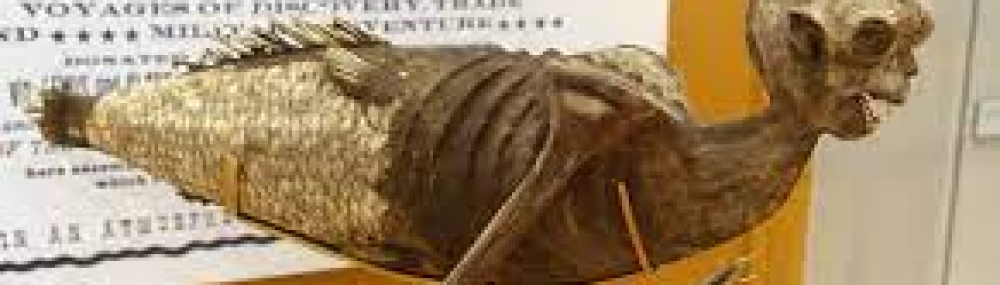
In one extreme, these real live Monsters are stripped entirely of their humanity– their individuality, their dignity. “Freak shows” are an example– the people responsible for the profits were often unpaid, especially if they were people of color, and, to the public, unnamed (The Bearded Lady, The Elephant Man)– treated as animals. In some cases, even, they become inanimate objects– the human value of respect for corpses does not extend to preserved specimens of monsters, such as these fetuses presenting Sirenomelia, preserved in the Medical Museum of Copenhagen. Preserved collections of biological specimens can be critical to studying and understanding disease. But these specimens are stored and displayed as curiosities; these prenatal humans were too strange to be buried. 1


Bringing the name of a medical condition this loaded into a short film representing a fantasy mermaid is a powerful choice. Škarnulytė portrays a graceful mermaid with a glittering tail, swimming powerfully through water barely above freezing. Her mermaid is not disabled, she is not a medical miracle, and she is not a guest on Oprah. But– she is also a monster. She operates to show us our world from a different angle– in fact, through this mermaid’s eyes, our “normal” world becomes as strange and fascinating as abnormal physiology. This defamiliarization (or distortion! 1:11) of things like satellite dishes (1:51), roads (2:43), and bridges (3:32) has a powerful effect; it allows us to bring everything to a level playing field– the human and nonhuman, the terrestrial and aquatic. Icebergs are as strange as ice-cutting ships. Trees are as strange as tunicates (3:14). From this new perspective, we see, briefly, unburdened by our associations, biases, our values, and our deeply programmed sense of “normal”. From this perspective, for a moment, we might see infants born with sirenomelia not as monsters, not as objects, but as babies, as strange and fascinating as all babies are.
Our instincts to collect, cultivate, categorize, and understand are powerful traits of our species. Those instincts are responsible for our technology. Our ability to form cultural values has allowed the unification of our societies. Our extreme sensitivity to “normality”, evidenced by the uncanny valley effect, the narrow threshold between normal and abnormal, is an artifact of remarkably powerful brains, capable of processing incredible amounts of information. Whether or not we assign positive or negative value to these human traits, we cannot escape them; they are part of being human.
However– every once in a while, we benefit from lifting those blinders; Sirenomelia is an opportunity for us to release the need to categorize, to pathologize, to separate water and air, to understand.
- What might different spiritual practices say about the fates of their souls, due to the lack of burial ritual? Undine, Melusine, and the Little Mermaid were born without souls, and ultimately each failed to acquire one. Do souls come from a pair of legs? ↩︎