Project Proposal

For my final project, I want to expand on my post about Derek Walcott’s poem about the sea’s history, and how much hold water has on human history. The original focus of my post was how it pushes the human need to utilize violence and imperialism as a land marker for human record. The sea’s ability to act as a mass that holds memory is expanded on within his poem, as well as many other works throughout our readings.

I want to expand on how the sea keeping so many of humanity’s secrets makes it something so integral to society; nature surrounds us and keep track of everything we do and do not see. Without it, we have no complete and unbiased book on what truly occurred to us, so it requires recognition, and thereby protection, from us to keep its stability possible. By tying in some of the themes of Sirenomelia and The Deep as other credited resources, it proves how versatile the message remains through the same story, told in different ways.

Discovery #2

strop on these goggles, I’ll guide you there myself.
It’s all subtle and submarine,
through colonnades of coral,

past the gothic windows of sea-fans
to where the crusty grouper, onyx-eyed,
blinks, weighted by its jewels, like a bald queen;

and these groined caves with barnacles
pitted like stone
are our cathedrals,

and the furnace before the hurricanes:
Gomorrah. Bones ground by windmills
into marl and cornmeal,

and that was Lamentations—
that was just Lamentations,
it was not History;

For this close reading, I aim to take a deeper look at Derek Walcott’s poem, “The Sea Is History”, particularly these five stanzas. In this passage from the poem, Walcott beautifully frames the ocean floor as its own cathedral or church of sorts. Throughout the poem, he uses the Old Testament and biblical references to equate the history of the slave trade with written religious History. At the poem’s climax, he finally confronts the irony and reshapes the Ocean into its own sacred place. Fusing the “natural” world with our perception of a divine and holy place. This passage exposes how Western historical education ignores the submerged history of the slave trade, placing written biblical tales on a higher plane than a physical archive of history, such as the ocean.  

In the very first line, Walcott writes, “Strop on these googles,” calling on his readers to look underwater and be witnesses to the concrete history hidden beneath the surface. This reminded me of a quote from David Helvarg we read earlier this semester, “More is known about the dark side of the moon than is known about the depths of the oceans.” Eurocentric education could utilize technology to uncover more about the slave trade, but it seems that when history reveals human flaws, it is often left buried, or rather, submerged. When Walcott uses phrases like “colonnades of coral” and “gothic windows of sea fans”, the imagery invokes us as readers to blend our religious practices, monuments, and architecture with the natural environment of the sea. Where our churches, propped up by columns and decorated with stained-glass windows, are our archive of time past and people lost. The sea is the same for the history of the Caribbean

slave trade. “Crusty grouper, onyx-eyed, blinks, weighted by its jewels, like a bald queen.” Perhaps this fish is a perfect metaphor for a decorated pope or priest. An integral part of this sacred submerged place. “And these groined caves with barnacles pitted like stone are our cathedrals.” The beauty of the sea and all it can create can be just as impressive and awe-inspiring as a human feat, such as the Notre Dame Cathedral. We count the days it took Michelangelo to paint the ceiling of the Sistine Chapel, but we do not tally how long it took for the caves to become “groined,” just like the ceiling of a church. And when we do discover information about the archaeological wonders that are sea caves, it is not added to our curriculum and spoon-fed to us. Just as the human church holds loss, suffering, and destruction within its history, so does the “sea church”. The sea also holds places like “Gomorrah”, a city of death and despair, destroyed for its sins. “Bones ground by windmills into marl and cornmeal.” The seafloor is a graveyard for more than just fish; the ocean acts as a cemetery for bodies, stores, and memories. There are bodies and items submerged that may never be discovered, but the story of brutality and cover-ups remains the same. Saltwater may erase physical evidence, but humans are the ones who tried to erase history first. When the education system fails to provide the proper setting and context for history, we are left with no concept of our impact off the land. The Middle Passage is taught as a transportation from one landmark to another, but what happened in between foreshadows all that follows on land. We can dig into the sparse historical accounts of the brutal, long journey, but we know that the voices drowned and all the stories silenced by pure fear are lost to history. If we can see the ocean as a physical archive of history, we could unravel the secrets hidden beneath layers of Eurocentric perspectives and written historical education.

As much as Walcott is calling on us to reframe our perspective of the ocean as a museum, literally, he is also calling us to dive into history itself. To determine the truth that lies beyond the surface of the written page. After all, there is heaps more history beyond the Bible and the moral lessons it holds. “And that was JUST Lamentations, it was not History.” This line packs the punch in this passage and really calls us to question everything we think we understand about history. In this line, we are reminded that just because something is written or material does not make it fact. With 8 years of catholic schooling under my belt, I’m no stranger to biblical texts being used as a tool for justification, as if it were almost scientific. I was taught about the stories of the Bible in a linear timeline that felt like a history class. And even in my history classes, the history of land and more importantly, “holy land” was presented as the cornerstone of my catholic education. I know that there is truth to these biblical stories just as much as I know they are riddled with myth, as I do with the environmental literature we have discussed in this class. I do believe that stories of sea creatures may be just as accurate as stories about turning water into wine. In reading this poem, I began to see the ancient stories of mermaids, sirens, and other hybrid seafolk as a kind of bible. A way to frame oceanic history through human writing. A more accessible or comprehensible way of understanding the environment that takes up over 70% of our globe. If we read these stories as cautionary tales, as we see in the Old Testament, they can also serve as a tool for teaching history. Noticing the myths and natural environment as historical truths or sites is of utmost importance.  

Overall, this group of stanzas from Derek Walcott’s Poem, “The Sea is History,” urges us to view history as more than what is written. To see the sea as a literal and metaphorical holder of earasaised histories. By illustrating the ocean as both sacred and dismal, he challenges harmful Western narratives that silence a time and place in history. This passage illuminates the fact that cherry-picked colonial historiography dictates U.S. education, ignores essential stories, and promotes a false collective memory of the slave trade.
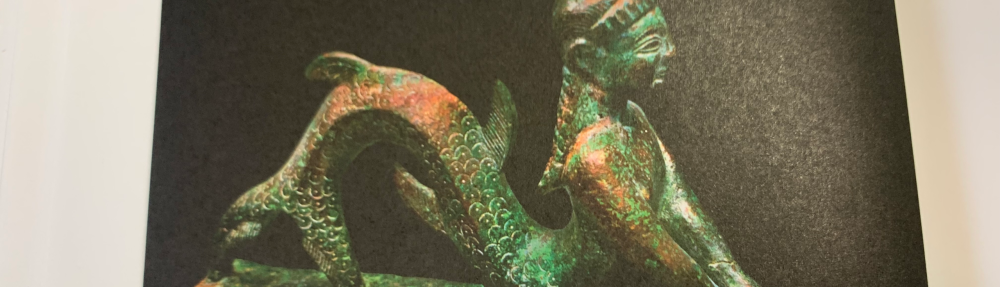
Sacred Texts, Silenced Histories in “The Sea is History”

Derek Walcott’s “The Sea is History” uses biblical structure not simply as a stylistic choice but as a critical framework for analyzing how Western powers recorded, interpreted, and ultimately controlled history in the Caribbean. Walcott’s references to Genesis, Exodus, the Ark of the Covenant, and Lamentations reconstruct a familiar Christian chronology. However, he fills each biblical moment with the events of colonialism, slavery, and cultural destruction. By structuring the poem as a distorted biblical timeline–moving from Genesis and Lamentations–Walcott critiques how colonial and Christian narratives have overwritten indigenous and African histories. Walcott’s poem, therefore, functions as an intervention by exposing how written, Christian-based historical frameworks directly displace Indigenous and African histories, and it offers a counter-history rooted in the physical realities of the Middle Passage and its aftermath. 

Walcott begins with a direct challenge to Western conceptions of historical legitimacy. The opening question–“Where are your monuments, your battles, martyrs? / Where is your tribal memory?” (lines 1-2)–is phrased like an interrogation from a European authority. It represents the Western assumption that history must be preserved through monuments, documentation, and written evidence. This logic mirrors the structure of the Bible, which Western culture often treats as the ultimate historical archive because of it being a chronologically ordered, text-bound account that certifies a people’s origins. This implied standard resembles the injunction in Deuteronomy to “remember the days of old; consider the generations long past. Ask your father and he will tell you, your elders, and they will explain to you” (32:7), a command tied to written and genealogical record-keeping. The speaker’s answer, “The sea. The sea has locked them up. The sea is History” (lines 3-4), directly opposes this definition. Walcott establishes that the history of the Caribbean cannot be found in the forms that Western historians value. It exists in a different medium that isn’t writing, but the ocean, which holds the remains and experiences of enslaved Africans. This distinction sets up the poem’s argument. Walcott is not simply describing memory; he is identifying the limits of Western archival practices and showing that those limits contribute to the erasure of Caribbean history. 

The poem’s movement into “Genesis” (line 9) marks the first of Walcott’s revisions of biblical narrative. Instead of the creation of the world, “Genesis” becomes “the lantern of a caravel” (line 8), referring to the arrival of European ships. By replacing the biblical origin story with the beginning of colonial intrusion, Walcott critiques how the West positions itself as the starting point of civilization. His revision exposes that what the Bible names as the beginning of life, Caribbean history names as the beginning of violence. This substitution is analytical, not metaphorical…Walcott demonstrates that colonial and Christian frameworks do not describe Caribbean reality accurately. Instead, they replace local histories with European interpretations of beginnings, origins, and meaning.

Walcott’s next biblical reference, “Exodus” (line 12), continues this critique. In the Bible, Exodus recounts the liberation of the Israelites from slavery. Walcott’s version is the opposite. He describes “the packed cries, / the shit, the moaning” (lines 10-11) in the holds of slave ships. Rather than liberation, this “Exodus” represents enslavement and forced displacement. This reversal directly critiques how Christian narratives were used historically to justify colonial domination. The enslaved were taught a biblical story about freedom while experiencing the complete denial of freedom. 

The reference to “the Ark of the Covenant” (line 16) continues this rewriting. Traditionally, the Ark symbolizes divine authority and continuity. Walcott’s description–“Bone soldered by coral to bone” (line 13)–places the Ark underwater, made of the bodies of the enslaved. This is not a poetic flourish; it is a direct critique of how Christian symbols gained authority in the Caribbean at the expense of African and Indigenous cultural memory. The new “Ark” is not divine but historical because it records the violence that Christian frameworks either ignored or sanitized. Walcott uses the Christian symbol to show how Christian narratives displaced the cultural and spiritual structures of the enslaved. The biblical reference allows him to highlight a specific historical process: the substitution of African cosmologies with the Christian doctrine. 

When the poem reaches “Lamentations” (line 49), Walcott emphasizes destruction and mourning. The biblical Book of Lamentations recounts the fall of Jerusalem, but Walcott’s version refers to the repeated devastation of Caribbean landscapes through both natural disaster and colonial exploitation. The line “that as just Lamentations, / it was not History” (lines 50-51) is so important. Walcott critiques the way Western narratives treat colonial suffering as incidental, marginal, or irrelveant ot “official” or “real” history. Lamentation, in his framing, is not part of recognized history because it does not appear in Western archives. The poem, therefore, distinguishes between written history, which reflects the perspective of colonizers. And lived history, which reflects the experiences of the colonized.

One of the poem’s clearest critiques of Western archival practices appears in the lines, “but the ocean kept turning blank pages / looking for History” (lines 24-25). The “blank pages” indicate the absence of written documentation of the experiences Walcott is recounting. The Atlantic slave trade produced no journals written by the enslaved, no monuments created by them, and no records preserved in their voices. Walcott uses the image of a blank page to explain how Western standards of documentation create historical gaps. If writing defines what counts as history, then the lives of those denied literacy, citizenship, or authorship become invisible. The poem argues that Western historical frameworks erase history not because the events did not happen, but because they were not recorded in the medium that the West values. The poem ends by asserting that history “really” begins not in Western writing, but in the ongoing struggle to recover suppressed voices. This is Walcott’s final critique…the biblical timeline he has revised shows that Western frameworks dictate beginnings, endings, and meaning in ways that erase non-Western histories. By rewriting scripture, he exposes this erasure and replaces it with a historically grounded alternative. 

Week 12: A Place of Untold History

There is bond between humanity and nature that is unfortunately unable to be told by either side. It either leads to biased opinions or beliefs from humans, or just information that is simply not able to be processed by humans. Despite this lack of information, there is a way that humanity can connect with all forms of life that have existed since the early formation of the planet, and that is the Ocean. In Derek Walcott’s poem The Sea is History, it tells about significant moments in time as well as scripture and how it is all tied with the environment through the sands, the tides, and the marine life. Now while history as we know it is respected and continues to be so, there is without a doubt history that was undocumented; a perspective from the people that did not have the privilege of writing down information nor accounts from their point of view leading to certain events being forgotten or lost in time.

Connections between the imagery of ships, artifacts, and events in the bible referenced by Walcott are made to showcase the undisclosed chronicles of the people that were traded and shipped overseas to places against their will,

“as the white cowries clustered like manacles
on the drowned women,

and those were the ivory bracelets
of the Song of Solomon,
but the ocean kept turning blank pages” (Line 20-24).

While history can be altered and is subject to change over time with more and more information being revealed by historians, there is no denying that there is truly no way of certifying past events truthfully, but this very statement then leads to the question of what is considered factual history and what is not? If one were to answer this from a colonialist point-of-view, there would be no denying that documented historical accounts are sacrosanct leaving very little room for other perspectives (i.e. opposing views). If this is the universal rule in regards to history, then where does that leave the history that was never written down, the history that was erased, and the information that was not believed to be true? The medium between what is believed to be true and what is believed to be fabrication is the environment and as mentioned by Walcott, “The sea. The sea has locked them up. The sea is History” (Line 3-4). To the countless number of people that have been forgotten in time, to the honorable and the broken, there is no other representation of their troubles and background, other than the environment and whether or not some may not consider it, the history is there in the waters, and it can’t be erased.

The War of the Water

Derek Walcott’s poem The Sea is History rounds out a really beautiful image that was begun by the first short film we saw, Sirenomelia. They both utilize the ocean in such an intricate way to point out human emphasis on violence as something of value, rather than destruction.

His opening of the poem, asking the sea, “Where are your monuments, your battles, martyrs?” (Walcott, line 1) reflects so much more than just his question as to why the ocean isn’t appreciated. The questions feel somewhat rhetorical, that there’s nothing to memorialize the ocean when it does so for itself. It stretches on for miles and miles; so much of this never ending mass existed long before human record, or humans themselves, did. It is his choice of wording though, that seems to trigger this idea of more than just being about the sea’s need to be recognized for its totality. He asks about monuments, these statues and physical representations of what once was in order to be faced by every following generation for its bravery; he asks about battles and martyrs, these incredibly discussed and revered objects of discussion because of their sacrifice. All of it though ties together when analyzing all of the terms base themselves in violence, in war-like imagery.

Monuments of the modern day often depict leaders of military, or political figures who incited some sort of change that often resulted in violence because of the overwhelming resorting measures to it in our culture. Battles are the most obvious, with the heavy denotation towards wartime activity, with martyrs often being seen as those involved in these battles. Relating these images, of what society often describes as frightening and gory when looked at in the present tense, to something as gentle and peaceful as the sea creates this greater comparison of how society views appreciation. It ties itself to violence; we crave it to prove our superiority and simultaneously, our appreciation for it. In order to truly be seen as an object of affection or of worth, we must prove we’re worthy through our ritualistic behavior.

This emphasis we place on it additionally seems to prove the reason that Walcott must ask the question at all: the way we view the ocean is the main reason we do not consider it an incredible source of life. In describing it as this peaceful and beautiful place, in the phrases we use of its gentle ebbing and flowing, it becomes associated with this antithesis of our culture demand for aggression. It cannot be fathomed that the ocean is a valuable part of day-to-day life and habit if it does not revolve around these primal needs to prove dominance over the rest of the beings on our territory. In order to ever have a place, it must be a part of this torturous ideal; it must carve out its name in death.

The Sea Records

In the poem, “The sea is history” by Derek Walcott as the title says is about how the ocean carries a rich history. Specifically of the slave trade, of those who were carried over the sea to a new land by force. Of those who did not make it. From the very first few lines, Walcott empathizes the identity of those people. Those who suffered making it across and from those who couldn’t.

Where are your monuments, your battles, martyrs?
Where is your tribal memory? Sirs,
in that grey vault. The sea. The sea
has locked them up. The sea is History.

This first passages in a way speaks more on their culture and identity than any historical account could. Setting the tone of the poem that this isn’t simply a tragedy because slavery was awful. Or even why it happened. It laments the true tragedy that the culture, identity, and memory of those who suffered during the slave trade have been ignored in historical accounts. In the way people learning/reading about them only see it was tragic. Not of who they were. As written in these lines below.

and that was Lamentations—
that was just Lamentations,
it was not History

What these lines mean is the historical accounts are focused not on the slaves themselves. Which is why in the poem’s beginning lines Walcott wrote how the sea recorded their true history. Keeping it in locked for those who wish to dig deeper.

What Lies Beneath: The Meaning of “The Sea Is History”

In “The Sea Is History,” Derek Walcott transforms the ocean into a living archive of colonial trauma and suppressed memory by using biblical allusions to explore how the histories of enslaved and colonized peoples have been submerged beneath the surface of Western historical narratives. Through his own reworking of Genesis, Exodus, and other scriptural imagery, Walcott suggests that the sea holds not only the remains of the dead but also the spiritual and cultural foundations of a displaced people. His poem argues that history–the true and honest history–exists not in monuments or written records, but in the depths of the natural world, where human suffering has been both concealed and preserved.

The poem’s opening question, “Where are your monuments, your battles, martyrs?” (line 1) mimics the authoritative tone of a historian demanding evidence of a civilization. The speaker’s response, “in that grey vault. The sea. The sea has locked them up. The sea is History,” (lines 3-4) reverses this expectation by locating history not in material ruins but in the immaterial, unfathomable depths of the ocean. The repetition of “The sea. The sea” echoes like waves, grounding the poem’s mediation in the physicality of the natural world while highlighting its function as a repository or memory. When Walcott later writes, “Bone soldered by coral to bone, mosaics mantled by the benediction of the shark’s shadow,” (lines 13-15), he fuses the sacred with the violent. The “mosaics” and “benediction” evoke religious sanctity, yet the imagery of bone and shark transforms the ocean floor into a brutal cathedral built upon human suffering.

By structuring the poem as a distorted biblical timeline–moving from Genesis to Lamentations and the New Testament–Walcott critiques how colonial and Christian narratives have overwritten indigenous and African histories. The biblical framework becomes a way of reclaiming sacred language to tell a different kind of origin story, one that is rooted in the Middle Passage and the resilience of the oppressed. When he writes, “as the sea’s lace dries in the sun but that was not History, that was only faith,” (lines 64-66), Walcott emphasizes the fragility of liberation and remembrance, suggesting that official accounts of emancipation fail to capture the depth of lived experience.

Ultimately, Walcott’s poem insists that the ocean’s silence is deceptive–it is not empty but resonant, containing the echoes of every lost voice. Through the sea, Walcott redefines history itself as an act of remembrance and resistance.

The Grey Archive

In Derek Walcott’s poem “The Sea is History” there is a conversation within the poem that analyzes the concept of origin stories and what is marked a history as opposed to myth. What is considered history is framed in terrestrial markers by the speaker of the question at the beginning of the poem. The question is answered with elements of the reoccurring concept in our mermaid readings of the below surface ocean being a locked up and restricted place, but the poem will unlock that history that has always been there. While the themes of religious myth work as an entry point for comparison Walcott blends the events that happened on and within the ocean to link the land events that was remembered in the ocean. Walcott brings History as being measured outside the confines of imperialist definitions.

What stood out to me was his play on language with the ocean creatures and oceanic elements carrying double meanings to aid in the historic importance of the ocean. He links oceanic terms to the terrestrial, bringing balance and attention to a connection the terra-dominant language typically denies. Lines such as “the white cowries clustered like manacles on the drowned women…”. Yellow cowries (on land) were used as a shell money in Africa (“cowrie”). Being made into manacles also known as handcuffs, references the enslavement of African people who were monetarily measured in their worth to the system they were violently dragged in to.

The designation of “white” cowries, carries with it the meaning of the monetary price placed on black African people enslaved by white (European/imperialist) forces. As Walcott characterizes the sea as grey, it brings not only imagery of the ocean in stormy conditions but of the result of the colors of black and white combined together. This not only holds the meaning of the acts witnessed by the ocean, but integrates the ocean into being part of the human experience, not just the other or a setting.

Work Cited

“Cowrie.” Encyclopædia Britannica, Encyclopædia Britannica, inc., www.britannica.com/animal/cowrie. Accessed 8 Nov. 2025. 

Walcott, Derek. “The Sea Is History.” Poets.Org, Academy of American Poets, 28 Mar. 2025, poets.org/poem/sea-history. 

Week 12: The Ocean as Archive

 Enslavement of the African people and colonization of the Americas took place during what is described as the ‘rebirth’ or the peak of Western European civilization, the Renaissance. It is omitted from History or purposely emphasized as two separate entities of human cultural movements. The exploration of the seas, the discovery of the Americas, enslavement and massacre of indigenous Americans, and the forced enslavement and commodification of Black Africans occurred at the same time that all these civilizations were experiencing a strong rebirth in culture, that were the result of complex and intricate organizations of cities and kingdoms. However, the European perspective of history can only attest to its own grandeur.

Derek Walcott reminds us of this in ‘The Sea is History’ when he links the movements of the middle passage, the Transatlantic Slave Trade, to a period highly regarded as the scientific, artistic, and architectural overhaul of European culture:

“but where is your Renaissance?

Sir, it is locked in them sea-sands
out there past the reef’s moiling shelf,
where the men-o’-war floated down;

strop on these goggles, I’ll guide you there myself.
It’s all subtle and submarine (lines 33-38)”

A civilization underwater is a byproduct of the atrocities committed against black bodies on a crowded cargo ship, which, like we saw in Gabrielle Tesfaye’s short film “The Water Will Carry Us Home,” readily disposed of unwanted bodies in the waters of the Atlantic: children, pregnant women, the sick, the dying, or dead.

The ocean represents the history stripped from the people that were conquered and enslaved, a massive interruption and erasure of the written and oral histories of multiple cultures, and the disappearance of their people. Walcott shows us a culture carried down to the depths of the ocean, a history as distorted as our vision underwater, of which we need goggles to see better.

This poem, which repeatedly tells us what isn’t history, until nations are organized, which is history, makes us question the validity of History. Why are certain events omitted? Why do some histories count but others do not. Is there a danger in verifying that while millions of people were forced across the middle passage, and thrown into the ocean, and the survivors forced into harsh labor; that Europeans were luxuriating in what slavery and colonization had to offer: raw materials, sugar, gold, silver?

Under History, our legacy and contribution to the world did not exist until the moment everyone arrived on solid land and worked for one crown or another. What is taken from us when history is viewed from this lens but proof of our existence on earth: our lineage, our story, where and who we come from. What was experienced in the water is erased by History, but is witnessed by the Ocean and the ones buried in “that grey vault, the sea,” and there is still more to learn and recover.