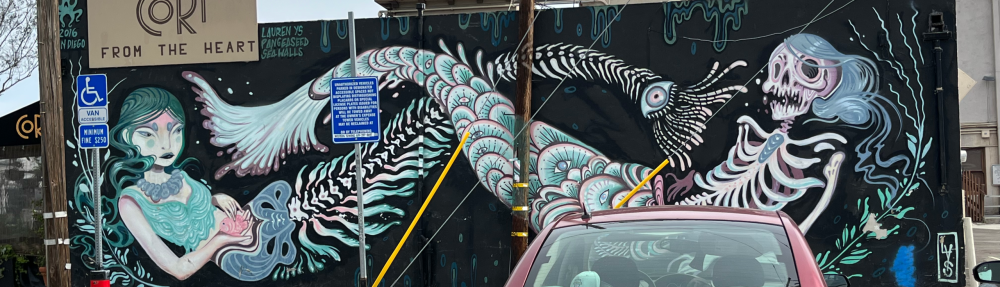
Lebey is extremely playful in his interpretation of the story of Melusine. As Raymondin is approaching his wife during the culmination of his betrayal, Lebey describes “He slid slowly forward… And in the moonlight that made his coat of mail glisten, he had the appearance of a strange serpent with iron scales.” How ironic, this image of Raymondin, serpent-like, slithering towards his own despair. Here, our author coils around the infamous, biblical origin story of human sin. Maybe Eve bit the apple, but Adam was the snake. Lebey continues to meander this inverted narrative in the next chapter. First with the reversal of the typical mermaid narrative: “Deceived, as women are and always will be, by your handsome body, your honest face, your sweet appearance, I did not suppose you capable of treason…” Contrary to mermaid lore that focuses on the human’s narration, Melusine’s point of view upends the lure of the beauty of the hybrid. To Melusine it is Raymondin who lured her in with his stoic stature, his handsome innocence. Digging deeper, giving a voice to Melusine not only upends the typical mermaid lore, but transposes the legend of Adam and Eve. “If you had not broken your word” Melusine tells Raymondin “I could have remained in this world and been saved from torment and misery in the other.” The notion of women blaming men for eternal damnation is a role reversal of sin. Lebey’s reimagination of the story of Melusine is an upheaval of man’s dominion. The depiction of unruly nature, the serpentine likeness of Raymondin, the sensual luring of Melusine, the interpretation of betrayal. All contribute to dislodge the concept of man’s supremacy. Lebey plays with the contortion of societal narrative. After all, this is a time for social reform. The Parisian lost generation of the post-war 1920s, struggling to find their footing on a war-torn continent. Lebey takes a story used to assert the lordship of men and instead tears down their dominion.
Maybe Eve bit the Apple, but Adam was the Snake
1