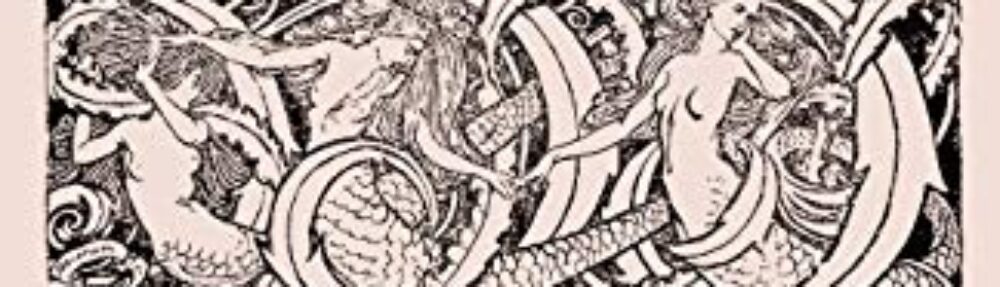
Christianity meanders its way through mermaid stories like an unrelenting river, unbothered by obstacles as large as mountains or as abrupt as fallen trees. The river of Christianity carries poisonous fresh water to powerful salt-laden mermaids, brackishly destroying their environment to favor its own. Crushing their spirits, but wait, they have no spirits. The overt portrayal of mermaids to want, no, to need a soul is like a sodden Stockholm syndrome. By picking up where Undine and Melusine left off, Hans Christian Andersen’s terracentric language in his reiteration of a lack of an afterlife in “The Little Mermaid” perpetuates man’s dominion over nature.
The stories of the relationships between water deities and noble men use the guise of love to convey the superiority of humanity. The little mermaid wants to enter the human world to be with her prince, but more than that, she would give up everything for one human day “to have the hope of sharing in the joys of the heavenly world.” Andersen escalates the message we learn from Undine by reiterating the ascent to heaven: “a soul that lives eternally… even after the body has been committed to the earth— and that rises up through the clear pure air to the bright stars above! Like as we rise out of the water to look at the haunts of men, so do they rise to the unknown and favoured regions, that we shall never be privileged to see.” (118) In the case of the little mermaid, Undine, and even Melusine it is not love that they are truly after, it is a soul; a pure eternal existence that is thrust above love. This supports a modern Christian’s school of thought: getting into heaven is more important than earthly love.
What distinguishes the air of superiority of man over nature is the language that Andersen uses. He describes the “clear pure air”. The air not only clear but pure. Pure and heavenly, but also pure as in unmixed. Unmixed, non-hybrid humans that can ascend to heaven. This is a clear message that breathing air, living on land is preferable than being in the ocean where the sea-folk dwell. Andersen also categorizes the deep as clear, “clear as the purest crystal” in fact, but it is the crystal that is pure, it is not pure within itself, it is not untainted by immorality as the air is. The water is mixed up, salty, contaminated and filled with hybrid, mixed creatures, where land is filled with the “haunts of men”. It is the soul that does the haunting. This precise choice of the word “haunts” gives men souls, it gives the beings above the water superiority. Andersen goes on to explain the ascent is into a “favoured region”. No matter how beautifully the ocean is presented, it is not the favored region, not compared to what is above it, and what is above that. Why is upwards always better? Because the higher you go the closer you are to heaven; and the lower, to hell. And who lives in the lowest region of all? It is not unlike the portrayal of maps. Pre-dominantly white nations/continents laid above. The favored regions, the above, have the right to conquer what is below, whether it be land or sea. Describing upward as a favored region gives men dominion to all below them. It is interesting then, that the notion of heaven, that a claim to what is above in turn gives claim to what is below. This language: “pure air”, “haunts of men”, and “favoured regions” though not earthly in a sense, is terracentric because it advocates land over the sea.
Although this is the first story that actually gives us a visual of merpeople, their culture, their architecture, their familial relationships, even their hopes, wants and dreams, the fact that they are still missing a soul, and are yearning for heaven is a greater acclamation for superiority. That the little mermaid is willing to leave her beautiful home and her whole family behind in the sea to become foam, so she can live eternally in heaven promotes Christianity’s claims to the earth. Genesis 1:26 asserts man’s dominion, stating “…and let them have dominion over the fish of the sea, and over the fowl of the air, and over the cattle, and over all the earth…” It is clear for men that they have dominion over birds, cattle, and land. But the ocean is a mystery. It is a mystery now, it was Mars 200 years ago. How could Christianity advertise their claim of a realm they knew almost nothing about, not even a fraction of what lived there. Merpeople were their answer. Depicting hybrid humans who could express a desire for a Christian soul and a “pure” immortal life finalizes the terms in Genesis 1:26. From a stone carving of a split tail mermaid, silently attempting to warn of heathenism and immoral women, to centuries later, spun into tales of earthly dominion. Mermaids: a true test and showcase of Christianity’s subservient, authoritarian followers.
It is not just the moral of the little mermaid that perpetuates the need for heaven, or the above over below, it is language. Steve Mentz puts forth the idea that terracentric language guides our way of thinking about our environment. Readjusting earthly phrases will help propagate a fonder outlook on the watery parts of our world. I would like to elevate this notion and claim that terracentric stories further influence our perception on the environment and its functions. “The Little Mermaid” has been adapted numerous times. But what we really need to be able to tear down the Christian colonization of the ocean, is not a mermaid story but a human story. In other words, not a story where a mermaid discovers and yearns for our world. A story where a human yearns for the mermaid’s world, decentralizing the Christian concept of humanity’s dominion over land and sea.