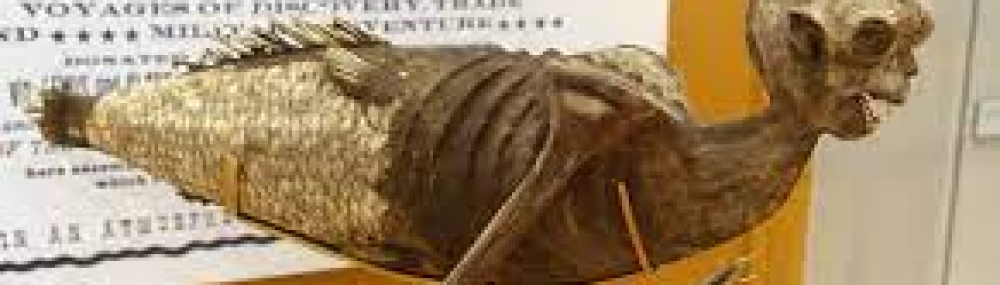
Merpeople, specifically mermaids, have been known to be seductive sea monsters who lure sailors to their death, and that has well founded symbolism in of itself. Yet there has also been depictions of merpeople that are valued for the knowledge they bring to humans. This dichotomy of symbolism of sea creatures is beguiling and nonetheless makes sense. In The Penguin Book of Mermaids introduction, Christina Bacchilega and Mari Alohalani Brown explains “that everything we need to survive, in one way or another, depends on water, it is unsurprising that peoples across place and time have ascribed religious significance to water and developed water symbolism” (xiv). In light of this it is clear that these crosscurrent myths would have their own symbolism not just for water but for the creatures that live in it. Focusing on the merpeople whom are valued and symbolic of knowledge, myths such as “Oannes” and “Odysseus and the Sirens” depict such symbolic knowledge and concurrently portray water spirits in different lights.
“Oannes” is described as something of a messenger of knowledge, a god that educates humans; the deity was something that was praised and attractive in its mythology. Oannes knowledge and education consisted of “convers[ing] with men; but took no food at that season; and he gave them an insight into letters, and science, and every kind of art […] so universal or his instructions, nothing material has been added by way of improvement” (4). In Babylonian mythology Oannes, whether he be a messenger or a god, was not feared but revered for what he gave humans. He came to the humans and gave them his knowledge without wanting or needing anything in return. Now in Babylonian culture water often symbolized the potential for creation and order, and Oannes is an exemplary folktale of such symbolism. A literal entity that brings the humans of Babylon order and civilization amongst their chaos.
In Homer’s Odyssey, the Sirens in all technicalities are thought to be seductive, though surprisingly their alluring song is not one of destruction but one of wisdom. The book explains that “Odysseus is subject to erotic temptation more than once in the course of his homecoming, but the Sirens’ lure is of a different kind. Homer Sirens’ sing a song that promises knowledge— a wisdom that bridges worlds— instead of pleasure” (10). Thus, these sirens may be stereotypically the “monsters” originally thought to be, yet in reality they wish to provide Odysseus with a different point of view on life. Just like Babylonian mythology, Greek mythology water is symbolic of creation and transformation, The sirens knowledge may not be one of facts or educating on order, but they want to get Odysseus to stay and learn from the wisdom they have to give.

