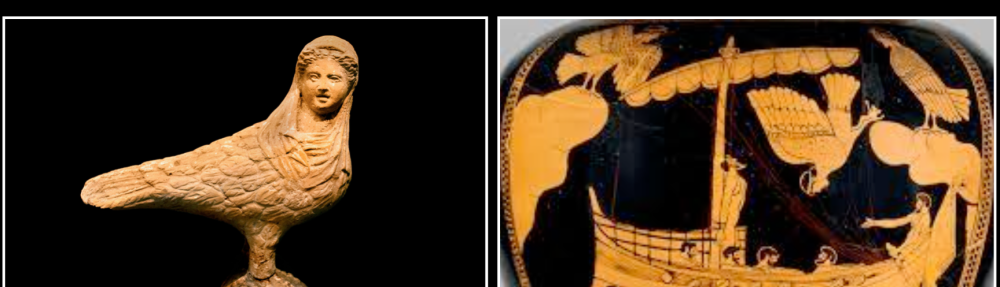
Mermaids have been used throughout literature as a reflection of ourselves, and how we connect with our environment, whether it is to fear or desire it. In the story of “The Day after the Wedding” Undine by Froque explores the idea of who has the privilege of attaining a soul and who doesn’t. The tale along with other mermaid stories such as The Little Mermaid by Hans Christian Andersen, have strong tones and themes of Christianity, which entails that humans and their connection to religion somehow makes them more superior than other living beings. There is such a distinctive line between humans and their desire to separate themselves from nature, and religion more specifically Christianity is used to thicken that line, creating a boundary.
In “The Day after the Wedding” from Undine the story opens up with a light, dreamlike quality. The lovers are entwined in bed, yet there are feelings of distress from Huldbrand as he has experienced a nightmare of spectres disguising themselves as beautiful women. This foreshadowing points towards Uldine and her hybridity, being human-like in her beauty and appearance, but a water spirit by nature. People are enamored by Undine for “the young wife seemed so strange to them yet the same (pg. 102.)” Her other-worldiness is apparent to others, and Undine responds to the people with an overwhelming amount of gratitude.
Undine is characterized to be a vivacious woman, who is bright, bubbly, and unpredictable. Her emotions flow and are expressed freely similarly to how water moves without restraint. After her marriage with Huldband, importantly a Christian man, she becomes more aware of her unruliness and of social norms. This process of assimilation occurs through Undine’s union with a human man, subduing her original qualities that are representative of natural elements. Strong Christian themes are sprinkled throughout the story, especially when the priest is the first one to greet her “with paternal affection beaming in his face” during the ceremony Undine apologizes to him profusely and “begged him to forgive her for any foolish things she might have said the evening before” asking him to pray for the welfare of her soul (pg. 103). This transaction between the fatherly-like priest and Udine paints her newfound connection with God as one of his new children, atoning for lack of religious connection before. When conforming herself due to the marriage it is shown as she is described to be attentive, quiet and kind throughout the whole day, those who have known her longest expected her capricious spirit to burst through at any moment, but it never came (pg. 103). This transition from her being a free water spirit to becoming an idealized traditional Christian wife is shown as she becomes more bounded to religion.
Furthermore, religion is especially used to create a boundary between humans and the environment as Udine goes on a long soliloquy expressing her true identity as a spirit. These elemental spirits appear like mortals; they are described as even “more beautiful than human beings” and even far superior than the human race. Despite being superior they contain no soul, which is considered to be an evil peculiarity (pg. 105). This idea that these environmental spirits that are well connected to nature not containing a soul, pushes the narrative that humans are superior to the environment because of their involvement with religion, with God. It is not unless an elemental spirit is wedded to a Christian human that they are able to attain a soul, the concept of a soul is to be immortalized for eternity even beyond life on Earth.
The line drawn by religion between humanity and the environment is thickened when the story continues to unfold. Despite Undine’s assimilation to the human world, marrying a Christian man, subduing her original personality to be more palatable, and going as far as attaining a soul she is still eventually betrayed and cast aside by Huldbrand. Huldbrand ends up falling for Bertalda because of their shared commonality of being human. Even after all of Undine’s efforts of conformity and Christianization, she is monstrified by the people and is accused as a “witch who has intercourse with evil spirits.” The tale is a reflection of religion being used to demonize wildlife despite us being a part of it.