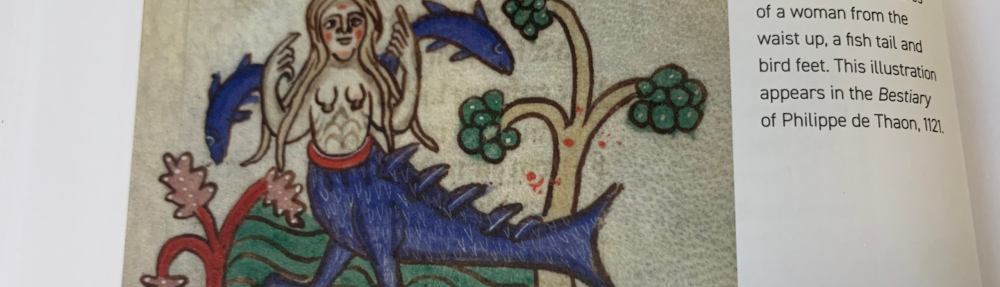
This week’s reading of Melusine “Departure” made me think about the innate human desire to cave into temptation, seeking answers to our curiosities, and how it sometimes results in our loss of innocence. The chapter “Departure” shows distinctive parallels between a well known creation story, Adam and Eve. The story of Adam and Eve is set in a paradise-like setting, a garden filled with harmony and pure bliss. The couple’s innocence shatters due to their disobedience to their creator, rendering their realities forever-changed and negatively altered. Similarly, Raymondin and Melusine live in the comfort of their noble walls, a kingdom in which they are protected from the outside world. It is Raymondin’s curiosity that leads the couple to their tragic fall, “he, through his curiosity, she, without it being her fault, by her very nature. And he no doubt threw the fault on her, and she told herself that they would still be happy but for his cursed curiosity” (142). Raymondin heavily projects his wrongdoings onto his wife, and breaks a promise that disrupts their routinely peace and innocence.
Despite all of his begging for things to remain unchanged, to continue to live with each other, the damage is irreversible. “God, this same God, does not permit it” Melusine exclaims, which ties back to the Christian re-framing of this story. Even though Melusine forgives her husband, she implies that God does not- for he broke his promise to her in front of his people and has made his initial wrath and disdain known. With my limited knowledge of Christianity, “The Romance of the Faery Melusine” by Lebey reads as a cautionary-tale of what it means to let our suspicion blind us from our morals. Suspicion is a sin, one in which Raymondin acted on to fulfill his desire of the unknown. Humans and their natural desire to seek what they cannot, even if that means jeopardizing their wealth, well-being, and marriage truly shows how powerful our want to be in control is. It makes me wonder if the love that Raymondin claimed to have for Melusine, was more of a desire to control her. And when her true form was revealed, Raymondin might’ve been more upset at the loss of the illusion of control more than her being a hybrid.
Great point here, and one that I am eager to hear more about: ‘It makes me wonder if the love that Raymondin claimed to have for Melusine, was more of a desire to control her.” Perhaps we can ask this question tomorrow, from the perspective of our class subject matter– lit and the environment– to consider what this story is telling us about man’s desire to control her (Melusine and nature). Nice work!
Hi Salinas. I also saw a lot of similarities between this chapter and the story of Adam and Eve. I find it interesting that it is the man’s curiosity that is the downfall of the couple rather than the women’s. I really like your last sentence, that Raymondin was more upset at the loss of his control than her hybridity. That seems to be true considering how readily he tries to mend what he just broke by sneaking into her room. Is Lebey trying to show us that God is the only one in control? Since even though Melusine and Raymondin want to forgive each other and move in, God does not permit it.
That quote was such a huge one Salinas! I’m glad you’re talking about it. Also, your takeaway is put so well– “Humans and their natural desire to seek what they cannot, even if that means jeopardizing their wealth, well-being, and marriage truly shows how powerful our want to be in control is.” Curiosity= need to control! that crazyyy
Hi Salinas!
I loved your post on our reading this week! You had such great insights and something that stood out to me was when you said that its “a cautionary tale about what it means to let our suspicion blind us from our morals“. I absolutely loved that you pointed that out in that way. Pointing out how things can blind us from whats right in front of us. It really makes us think about our own lives and decisions. Great post!