Final Project Proposal

I am going to write Pip into The Deep by Rivers Solomon. I believe that Herman Melville purposefully delivered Pip to his ancestors in Moby Dick. I can’t stop thinking about the intersection of Pip’s soul lost to the Antilles and the wajinru from the Deep.

Thesis:

In creating a safe space for the descendants of the Middle Passage, The Deep and its predecessors clipping. cultivate a sense of belonging for people whom have lost their terrestrial ties. No longer being tied to their old land and unwelcome in their new, History for descendants of the Middle Passage is easily alterable and erased. Using the ocean as an archive and rebirth gives a voice and reorients descendants that were once victims of an attempted erasure. Including Pip, a free working class American, into the narrative of The Deep adds a layer of connection to the descendants of the Middle Passage.

Project Proposal

For my final project, I want to expand on my post about Derek Walcott’s poem about the sea’s history, and how much hold water has on human history. The original focus of my post was how it pushes the human need to utilize violence and imperialism as a land marker for human record. The sea’s ability to act as a mass that holds memory is expanded on within his poem, as well as many other works throughout our readings.

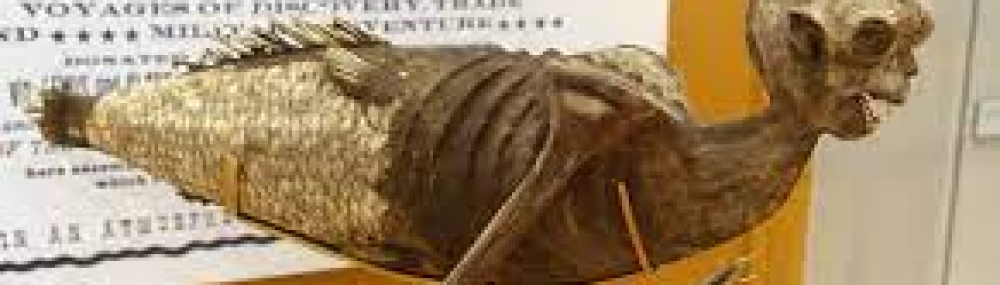
I want to expand on how the sea keeping so many of humanity’s secrets makes it something so integral to society; nature surrounds us and keep track of everything we do and do not see. Without it, we have no complete and unbiased book on what truly occurred to us, so it requires recognition, and thereby protection, from us to keep its stability possible. By tying in some of the themes of Sirenomelia and The Deep as other credited resources, it proves how versatile the message remains through the same story, told in different ways.

Final Project Proposal

For my final essay, I plan to expand my Discovery 1 about The Romance of the Faery Melusine by Andre Lebey. In my first essay, I focused on how the story reveals humanity’s fear of nature and the desire to control what cannot be fully understood. For my final project, I will develop this idea further by connecting it with Helen Rozwadowski’s Vast Expanses: Introduction: People and Oceans. Using Rozwadowski’s discussion of how humans turn the ocean into a concept shaped by knowledge and power, I will explore how Lebey’s portrayal of Melusine reflects the same human impulse to dominate and define the natural world. My essay will analyze how both texts show that human curiosity often becomes a form of control, turning nature, from the sea to the supernatural, into something that must be explained, contained, or destroyed.

The Rebirth Beneath the Waves

In The Deep, chapters 8–9, the part that stood out to me was the scene where Yetu and Oori meet again at the end of the story. The line, “She did not transform in the way wajinru pups transformed in the two-legs’ bellies. She didn’t grow gills or fins, but like Yetu, she could breathe both on land and in the sea. She was a completely new thing.” I thought this moment shows how the story connects memory, pain, and love to the idea of becoming something new. Oori doesn’t just change into a wajinru, she becomes a bridge between two worlds, land and sea, human and ocean. Through her, I think it shows that transformation can come from understanding and connection, not just survival.

I also liked how this scene turns the ocean from something dark and heavy into something peaceful and full of life. When Yetu invites Oori “into the dark, into this world of beauty,” the darkness doesn’t feel scary anymore. It feels calm and comforting, like the deep sea itself. I think this shows how Yetu learns to see her memories differently, not as pain, but as something that gives her strength. I thought the water became a symbol of healing, where remembering is not a burden but a way to live more fully. Another part that I found interesting is how Oori can breathe both underwater and on land. It feels like a metaphor for balance, between past and present, pain and peace, self and community. It made me think that being “a completely new thing” means not choosing one identity, but accepting both.

For me, this ending reminded me that healing means carrying the past with us, but letting it shape us in a softer way. Like water, memory keeps moving and changing, but it also gives life. In this way, I thought The Deep ends not in tragedy, but in rebirth, where Yetu finally finds peace within the waves and within herself.
Redefining Gender and Identity

There was so much to unpack for these three chapters, but one of the ideas that stood out to me is the exploration of identity. Yetu is burdened by containing all of the History of her people, so much so that her identity outside of it is non-existent. She has asked herself “Who was she outside of her relationship with her kin? (pg. 101)” By learning history, we learn more about ourselves. The wajinru people who constantly live in the now are hallow without the understanding of their origins, but how much are we defined by our past compared to what we create ourselves? Is there a balance? Yetu is faced with such questions that the readers are forced to think about as well. Saving Yetu meant letting go of the all-consuming History that contains tragedies and endless trauma, and yet to let of the History means killing a huge part of her as well. Making her empty. The novel is perhaps a metaphor to the importance of not being lost to ignorance of the past, while creating a more hopeful future and a continuation of our identity beyond History. That the harsh past isn’t for one person to bear alone but rather it is something that must be carried and healed together by the community. A togetherness that keeps each other whole.

The idea of gender in “The Deep” was a fascinating concept to me, especially as someone who identifies as Female Non-Binary. When Yetu has a conversation about bodies with Oori, she revelas that there were men, women, both, an neither and such things were self-determined. The freedom of the Wajinru people in choosing their gender makes be believe that there are little to no gender roles on their society. No discrimination, since they have a better understanding of what it means to embody both male and female counterparts physically.

Unrelated, but here is a picture of my reading buddy for this book. 🙂

The Deep chapter 5-7

In the following chapters of the Deep by Rivers Solomon, we get a further view into the perspectives of the main character, Yetu, specifically in her interactions with other members of this fictional society, like her amaba and Oori. For example, through her conversation with her amaba, we can see in further depth the concept of “ignorance is bliss”, as her mother refuses to believe her own daughter’s claims of how horrible and painful the role of Historian is. To me, this mirrors modern society’s tendency to ignore large parts of our own history if it does not fit within a certain narrative that is commonly accepted. For example, in schools we are taught that concepts of racism such as slavery and mistreatment of groups like Natives was simply a bad thing that happened a long time ago, however we are not commonly taught in-depth the horrors of what exactly went on or how the effects are still present to this day.

The society narrated in this novel reveals how there is no such thing as a society without pain or flaws and that an act of remembering is more than a mental concept, but a physical one as well. This novel as a whole reminds me of the book the Giver, which many people probably read in middle school, where the main character is the only one with memories of our flawed society’s past within a “utopian” world without war or pain. Despite that world being a “perfect” society, there still is a need to have one person remember everything, just like the Deep. If they pile all of that history and responsible upon one singular person so as to not burden the rest of society to keep it “perfect” for everyone else, that begs the question of why they even need to remember anyways? Obviously, we as readers know that history is important to learn from, but what good is it if only one person can access this knowledge? I think that this means that no matter how hard we try, we can’t eradicate completely pain or the past, we must face it in one way or another, even if all evidence is erased except small remnants. The second point that I noticed is how throughout the chapters, Yeti’s act of remembering is described as physical above mental. For example, when the memories go back into her after the Remembrance, it is described as a seizure. The novel also describes memories as if they are physical objects she is carrying and being burdened with. I think this shows how history is more important than simply remembering, but it is trauma that can affect our lives in very real, tangible ways even if we do not easily see those correlations.

What makes a good parent in a Broken world?

“Her amaba didn’t want to believe that things Yetu spoke about were true. If they were, what would it say about her as a parent to have consented to her becoming a vessel of such ugliness?” (Solomon 99-100).

I chose to close read this line from The Deep by River Solomon, this line not only reveals the emotional distance between Yetu and her amaba but also the way denial is used as a protective force within communities that have been shaped by trauma. The phrasing, “didn’t want to believe,” suggests that disbelief is not rooted in evidence but in a psychological necessity. Solomon uses the refusal less as ignorance and more as a coping mechanism–one that lets her maintain faith in cultural traditions that demand individual sacrifice.

The metaphor “a vessel of such ugliness” encapsulates the heart of the conflict. “Vessel” implies containment, something hollowed out so it can carry something else..For Yetu, becoming the Historian means being emptied of her own interiority so that she can house ancestral memories. But the keyword is “ugliness.” Unlike other descriptions of History–which can feel sacred, monumental, or heavy–“ugliness” frames the stored memories as morally contaminating. This isn’t simply a burden; it is defilement. The pain of the past becomes something grotesque, so disturbing that even hearing about it threatens those who remain unexposed.

This reframes her amaba’s denial as a form of self-preservation. To acknowledge the truth of Yetu’s suffering would mean acknowledging her own complicity in handing Yetu over to a role that causes psychological and physical turmoil. The rhetorical question–“what would it say about her as a parent”–reveals that the fear is not of Yetu’s pain, but of the mirror it holds up. The mother’s identity as a good parent depends on maintaining the belief that the system is just, that sacrifice is noble, that the Historian’s role holds dignity rather than destruction.

Solomon complicates this idea of communal survival by suggesting that protecting the collective often requires emotional abandonment of the individual (Yetu). Yetu’s mother is not a villain; she is a product of a culture where survival depends on selective seeing. In this moment, the novel confronts the reader with this painful truth that love can coexist with complicity–and that sometimes, the deepest wounds come from those who believe they are doing what’s best..

Final Paper Proposal

For my final essay I am planning to write about the parallels between the story of Melusine and Hans Christian Anderson’s The Little Mermaid. Examining the concept of “otherness” to the environments they journey to after psychological and physical expense still does not give them access to the environment of their choosing. Their dehumanization and the infantilization of their bodies by their chosen homes safeguards a concept of superiority by imperialistic and patriarchal systems.

I have been researching my chosen texts and have dropped using The Lure as there has not been much academic mention of it. I believe there could be a connecting point of between the two remaining stories with how hybridity equates monstrosities and aids in the exclusion the characters feel from their chosen homes.

Thesis:

In the stories of Melusine and The Little Mermaid the characters embark on journeys away from their home environments with aspirations of establishing their lives in new homes and bringing the talents they possess to benefit their new community, but they are unable to bridge the social barriers of their new environment. In the stories this rejection from their chosen environments with their designation of “other” preserves the power of hierarchical systems and serves as an allegory of outsiders being a threat. 

Project Proposal

Paper plan: For my final research paper, I am planning on using my Discovery 2 post about “The Sea is History” by David Walcott where I analyzed how the poem uses extensive Biblical knowledge and references to depict the sea as containing even forgotten human history. I am planning on connecting this discovery to the week 10 reading by Eric Paul Roorda, where I wrote about terracentrism and the human tendency to base our worldviews around land-based narratives. I am planning on connecting these two works by discussing how the poem points out that human creations and history are only temporary moments in an infinite timeline, despite them seeming so strong and powerful at their time, however the ocean actually is forever, and that is the human fallacy of overestimating the greatness of land that Roorda’s work points out. Based on my feedback, I can also connect Steve Mentz’s ideas of how this fallacy is perpetuated by human’s language and way we chose to frame our worldviews.

Thesis: In David Walcott’s “The Sea is History, the poem’s extensive use of biblical allusions and oceanic imagery exposes how human history, no matter how powerful it seems, is ultimately temporary and easily forgotten on land, a claim that aligns with Eric Paul Roorda’s critique of terracentrism by revealing the human mistake of centering our worldview on land-based narratives instead of recognizing the ocean as the deeper and more enduring archive of human experience.

Final Essay Proposal

For my final essay, I am committed to focusing on The Deep. I will focus on the trauma that lingers from history. With that, I will be building off my week thirteen blog post, so my working thesis is based on that and will most likely be changed as I continue writing. The author’s language in her metaphors of cavities, holes, and vessels of Yetu and the wajinru people depicts how knowing history and or lack of knowledge of your history impacts a person. In lieu of some research, from the article “Salvaging Utopia: Lessons for (and from) the Left in Rivers Solomon’s An Unkindness of Ghosts (2017), The Deep (2019), and Sorrowland (2021)” by Megen de Bruin-Molé, there is much to discuss in how history and sharing history in kinship is important not just for the community that is impacted but for those outside that community too. This allows and helps me discuss characters outside of the Wajinru such as Oori.