A Way out of No Way: Water Spirits

Dion Jones

Prof J. Pressman

ECL 305; Literature and the Environment

7 September 2025

The ocean is a great and mysterious path—a vast world all its own, as a result, the merfolk and water spirits of this weekend’s readings from “The Penguin Book of Mermaids” utilize certain properties of the waters around us: reflection and obscurity. The divine beast-who-is-sometimes-a-deity Oannes reflects human qualities through his teaching of art, symbolic language, and sciences (pg 5). Simultaneously, Oannes embodies obscurity through his amphibious nature, hybrid body, and his returning to the Sea at night (pg 5). His power is either internal or an extension of his connection to other deities, making him greater than humanity, yet a resource/servant for/to us. 

The story of Kāliya the Snake/Naga manifests these two properties differently. The snake king possesses human-like recognition of divine figures and the power of speech but reflects human anxieties and conflict with wildlife. Human and divine encroachment and reproduction of environments creates the opportunity  for Kāliya to take over the pools which invites conflict. The presence of venom/poison as well as the presence of many snake wives causes a hazardous situation that led to the great snake’s defeat and banishment (pg 6). This story is  an argument against the spreading/ muddying of boundaries between humans/divine figures and the natural world.

The Tuna of Lake Vaihiria differs from the previous depictions in that it uses two opposing depictions of water spirits. If you count Maui as water spirit, then water spirits can act as a positive masculine figure who embodies human moral qualities but with superhuman capabilities. The eel instead plays the role of trickster, disguising his monstrous form in order to lord over the freedom and sexuality of his human bride (pg 13). In this way, the water spirits reflect the best and worst of adult human relationships.

Week 3: The human obsession with mermaids, the unknown, and ourselves

Apprehension and Apathy: Entertainment’s Love Story

“What bears keeping in mind is that the value of stories is not the degree to which they are authentically native, but the ways that they reflect the concerns or values of the group who tells and retells them” (Penguinn xv). This week, all of the historical understandings and ways of consider mermaids legitimacy are just as interesting as last week; although this week’s takes a much more opinionated approach from the get-go. In reading this passage about mermaids, and recognizing how methods of story passage reflects human thought, it really only becomes clearer how fear drives us in thinking of mermaids.

While we convey them as beautiful sea creatures to be fawned over as princesses or to be immortalized in art, we still consider them other. The passage begins outright with admitting how their existence is something humans inherently do not trust; their ability to be half aquatic, half part of a world we understand so little of, and half able to disguise themselves and coexist with us. The introduction truly names this as a result of our view of that which confuses us: “We humans do not deal well with the betwixt and between – liminality makes us anxious” (xi).

As outlandish as it sounds, this phenomenon appears majorly in children’s television, with monsters completely unrelated. The biggest example I can think of was watching Wizards of Waverly Place as a kid, a show about a family of wizards in New York City, and how major the plot point of them keeping their powers a secret is. The threat was if they were to be found out, they’d expose the rest of the Wizarding World to be questioned/dissected by the authorities to discover more about these unnatural beings, effectively dismantling their society (which eventually actually does happen in a two-parter in the later seasons). It’s similar to the characters in Harry Potter, who cannot expose magic because of regular people’s dangerous curiosity that borders on harm. Looking at it as an adult, it’s clearly a result of human anxiety; if we don’t understand something, we need to pick it apart until we do, and we disregard how it impacts whatever we’re researching for the sake of our peace.

The same occurs with even more ridiculous examples, like my favorite adult sitcom, American Dad. The existence of Roger, an alien who puts on human clothes and appears to everyone outside the family as an actual human, plays a joke on the human conspiracy that aliens walk amongst us, but have the ability to blend themselves in with regular people. Because the main character works for the CIA, Roger’s nearly discovered multiple times, but utilizes his personas to throw them off his trail by accusing anyone else, or claiming to have random powers that he could hurt them with so people avoid provoking him. People truly believe him blindly, and puzzle us, the audience, into wondering how an alien with basically zero tangible powers could be both incredibly powerful and so unrealistically feared. It all ties back to this idea that humans won’t tolerate something “other” that exists and can be indistinguishable; it terrifies people enough that they’ll believe anything negative told about it once, because it means they don’t have to accept something that disobeys natural order.

While it all seems entirely unrelated to mermaids when you look at it from a perspective outside of mine, it comes together when we recognize how these beings are treated because of their differences. They’re ousted, and painted to be villains, so nobody really cares what happens to them in the television shows, except the outside audience that understands them on a deeper level. With mermaids, unless we actively seek to study them, and recognize their relevance to our lives, or their relevance in the overall natural environment that’s currently deteriorating, they just seem like monsters to be pushed aside. Humanity doesn’t care about mermaids, in spite of the rich background and cultural understanding they hold about our past, present, and vulnerable future. They act as warnings the way monsters should, as told by the quotes presented in class, and as a major reflection of our vital interaction with the Earth itself; we can only begin to see these if we reject this apathy as a result of artistic anxiety.
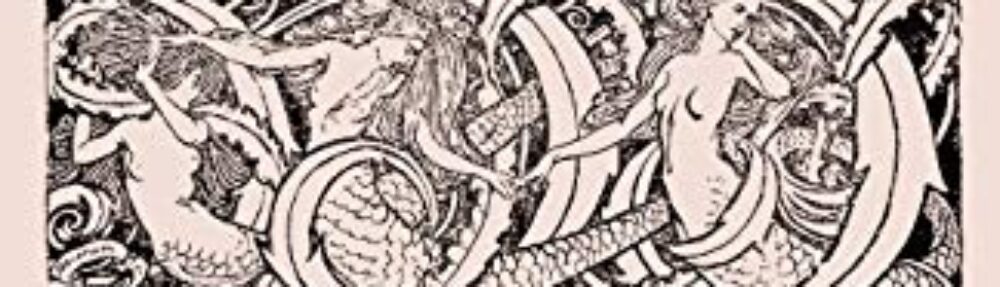
Mermaids and Mo’o

In an introduction to The Penguin Book of Mermaids Christina Bacchilega and Marie Alohalani Brown define monsters etymologically as “That which reveals, that which warns”. Going on to say that “Biform are signs, then, that often serve as admonition for humans not to cross borders and incitement to do so.” (xii) This definition reveals our classroom perception of mermaids represented on maps. Easy to perceive as a place to stay away from, or a place to colonize, to humanize.

In their collection of mermaid mythology our authors notice that duplicity and demonization are most prevalent in European societies and reflect an anthropocentric worldview. Furthermore, these tales exhibit a society’s relationship with water.

As it does between nations, races, and religions, always being depicted as the other, as the permeating being, inherently demonizes. Concealing a merperson’s environment strips the capability of sympathy and relatability of their circumstance, “the experience is conveyed as a disappearance form the human world—the only proper social world—into an abyss that is not described. This silence in the narrative furthers the perception of the captivating mermaid as monstrous.” (xix) Not only are these European tales monsterizing the mermaids but they are monstering the ocean itself.

In contrast, Hawaiian myths of the mo’o “renowned for their loveliness” offer a reflection of a society with an animistic world view. “there are no tales of men who try to tame their mo’o partners, because the mo’o, like the features of water they embody, cannot be contained or domesticated.” (xx) Hawaiian water deities display a respect for the ocean and for “nonhuman life”.

A European, monstrously depicted mermaid reveals a fear of the other as well as a fear of the ocean. And what lies beneath the ocean, a fear of the unknown. On the other hand, a respect towards water deities, like mo’o, embodies respect towards the ocean and therefore respect for life itself, no matter the form.

A harmless ‘known’ makes a scary ‘unknown’

What caught my eye was the beginning of “Their Bodies, Our Anxieties,” where it discusses how we prefer our world to be well-ordered and sharply defined in categories, but it highlights the similarities between hybrid monsters and humans. They’re able to eat, sleep, and breathe like us, but seemingly hold enough distinctions for us to shy away from them. This reminded me of some recent trends in horror since at least 2014, where we take what was ‘safe,’ for example, a children’s mascot, and proceed to make it monstrous in a subtle way, for example, having the mascot act irregularly hostile towards children when it shouldn’t be. It adds to the uncanny anxiety we feel towards the subject, but it also fascinates people, myself included, as mermaids, or at least their early versions, don’t seem all that harmful. Then later, they’re made out to be temptresses whose goal is to lead men astray and consume them. When reading about the part where the text talks about the beauty of a mermaid, it got me thinking about how both halves of a mermaid show our odd interest in the known and unknown. The upper half is what we’re used to and can recognize as distinctly normal; this carries on with the lower half too, as our brains can recognize that it’s a fish. But when you put it all together, what is ‘known’ becomes a fearful yet interesting ‘unknown.’ We can recognize its not a natural thing for a woman’s upper half to be conjoined to a fish lower half, however, it still has that ‘harmless’ feel allowing later interceptions to add unsetting traits that would attract both fear AND attention. It’s interesting to know what looks harmless to us might be the most dangerous thing in the room, and it isn’t solely a modern trend but has been going on for centuries.

Merpeople as Bearers of Knowledge in Myth

Merpeople, specifically mermaids, have been known to be seductive sea monsters who lure sailors to their death, and that has well founded symbolism in of itself. Yet there has also been depictions of merpeople that are valued for the knowledge they bring to humans. This dichotomy of symbolism of sea creatures is beguiling and nonetheless makes sense. In The Penguin Book of Mermaids introduction, Christina Bacchilega and Mari Alohalani Brown explains “that everything we need to survive, in one way or another, depends on water, it is unsurprising that peoples across place and time have ascribed religious significance to water and developed water symbolism” (xiv). In light of this it is clear that these crosscurrent myths would have their own symbolism not just for water but for the creatures that live in it. Focusing on the merpeople whom are valued and symbolic of knowledge, myths such as “Oannes” and “Odysseus and the Sirens” depict such symbolic knowledge and concurrently portray water spirits in different lights.

“Oannes” is described as something of a messenger of knowledge, a god that educates humans; the deity was something that was praised and attractive in its mythology. Oannes knowledge and education consisted of “convers[ing] with men; but took no food at that season; and he gave them an insight into letters, and science, and every kind of art […] so universal or his instructions, nothing material has been added by way of improvement” (4). In Babylonian mythology Oannes, whether he be a messenger or a god, was not feared but revered for what he gave humans. He came to the humans and gave them his knowledge without wanting or needing anything in return. Now in Babylonian culture water often symbolized the potential for creation and order, and Oannes is an exemplary folktale of such symbolism. A literal entity that brings the humans of Babylon order and civilization amongst their chaos. 

In Homer’s Odyssey, the Sirens in all technicalities are thought to be seductive, though surprisingly their alluring song is not one of destruction but one of wisdom. The book explains that “Odysseus is subject to erotic temptation more than once in the course of his homecoming, but the Sirens’ lure is of a different kind. Homer Sirens’ sing a song that promises knowledge— a wisdom that bridges worlds— instead of pleasure” (10). Thus, these sirens may be stereotypically the “monsters” originally thought to be, yet in reality they wish to provide Odysseus with a different point of view on life. Just like Babylonian mythology, Greek mythology  water is symbolic of creation and transformation, The sirens knowledge may not be one of facts or educating on order, but they want to get Odysseus to stay and learn from the wisdom they have to give.

Week 3: A Mermaid’s Purpose

As I was reading “Introduction: The Stories We Tell About Mermaids and Other Water Spirits” (Penguin, ix-xxii) it made me wonder if there was a collective idea as to why the mermaids in our stories often lack agency. The introduction notes “the mermaid’s perspective is rarely presented and instead basically assumed (pg xix).” Our limited understanding of the vast deep seas leads us to shape a narrative in which humans are dominant above all creatures- even the alluring, dangerous and oftentimes otherworldly beautiful mermaid. Perhaps a mermaid’s lack of agency in these stories are not only for humans to assert their control, but to also make sense of the unknown. Historically the sea has always been difficult to understand, as so much of it hasn’t even been explored today. Over 80% remains unknown. The unknown is uncomfortable, as it is captivating. The mermaid embodies those two qualities, and as mentioned in the reading she tries her hardest to “pass” as a human on land but is never fully accepted (xvii). This “otherness” is the reason why a man has a strong desire to pursue her, and to domesticate her. Perhaps this possessiveness of the mermaid strips her from her agency, all in the name of “love” that seems more plainly like desire. 

A mermaid’s lack of agency in a patriarchal sphere brings me to our reading “Sedna” (Inuit). I’ve actually read this story before for my mythology class, and was absolutely flabbergasted by her father’s sudden act of betrayal- especially since he spent so long looking for (who we all thought was) his beloved daughter. This creation story could simply just be a creation story, or it could be deciphered to have many themes. Those themes being betrayal, connection to nature, especially the spiritual connection that the Inuit people had with the sea. Still, I couldn’t help but to see Sedna’s story being patriarchal in nature. Despite her transformation in becoming a powerful sea goddess who controls the animals of the sea, it was all due to her suffering that caused this. Sedna having to be married off, then deceived by her husband followed by her being dispensable to her father. To me, this creation story showed Sedna’s lack of agency in a man’s world, only to find her power in another world- the world of the sea. 

Art Credit: Sedna by Antony Galbraith

Week 3: Merpeople and Cohen

For this post I will be focusing on the introduction of The Penguin Book of Mermaids. It is very intriguing to me because I took an ECL 220 class on monster theory and how monsters reflect our anxieties, and we learned from last week’s discussion that mermaids in general (not just medieval or contemporary) are quite literally a part of monster theory.

The introduction to the Penguin Book of Mermaids presents us with some interesting info about aquatic creatures and how they reflect our cultural anxieties. What stood out to me in the “Their Bodies, Our Anxieties” section is the uncanniness that we experience when we combine a being with non-human traits with humans; Bacchilega and Brown use aquatic humanoids as an example (xi). Jeffery Jerome Cohen’s seven monster theses can be seen at play here; keywords such as “thresholds” and “anxieties” and how mermaids are described here has me thinking about them. Here is how I would connect merpeople and aquatic humanoids in general to some of Cohen’s theses, specifically I, III, VI:

Thesis I: The monster’s body is a cultural body

This thesis is referenced in the text itself: “In contemporary cultural theory, we are reminded that ‘a construct and projection, the monster exists only to be read; the monstrum is etymologically ‘That which reveals,’ ‘That which warns.”” (xii) Monsters reflect our culture’s “fear, desire, fantasy, and fantasy,” (Cohen 4) and aquatic human-creature hybrids are no exception to the monster spectrum. Merpeople are sometimes featured in maritime fantasy/fiction novels, and they are usually depicted as humans with a giant tail instead of a pair of legs. Although they could be considered human, their monstrosity stems from the fact that they live in a largely-unknown uninhabitable environment outside of human society. Because their bodies reflect our desires to explore more of the ocean and our fear of not knowing what lies there, it therefore fits Cohen’s first thesis.

Thesis III: The monster is the harbinger of category crisis

Merpeople are usually part-human and part-fish, and some portrayals give them the ability to switch between human and fish at will. Because they exist between two categories, it is difficult to categorize them into either human or fish. Their in-between existence, therefore, “questions binary thinking and introduces a crisis” (Cohen 6).

Thesis VI: Fear of the monster is really a kind of desire

The text basically says it: “Our ambivalence toward mermaids and other water spirits finds its representation in their bodies, which are often alluring, but can also be frightening.” (xii) For instance, the siren is a fearsome type of mermaid that sings a beautiful song that lures sailors to their doom. She flips the gender binary by depicting the woman as the one in power, enticing men into falling for her song and compelling them into doing what she wants. Since we live in a patriarchal society, this power, then, is what women desire most.

I think it’s interesting to see what I’ve learned from my previous ECL classes make an appearance in the readings for this class. Here’s my question: how would you apply Cohen’s monster theses to a monster that you’ve encountered/yet to encounter? It doesn’t have to be mermaids, but it’d be intriguing to see his theses applied to merpeople in particular.

Explanations of origin

I remember from class that we discussed that some mermaids that we read in stories may not seem like mermaids at first glance but are such as the story of Odysseus where he was attacked by sirens which flew but held a figuire closer to that of a mermaid.In this case the story of kaliya and the serpent are similar to that in which while the serpent isnt the mermaid itself but what the outcome of the story allows for the creation of mermaid.I had also found it interesting how throughout the story they focused primarly on the use of fire as a description.I also had found it interesting as the use of the word fire which primarly is used as a method of cleasing and rebirth in many other stories.In the story when they talk about the serpent they describe the flailing of the snake when confronted by krsna as “they burst at once into flame smitten by the wind and carried by water burning by that snakes evil fiery poison”. I felt that this quote was important because during that time I believe that there may have been fires in the area and they were being carried across the area by the wind in which they were only put out by the raining season.After the snake was defeated the snakes wife had begged for mercy,but what I had found interesting was the description of the wifes.In the story they described the snakes wifes as “adorned with fetching necklaces,who were beautiful with jangling necklaces” which I felt is a description of a mermaid by their sexuality and how they were described attractive which is usually a main characteristic of a mermaid.It was also interesting as they had adorned the mermaids with man made objects like necklaces and jewlery Which I only know of one thing to use jewelry which is us humans.I believe that the reason why they had to make clear that they were adorned with jewelry is in order for them to be closer to humans and make us the reader have pity not only for the snake but the wives as well.The end of the story was also interesting because the snake spoke and stated that he “was defeated and asked for mercy” which was given due to him not doing anything on purpose and was then cast to the ocean from the river with his ancestors and wives.I found this interesting as well for the reason that when we think of the location of mermaids we think oceans or by the beach which is where they were cast to after being defeated.It then further deepens the story by leaving the story open ended by stating that they were not killed but the snake,wives,and children presumably still alive continuing their lineage within the ocean.

Week 2: Mermaids and the Church

The introduction of Merpeople: A Human History explored how mermaids became deeply ingrained in medieval European culture and imagination. The church treated mermaids not just as mythical sea creatures, but as symbols with moral purposes. Through sculptures, bestiaries, and sermons, mermaids were used to warn believers about the dangers of desire and sin. Mermaids also appeared on medieval maps and became part of local folklore. Stories like the Orford mermaid and the Harlem mermaid are used to show how Christians tried to fit these creatures into their worldview. And these stories are not just entertaining, they also reinforce the teachings of the church.

One part of the reading that caught my attention was how the Church used mermaids in sacred spaces. I was surprised to learn that cathedrals had wooden carvings of topless mermaids. But these carvings were not just for decoration, they were intended to warn the faithful about desire and vanity. I find it interesting that the Church permitted nudity in these cases, showing that female sexuality could be displayed as long as it was framed as dangerous and sinful. I thought that this reveals how carefully the Church controlled what people saw and how they thought about desire. The Haarlem mermaid story also stood out to me. In this story, a captured mermaid is clothed, taught to pray, and integrated into human society. I thought that it reflects the Church’s broader goal of controlling the wild or unknown. Even a magical creature had to be civilized to fit Christian norms. I thought this story is not only about a mermaid, but also a clear metaphor for society’s attempts to shape and discipline those who are different or threatening.

I also found it fascinating how these stories blurred the line between myth and reality. By placing mermaids in art, manuscripts, and sermons, the Church made them feel real. Once real, they could be feared, captured, and tamed, reinforcing the Church’s power over desire and imagination. This combination of fascination and fear seems to have shaped how people understood the world and even continues to influence how we see mermaids today. Overall, this reading helped me see mermaids as more than just fantasy creatures. In the medieval imagination, they served as moral teachers, cultural boundary markers, and symbols of control. It made me wonder how many other mythical figures were used in similar ways to guide people’s beliefs and behaviors.