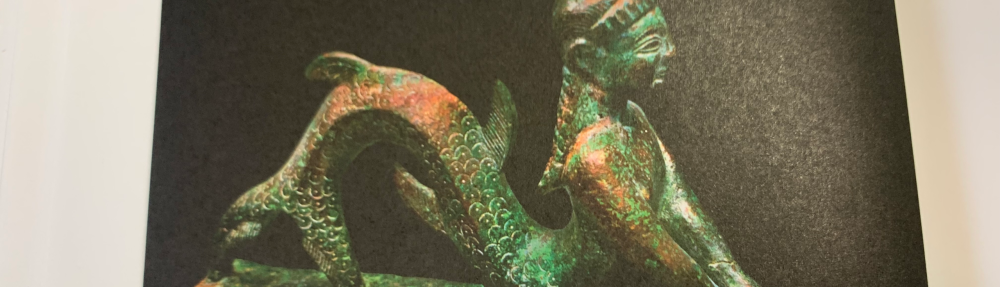
Final Project – Essay

In The Deep by Rivers Solomon, intergenerational trauma surfaces as a living archive, revealing how bodies carry and transmit historical memory. Through Yetu’s anguish, showcased in her collapse under the weight of Remembrance, reveals how bodies become living repositories of history.  By examining the ethical responsibilities of narrating such inherited pain, this essay argues that the novel redefines history not as a fixed record but as an embodied, collective experience shaped through storytelling, silence, and survival. 

In the novel, the weight of History of the Wajinru is placed upon Yetu, where she must relive the narrative of her ancestors to be able to tell their story. Earlier in the novel, before the Remembrance is conceptualized to the audience, Yetu is described as having been “withering away” (3). Yetu’s emotional burden is transformed into physical deterioration, illustrating that intergenerational trauma is carried in the body. The verb “withering” evoked the image of a plant losing life, shrinking, drying, and collapsing inward. This metaphor underscores that the historian’s role does not merely tire Yetu but literally erodes her from within, as though the accumulated weight of ancestral grief drains her life force. Her body became evidence of the community’s unresolved past. The use of past progressive “had been withering away” also showcases duration. This is not a sudden collapse but a slow, ongoing unraveling, mirroring how generational trauma operates over time, lingering, cumulative, and inherited. Then, it’s introduced how Yetu would go through a ritual described as “Remembrance,” where she would “relive the wajinru’s history all at once” and “put order and meaning to the events, so others could understand” (9). This description of Remembrance in which Yetu must “relive the wajinru’s history all at once” foregrounds the bodily intensity of inherited trauma. The phrase “relive..all at once” suggests not a distant or intellectual engagement with the past but a total overwhelming re-experiencing. To rely is to undergo something again in the present tense; the verb collapses historical time into the immediacy of sensation. Rather than consulting documents, Yetu’s body becomes the site through which generations of suffering return, situating her collapse not as weakness but as evidence of how intergenerational trauma saturates physical being. The requirement that she “put order and meaning to the events, so others could understand” reveals the ethical burden placed on the one who carries communal memory. The verbs “put order” and “meaning” indicate that the historian’s task is no neutral recording but a transformative interpretation: she must shape raw pain into narrative. The phrase “so others could understand” underscores that Remembrance is not only an act of recall but an obligation to translate trauma for the collective. The ideas arise on what narratives are told and to what extent to make History understandable and digestible to the majority. What pieces of history are cut off because they hurt too much to retell, or there is fear of making another feel uncomfortable?

In Yetu’s experience during the Remembrance, she experiences the outward expression of the wajinru people, noticing that rememory is just as physical as it is emotional. She describes this observation as “they knew things in their bodies, bits of the past absorbed them and transformed into instincts” (11). This line collapses the distinction between memory and physicality, suggesting that knowledge of the past is not learned intellectually but embodied. The verb “knew” paired with “in their bodies” implies that wajinru’s history circulates through muscle memory, sensation, and reflex rather than through conscious recollection. Thus, showcasing intergenerational trauma functions as a living archive, one stored not in written record but in the flesh itself. The phrase “bits of the past absorbed them” illustrates that the past is not something they retrieve but something that literally enters them, seeping into their physical being. The word “absorbed” evoked osmosis, permeability, and involuntary intake. It positions the body as porous to history, unable to choose what it takes in. This echoes Yetu’s experience in Remembrance, where inherited trauma overwhelms her body, demonstrating how the past is not simply remembered but imposed. The line “transformed into instincts” reveals how trauma becomes behavioral, shaping how the wajinru move through the world. Instincts are automatic pre-conscious responses; they bypass deliberation. By describing historical memory as transformed into instinct, Solomon shows how intergenerational trauma becomes habitual and self-perpetuating, guiding the community’s actions even when they do not actively recall the sources of their fear or cation This transformation also races ethical questions: if the past shapes instinct, then history is not a neutal inheritance but a force that molds the body’s responses, often without consent. This showcases that history in The Deep is not simply carried but embodied, absorbed, and enacted; the novel reconceives history as an intimately physical collective experience shaped by storytelling, survival, and the silent workings of the body.  Yetu also embodies this weight and pressure as the historian internalizing “her people’s survival was reliant upon her suffering” exposes the ethical and bodily stakes of historical memory (15). The phrase frames Yetu’s pain not as incidental but as structural, a requirement for the community’s continued existence. The noun “survival” evokes the most fundamental of needs, suggesting that memory is not simply important to the wajinru but essential to their identity and cohesion. Yet this survival is sustained through “her suffering,” a phrase that isolates Yetu as the singular vessel who must bear the collective’s inherited trauma. The choice of the word “reliant emphasizes dependency and imbalance. It signals that the community has built an entire cultural system on the extraction of Yetu’s bodily and emotional well-being. The burden of remembering of carrying the living archive is not evenly shared but placed disproportionately on one body. The fact that their “survival hinges on her physical and physiological deterioration shows that memory is not external but enacted through the body. Her suffering becomes the mechanism through which that past is preserved. The health of the community necessitates the breaking down of the individual, further illustrating how trauma takes material from in Yetu’s body. Ultimately, the wajinru’s need to remember and the violence of making on body hold that memory. It encapsulates the ethical dilemma of how storytelling, the preservation of history, demands sacrifice, and how that sacrifice becomes inscribed on the body of the historian. 

Towards the end of the novel, the existence of Yetu herself is an external archive; her life brings the narrative of her ancestors alive.  She has an inheritance of the intergenerational trauma being wajinru, claiming “All the memories of those who’ve come before, they lived inside me” (94), demonstrating the novel’s central claim that history is not an external archive but an inhabiting force, one that takes up residence within the body. The phrase “lived inside me” is especially powerful because it gives memory agency; memories are not static objects but living presences that occupy Yetu’s internal world. By describing them as “living,” the text emphasizes that the past is active, animate, and continual, aligning directly with intergenerational trauma in The Deep functions as a living archive rather than a closed, completed record. The shift from “those who’ve come before” to “inside ne” collapses the boundary between ancestors and the self. The collapse shows that Yetus’s identity has been overtaken by the historical suffering she carries; she contains multitudes not metaphorically but literally. Memory here is spatial; it fills crowds and occupies her, revealing the overwhelming nature of inherited trauma when it is borne by a single body. At the same time, the sentence’s simplicity conveys the emotional exhaustion behind it. There is no ornamentation, only the stark truth that Yetu has endured. This clarity reinforces the ethical stakes when history “lives inside” a person; it becomes impossible to maintain emotional distance. The line foregrounds the cost of being the historian. Yetu becomes the place where past and present merge, where the community. This quote encapsulates the novel’s redefinition of history as an embodied, collective, and ethically fraught experience. It demonstrates how storytelling and survival intertwine, how silence becomes both refuge and danger, and how the body becomes the ultimate vessel for ancestral memory. In affirming that the past “lives within her, Yetu articulates the novel’s final insight, that history is not something we stand outside of, but something that inhabits us, shapes us, and must ultimately be renegotiated to allow both individual healing and communal continuity. 

In Walcott’s poem “Sea is History”, Walcott’s question “where is your tribal memory?” (line two) functions as both accusation and lament, pointing to the erasure of African and Afro-diasporic history through colonial violence. The pointed ‘where’ carries a tone of loss, implying that what should have been preserved has been scattered, submerged, or forcibly obscured. This question mirrors the central concern of The Deep: how people whose pasts have been ruptured by atrocity can reconstruct a sense of identity when their archives have been destroyed. Memory becomes embodied, stored in Yetu’s collapsing body because no external repository remains. Waltcatt anticipates this idea that if “tribal memory” cannot be found in books or monuments, it must exist elsewhere, often in the body itself, through inherited pain, silence, and survival. The question, therefore, underscores the fundamental problem both texts confront: how to locate a history that has been drowned, suppressed, or never written down. Both texts ultimately suggest that history does not disappear; it migrates into new forms. Further down in the poem, Walcott creates an image of the middle passage: “then came the men with eyes heavy as anchors who sank without tombs” (line 26). This imagery of “men with eyes heavy as anchors” evolved from the Middle Passage, where enslaved Africans were thrown or forced overboard, their bodies sinking to the sea floor. The simile “heavy as anchors” gives their eyes a weight beyond physical gravity, emotional, historical, and symbolic. Their eyes carry the burden of what they have seen: violence, rupture, and dislocation. This weight parallels the unbearable load carried by Yetu, whose role as historian forces her to hold within her collective trauma of her people. The phrase “who snake without tombs” speaks to historical erasure and the violent denial of memorial space. These men have no graves, no monuments, nor records, echoing the absence of written history that haunts the wakinru. Their bodies become their tombs; their descent into the sea becomes an archive. Walcott thus transforms the ocean into a repository of unmarked trauma, directly aligning that history survives through embodied, submerged, and non-traditional form. In The Deep, the submersion is literal: the wajinru originate from pregnant Africans thrown overboard. Their entire existence emerges from the very bodies that “sank without tombs”. Yetu’s suffering as a historian reenacts their descent;  the weight of remembrance threatens to drown her. Walcott’s anchors and Yetu’s collapse are parallel metaphors for how violence enters the body and remains there, shaping future generations. Overall, Walcott’s imagery of drowned men and lost “tribal memory” amplifies that history is never fixed or safely archived; it is bodily, fragile, collective, and continually reshaped by those who bear its weight. 

In The Wake: On Blackness and Being by Schritina Sharpe discusses the power of rememory. Sharpe asserts, “in the wake, the past that is not past reappears, always to rupture the present” (9). The assertion “the past that is not past” powerfully captures the concept of intergenerational trauma as a force that refuses containment within historical time. The repetition embedded in the phrase “past that is not past” disrupts linear chronology and insts that certain histories, particularly those shaped by racial violence, remain ongoing. This resonates directly that trauma in The Deep operates as a living archive, lodged in embodied rather than isolated in a distant, completed moment. Sharpe’s language of “reappears” highlights that the past resurfaces involuntarily and unpredictably, much like the wajinru’s ancestral memories surge through Yetu’s body during Remembrance. The verb emphasizes return and haunting, echoing Yetu’s experience of being repeatedly overwhelmed by memories that are not hers alone but inherited, communal, and unresolved. Both Sharpe and Solomon depict the past as active, a force that continually intrudes upon the present rather than a stable record that can be stored away. The phrase “to rupture the present underscores the violence of this reappearance. The word “rupture” connotes a breaking, tearing, or shattering, highlighting the destabilizing impact of historical trauma on contemporary life. This aligns with Yetu’s physical collapse under the weight of Remembrance reveals how bodies become sites where historival trauma interrupts and overwhelms the self. Her fractured sense of identity, pulled between her own desires and the collective memory she carries, embodies the rupture Sharpe names. The present is not allowed to remain intact; it is continually split open by what came before. Finally, Sharpe’s framing of living “in the wake” connects to The Deep at the level of metaphor and origin; the wajinru emerge from the wake of the slave ship, from the literal waters that hold the dead of the Middle Passage. Their very existence is shaped by this ongoing past that never stops reappearing. Yetu’s struggle to carry their history mirrors the condition Sharpe describes, living with a past that insists on being felt, witnessed, and re-narrated even as it wounds.

Ultimately, The Deep positions trauma not as a distant inheritance but as a living, embodied archive that demands ethical reckoning. Through Yetu’s sole role as bearer of communal memory and her eventual recognition that history “lives inside” Solomon, the text exposes the violence of isolating collective pain within one body. Memory in the novel is not safely and comfortably contained in records or monuments; it circles through flesh, instinct, and suffering, shaping identity and survival in what cannot be ignored. Historical remembrance is a practice to teach and for us to listen. Intergenerational memory as a living archive, Solomon challenges readers to confront the violence embedded in acts of remembrance while also imagining new forms of collective care and shared responsibility. No one should hold the weight of their trauma solely on their own. It is very important to hear history from the perspective of those who truly lived. We have to be open to the truth, the real traumas, and pain they experienced. When people tell their narratives, they should not feel they need to leave out details in fear of making the listener uncomfortable. This novel affirms that healing does not come from forgetting the past, but from renegotiating how it lives with us, so that survival no longer requires the quiet drowning of those who remember. 

Works Cited

Academy of American Poets. “The Sea Is History by Derek Walcott – Poems | Academy of American Poets.” Poets.org, 2019, poets.org/poem/sea-history.

Sharpe, Christina. In the Wake: On Blackness and Being. Durham, Duke University Press, 2016.Solomon, Rivers. The Deep. Saga Press, 2019.

Solomon, Rivers. The Deep. Saga Press, 2019.

Final Project – The Seas Will Sing

My final essay and my project based on the concept from The Deep and Derek Walcott’s poem 🙂

The exact number of deaths during the Middle Passage is unknown, and I wanted to convey it artistically, with literature and numbers. The sea keeps all of this as archived, even if we don’t want to know it.

The Recipe for a Hero (Final Essay)

In the chapter titled “The Great Old Hunter” from The Romance of the Faery Melusine, André Lebey creates a symbiotic relationship between humans and nature when describing nature as being “menacing and dangerous” because it is “full of the unknown” (Lebey 11). The dangerous quality of nature then formulates the need for heroes to protect the townsmen who are “huddled for comfort against their wives” as the dangerous creatures lurking in nature infiltrate the nearby village (Lebey 11). By intertwining nature and humanity, the text critiques the idea humans are separated from nature since the heroic persona and human virtue is built in the context of an environment that forces it to overcome threats and danger.

From the start of the chapter, Lebey begins to build the relationship between humans and nature when revealing that “They lived close to nature in those days, even in towns,” since the “Fields came right up to the walls and the forest was close by” (11). Right at the beginning of the story, nature is already becoming an integral part of the narrative through its close proximity to what is deemed as civilization. In this section, nature is not a faraway entity, but is a being that is interwoven into life within the village by explicitly stating that people “lived close to nature” and that it “came right up to the walls” of the town. It is not something that the villagers can easily ignore since the town is on the threshold of the forest. Whether it is for good or bad, the villagers develop in conjunction with the forest’s inhabitants because of their proximity. Here, the reader can see that every action of the townspeople or forest beings ends up directly impacting the livelihood of one another. Nature is then characterized as a neighbor to the town, as they exist alongside each other. Through this weaving of humans and the environment around them, Lebey is then able to create the perfect surroundings for someone like Count Aimery to exist. As a result of living so close to nature, Count Aimery is able to naturally become a hunter because he has direct access to nature on a daily basis. Count Aimery can then evolve and go on hunts due to the setting that Lebey places the town in, where humans live in a space woven with nature. One can then see how his life is shaped by his entanglement with nature since it gives him the basis to foster his skills to become “a great hunter” (Lebey 11). This forces the reader to take into consideration how nature influences the actions of those in that specific environment. Constructing the forest “close by,” the town transforms into a way for Lebey to showcase how influential nature can be in one’s life. It is not merely a place; rather, it is a force that can ultimately create the structure of a human life.

Knowing that the forest is nearby the village, Lebey then positions the forest and all those who inhabit it as “[…] menacing and dangerous, full of the unknown, concealing the surprising and the supernatural” (11). Before he even truly begins the story of the hunter, the forest is specifically defined as a place where evil lurks. By using words such as “menacing” and “dangerous” to convey the characteristics of this environment, it becomes something for the townsmen to fear and creates a sense of tension within the village since they live adjacent to the forest. Nature is not characterized as a passive being that simply exists, and instead is given a role as a perilous environment that is able to harbor these “unknown” and “supernatural” beings. The employment of the term “supernatural” also becomes vital since it creates the notion that not only is the village under threat, but it is under increased threat because the forest is essentially beyond the realm of this world. The reader then knows to be wary of this environment because it is being presented as an entity that can cause damage to the village and those who live there, since the actions of nature have an effect on those who live by its borders. Through the utilization of a hostile tone when describing the forest and the individuals that occupy it, the author leaves no doubt that nature is an evil force within the village because of the conflict it has created for them. In turn, when Lebey notes in the subsequent lines that “All along the bushes by the pathways the eyes of the lynxes burned, watching the old women, bowed under kindling” (Lebey 11), he continues to reinforce this threat of unearthly creatures on the community. Rather than the lynxes watching the old women, Lebey explains that their eyes were “burning” to evoke a sense of mysticism since it feels as if they have a fire behind their eyes that is not normally present within these creatures. The reader is now able to recognise the danger the villagers are in, knowing that these may not be normal creatures since the “burning” eyes of the lynxes are a mark of their “supernatural” qualities. Nature then transforms into the villain in the narrative by being an ever-present danger and frightening those who are merely trying to live their lives in town. It looms over the town as the townspeople are being watched by the “burning” eyes of creatures who call the forest their home.

Within the essay, “The Trouble with Wilderness: Or, Getting Back to the Wrong Nature,” author and historian William Cronon reveals the danger in thinking that humans are detached from nature. In particular, Cronon describes how it “embodies a dualistic vision in which the human is entirely outside the natural,” which then “[reproduces] the dualism that sets humanity and nature at opposite poles” (17). Cronon is directly mirroring what can be seen in Lebey’s narrative as they both seek to combine humans and the environment around them. Rather than seeing nature as something that is removed from civilization, both Cronon and Lebey  “embody” a line of thinking that places nature as something that is part of everyday life. Even early literature, such as the Bible, often depicts the wilderness as a grand fantasy where one must venture away from civilization and towns to be truly in nature. The environment then becomes this awe-inspiring entity that is devoid of any perceived human elements or interaction. In turn, it may create this detached feeling from this form of nature because it is outside the scope of what is deemed as civilized, since it is viewed as being formulated by “nature” itself. However, Cronon notes that this idealistic view of nature “gets us into trouble only if we imagine that this experience of wonder and otherness is limited to the remote corners of the planet” (24), illustrating how we do not need to actively seek out nature since nature can be as simple as a tree in a backyard or a flower in a garden. Subsequently, the separation between nature and humans is blurred when we realize that the wilderness is all around civilization. Applying this thinking to The Romance of Faery Melusine, one can then see that Lebey moves away from “dualistic thinking” about nature and humans by highlighting how close the villagers live to nature. The forest is not simply a backdrop for the story, but plays a pivotal role in the lives of the people living in the town. The constant danger nature presents because of its close proximity to civilization forces humans to interact with nature as they try to fend off any lurking danger. Instead of positioning nature as a distant entity, Lebey brings it to the forefront through its influence on the villagers’ daily life. Here, one can see how Lebey showcases the “wonder and otherness” of nature at the village’s doorstep as the forest’s creatures dangerously seep into the town. The close proximity of the forest to the village then heightens the intertwining of humans and nature that is depicted in Cronon’s essay, since these two entities are forced to interact within their daily lives. Thus, both texts serve to erase the boundaries between humans and the environment by illuminating how much these two entities interact with each other.

Towards the end of the passage, Lebey then explains that because of the evil nature of the forest, it is a chance to showcase heroic virtues since “[…] evil reigned only if heroes failed to confront its dangers. It seemed that one existed to give rise to the other, for humans do not show their mettle if left to themselves” (Lebey 12). Through these lines, Lebey takes on a more optimistic view of the forest by claiming that it was created to “give rise” to heroes as a way to protect the community and dominate over evil. He is then cementing the intertwining relationship between humans and the natural world through the idea that they cannot exist on their own. This highlights the idea that human heroics depend on the presence of evil because it forces them to play the role of the hero in order to protect the town and the “townsmen huddled for comfort against their wives” (Lebey 11). The fear of the creatures from the forest drives people from the village to step up and defend the villagers from these otherworldly beings. The reader then understands that having nature as a threatening force is not an inherently bad thing because it is a critical force in building human character. Without the dangers that the forest presents, there might not be an opportunity for humans to display their superiority since nature gives them something to fight against due to its evil characteristics. If everything is always safe, then there would be no need for heroes to protect people or showcase their might. In turn, Lebey essentially points out that it is a good thing that the villagers live so close to danger because they are able to showcase their “mettle” that would otherwise be hidden away. Despite the turmoil and anxiety that the forest brings to the village, it is this exact evil that allows for humans to embody the persona of a hero and showcase their excellence that would not present “if left to themselves.”

In the section “The Emergence of Environmental Humanities” from The Environmental Humanities: A Critical Introduction, Robert S. Emmett and David E. Nye highlight this very thinking when explaining how “a disconnected and isolated ‘thing’ or object does not and cannot exist. Rather, every object and being is defined by its relationships,” meaning that “It is part of networks and only has meaning in relation to its surroundings” (9). In essence, this dismantles the idea of a dichotomy between humans and nature by positing the notion that an entity does not exist alone as an “isolated thing,” but in tandem with its surroundings, since it only exists within the context around it. When using this perspective to look at the forest and village presented in Lebey’s story, it becomes impossible to see these two entities as separate from one another, since they do not exist as solitary individuals. Every action that these “supernatural” beings from the forest take directly impacts the lives of those living in the village. Lebey’s depiction of the forest as a threat is then dependent on its ability to destabilize the lives of the people living in the town bordering the forest. As a result, the forest is defined as “dangerous” because of its close proximity to the village. Much like Lebey, Emmett and Nye situate nature as a place where human personas can be formed and harbored since “Human beings are not independent of the natural world, but are part of it” (9), making them “an active part of nature” (8). It is through their relationship with the forest that allows humans to rise as “heroes” because of the direct threat that the forest and its creatures present to the townspeople. Therefore, Emmett and Nye help further cement the belief that someone like Count Aimery is not necessarily born a hero, but is molded to be a hero because of the circumstances that force him to rise up and defend the town from the beings that lurk around the borders and spill into the town.

The weaving of humans and nature throughout this chapter of The Romance of the Faery Melusine then serves to move away from the idea that they can exist separately, since the heroic identity is founded within the connection between humans and the environment around them. As opposed to thinking that humans form their identities in isolation without any exterior forces, Lebey asks readers to rethink this notion by formulating the idea that it is through this “menacing” and “dangerous” environment that Count Aimery and others are able to reveal their greatness by hunting these dangerous creatures. The same forest that is home to all things “unknown” and “supernatural” can also be the place where virtue and nobility is born. Subsequently, humans may not know the extent of their superiority without the presence of danger threatening their livelihood. The forest becomes integral to humans because through these experiences with evil and danger, it gives them the space to prove their worthiness.

Works Cited

Cronon, William. “The Trouble with Wilderness: Or, Getting Back to the Wrong Nature.” Environmental History, vol. 1, no. 1, 1996, pp. 7–28.

Emmett, Robert S., and David E. Nye. “The Emergence of Environmental Humanities.” The Environmental Humanities: A Critical Introduction. MIT Press, 2017, pp. 1-21.

Lebey, André. “The Great Old Hunter.” The Romance of the Faery Melusine. Translated by Gareth Knight, Skylight, 2011, pp 11-22.

Final thoughts

In this reflection of my this class is that in my most of my years of academia has been an interesting and analytical struggles that it was something I have learned this year that throughout this semester is justified every time I have to to do a blog about a section in a chapter of a books, articles or poems and writing about these things have been one of the most difficult to analyzed and interpret into words to a understandable length is for myself and others.

What I have learned from this is that there is lots of mermaids that I didn’t really know about that there is much to learn about mermaids and it was a truly mythical experience that I usually don’t believe in and this class has shown me actual documentations on Mermaids.

Thank you Professor pressman for teaching me and my classmates about how Mermaids impact and how to analyze texts and writing them into blogs and essays. It was difficult but it was a skill worth learning.

Final Paper: “The Ocean is History” supported by Mentz and Roorda’s works.

In David Walcott’s “The Sea is History, the poem’s extensive use of biblical allusions and oceanic imagery exposes how human history, no matter how powerful it seems, is ultimately temporary and easily forgotten on land, a claim that aligns with Eric Paul Roorda and Steve Mentz’s critiques of terracentrism by revealing the human mistake of centering our worldview on land-based narratives instead of recognizing the ocean as the deeper and more enduring archive of human experience. 

First, in “The Sea Is History” by Derek Walcott, the poet portrays the ocean as an archive of cultural memory by referencing Biblical and historical knowledge, thus revealing how man-made monuments and stories are temporary but can be preserved within the ocean which carries an enduring record of human history. By connecting biblical narratives with the ocean, Walcott shows that the sea exposes and carries the realities that Scripture and monuments often spiritualize or brush over, revealing history’s buried truths.

“Where are your monuments, your battles, martyrs?” (ln. 1).  Walcott opens with a challenge. He asks where the remnants of man-made creations can be found once they are long gone, to which the reply is, “The sea / has locked them up. The sea is History” (ln. 3-4), thus establishing the foundation of the poem where the sea is portrayed as a vessel containing historical knowledge and depth. 

Walcott’s challenge to monuments can be further understood through Eric Paul Roorda’s concept of terracentrism, as written in his introduction to The Ocean Reader, which describes the deeply ingrained human fallacy to center history, meaning, and value on land-based narratives rather than those of the ocean. As Roorda explains, “Those who have considered the watery majority of the planet on its own terms have often seen it as a changeless space, one without a history. Because the Ocean can’t be plowed, paved, or shaped in ways the eye is able to discern, it has seemed to be a constant, while the land has changed drastically over the centuries” (Roorda 1).  Here, he explains how because terracentrism shapes human worldviews, and thus how humans record and remember the past, only easily visible, changeable, and human-created spaces such as monuments, cities, and other land-centric features are considered significant in the recording and studying of the world’s history. On the other hand, and as Roorda described, the ocean is often wrongfully perceived as empty, unchanging, or merely an insignificant backdrop to human history, being dismissed as a geographical feature due to the fact that humans cannot easily perceive the true change and cycles it goes through, for example all of the ocean’s changes and contents are submerged and not visible to humans. So, land becomes the default perspective for the recording of history and thought, enabling humans to feel powerful and create a sense of achievement through tangible structures and borders meant to endure for long periods of time. Monuments are thus significant to humans because they provide something tangible as well as stability, and they are able to be claimed and controlled, which are qualities that are valued within land-based thinking. In contrast, the ocean is fluid, constantly moving, and impossible to fully claim or control, which prevents it from conforming to the fallacy of a terracentric worldview. Even the engineered “names” that humans give to parts of the ocean, like the Indian Ocean or Atlantic Ocean, in an attempt to divide and control them into different entities, does not take away from the fact that the ocean is factually and permanently one large body, or how “seawater travels widely and endlessly across these artificial geographic markers” (2) no matter how many futile attempts humans make to tame it. Roorda mentions how as a result, histories associated with the sea are often overlooked or erased, not because they lack significance, but because they cannot be easily understood in a society that only fathoms land as a site of importance. Walcott’s line that “the sea has / locked them up” (ln. 3-4) directly rejects the assumption that history must be visible on land to be valued. Instead, the poem exposes how terracentrism limits historical knowledge because it correlates permanence with truth and dismisses what cannot be controlled or owned. The ocean’s lack of stability and clear borders undermines the power of monuments as the most reliable mediums of remembering history, revealing that what humans choose to remember is shaped less by a true appreciation for historical depth and more by means of power, control, and comfort in understanding. Thus, Walcott’s opening lines do much more than merely introduce the sea as a setting for the poem, but rather they challenge the very logic by which humans define history. By positioning the ocean as a true vault of monuments, battles, and martyrs, Walcott’s work aligns with Roorda’s critique of land-centered history and exposes the human mistake of looking at land-based narratives over fluid, ocean realities. Through this lense, Walcott’s poem can be read as a poetic refusal of terracentrism, insisting that history exists and is held not where humans have tried to anchor it, but where it has been forgotten or allowed to endure beyond human control and perception.

Walcott continues by chronologically describing Old Testament books of the Bible. He first describes Genesis, then Exodus, then the Song of Solomon, then Lamentations. By shifting from book to book specifically in chronological order, the work shifts from a mere poem to more of a story with a sequence of events, similar to human history. Walcott is further emphasizing the representation of the ocean as a continuous timeline containing such history and depth. For example, in his representation of Exodus, Walcott writes, “Bone soldered by coral to bone, / mosaics / mantles by the benediction of the shark’s shadow” (ln. 13-15). This could be referring to the famous Exodus story of Moses delivering the Israelites from slavery in Egypt. In doing so, he parts the Red Sea just in time for the Israelites to safely escape, but the waves come crashing down on the Egyptians in their wake, thus drowning their pursuers. The imagery of coral and bone being soldered together imply a connection between elements of the ocean and the land/humans, and the specific usage of the word “soldered” implies permanence, as if they are permanently connected in history. The usage of the word “mosaics” also provides relevance as that form of art consists of several small pieces fitted together to form a larger picture. In this context, the different, small remnants of the past and history held within the ocean are more that mere bits of debris, but rather the parts that make up larger history if put together. In this story, the bones and bodies of the Egyptians lie among the coral and water, forever preserved by the blessing, or “benediction of the shark’s shadow,” in the sea. The poet uses this popular biblical story to materialize the death and the religious story. The ocean becomes not a metaphor but an archive of bodies, holding the truths that triumphant narratives erase. The biblical reference paints the ocean as an archive and it exposes the gap between Scripture’s symbolic story and the physical reality the sea remembers. 

The human tendency to trust land over ocean as reliable grounds of history can again be explained through Eric Paul Roorda’s Ocean Reader and critique of terracentrism, which reveals how familiarity and control shape what humans consider meaningful because it is more comfortably understood. The ocean resists human control and thus, human-written narratives. It does not organize history into neat beginnings and endings or preserve events in ways that may be skewed or untruthful. As a result, humans are more comfortable trusting land-based narratives and perspectives because they align with familiar structures of meaning and authority that society is conditioned to value and view as necessary, while distrusting the ocean because it does not contain those rigid structures. Walcott’s depiction of Exodus directly confronts this bias that Roorda introduces by separating the biblical story’s symbolic, land-based narrative from the ocean’s physical holdings of bodies and bones, and thus objective memories. Where the Bible frames the drowning of the Egyptians as a necessary step in the divine escape, the ocean preserves the physical remains of that event without religious interpretation or meaning. The ocean refuses to be manipulated by human-written agendas or narratives and instead shows only the objective truth, and it does not allow humans to distance themselves from or justify suffering. Raw histories are not turned into metaphors, but rather held within coral, bone, and sediment, as Walcott describes. By trusting land and religious propaganda over the ocean, humans try to protect themselves from confronting the full weight of historical truth and violence. Roorda exposes humans’ selective attention to the ocean as he writes, “They relentlessly hunt sea creatures, taking 90 million tons of fish from it annually. They use it as a highway, with 100,000 ships at sea right now. They study it, find inspiration in it, play on it, and fight over it” (Roorda 3). Humans rely heavily on the ocean for transportation, food, and cultural inspiration, yet ironically exploit it and selectively choose to ignore the need to care for the ocean. Walcott further adds to the conversation of human selectivity as a fallacy in perspective, showing that what humans dismiss as unstable or lacking in history is in fact the space where history is preserved the most honestly. In doing so, the poem along with Roorda’s work reveal that human reliance on land-based narratives is not rooted in the desire for truth, but in comfort, control, and the need to tell stories that affirm human values.

 In Walcott’s representation of the Song of Solomon, a book about marriage and poetic love, he flips the romantic narrative with descriptions of “white cowries clustered like manacles / on the drowned women, / and those were the ivory bracelets / of the Song of Solomon” (ln. 20-23). The poet’s mention of drowned women chained with manacles could be referring to the slave trade where many slaves died in transportation overseas, once again associating human and ocean elements by comparing cowries to the chains. The typically beautiful and romantic images of “white cowries” and “ivory bracelets” represent bondage, definitely not poetic love, in this poem. By flipping the theme of the Song of Solomon, Walcott is contrasting Biblical stories with historical reality, or idealistic love versus slavery. The ocean preserves the bodies, and therefore real history. The poet thus paints the ocean as not only a mere vessel that preserves stories, but also harsh truth, no matter how buried. 

After chronologically describing Lamentations, Walcott shifts his poem to the New Testament with the lines, “the spires /  lancing the side of God / as His son set, and that was the New Testament” (ln. 56-58).  Biblically, the New Testament begins with the emergence of Jesus Christ, who was crucified. The imagery of spires piercing the “side of God” is reminiscent of how when Jesus was on the cross, Roman soldiers pierced his side with spears to see if he had died yet. The images of God’s son setting can have a double meaning. It can represent Jesus, the son, dying on the cross, but also the sun literally setting, thus bringing about a new day in history and narrating an end and beginning simultaneously. Waves enact “progress,” not because they advance but because they erase and renew with every break, and they become the mechanism and vessel through which human stories are submerged and remade. This pushes the biblical imagery toward a reflection on historical time itself, how events are layered, repeated, forgotten, and preserved beneath the surface. Walcott characterizes these sequence of events as “waves’ progress,” once again connecting the sea to human history and stories. The pun on “son/sun” links Biblical narrative to the natural flow of time, suggesting that endings and beginnings, written through the imagery of crucifixion and sunset, are layered within the ocean’s depths. Waves enact “progress” not by moving forward but by continually erasing and rearranging the world’s surface, mirroring the ongoing process by which human histories and stories are written, buried, and re-told.

Walcott’s rejection of linear progress through the image of waves is further explained by Steve Mentz’s concept of how language is a key factor in terracentrism. In the preface to Ocean, Mentz argues that terrestrial thinking is too limited, a problem caused by the language that humans use, for example “progress,” “ground,” and “field.” “Progress” assumes that history moves in a straight line toward continuous improvement or resolution, however Mentz proposes the use of “flow” instead, a term that emphasizes circulation, repetition, and transformation rather than linear advancement. “Thinking in terms of cyclical flows rather than linear progress makes historical narratives messier, more confusing, and less familiar. These are good things” (Mentz xvi). Here, he argues that history and advancement do not come in the commonly accepted form of regularity and standardization, but rather in a more fluid, unpredictable way like the flow of the ocean and waves. These metaphors contrast from the land-centered experience, where everything appears solid and movement can be measured. Ocean “flow” does not move toward a fixed endpoint at the end of a linear path, but rather it moves through cycles and waves. Walcott’s description of “waves’ progress” mirrors Mentz’s concept because the waves do not represent improvement or forward movement in the traditional, human sense, but rather display change through constant breaking, erasing, and reshaping of the surface. Thus, Mentz’s claim supports Walcott’s poem in that oceanic thinking is more realistic and flexible than terrestrial metaphors by refusing clarity and linear-based “progress.” Mentz writes, “The blue humanities name an ocean-infused way to reframe our shared cultural history. Breaking up the Anthropocene means reimagining the anthropogenic signatures of today’s climactic disasters as a dynamic openings” (Mentz xviii). In order to address true history, the ocean cannot be written out of it, and history itself cannot be viewed as a linear timeline, but rather as something “dynamic.” History, similar to water, does not stay put, but rather it builds as time goes on, distorts, and is reremembered. Mentz’s framework helps explain how Walcott’s imagery not only emphasizes the ocean as a keeper of history, but actively describes how history itself moves.

Ultimately, “The Sea is History” by Derek Walcott uses heavy Biblical allusions and connections between humans and nature in order to further the purpose of depicting the ocean as a vessel preserving truth and history, which is supported by Eric Roorda and Steve Mentz’s works exposing terracentrism and human-centered narratives. 

Works Cited

Roorda, Eric Paul, editor. The Ocean Reader: History, Culture, Politics. Duke University Press, 2020.

Mentz, Steve. Ocean. Bloomsbury Academic, 2020. ProQuest Ebook Central, ebookcentral.proquest.com/lib/sdsu/detail.action?docID=6036857.

Better Ways to See History in Rivers Solomons The Deep

In Rivers Solomon’s novel The Deep, they use an extended metaphor of empty spaces (such as cavities and vessels) to depict the Wajinrus’ forgotten history as a literal void carved into its people. This is clearest in Yetu, whose role as historian turns her body into a sort of container for communal memory, one that is filled and emptied at a great cost. Solomon uses this metaphor to urge their audience to see the trauma of historical loss as not merely just emotional but constitutional; it shapes who a person becomes through a history that they must hold (in Yetu’s case) or the history they lack (in the Wajinru’s).  

In chapter one of The Deep, Amaba says:

One can only go for so long without asking ‘who am I?’, ‘where do I come from?’, ‘what does all this mean?’, ‘what is being?’, ‘what came before me and what might come after?’. Without answers there is only a hole. A hole where a history should be that takes the shape of an endless longing. We are cavities (Solomon 8).

Solomon uses repetitive anaphoric rhetorical questions—“Who am I? What does this all mean? What is being?” This repetitive structure creates momentum and rhythm creating a feeling of longing and searching in order to emphasize the uncertainty and human need for understanding oneself. Most prominent is the imagery of the “hole” and “cavities.” These words visually create a picture of emptiness and loss due to a past, or in this case, history, that has been erased. The “hole where a history should be” is an absence of ancestry, a lost and forgotten origin. The “hole” in this case would be a symbol of a void left from the disconnection from heritage and identity. Amaba’s last words, “we are cavities,” extend this metaphor of a “hole” in history as a way to describe how trauma and loss quite literally shape people. There isn’t merely just a “hole” in history; the people most impacted by that “hole” become empty and hollow—like a cavity. In Pauline Alexis Gumbs article “Undrowned: Black Feminist Lessons from Marine Mammals,” Gumbs discusses what it means to Remember, and in reference to what she has been deprived of, the people and things she has lost, she states: “I’ve come back for all the names I’ve never known since you were stolen. And I am never far away from you in fact. I am creator and creation. Right here, the source of all love ever” (Gumbs 35). Gumbs phrase “names I’ve never known” parallels how the Wanjinru’s historical trauma creates gaps in identity. Which, in turn, connects back to Solomon’s metaphor of “holes,” these losses that exist not because the past doesn’t exist but because it was violently taken from them. Furthermore, when Gumbs says “I am never far away from you,” she resists the idea of total absence of what is lost. The Wajinru’s past and history, for most of the novel, is just out of reach, leaving them structurally hollow, rarely able to access the past that shapes them. On the other hand, the rememberings are literally “never far” from her as her role as historian. Yetu becomes the vessel of collective memory defined by what she holds. While the Wajinru, stripped of that history, become cavities defined by what they lack and are hungry for. Further, the line “I am creator and creation” suggests that the act of remembering, as well as recalling history, is an act of survival and identity. Yetu, and the Wajinru as a whole, are “created”  and are self made (creator) by the lack of their history, though that history does not just fully disappear; rather, it restructures bodies and identities through its absence.  

In succession to the first quote, Amaba believes that Yetu wouldn’t understand what it’s like due to her being the “historian.” Though Yetu thinks to herself that she “did know what it was like. After all, wasn’t cavity just another word for vessel?” (Solomon 8). The Oxford Dictionary defines cavity as “an empty space within a solid object, in particular the human body,” and a vessel is described as “a hollow container, especially used to hold liquid, such as a bowl or a cask.” A vessel, in Yetu’s case, is just another sort of cavity. Yetu is a vessel (cavity) made to hold the past and ancestors for the Wajinru people, then, when the time comes, those are scooped out of her and poured into the cavities of her people. And a cavity left untreated, left unfilled, can lead to pain and infection in a person, much like a cavity in one’s tooth. Solomon’s use of “cavity” and “vessel” is evocative of Gumb’s understanding of identity formation, where she explains: “I think about repetition and code, and when we prioritise what communication and why. And how we ever learn our names in this mess. And the need that makes us generalise and identify. Become specific and vague” (Gumbs 31). Repetition and code parallels Solomon’s repeated metaphor, depicting how history is encoded into one’s body, not simply just told through language. The pondering of “when we prioritise what communication and why” reflects the  Wajinru’s having a Historian hold all the memories of their people, then only annually placing those memories into the people. This form of communication of the Wajinru people depicts how when history is communicated, or withheld, is just as important in shaping one’s identity as the history itself. Gumbs goes on to describe the movement between “generalizing” and “identifying,” which corresponds with how Solomon depicts the Wajinru’s collective versus Yetu’s individual identity. For the Wajinru people, their trauma is shared or “generalized,” while Yetu’s is so individual to her as a hyper-specific vessel of memory. Gumbs’ insight to identity becoming specific and vague exemplifies Solomon’s cavity and vessel paradox. The Wajinru’s identity is vague because of how removed the past has been from them. Whereas Yetu’s is painfully specific due to holding all the ancestral memories, which overwhelm her body. Gumbs quote reinforces Solomon’s metaphor that history is constitutional and how the distribution of the past and memories is determinant in how whole or hollow someone becomes. 

In chapter five of the novel, after Yetu has left the Wajinru and her role as historian, she meets two legs and finds herself irresolute without the rememberings. Suka (one of the two legs) holds out her hand, sparking a lost memory in Yetu, but “when she reached out for the past, nothing was there. The emptiness inside her stretched far and wide in every direction like a cavern. It was lonely. She had thought herself unmoored when she was the historian, but this did not compare. She was a blip” (Solomon 78). For the first time, since before she was about fourteen, Yetu is experiencing what the rest of the Wajinru’s lives are like. As she tries to find where or what this memory is “the emptiness inside her stretched far and wide in every direction like a cavern,” there is yet another metaphor/simile for this emptiness that Solomon describes—cavern. A cavern, according to Merriam Webster, is a cave, one of large or indefinite extent. This simile expands Solomon’s metaphor from that of something that holds (cavity) or carries (vessel) to something that is an expansive, inhabitable absence. Comparing the lost memories to a cavern is as if to say that Yetu was living in a space of absence. Solomon describes this absence, ending the quote with a fragment: “she was a blip.” Now that she is unable to reach for those memories, she has a diminished sense of self. Like the Wajinru, without her history, she is a “blip,” there is a certain insignificance and impermanence to her identity. In Helen Rozwadowski’s book Vast Expanses: A History of the Ocean, Rozwadowski discusses the sea as a cultural, environmental, and geopolitical historical archive. To evolve our relationship with the ocean, she declares that “we must transform our understanding of the sea, to one bound with history and interconnected with humanity. Such a new vision, with new metaphors, can form the foundation for positive change” (Rozwadowski 227). Rozwadowski’s claim that the sea is “bound with history and interconnected with humanity” aligns with the Wajinru’s connection to memory, where their trauma originates in histories that are submerged, not erased. Additionally, Rozwadowski mentions this need for “new metaphors,” which we see Solomon depict in the Wajinru, especially Yetu, where memory is something physically carried in the body. Solomon’s metaphor pushes forth the “foundation for positive change” that Rozwadowski calls for; the metaphor of void spaces replaces abstract notions of history being intangible, with bodily constitutional consequences. Essentially, what Rozwadowski means is that metaphors shape ethical outcomes, hence Solomon’s metaphor demonstrating the conceptualization of history as something detachable at the cost of one’s identity and wholeness. For example, when Yetu becomes “a blip” without the rememberings, Solomon affirms the danger of a worldview that disconnects humanity from its histories, as warned by Rozwadowski.

By the end of the novel, in chapter nine, Yetu realizes a better way for her and her people to hold and carry history. As Amaba begs for her to not bear it all alone, Yetu ponders for a moment, “usually, after the remembrance, the historian waited nearby, empty of memories, but what would happen if they stayed? […] could they live out their days all sharing the memories together?” (Solomon 148). The historian being “empty of memories” continues Solomon’s extended metaphor of the body as a void to be filled or left hollow, thus reinforcing memory and history as being housed within. The phrase “empty of memories” also treats memory and history as something tangible that can occupy space. Yetu then rhetorically poses the questions “what would happen if they stayed?… sharing memories together?” This line of questioning invites the reader, as well as Yetu, to imagine an alternative structure of sharing history and memories. This communal language of “they” and “together” raises the possibility of distributed memory, challenging the isolation of the historian’s role and the Wajinru’s emptiness and longing for the past. By posing this question of a new way of sharing memories, Solomon urges their reader to consider the moral costs of isolating trauma to a single body, along with the trauma to one’s body of not having any history to hold. Rozwadowski, too, acknowledges the importance of knowing and understanding the past, especially the past in relation to the ocean: “Many environmental narratives lapse into tales of inevitable decline. Until we recognize the ocean’s past, and our inextricable relationship to it, we will not make much headway in changing that relationship for the better” (Rozwadowski 227). Both Rozwadowski and Solomon emphasize this “inextricable relationship” to the past, whether that be ecological or cultural. There is an emphatic importance to understanding that history, or memory, is not something that is merely disposable but deeply entwined to humanity. When Yetu proposes the idea of a shared remembrance, she too rejects the narrative of “inevitable decline” by suggesting that a collective reconnection to history can reform a people’s suffering. Solomon and Rozwadowski implore their audience to heal by refusing narratives of inevitability and embracing shared responsibility for history and its trauma. It is through this shared responsibility that one’s relationship to their environment can change for the better. 

Solomon’s overarching metaphor solicits their audience to understand the dangers and harm that a loss of history and ancestry causes a person. It leaves them filled with questions and uncertainty, and a hole that is hard to fill. By using this metaphor throughout the novel, Solomon implores one to think about how history is told, how history is held, and better ways of sharing history. The novel portrays the real human costs of the erasure of histories and an urge to imagine the advantages of shared history, especially histories that are often (and quite literally) lost to sea; histories that need shared “remembering” to enable healing rather than prolonging trauma. 

Works Cited

Gumbs, Alexis Pauline. “Undrowned: Black Feminist Lessons from Marine Mammals.” Soundings (London, England), vol. 78, no. 78, 2021, pp. 20–37, https://doi.org/10.3898/SOUN.78.01.2021.

Rozwadowski, Helen M.. Vast Expanses : A History of the Oceans, Reaktion Books, Limited, 2019. ProQuest Ebook Central, https://ebookcentral.proquest.com/lib/sdsu/detail.action?docID=5631456.

Solomon, Rivers. The Deep. Saga Press, 2019. 

Final Project: The Myth of (Human) Superiority

In the stories of Hans Christian Andersen’s The Little Mermaid, Agnieska Smoczynska’s film The Lure, and André Lebey’s version of Melusine the characters embark on journeys away from their home environments with aspirations of establishing their lives in new homes and bringing the talents they possess to benefit their new community as immigrants, but they are unable to bridge the social barriers of their new environment because of all they must sacrifice to assimilate. In these stories this rejection from their chosen environments with their designation of “other” preserves the power of hierarchical systems and serves as an allegory of outsiders and immigrants being a threat.

In Hans Christian Andersen’s The Little Mermaid, for the title character “there was nothing she delighted in so much as to hear about the upper world. She was always asking her grandmother to tell her all she knew about ships, towns, people, and animals” (109). The little mermaid idealized and revered the human world like immigrants who dream of joining another community. Her interest in the world above water predated her interest with the prince, making the human world her first infatuation and aspiration. The little mermaid impatiently waits for her access to this land of her dreams and is further enthralled on her first visit to the surface by seeing the human experiences of celebration and mortality. The prince’s birthday party shows new experiences that the little mermaid has not encountered such as dancing and fireworks, “large suns were throwing out sparks…and all these wonders were reflected in the calm sea below” (Andersen 114). This comparison shows how the little mermaid sees the brightness and life of the human world that does not reach into her world.  She stays late into the night, not wanting to let go of this experience and inadvertently becomes entangled in the lives of humans.   

When the prince almost drowns during the storm, she remembers humans’ inability to survive under water like her. This is when the first of her abilities benefit the human world. Not only in the single life of the prince, but also the kingdom he reigns over. The little mermaid’s choice to save him and carry him to shore more than likely saved a kingdom’s power in the political world. The little mermaid saves the prince as an individual, not as a political act but she soon sees in the land-based rescue of him contributing to the happiness of the community around him. “And the mermaid saw that the prince came to life again, and that he smiled on all those around him. But he did not send her a smile, neither did he know she had saved him, so she felt quite afflicted” (Andersen 116). She understands her contribution, how she has added value to the human world, but because she is separate from the space of humans, her contributions are not recognized by the population she hopes to be considered equal to. 

In Andersen’s story the little mermaid believes the possession of an immortal soul is another quality of humans that puts them in higher position than mermaids. Her grandmother explains to her that only the love of a human and a Christian marriage would grant her the same status as a human, “But this will never happen! Your fish’s tail, which is a beauty amongst us sea-folk, is thought to be a deformity on earth…” (Andersen 119). This additionally deepens the little mermaid’s belief that her form and species is beneath humans, making her willing to reject her world to be part of the human world that is depicted as superior.

The cost of having human legs is the little mermaid’s voice, as a stranger to a new land this immediately puts her at a disadvantage. She cannot assert her personality or identity without a voice and much like her grandmother had explained a tail was a deformity, her absence of speech will also be considered another type of deformity to humans. As Pil Dahlerup states, “but, being mute, she, who in her former element was the foremost singer in the whole world of land and sea, cannot express her feelings of love and longing, and her exquisite looks and expressive dancing turn her into a mere pet for the prince” (413). The little mermaid even after having crossed the boundary between being an inhabitant of water and then of land is still considered inferior to the humans around her. Her lack of voice is similar to what immigrants experience in their chosen homes as language and political standing prohibits their participation in the environment around them.

The little mermaid understands the importance of a voice and knows that her voice is one of the talents she could bring to the world of humans, she will have to relinquish not only her tail that made the rescue possible but the voice that is a unique talent. When the Sea Witch asked for it as payment, the little mermaid answers, “but if you take away my voice…what have I left?” (Andersen 122). She is told by the Sea Witch that her new human body will be all that she needs to complete her task and obtain an immortal soul. The human form and status are set up as the ideal that can conquer all obstacles, both to reader and the characters of the story.

When the human form does not negate the little mermaid’s payment of the talents she sacrificed, she is presented with a new moral problem. Through the further sacrifices of her sisters, the little mermaid can choose to resume her own life as a mermaid by killing the prince that rejected her or die herself. With being underestimated by humans in what they determined to be her inferior state she has access to the prince and can easily kill him while he sleeps. This exemplifies the threat some see of the “other” in their community, that the unassuming and subordinate people from outside can cause substantial harm to the people in the community they join.

In The Lure (dir. Agnieska Smoczynska) the threat of the “other” is more evident because unlike the little mermaid, the mermaids in the film do not have to sacrifice their tails to participate in the human world. The mermaids Silver and Golden in the film bounce back and forth between being considered dangerous animals and innocuous sexual objects by the humans around them. They are suspected to be threats and kept in dependent positions in their life and work. Even after their talents have brought money and success to the band they join on land, they are kept under a restricting level of the human’s control. Silver confronts the humans saying, “we can’t go to restaurants or bars. We work, but we don’t get any money,” (The Lure 53:37). The response from the character of a Krysia, a mother-figure and vocalist of the band, infantilizes the mermaids by replying, “You’re still kids. Kids can’t have everything they want” (The Lure 53:50). The treatment and approach to Silver and Golden by humans in the film does not reflect an opinion of the mermaids being kids, but because of their unfamiliarity with the human world they have started to make their lives in, the human band members are able to exploit them with presumed authority.

Reducing them to children makes the humans feel superior to the mermaids, while also being terrified of them. This and other physical impediments make the human world experience muted for the mermaids. Mietek, the love interest of Silver tells her “to me you’ll always be a fish, an animal,” (The Lure 33:59). This causes Silver to see herself through a perspective of not being worthy of the human world. Silver wants to participate fully in the human world so she can enjoy it in the same way as other humans. Golden wants to maintain her mermaid nature as she plans for their current home to be just a visit not a new home. For Golden, the talents her and Silver have of singing and enchantment are a way for them to access the human world, not become members of it. Golden still hunts humans and uses the oceanic language with Silver without the concern of how uncomfortable it makes humans, even after it leads to violence against them.

With this divergence of their approach towards the human world it shows the challenges of maintaining identity in new surroundings with people who do not trust them for being outsiders. Silver hides her power and tries to share it with humans to be accepted while Golden refuses to deny her power or abilities. Golden is considered more of a threat for her unwillingness to accept humans as being superior, reflecting that the “other” or immigrant who does not assimilate is a threat to the community they are residing in.

Visiting the human world does not mean a mermaid has to give up being a mermaid. It is a temporary state that they have the power to flow in and out of, but to assimilate they must cut off their tail like the little mermaid. In the world of the film there are several mermaids on land, all of them aware and most believing that “…if you cut off your tail, you’ll lose your voice” (The Lure 1:09:13). This creates an experience of not being able to truly assimilate into the culture of humans they are living around because they lose their strength and talent to be there. Cutting off a tail isn’t about participating or having a presence in the human world, it’s about joining the human world permanently and cutting themselves off from their mermaid world. It is a transition from visitor to resident. When immigrants are forced to reject or cut off their connection to the lives they lived before, it becomes a loss in identity and truly a loss for the new places they have decided to call home.

Silver choses to cut off her tail so she can be with her lover Mietek, but it comes at the great sacrifice of her voice. Her interactions in the world become strained and as a singer it does take away her ability to participate in all the things she enjoyed as just a visitor. The operation makes her disabled both physically and professionally, without these talents her worth in the community she has joined is diminished. She is unable to bridge the transition to being part of the human world because she had to give up all the talents that granted her entry to the human world. Soon after her transition to human, her lover rejects her and marries a human. This puts Silver in mortal danger as it was for the little mermaid, and she must choose her life or Mietek. 

Silver makes the same choice as the little mermaid. Believing her rejection is justified, she sacrifices herself for a human, keeping the hierarchical system of human superiority over all others in place. While Silver is reduced to sea foam, her sister Golden who did not endorse the system of humans, kills Mietek before returning to her home in the water. The threat of the unassimilated visitor is portrayed as a scarier risk in this story because it is resilient to propaganda of ranked systems. It relies on exclusion to bring a sense of inferiority, pressuring the visitor to commit to the ways and structures of the land they occupy and become the subordinate to the structure or leave. The story in The Lure shows how the “other” or immigrant who does not conform to the model of being inferior can lead to disruption and danger in a new chosen environment. 

In the story of Melusine she is able to bridge the barriers of the human world for a longer span of time than the little mermaid or the mermaids of The Lure. This is in part because she maintains her talents in the human world and is protected through her marriage to Raymondin. Having her talents of magic and political understanding she can create her own secure territory. He gives her residency in the human world with his position as a lord over land and she has more protection with this marital commitment than the other stories’ mermaids. Though eventually her position as an “other” and immigrant ruling over land puts her in the position of a political target when her power is challenged. 

On the first meeting of Melusine and Raymondin he comes to her in a position of weakness. Raymondin “too broken to have any pressing need for the unknown” (Lebey 23). He has killed a family member and fears the retribution of his family, leaving him isolated and ready to flee his homelands. Perhaps becoming an immigrant to different lands himself and understanding his loss in position in the human world. Melusine offers him an alternative to this fate by joining in a marital alliance with him, promising “without me, without my counsel, you cannot escape being accused of murder…if you listen to me, and take account of what I say, I promise to make you the greatest lord of your line and the wealthiest” (Lebey 25). She is offering a partnership that will not only save him from the consequences of his actions but also improving on the position he held before the crime he committed. The little mermaid, Silver, and Golden could not offer this level of power to their suitors because of what they had to give up being in the land of humans. In return Melusine asks for a marriage between her and Raymondin as well as his acceptance of her maintaining a boundary of her body and time. Melusine acts with the power she knows she possesses “these tales offer a catalogue of behaviors that exemplify the power that husbands wielded over their wives and how they were prepared to use it… These are notmutually exclusive desires as both could co-exist, but the presence of the pact shows that the fairy woman did not seek belonging at any cost” (Shaw 113).

When Raymondin does agree to her terms, unlike when he first meets her “he began to feel a man again, full of vigour” (Lebey 26). This alliance has strengthened him, not only in his mind but in his position in the world. Both he and Melusine understand the hierarchical system of humans and place themselves at the top so they may rule and not be subject to it. Instead of believing in a lesser position as an immigrant to the human world like the little mermaid and Silver, Melusine does not subscribe to non-humans being subordinate though most around her will.

Melusine does keep her promise of the alliance. Raymondin and the heirs she births into the world accomplish and conquer many things, pursuing their own journey of the unknown and placing themselves in positions of power around the land. Her talents build and preserve their castle Lusignan, a neutral space. “In Melusine’s case, while she appears to create a third space protected by ownership, once these boundaries are secured, she introduces alternative ways of thinking that trouble traditional understandings of ownership and the boundaries upon which they depend” (Shaw 119). Melusine secures for herself and the people of the land a place where she is not the “other” but connector of community.

Her upholding of their alliance benefits both as well as their family. Still the marriage is not without problems as the children of the ruling couple have various forms of deformities, but Raymondin is still made happy by the marriage and the success it has given him. This shield of power covers both members of the marriage; he does not need to be beholden to any other power, and she maintains the image of being human like her husband and thus not suspected as an “outsider” threat.

Though as time passes Raymondin grows too comfortable in this position of power and forgets the position he once occupied which his wife secured for him with her talents and resources. He has conquered parts of the world as has his sons, which he is reminded of while reading a letter from them before he breaks the boundaries of his wife’s territory. This coupled with the suggestion of his family member about Melusine reignites this desire to conquer unknown territories, because Melusine with her boundary was not entirely his possession like he hoped for when they first met. His family member reminds him of this inadequacy, setting off the events that will lead to the destruction of the marital alliance. As the beginning of The Romance of the Faery Melusine implies humans often go looking for fights when idle, “it seemed that the one existed to give rise to the other, for humans do not show their mettle if left to themselves” (12). With no new lands to conquer Raymondin sets out to prove his dominion over Melusine. 

The power of Melusine’s autonomy was also her weakness, as it conflicted with the human hierarchal system that places husbands in power over their wives. While Lusignan is a neutral space she built, in it are people from other backgrounds that uphold the systems of inequality. When Raymondin is confronted with her Saturday-serpent form, Melusine’s “otherness” erases the image he has held for her for years. “But then saw her husband lying there at her with a look of hatred” (Lebey 138). Raymondin then retroactively blames Melusine for all the lives and actions of their children, “serpent always…you are only a phantom, and so is your fruit! None of those who have come from your cursed womb know how to come to a good end, because of the sign of reprobation with which you have marked them by you sin” (Lebey 139). Now Raymondin has the opportunity to blame the “outsider” for any misfortune as he has now separated his feeling that they were “themselves one” (Lebey 121). This translates to the threat of Melusine or any outsider bringing the pollution of her “otherness” to be inherited down to her children who will inherit the land and position of their father.

This is the perceived ultimate threat of the “other” and immigrant, a continuation in the community containing an outside influence in the form of future generations. Inclusion results in the loss the structure that thrives on categorizing and establishing superiority. In the stories of Hans Christian Andersen’s The Little Mermaid, Agnieska Smoczynska’s film The Lure, and Melusine mermaids joining the human world is a clear reflection of how human communities require the sacrifice of identity and talents to gain access to their environment because they fear their self-designated importance being challenged. The little mermaid was stripped of all the things that made her distinctive and exceptional for the promise of a body that was portrayed as the pinnacle of lifeforms on land and sea, only to be treated as an inferior. Silver had power that was used by others, while they still demeaned her non-human qualities until they shamed her into giving up her advantages so she would be as mediocre as the humans that surrounded her. Melusine shared and used her talents with the support of humans as long as it put them at an advantage, but the first time her magic could not protect she was expelled from the world she had built. These stories demean and vilify the outsider or immigrant as threats to give justification for the exclusion and mistreatment a hierarchal system is designed to prosper on. Assimilation is presented as way to bridge the regulated barriers of inclusion, when it only provides support to the concept of inequality that is built within the myth of human superiority.

Works Cited

Anderson, Hans Christian. “The Little Mermaid”. The Penguin Book of Mermaids, edited by Bacchilega, Cristina, and Marie Alohalani Brown. Penguin Books, 2019. 

Dahlerup, Pil, et al. “SPLASH!: SIX VIEWS OF ‘THE LITTLE MERMAID.’” Scandinavian Studies, vol. 62, no. 4, 1990, pp. 403–29. JSTOR, http://www.jstor.org/stable/40919202. Accessed 14 Dec. 2025.

Lebey, André, and Gareth Knight. The Romance of the Faery Melusine. Skylight, 2011. 

The Lure. Directed by Agnieska Smoczynska, Janus Films, 2015.

 Shaw, Jan. “Belonging in the Borderlands: Narrative, Place-making, and Dwelling in Jean d’Arras’s Mélusine.” Exemplaria, vol. 36, no. 2, 2 Apr. 2024, pp. 109–130, https://doi.org/10.1080/10412573.2024.2406698. 

From Managing Nature to Living With It 

Environmental problems are often treated as scientific failures. Climate change, water pollution, and species extinction are approached through data, improved infrastructure, and new forms of resource management. Yet despite decades of scientific research, global conditions continue to deteriorate. Knowing what is happening to the planet has not been enough to change how humans live within it. This reveals that the real problem is cultural. It forces us to ask not just what we are doing to the environment, but how we imagine our relationship to it in the first place. This is exactly where the environmental humanities intervene. In “The Emergence of the Environmental Humanities”, Emmett and Nye argue that scientific knowledge alone cannot solve the environmental crisis because the greatest barriers to change are cultural and shaped by behavior, values, and institutions rather than by a lack of information. They challenge the deeply rooted Western belief that nature is something humans can control, fix, or manage from the outside. Instead, they shift responsibility inward, toward the ways human actions structure the world. 

A similar challenge to the Western way of thinking is the African water spirit traditions seen in “African Mermaids and Other Water Spirits.” In these stories, rivers, lakes, and oceans are not seen as resources but as living beings with identity, personality, and power. Water spirits such as Yemoja or Mami Wata do not just live within the water, instead they are often understood to be the water itself. These traditions imagine the environment not as an object for extraction but as a real life presence that demands respect and care. Through myth, spirituality, and storytelling, African water worlds are able to construct an ethical relationship between humans and water.  Although these two texts come from very different intellectual and cultural traditions they both come to a very similar conclusion. Both challenge the idea that environmental crises can be solved through control alone, and both insist that how humans imagine nature directly shapes how they treat it. Together, “The Emergence of the Environmental Humanities” and “African Mermaids and Other Water Spirits” challenge the Western belief that humans “manage” nature by showing that environmental responsibility is shaped by culture and imagination rather than by technology alone. Through Emmet and Nye’s claim that humans only manage the behaviors that affect environmental systems, and through African water spirit traditions that personify rivers as living beings with identity and power, these texts reveal that the environmental crisis is not just a scientific failure but a cultural one. Together, they argue that sustainability depends on a shift from control to relationship, one that redefines water not as a resource to be used, but as a being we are responsible to. 

In “The Emergence of the Environmental Humanities”, Emmett and Nye challenge the assumption that the environmental crisis can be solved just by improving technology or collecting more scientific data. While they fully acknowledge the importance of scientific knowledge, they argue that science alone has never been enough to produce real environmental change because the real problem lies in how humans behave within the world. They locate the root of ecological collapse within human culture itself, within the behaviors, values, and institutions that shape how people act on what they already know. This idea becomes especially clear in their powerful statement “we do not manage the environment, only the behaviors that affect its structure and processes”. In this single sentence, Emmett and Nye completely flip the way we usually think about environmental responsibility and redirect attention away from nature itself and toward human culture. The sentence begins with the claim, “we do not manage the environment,” which immediately disrupts one of the most common assumptions in Western environmental thinking. The word “manage” usually implies control, authority, and the ability to fix something through planning and regulation. We talk about “managing” water, land, forests, and even climate impacts as if nature is a system that exists for humans to organize and correct. By denying that we can manage the environment at all, Emmett and Nye reject the idea that humans stand above nature as its controllers. The sentence then shifts with the word “only” to “the behaviors that affect its structure and processes.” The word “only” becomes a powerful boundary which limits what humans can actually control. We cannot control ecosystems, weather, or the planet itself, but we can control our behaviors. The word “behaviors” is intentionally broad, referring to everyday habits, systems of consumption, political decisions, and cultural norms. By framing environmental damage as the result of collective human behavior, Emmett and Nye move responsibility away from the natural world and onto society itself. Environmental harm is no longer something that just happens to us, it is something produced through our actions, patterns, and priorities. 

The final part of the sentence, “structure and processes” brings science back into the conversation. These words point to physical systems like climate, ecosystems, and natural cycles. By placing scientific language inside a sentence that is mostly about culture and behavior, Emmett and Nye show how closely connected science and the humanities really are. Science tells us how environmental systems work and how they are being disrupted, but the humanities help explain why people continue behaviors that cause that disruption. This shows us how scientific knowledge is not dismissed, but it is incomplete without cultural understanding.This idea becomes clear in the examples Emmett and Nye give of failed sustainability projects, especially the planned eco-city near Shanghai and the Huangbaiyu “ecovillage” in China. Both projects were designed with good environmental intentions and advanced technology, yet both failed because local people were never truly included in the process. Farmers were not consulted, daily lifestyles were misunderstood, and the designs did not fit the cultural or economic realities of the communities. As a result, many people refused to live in the new homes.These failures perfectly teach us that sustainability cannot succeed if it ignores human behavior, culture, and trust. Emmett and Nye reinforce this idea through their use of Tom Griffith’s observation that “scientists often argue for the need to overcome deficits of knowledge, but rarely ask why we do not act upon what we already know.” This quote shows one of the most frustrating contradictions of the environmental crisis.  We already know what is happening to the planet. We know about climate change, pollution, extinction, and water scarcity. Yet, knowledge alone clearly has not been enough to stop these patterns. The real challenges are cultural and within our economic priorities, political systems, comfort, convenience, and deeply ingrained habits that prevent meaningful change. Together, Emmett and Nye’s argument reshapes what environmental responsibility actually means. If humans do not manage the environment but only the behaviors that affect it, then the work of environmental care becomes ethical. The focus shifts from trying to “fix” nature to examining ourselves, our values, our choices, and the systems we continue to support. Environmental failure becomes a mirror reflecting the ways society understands (or misunderstands) its relationship with the natural world. This redefinition of responsibility also explains why so many environmental solutions struggle to succeed. Solar houses can be built, but people must be willing to live in them. Sustainable cities can be designed, but communities must be ready to adapt their daily lives. Scientific models can predict collapse, but prediction alone does not create care. Emmett and Nye ultimately argue that without a cultural shift and without changing how humans imagine their place in nature, environmental action will continue to fall short. 

In “African Mermaids and Other Water Spirits,” the relationship between humans and water is imagined in a completely different way than in most Western environmental thinking. Instead of being treated as a resource to control, extract, or manage, water is understood as alive and full of spirit, identity, and power. This idea is clearly shown in the line, “African water spirits often personify the source of water in which they live and sometimes bear the same name as the river in which they dwell.” Like Emmett and Nye’s statement about behavior and control, this sentence reshapes how responsibility toward the environment is understood. Through personification and spiritual relationship, the text presents water not as an object humans use, but as a being humans live with. The key word in this sentence is “personify.” To personify something is to give it life and personality. When rivers and lakes are personified through water spirits, they stop simply being an object and instead become an alive presence with their own will and power. Water is no longer just something that flows through space, it becomes someone. This mindshift completely alters the relationship between humans and the environment. You cannot casually pollute, dam, or drain something that you recognize as alive in the same way you recognize another person as alive. The line goes even further by saying that these spirits “bear the same name as the river in which they dwell.” This detail is especially important because it removes the boundary between the water and the being. The spirit is not just living inside the river, the river is the spirit. In Western worldviews, nature is often separated into physical matter on one side and meaning or value on the other. This line collapses that divide. Water is not just meaningful, it is a meaningful being. The river holds memory, identity, and presence, not just economic value. By naming rivers as spirits, the text shows how environmental responsibility becomes personal. A river with a name is not anonymous. It can be respected, remembered, honored, or violated. This creates a level of accountability that is often missing in Western environmental systems. When water is imagined as a named being rather than as a commodity, environmental harm becomes personal. Pollution is no longer just waste disposal, it becomes an act of disrespect. Damming becomes more than engineering, it becomes interference with a living force. The text later expands on this idea by showing how water spirits continue to appear in modern settings, especially near dams, construction zones, and development sites. These new sightings turn ancient traditions into present day warnings. They suggest that water has not lost its power just because modern infrastructure has changed the landscape. Instead, water spirits function as a kind of cultural warning system. They signal danger when water is being misused or disrespected. Long before environmental science developed language for ecosystem collapse these traditions already carried systems of care, caution, and accountability. 

What stands out most is how these stories regulate human behavior without relying on laws, policies, or scientific institutions. Rituals, taboos, and spiritual respect guide how people interact with water. You do not take more than needed. You do not treat water carelessly. You acknowledge its power. These practices show that sustainability does not always come from new technology, it can come in the form of relationships. In this way, African water spirit traditions already embody what Emmett and Nye argue Western cultures lack, which is, a way of shaping behavior through values and imagination rather than through control and domination. The personification of water also challenges the idea that nature is separate from human life. The spirits move between the human world and the natural world freely. They appear in dreams, stories, rituals, and daily life. This dissolves the nature and culture divide that Emmet and Nye critique throughout their work. Humans are not positioned outside the environment looking in. Instead, they are embedded within the living system. Most importantly, these African water traditions reshape what responsibility feels like. Responsibility in Western environmental thinking is often legal such as meeting emission limits or following specific regulations. In the world of water spirits, responsibility is emotional, spiritual, and personal. If you harm the river, you are not just breaking a rule, you are offending a being. Through this lens, water is not something to be “managed” at all. It is something to be honored, lived with, and approached carefully. 

When placed side by side, “The Emergence of the Environmental Humanities” and “African Mermaids and Other Water Spirits” reveal two very different ways of thinking about the environment, yet they both untimely lead to the same conclusion. Emmet and Nye are able to diagnose the environmental crisis as a failure of culture and behavior rooted in Western ideas of management and control. African water spirit traditions, on the other hand, offer a worldview in which water is imagined as a living being embedded in relationships of care, respect, and accountability. While one text is written through academic theory and the other through spiritual storytelling, both argue that how humans imagine nature determines how they treat it. In this way, these texts show that sustainability depends not only on science and policy, but on a deeper shift in imagination. Western environmental logic is built on the idea of management. Nature is positioned as something external to humans, something to be organized, monitored, extracted, and repaired. This logic assumes that humans stand above the environment as planners and problem solvers, controlling damage through innovation and regulation. Emmett and Nye directly challenge this mindset when they argue that “we do not manage the environment, only the behaviors that affect its structure and processes.” Their claim exposes how deeply flawed the logic of control truly is. If humans cannot manage nature itself, then every attempt to “fix” the environment without changing behavior is bound to fall short. The problem is not just what technology we use, but the worldview that tells us nature is something to control in the first place. African water spirit traditions offer the opposite assumption. Instead of control, they prioritize relationships. Water is not imagined as a resource, but as a being with identity, power, and presence. Through personification and naming, rivers and lakes become moral beings rather than just materials to use. This worldview does not rely on management systems and data collection to produce care. Instead, it uses story, ritual, and spiritual meaning to shape behavior. Where Western systems attempt to enforce sustainability through external rules, water spirit traditions cultivate responsibility from within through relationships. This comparison shows us that imagination itself functions as environmental infrastructure. Emmett and Nye argue that cultural systems shape behavior more powerfully than scientific knowledge alone, while African water spirit traditions demonstrate exactly how that shaping happens. When water is imagined as alive, behavior toward water changes. When water is imagined as a resource, exploitation becomes normal. Imagination is not separate from the environment; instead, it actively structures it. Both texts ultimately reject the idea that humans exist outside of nature as managers. Instead, they insist that humans are embedded within environmental systems, whether through climate processes or through spiritual relationships with water. This shared rejection of separation is crucial. When humans are imagined as separate from the environment, it becomes easier to justify extraction, pollution, and domination. When humans are imagined as part of a living system, responsibility becomes unavoidable. What unites these two texts most strongly is their shared claim that the environmental crisis is not just a scientific breakdown, but an imaginative one. Emmett and Nye show how Western culture has organized itself around control, efficiency, and dominance. African water spirit traditions reveal what it looks like to organize a culture around relationship, respect, and accountability. Together, they suggest that real sustainability will never come from better machines alone, it must also come from better stories, better values, and better ways of imagining our place in the world.  

Climate change, water pollution, dam construction, and water scarcity are often discussed through numbers, charts, and projections. We measure rising sea levels, track drought patterns, and debate emissions targets. All of this data is important, but as Emmett and Nye make clear, knowing what is happening to the planet does not automatically change how humans behave within it. The environmental crisis persists not because we lack information, but because the dominant cultural imagination still treats nature as something separate, manageable, and ultimately disposable.This is what makes both “The Emergence of the Environmental Humanities” and “African Mermaids and Other Water Spirits” so important. Together, these texts show that environmental collapse is not just a scientific emergency, it is a cultural and imaginative one. Emmett and Nye reframe environmental responsibility by reminding us that we do not manage the environment itself, only the behaviors that shape it. This shift forces accountability back onto human choices, values, and systems rather than onto the planet as something to be “fixed.” At the same time, African water spirit traditions reveal what it looks like to live inside a worldview where water is not an object but a living presence. When rivers are spirits, and water has a name and a personality, environmental harm becomes personal and care becomes relational. These texts reveal that sustainability depends on how humans imagine their place in the world. If water is imagined as a resource, it will be used, controlled, and eventually exhausted. If water is imagined as a being, it will be approached with respect, caution, and reciprocity. These are not just symbolic differences, they shape real behavior, real systems, and real consequences. Stories, myths, and cultural beliefs function as powerful tools that regulate how people act long before policies or technologies enter the picture. Ultimately, these texts show that the environmental crisis is an imaginative one. How we picture water, either as a resource or as a being, shapes the behaviors that determine its future. Emmett and Nye show why scientific knowledge alone cannot change a culture built on control, while African water spirit traditions offer a model of responsibility grounded in relationship. Together, they suggest that real sustainability begins with reimagining our place in the world. Before we can heal the planet, we have to change the stories we tell about it.

Final Essay/Creative Project!!!

The Musical Tale of the Siren

Sirens and their connection to the sonic are crucial to understanding Mermaid history. Sirens, as a symbol of sound and music, illuminate their role as sonic storytellers. This connection is emphasized through a playlist that was cultivated over the course of the semester, The Penguin Book of Mermaids by Christina Bacchilega and Marie Alohalani Brown, and claims from Meri Franco-Lao’s Sirens: Symbols of Seduction. In exploring early concepts of Mermaids as Sirens, these references accentuate Sirens as voices that embody survival and memory through both literature and sound. Each song within this playlist furthers the notion of Sirens and their historical connection to the sonic through music and sound.

From early literature, Sirens have been portrayed as accompanied by musical instruments and hypnotic voices. The Penguin Book of Mermaids mentions that “reductive definitions of mythological Sirens as real-life ‘harlots outstanding in both instrumental music and sweetness of voice’ who ‘reduced passers-by to beggary’ already circulated in Greek and Roman antiquity” (Bacchilega and Brown xii-xiii). This furthers the idea that Sirens have almost always had some form of relationship to the sonic. Sirens connect to sound on both a literary and an instrumental level, intertwining them with their own history as an alternative form of storytelling. The idea of Sirens as sonic storytellers is presented by “a phrase from Clement of Alexandria,” as Franco-Lao states, “Those who were as if dead and did not partake of the true life were revived by the sound of their song” (Franco-Lao 54). This revival illustrates the importance of storytelling, for instance, historical remembrance. The voices and music of the Sirens revive the stories and the lives of those forgotten throughout history. 

The song of the Sirens is more than just a hypnotic sound; it’s also “Music of movement and music to form movement, according to the Platonic concept”(Franco-Lao 43). This musical movement emphasises the idea that a Siren’s voice carries meaning and importance. Historically speaking, the music and voice of a Siren tell the parts of history the world might have forgotten or washed away. Their voices shed light on lost stories and memories because it was originally thought that, “Whoever hears this [Siren] sound acquires memory of past and future and of the underlying truths governing them” (Franco-Lao 40). This connection of Sirens and the sonic emphasizes the idea that water tells a story, and Sirens are used as the voice of water and history.

Each song within the playlist I’ve created relates to some form of history through the eyes of a Siren. The connection between the music and the Siren will be either lyrically or musically, depending on the song. Each song portrays something different and unique, following the flow and growth of our understanding of the Mermaids and Sirens over the course of the semester. This playlist will further examine the notion that the music and sounds of a Siren can tell a historical story that contains memories.

The first song is Mermaid Song by ConcernedApe. The eerie music and hypnotic voice grow louder as the song continues, helping us grasp the original concept of Sirens. This song plays a role in our understanding of how the Siren first started; these scary creatures that use their voice to lure men into the sea.

The next song is Elevenses by Lena Raine. The peaceful nature and alluring aspect of this song strongly connect to the true concept of Sirens. The flute in the song can be seen as a simple reference to the original tale of Sirens and how “they acquired human arms to hold their instruments”(Franco-Lao 1). This song adds to the idea that the Siren’s music doesn’t always have to be eerie. 

The following song in this playlist is Falling Stars by A Shell In The Pit. This instrumental song aids in the communal idea of the ocean. Seeing water as a form of history paves the way for those untold stories to see the light of day. This is possible because of the Sirens who play that music for the world to hear.

Echo of the Past by Jonathan Greer is another song that enlightens our understanding of Sirens and the sonic. This is because of its emotional tone and slow music, the kind of sounds that make someone reminisce. The softness of this song reminds us of the memories hidden beneath the depths of the ocean. This is the kind of memory the Sirens tell through similar songs.

Bellhart by Christopher Larkin is a song that aids in the idea that Sirens and water carry emotion. Holding onto history and memories causes emotions, and this song is perfect for reminding us. Each instrument holds an emotion, like water, and the Sirens use it to tell those emotions.

The next song is La petite fille de la mer – Remastered by Vangelis. This song carries a hypnotic yet peaceful tune that highlights the first concepts of the Siren. Vangelis’ song aids in our learning of the story of Melusine and how she “would return during the night, secretly, to protect her children, and even to nurse the youngest”(Franco-Lao 127). It holds an almost nurturing sound that only a Siren could execute.

The Shadow of Love by Stomu Yamash’ta is a song that brings to light the relationship between love and the Siren. Sirens and Mermaids have been known to be creatures of seduction, using their song as entrapment for young sailors. This song brings to light the emotional and loving aspect of the Siren. Where their song “is the music of the cosmos, ordered and harmonic by definition”(Franco-Lao 40). Yamash’ta’s song emphasizes the loving embrace of the Siren and her song of history and knowledge. 

Another song from the playlist that aids in our understanding of the Siren and the sonic is Before the Night by Joël Fajerman. This song feels like a fairytale, which reminds us that the story of the Siren isn’t meant to be just a fairytale or myth. Their music is meant to tell a story, the stories that have lost their voices over time. Fajerman’s song plays an important role in the true nature of the Siren’s song.

 The next song in the playlist is Lure of the Siren by Mo Coulson and Chris Conway. This song is exactly what it sounds like; it plays the sound of the Siren, her faint whispers as she’s meant to lure you to the sea. But this song shows something greater, the peacefulness of the water as the instruments play. It reiterates the importance of hearing the Siren, listening to what she is trying to tell you about the water and its history.

Oceans Breath is another song that aids in our learning of the Siren. This song is meant to remind us of the ocean’s rawness, the birds, and the sounds of the waves. The eerie start of the song, followed by the peaceful quickness of the jazz-like tune, highlights the importance of not looking solely at the surface. Sirens are only ever given surface definition, but the true meaning lies hidden underneath. This song shows the importance of looking further into the things we are being shown throughout history.

The next song is called The Last of Her Kind by Peter Gundry. This song is crucial to understanding the history that Sirens bring. The tune is dramatic yet whimsical and incredibly embodies the concept of Sirens as storytellers. It’s a peaceful start that slowly turns dramatic and reminds us of the painful aspects of the history that Sirens tells. This song shows us how Sirens take every and all memories of the ocean and use their songs to tell those stories.

THE MILK OF THE SIREN by Melanie Martinez is a song from the playlist that is important based on its lyrical content. Martinez states, “Engraved in our memory the harm that was done. Our mothers, the witches, they banished and burned. All of our sisters were killed and abused by sword-swinging men who would always accuse”(Martinez lines 6-8). This song is important to understand because it accentuates how the Sirens use their songs to expose the parts of history that have been brushed under the carpet. It’s crucial to note that Sirens have always been associated with music; their songs carry painful memories that have been forgotten by the majority.

The last song in this playlist is Frozen Drifts by Upright T-Rex Music. This song is completely peaceful throughout and plays a role in finally understanding Sirens. Once we see the Siren song as educational rather than torturous, we can use the knowledge to spread the stories they tell. 

All things considered, it’s important to see Sirens and the sonic as the voices of the ocean. They tell the stories of lost history washed away and forgotten. The Sirens bring light to those memories, and their songs give voices to those who have been silenced. The songs in this playlist emphasize the work Sirens do with their music. Music carries knowledge, and Sirens oceanize them, paving the way for a deeper understanding of the ocean as a living form of history. These songs reveal the true knowledge of the story of the Siren as sonic storytellers. When we listen to the Siren with an open heart and mind, we are shown stories we never knew had been lost. 

Works Cited

Franco-Lao, Meri. Sirens. 1998.

Bacchilega, Cristina, and Marie Alohalani Brown. The Penguin Book of Mermaids. New York, New York, Penguin Books, 2019.

My Playlist:

https://open.spotify.com/playlist/36IJC6BkSjvOto8BKkw2ji?si=mGHUVhXHR36UxGtuN-47WA&pi=vqIoc3EYTRq1b

I hope everyone has an amazing break! I will miss our class time together and all of your insightful takes on Mermaids!! My last semester has been one of the best ever, thanks to you all!!

ECL 305 Final: A Foam Between Two Worlds

https://publicdomainreview.org/collection/pyle-mermaid

In this unfinished 1910 painting by Howard Pyle called The Mermaid, a glowing mermaid is pictured holding onto a limp, young sailor with tight grip, on sharp, moonlit rocks, while green and blue waves come crashing down around them and white sea foam moving everywhere. This beautiful picture encapsulates the soul of Hans Christian Andersen’s “The Little Mermaid” –that deep, heartbreaking wish she has to leave her life below sea and join the human world; Trading her tail and beautiful voice for a pair of legs and the opportunity to have an eternal soul. Her pale arms are wrapped around the sailor’s sharp face, and the top of his head where a Phrygian liberty cap sits. This represents a symbol for freedom that makes viewers of this painting relate back to the prince the little mermaid pulls from the shipwreck in Andersen’s tale. This whole scene freezes this extremely tense, and emotional moment where she is stretching out from her world below, toward the sailor’s land life; Almost like she is between two worlds already. Pyle’s painting perfectly shows the Little Mermaid’s intense desire to join the human world. In the Little Mermaid by Hans Christian Andersen, the Little Mermaid says, “I would willingly give all the hundreds of years I may have to live, to be a human being but for one day, and to have the hope of sharing in the joys of the heavenly world” (Andersen 116). Through this artwork, Pyle shows through this intense boundary between sea and land, that this kind of longing can break down natural walls, just like how humans impact the environment today.

Through the use of light, Pyle allows viewers to emphasize with the Little Mermaid’s yearning. The light of the moon illuminates her upper body against the waters below, comparable to Andersen’s imagery of her rising from under the deep water, “blue as the petals of the loveliest cornflower” (Andersen 107). The shimmering light also surrounds her and creates an illusion of the “soul” she is yearning for. As the Little Mermaid’s grandmother said, When humans die, they “Ascend through the clear, pure air beyond the glittering stars”, but when a mermaid dies, she is “Dissolved like green seaweed. Once cut down it never grows again” (Andersen 117). The Little Mermaid and the sailor’s eyes meet while they are starting at each other. Hers in the sky looking up with great longing for his world, and his blank eyes staring down at her. This gaze represents her fixation on unreachable human vitality. According to a scholarly article written by Nancy Easterlin titled Hans Christian Andersen’s Fish Out of Water, Easterlin captures these opposing energies within the image and states that it is “the mermaid’s inwardness, isolation, and longing for a different kind of life than what is ‘natural’ to her” and she does not have the luxury of being an ocean playground, but rather an imprisoned ocean storm (Easterlin 252). The blues transition from the placid deep sea to the turbulent white foam showing how the union of body and soul is a disruption to the Little Mermaid.

When taking a closer look at their embrace, one can see the pain that comes with crossing over into a new world. The Little Mermaid’s arms are holding the sailor gently but still possessively, with fingers gripping as if drawing his warmth into her cold, scaly foam. This echoes the sea witch’s major warning: “Once you obtain a human form, you can never be a mermaid again! You will never be able to drive down into the water to your sisters or return to your father’s palace” (Andersen 119). Some of the sketch lines under the paint–wild webbed foam and shaky hand grips–show her sea nature fighting back, just like the sharp knife pain of her new legs on land. The freedom cap on the head of the sailor mocks the Little mermaid’s almost-human look (with just faint scales), making their embrace a risky doorway. She drags him into the sea even as she most desires his freedom from the land above. In another scholarly article written by Angel Tampus titled, Comparative Analysis of Hans Christian Andersen’s and Walt Disney’s The Little Mermaid, Tampus calls this the Little Mermaid’s “strong motivation to be a part of the world above,” which is tied to the story’s Christian idea that love is able to win a soul (Tampus 18). The rocks depicted in the image look hard and difficult to climb, while the foam rushes forward almost like a sense of impending doom closing in– or a small change to escape.

Pyle’s composition puts the mermaid and sailor at the center of the artwork, where the rugged rocks serve as a symbolic and literal divide. These sharp edges cut through the scene, showcasing the truly difficult transformation the mermaid is enduring. Each step she takes on land will feel like knives, mirroring the harsh stone beneath her. The rocks ground her tail while her upper body leans forward. This creates visual tension that represents here split identity between sea and land.

The color palette of the painting further invokes this theme of longing and disruption. The cool blues and greens dominate the waves, which evoke the mermaid’s natural underwater home. However, they still churn violently toward warmer highlights on her skin and the sailor’s face. This blending of temperatures represents the mermaid’s desire to replace her current cold oceanic isolation for now human warmth and connection, while the sea foam hints at dissolution, which is her ultimate fate if love fails.

Another thing that is important to notice is that the sailor’s posture and how it is contrasted with the mermaid’s active embrace. The tilted hat of the sailor suggests freedom slipping away as she draws him downward. This essentially changes the power dynamic. This reversal shows the little mermaid’s desperate agency. Instead of passively yearning, she is attempting to bridge worlds, even with the risk of pulling humanity into her destructive element.

In Pyle’s painting, the broader seascape portrays nature’s destruction. Waves are seen crashing against the rocks like invading ships, and Pyle’s rough white and blue brushstrokes make the ocean feel chaotic and broken around the Little Mermaid’s longing. The faint shapes in the foam suggest growths or sea creatures, which links sailors to the objects that they bring or lose–things that feed her desire for the human world but also dirty her home.

Going back to Easterlin’s article, her idea of a “mixed ontology” (being both nature and human) fits here: The Little Mermaid’s smooth body, going from human torso to tail, expresses how people often may see wild places as traps to escape in order to “move up in life (Easterlin 261). Seeing the moonlight shining only on the mermaid and sailor essentially makes both of them look small and alone in comparison to the vast blue sea. This illustrates the Little Mermaid’s isolation even though she is still in the presence of a human.

Because Pyle never finished this painting, this adds layers to this isolation. Visible brushstrokes and sketch lines reveal the progress that Pyle made. This in turn mirrors the mermaid’s incomplete transformation; How there is no smooth resolution, but only true, raw struggle. This imperfection parallels her in-between existence. She is neither fully mermaid nor human. She is suspended between the foam-like uncertainty.

The messy strokes of Pyle’s incomplete painting, with removed waves, expresses an undeniably raw and unrefined sense of longing without a perfect resolution to one’s struggle. Andersen’s end of his fairytale also provides similar imagery; However, foaming due to betrayal, the mermaid’s redemption comes from the “daughters of the air”, offering soul through deeds (Andersen 129). Looking back at the article by Tampus, Tampus describes this as”transcending one being to another,” enduring pain for transformation (Tampus 21). The sea form suggests the possibility of the mermaid’s ascension into the air, while the grandmother’s image of a “seaweed blanket “stays above the waves of the ocean.

As one’s gaze follows the turbulent waves outward to the horizon, the hazy outline of an uncharted human world is revealed above them. The radiant skin of desire juxtaposed with the darker sea tones that compose the sea emphasizes how deeply rooted desire can blind human to their inherent connection to nature. The sea foam created by the waves separates them from the potion that gave life to this body of water, creating a bridge between two worlds.

In this painting, texture invites closeness. The thick paint suggests spray and chill rocks; Writhing waves grip like the story’s living sea turned isolating. The colors showcase emotion, inviting deep blues turn to panicked whites, capturing longing’s thrill and danger. The mermaid’s warm skin provides the sole heat in the cold sea. Shapes help blend her curves into the sailor’s limp form, blurring hybrid boundaries. The sailor’s cap’s floppy liberty contrasts rigid sea constraints.

Through his painting, Pyle is showing the mermaid’s yearning as an echo of humanity’s desire to extend beyond its physical limitations, resulting in the destruction of the planet that sustains it by cutting down trees used for developing oxygen; taking more fish from the oceans than can be replaced; polluting the oceans with discarded plastic while seeking power, wealth, and progress, and treating wild lands and oceans as limitations. The mermaid’s sacrifice of her tail to experience the warmth of human embrace is similar to humanity’s sacrifice of nature for personal gain. All of this creates debris from ships and extraction rigs and ultimately depletes both the ocean and the shipwrecked treasures the shipwrecks leave behind. As Easterlin points out, the desire for what cannot be attained destroys the relationship between humans and nature (Easterlin 265), while also disconnecting humans from themselves and others through the process of creating these connections. In the end, because both Pyle and Andersen illustrate how longing can be found in all places, to truly belong, one most share a commitment to nurture, rather than destroy, nature, or they will otherwise float away as foam–cast adrift on the sea of their own making.

Works Cited

Easterlin, Nancy. “Hans Christian Andersen’s Fish out of Water.” ScholarWorks@UNO, 2011, https://scholarworks.uno.edu/cgi/viewcontent.cgi?article=1035&context=engl_facpubs Accessed 12 Dec. 2025.

Tampus, Angel, et al. “Comparative Analysis of Hans Christian Andersen’s and Walt Disney’s The Little Mermaid.” International Journal of Multidisciplinary Development and Educational Studieshttps://journal.ijmdes.com/ijmdes/article/download/91/90/91Accessed 12 Dec. 2025.

https://platform.virdocs.com/read/616251/45/#/4[x9780525505570_EPUB-43]/2/2[_idParaDest-46]/2,/3:0,/3:0