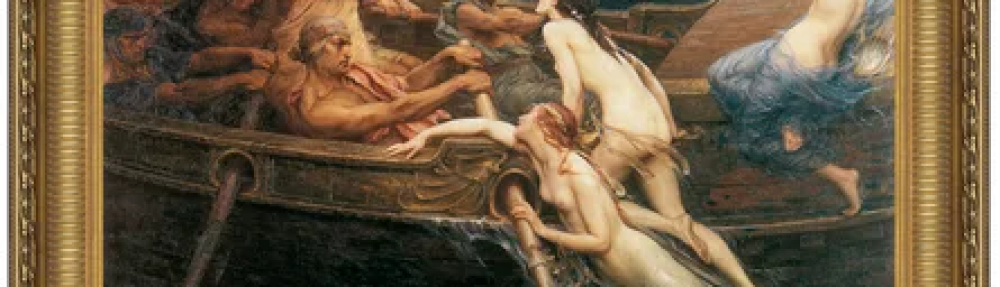
Discovery #1: Man vs. Mermaid

In Chapter 14: “Betrayal” from The Romance of the Faery Melusine, we are introduced to Melusine’s true form as a mermaid and her lover, Raymondin’s reaction to his perception of this new profound information. Prior to his discovery of the truth of Melusine’s true identity as a mermaid, we find him glancing at a tapestry, one which included a faun. He initially felt feelings of angst, followed by subsequent calm when he realized he could easily kill the creature. Why did Raymondin feel peace in the thought of killing the faun within the tapestry? The faun foreshadows the eventual reveal that Melusine is a mermaid, paralleling one subhuman creature, a mermaid, with another, the faun. Therefore, by exerting control over the faun by fantasizing about its demise, Raymondin seeks to regain the control he has lost by his wife’s secrecy by killing a subhuman creature similar to his wife. This dynamic aligns with the common depictions of the relationship between men and mermaids, where men attempt to conquer mermaids, since mermaids represent agency and knowledge. 

A faun, similar to a Mermaid, is sub-human. It is half man and half goat, a creature whose connection to nature is deeper than that of Raymondin’s, as exemplified by the tapestry’s depiction of the Faun immersed in nature, “He gazed at a fine tapestry which showed birds surrounding a page, on the ground and in flight, in an orchard full of flowers in which the colours of wings and petals combined. But while he saw nothing of that, he noted in the frame, filigreed in thin golden wire, a lively faun with open legs, and on its forehead two long horns that seemed to mock him” (Pg. 119).  Raymondin couldn’t see beyond the greenery, and detailed nature depicted, but was hyperfixed on the faun and the inadequate feelings it induced within him. The horns signifying power and strength, which Raymondin doesn’t have within the dynamic with his partner. Therefore, it brought Raymondin peace in having the thought of killing the faun within the tapestry, “[…] whatever the nature of the struggle, when it came to the end, however perfect his armour, he could, if need be, kill him. This thought calmed him for a moment […]” (Pg. 119). The betrayal for Raymondin may also be in how he can’t find peace in killing her, unlike the faun. One way to regain his power where the circumstances of control with Melusine and her boundaries are out of his hands, is through the imagined killing of the faun.

It’s important to note the way the faun is posed with its open legs, yet another parallel with Melusine. The sexual pose in which the faun is displayed, embodies the same sexuality depicted as Melusine combs through her hair as Raymondin found her, “Her bent back magnificent in profile, her breasts raised, as she combed her long golden hair […]” (Pg. 125). A common symbol of self gratification for mermaids, is combing through their hair with a comb. Raymondin sees this and realizes she has agency, no real need for him, and is doing so while enjoying her time alone in a space where he isn’t welcomed, “In her other hand she held a mirror, its crystal reflecting the moonlight on her face, which despite the life that animated it as she smiled to herself, gave it an almost lifeless quality” (Pg. 125). Melusine smiled at herself and enjoyed the space she had created for herself, given that she is a “fish” out of water within Raymondin’s natural habitat, just like the faun. The Faun and Melusine are both prisoners confined to unnatural environments where they don’t belong. She is in her space while holding her mirror, a symbol of her vanity, but also the acceptance she has for her circumstances unlike her partner’s immediate reaction, who has just become aware. This revelation illuminated Melusine’s other world, knowledge that she was actively choosing to hold it from him. Raymondin realised that his involvement in her life, or what he thought he knew about her, turned out to be further from his truth.

While Raymondin went against Melusine’s wishes by not respecting her clear boundaries, he was also betrayed by his lover.  Besides the dishonesty from Melusine, the reveal of her true form was the ultimate betrayal. Not knowing Melusine’s secret drove him insane, and his selfish desire for knowledge and power transformed him, “It was as if his reason, blind to other issues, was confined to a desperate will to know, which ended almost transforming him into another being” (Pg. 120), his desperation making him reminiscent of other sub-human creatures. Raymondin’s desire to know all leads him to break Melusine’s boundary, which will inadvertently harm their marriage. Even though he went against Melusine’s request, his betrayal felt justified because at least he was fighting to save her from “the devil”, which are really his own internal demons he was trying to save himself from, as further evidenced by the text’s religious assertion that, “[…] he fought on the side of God” (Pg. 121). It seems as though Melusine was the one in power, even within the confines of her own prison, without a God to act out for other than what her own needs are.

Melusine and the faun, while completely different beings of nature, share similar circumstances. Both of them are placed within unnatural environments limiting their ability to live freely in a world made to serve man. Each of them hold power over Raymondin which leads him to become a sub-human creature just like them. Even with the differences between the sub-human creatures and Raymondin, Melusine would not be the one found in the same circumstances as her beloved husband. Transforming into a creature hungry for knowledge, and eager for power. 

Why Science Alone Can’t Save the Planet

In Chapter 1 of The Environmental Humanities: A Critical Introduction, Emmett and Nye argue that “scientists excel at identifying and explaining such problems, but they alone cannot solve them. Solutions will require political and cultural expertise as well” (1). This passage makes it clear that the main idea of environmental humanities is that ecological crises are not merely scientific issues but also fundamentally cultural and ethical ones. The authors do a good job of juxtaposing the precision of scientific discovery with the failures of implementation. By using the Shanghai ecological community project, which was never built, because it ignored local farmers and scientists “studying rare birds” (2). The text reads as a confident declaration of what science can do, but then slowly turns into using words of limitation like “cannot solve” or “require”, which mirrors how knowledge without cultural context can result in the collapse of inaction.

By using examples such as “floating islands of plastic” and “garbage produced by human consumption,” Emmett and Nye evoke a vivid imagery of excess and waste for their audience, yet the moral emphasis is not on catastrophe but more so on human responsibility (1). The repetition of “we believe” throughout that same passage functions rhetorically like a creed, positioning the environmental humanities as an ethical community that is grounded in both conviction and collaboration. The authors’ use of language, using phrases like “constructive knowledge,” contrasts sharply with the rhetoric of crisis that often dominates environmental discourse. Their insistence that “humanists must offer constructive knowledge as well as criticism” redefines the role of humanities scholars from detached observers into activists in environmental problem-solving (2).

All in all, the Shanghai example used in Chapter 1 dramatizes the failure of hierarchical solutions for environmental change and highlights the need for interdisciplinarity rooted in local histories and their cultures. The text’s moral arc moves from scientific detachment to ecological empathy, further suggesting that effective environmental action must integrate a narrative, have ethics, and social understanding. In this sense, Emmett and Nye transform environmental thought from a study of nature’s decline into a humanistic question about how cultures choose to live on this planet–an intellectual and moral shift that defines the emergence of the field of environmental humanities itself.

Undine and the Living World of Nature

Undine and the Living World of Nature

Many struggle and face emotions of lacking belonging, despite having community. In “The Day After the Wedding, from Undine,” Undine’s description of the elemental spirits reveals how humanity views nature and the earth as alive and full of personality, yet separate from themselves. Each element being given human traits makes nature both feel more familiar and more mysterious. This is a reflection of Undine’s own identity feeling stuck between two worlds. This suggests that the story is really asking whether the boundary between humans and nature exists at all, and given Undine’s struggles not feeling a part of either world despite being caught between the two means there is no real boundary between humans and nature; only one the imagination creates 

Undine tells her husband, “There are beings in the elements which almost appear like mortals, and which rarely allow themselves to become visible to your race. Wonderful salamanders glitter and sport in the flames; lean and malicious gnomes dwell deep under the earth; spirits, belonging to the air, wander through the forests; and a vast family of water spirits live in the lakes and streams and brooks”(Penguin 103). Here, she describes them in a way that makes nature seem almost like it’s alive and aware of itself. She organizes nature into different categories. Some spirits sound enchanting while others feel dangerous but they all align to “your race” meaning human beings. This separation creates the idea that these creatures are like humans but not quite, which makes them something mysterious but beyond human control. This reflects Undine’s identity as someone who exists between two worlds. One human and one elemental. 

When Undine begins describing these spirits, she speaks with a type of power, as if she’s telling the human world a secret. She says, “there are beings in the elements which appear almost like mortals, and which rarely allow themselves to become visible to your race”. When she says “almost like mortals” it suggests both similarity and difference at the same time. These spirits are not fully human but they aren’t completely different either. They seem to exist on the edge of what humans can recognize, close enough to share similarities but strange enough to stay mysterious. The word “rarely” shows the control the spirits have as they “allow” themselves to be seen, meaning that nature can decide when to reveal itself. This gives power to the natural world because it’s something that humans will never be able to fully control or understand. Instead, nature chooses when to be visible, when to interact, and when to stay hidden. 

Undine then goes on to describe each type of elemental being. She says “Wonderful salamanders glitter and sport in the flames; and malicious gnomes dwell within the earth; spirits belonging to the air wander through the forests; and a vast family of water spirits live in the lakes and streams and brooks.” Each element, fire, air and water come alive with different movements and behavior. When she says “glitter”, “sport” and “wander” she gives the elements a sort of energy that makes the natural world feel expressive. Even the gnomes, who are described as “malicious,” show that nature has moods and emotions because it’s not always peaceful. By giving each element its own personality, Fouqué is able to humanize nature without taking away its wildness. He creates a world that feels enchanted but also believable, as if every part of nature has its own community with its own emotions. 

This specific passage made me change the way I think about the relationship between humans and nature. Usually, people see nature as something that’s separate. Something to look at, control or use. However, in Undine’s description, that separation doesn’t really exist. The natural world has its own personalities and emotions. Humans just happen to live alongside it. I think this makes the world Undine lives in almost feel like the human world thinks it’s in charge and the elemental just secretly shapes everything around it. The spirits “rarely allow themselves to become visible,” but that doesn’t mean they aren’t there. It just means humans have forgotten how to see them.

Undine becomes the bridge between these two worlds. She reminds us that she belongs to the water spirits but she has to explain this unknown reality to her husband and try to make him understand a world that he’s never seen. Undine’s description of the elemental spirits also reflects her own inner conflict. She knows the world she’s talking about because she’s part of it. She belongs to the water spirits she describes, but at the same time, she has to explain that world to her human husband, which shows how far away she’s drifted from it. She’s caught between knowing and explaining, between belonging to nature and trying to fit into the human world. This mirrors her identity throughout the story. She wants to love and live like a human, something the elemental spirits can’t do, but that wish also separates her from the world she came from.

There’s also something spiritual about how Undine describes these beings. They are not just “creatures” of nature, they are beings each with their own spark. The natural world in Undine isn’t just a collection of physical elements, it’s full of souls. This suggests that spiritual life exists everywhere, not just in humans. The way Undine speaks about these spirits gives nature a moral and emotional sense that challenges the idea of human superiority. The natural world becomes something sacred, deserving of respect and wonder, not human domination.Fouque doesn’t just use Undine’s words to create a fantasy world; he uses them to question the way humans see themselves in relation to nature. If there are spirits “almost like mortals” in fire, earth, air, and water, then humans are not separate from nature at all, they are just one kind of being among many. Undine’s description forced me to see the environment not as something outside of us, but as something that shares our emotions, our struggles, and maybe even our souls with. This moment in Undine stands out because it redefines what it means to be alive. It made me imagine a world where the natural elements have consciousness and purpose. Through Undine’s voice, Fouqué suggests that the boundary between humans and nature is something humans invented to feel special, but actually, we’re part of the same living system. Undine’s words remind us that nature isn’t silent. It’s full of stories, life, and emotions that we’ve simply forgotten how to hear.

Soul-Bearing vs Soulless: Who conquers the Environment?

In Undine, Fouqué contrasts soulless elemental beings with soul-bearing humans, since the elements are “obedient to [the elements] while they live,” yet humans’ disconnection from the environment causes some elements to “rarely allow themselves to become visible to [humans].” By showcasing the effortless harmony elemental beings have with nature and the subsequent lack of connection humans have, “Hence we have also no soul; the element moves us” (Penguin, 105). This story serves as an allegory about the corruption of the human soul, demonstrating how soul-bearing humans will always have a fractured relationship with nature than the soulless elementals, because of human innate soulful dedication to leave a legacy.

In the chapter “The Day after the Wedding,” Undine by Fouqué, Undine reveals she is a water spirit, a being a nature with no human soul. Undine opens herself vulnerably to her husband, recalling to him her life as an elemental spirit and her journey of acquiring a soul through their love. Undine begins her confession by stating her lack of a human soul, “Hence we have also no soul,” demonstrating that elemental beings are naturally separate, but nature itself does not possess them. The elemental spirit guides them. There is no definitive ‘bible’ for the elemental way to live; there are no ‘rights’ or ‘wrongs’. They do not have the consciousness to feel guilt or judgment. Undine’s element of water is the giver of her life: “The element moves us, and is often obedient to us while we live, though it scatters to us when we die.” Undine’s element is clearly water, which sustains her life, although her relationship with it does not embody loyalty over death, unlike human religion or marriage. There is no single all-powerful being or creator of all elementals, and when an elemental dies, its body is returned to the environment. There is, in fact, no afterlife for the elementals. Their bodies are  “scattering to dust,” emphasizing that Undine has never had to put pressure on her death; when she passes, there is no hope for a “heaven”, there is no conscious idea of lifelong judgment of a higher power, or the importance of a legacy one leaves behind on earth. Undine will not have to face her creator and have her fate decided.  For Undine, life was meant to be lived simply, not to seek a purpose until she found love. Her life before marriage, “ we merry, without aught to grieve us – merry as the nightingales and little goldfish and other pretty children of nature.” Undine highlights her past life of innocence, comparing the nature of nightingales and goldfish, creatures that do not experience complex feelings of grief and love, suggesting that before gaining a soul, she did have the emotional capacity for despair. This comparison demonstrates that acquiring a human soul through love has now awakened these feelings of suffering. This moment is an emotional and spiritual turning point for Undine as she reminisces on her old life and commits to the mortal world. Undine is no longer a “pretty child of nature”, she is a woman, vulnerable, soulful, and capable of deep happiness and suffering. 

The idea that nature was “often obedient” to Undine shows that her relationship with her element is a mutual one, where both respond and listen to each other, rather than one trying to dominate the other There is a natural rhythm between them, as there is no open space for betrayal between Undine and the water, no grief, soul, or moral burden. This demonstrates the idealized natural state where humans can be part of the ecosystem rather than the master over it, living a balanced life. Humans want a simple relationship with the environment, but their self-awareness complicates harmony because their own motives become their worst enemies. Undine explains to her lover that the elementals do not feel safety or a sense of connection to humans, stating, “in the elements which almost appear like mortals, and which rarely allow themselves to become visible to your race” (Penguin,104). This demonstrates how nature has to adapt to human life. Humans become so involved in their own devotion to purifying their souls to reach salvation that they do not take the time to comprehend the environment as a world of its own. In the rise of industrialization, humans became obsessed with creating innovations that would improve human livelihood. Humans began to see themselves as superior to the environment and became devoted to their own kind, neglecting a thought for a life outside of their own. In the afterlife, “mortals hereafter awake to a purer life,” meanwhile, the elementals return to the earth, showcasing the lack of urgency humans have to protect the environment, as nature does not serve them in the end to their salvation. The environment does not ‘collect’ or ‘save’ their soul, so to humans this serves nothing to their legacy. The pressures of having a soul bring selfishness to a person who cannot conceptualize a life without their presence. The ‘eternalness’ of a soul creates a hierarchy, leaving everyone or anything at the bottom to be used for their moral gain.   

Undine’s transformation of acquiring her soul through love mirrors the separation humans gain by their consciousness. These complexities of despair disconnect them from the natural world, and the sense of solidarity dissolves into selfish actions. Undine becomes more disconnected from her element as civilization distances her from her natural rhythm and environment. To maintain a sliver of her elemental life, she must hide herself away to indulge in her elemental form. She goes back and forth on the idea of revealing herself to her lover, because of her observation and discretion of the elemental life towards humans. Though, as Undine assimilates to the mortal world of humans, her desire for a soul increases, because of the emphasis of power placed upon the ‘soul bearing’. The cycle of life and death of the elemental showcases the dual role of the environment, the nurturing and indifferent. As “the element moves us…though it scatters us to dust when we die..” illuminates that when the elementals are alive, nature nurtures and obeys, but in death, it reclaims and dissolves, once again demonstrating this rhythm, the elemental creatures live within the environment. The soulless elementals do not need to establish their presence in nature to feel accomplished or worthy. In terms of humans, this cycle only emphasizes their lack of control over the environment. So, humans find a way to conquer by making the environment ‘livable’ to their needs. Fouqué showcases that nature will always outlast and outpower humans; time is always fleeting for the ‘soul-bearing,’ so their sense of urgency to conquer and leave a legacy only becomes fuel to their destruction. 

This story of Undines demonstrates that the ‘soul bearing’ human leads to an imbalance and tension within the relationship to the environment. Ultimately, it serves as an allegory about the corruption of the human soul, fueling egotistical ideation of superiority over the environment, causing the shattering of their relationship with the environment. When humans reject what they cannot control, this leads to destruction. With the story of Undine, Fouqué showcases how humans cannot live meaningfully with a soul while still honoring and remaining in harmony with the natural world.

Boundaries and the Poetics of Desire in “The Little Mermaid”

In Hans Christian Andersen’s The Little Mermaid, the natural world is described as not a static realm of beauty or terror but as a fluid, layered space of constant boundaries and thresholds–between sea and land, body and soul, sight and silence. The mermaid’s journey is not simply about yearning for love or immortality; it is about confronting the boundaries that define her existence itself. From the story’s first line, Andersen creates a world that is so dazzlingly transparent yet unreachable, “…at sea, the water is as blue as the prettiest cornflowers, and as clear as the purest crystal. But it is very deep–so deep, indeed, that no rope can fathom it” (108). This opening image establishes the story’s main paradox: what can be seen cannot always be in reach. In Andersen’s universe, beauty and desire exist behind this glass–something visible and almost tangible, but forever slightly out of reach. His tale becomes a meditation on longing as both an act of vision and a form of suffering. 

Yet Andersen does not romanticize this world that is full of boundaries. His oceanic imagery has both wonder and peril, clarity and concealment. The mermaid’s world glitters with visible barriers such as the “tall pointed windows of the clearest amber” of her father’s palace (108), the “broad flight of marble steps, the last of which reached down into the sea” (117), and the “clear pure air to the bright stars above” (118). These images of transparency invite vision but with a resistance to entry, which evokes the sense of a space where perception is always partial. In a sense, Andersen makes the ocean itself into a metaphor for consciousness–radiant but not clear at its depths. Like the wolves prowling the edge of the forest in the medieval world of “The Great Old Hunter,” the boundaries of Andersen’s sea suggest a moral and spiritual front; a place that both tempts and tests the soul. The Little Mermaid’s desire to cross those borders becomes a spiritual trial in which every one of her acts of seeing the other side comes with pain.

Each transition in the tale turns this metaphor into a physical experience. In the mermaid’s first transformation, turning fifteen, she comes to the surface to see the human world, and she becomes almost like a ghostly spectator. She watches a ship with “gay-coloured lanterns” and filled with music and light, yet she remains invisible to those aboard the ship (113). Her rescue of the prince occurs in the same paradoxical mode; it’s an act of intimacy that once again leaves her unseen. She kisses his forehead and saves his life, but when he awakens, “he did not send her a smile, neither did he know she had saved him” (116). Her desire–her wanting–to be seen turns into an experience of erasure. In this way, Andersen redefines love not as a union, but as asymmetrical. He creates this relationship between the mermaid and the prince to be a longing that can be seen but not touched.

The mermaid’s second transformation–the one that brings her from sea to land–literalizes the pain of crossing these boundaries. The sea witch warns her that every step will feel as if she were “treading upon such sharp knives” (121). This bodily torment turns her desire to be a part of another world into a kind of sacred suffering that echoes the Christian imagery of martyrdom that runs quietly beneath the tale’s surface. In giving up her voice for the mere chance to be with the prince, she trades her speech for silence and her agency for suffering. The loss of her voice, however, does not mute her completely. Andersen writes that her “expressive eyes” could express what her tongue could not (122). Yet this communication through her eyes, through something purely visible, exposes the same problem that controls the story’s imagery; seeing is not understanding. The prince reads her gaze as affection, but he has no understanding of the true pain she has undergone to be on the surface with him. Andersen’s choice to render their language as sight rather than sound only dramatizes the failure of expression across these boundaries–what happens when one world’s meaning cannot translate into another’s.

Even the story’s setting for sound reflects this fracture. The little mermaid’s sisters sing above the waves, but their song is distorted by the storm, heard by sailors only as “howling of the tempest” (112). This moment mirrors the earlier crystal clear imagery: something pure becomes broken or fragmented at the surface to the other side. Andersen uses these recurring distortions–of light, sound, and sense–to show how borders not only separate but also transform. The result is a poetics of a half-understanding of knowledge, where perception is being filtered through glass, water, and air. These are physical barriers that become emotional and spiritual, all while defining the mermaid’s tragedy of always being almost close enough to experience a life she cannot have.

When the mermaid’s journey ends not in marriage but dissolving into the sea, the story reaches its most haunting image of her final transformation. As she throws herself into the sea and becomes foam, she expects only the “pangs of death” (129). Instead, she awakens “amongst the daughters of the air,” the invisible spirits who tell her she has gained a soul, a new way of living, through her selflessness (129). On one level, this conclusion resolves the moral logic of Andersen’s ‘fairy’ tale of virtue and suffering that yield a spiritual reward. But on another level, it reaffirms the same paradox that began the story. Her final transformation–an invisible, airy being–truly embodies pure permeability. She has crossed every boundary, but only by losing her mermaid form. To cross and transcend the limits of vision and voice, she must become the very medium through which others see and hear. Her ultimate price of unionization of the two is almost like she needs to disappear. 

What makes Andersen’s ending so moving is that it refuses the consolations of romantic fulfillment. The mermaid’s transformation into air isn’t a victory but an acceptance that desire itself is the boundary that gives meaning to being. Andersen’s moral vision, like his imagery, is transparent yet unfathomable. He suggests that longing for something isn’t a flaw that needs to be cured but a necessary tension that lies between beauty and loss. Therefore, the story operates as a spiritual allegory–the mermaid’s love for the prince mirrors humanity’s longing for transcendence, a yearning to reach beyond the glass of the material world. Yet that same longing exposes the pain of separation between the visible and invisible, the human and divine.

To conclude, The Little Mermaid asks readers to dwell at the edge rather than cross it. Andersen’s tale, like the crystal clear sea that opens the story, insists that what shines beyond reach is what teaches us to feel, to hope, to mourn. The mermaid’s fate, which is neither entirely tragic nor redemptive, captures the fragile balance between body and soul and between being able to see and being seen. Her transformations show readers a moral map in which every ascension–from sea, land, to air–each movement shows that beauty and suffering are both connected. To live, for Andersen, is to live at the border of what’s possible, to feel both the ache of an incompletion and the holiness of longing. The mermaid’s world reminds us that the boundaries we cannot cross are also the ones that define us, shimmering just beyond our reach like light through the water. Painful, distant, and endlessly alive.

Fearing What Cannot Be Controlled

In Andre Lebey’s The Romance of the Faery Melusine, the conflict between Raymondin and Melusine is not only about love or trust, it is also about humanity’s fear of nature. This story shows how people try to control what they don’t understand. Raymondin’s growing suspicion toward his wife reflects how humans often react to nature, by fearing and trying to dominate it. His imagination does not just destroy his relationship but also represents a deeper idea about how humans separate themselves from the natural world.

When Raymondin breaks his promise and climbs the stairs to see Melusine, Lebey writes, “he climbed quickly in his eagerness to strike, his heart pumping under his coat of mail as he climbed the narrow winding stair, steeper and steeper, to the very top. There where he had never been before. Neither he, nor anyone, except her – and – who else?” (121). The words “strike” and “heart pumping” create a sense of aggression and tension. He is not moving with love or curiosity, but with the same mindset people have when they want to conquer something unknown. The place “where he had never been before” can be read as more than a room, it symbolizes the natural world that humans are not meant to control. Melusine’s private space becomes a kind of sacred natural environment, one that Raymondin violates out of fear and jealousy. By doing this, he repeats what humans have done for centuries, entering spaces that should remain untouched, just to prove their control over them.

Raymondin’s fear of Melusine’s true form reflects a larger pattern of how people view nature as dangerous or monstrous when it resists control. Melusine, being half human and half water spirit, represents the connection between the human and natural worlds. Instead of seeing her hybridity as something beautiful or balanced, Raymondin sees it as a threat. His imagination turns her into something unnatural and terrifying, showing how easily humans misinterpret what they cannot explain. Through him, Lebey suggests that the real monster is not the creature in the water but the human who cannot coexist with it.

Lebey’s use of sound and movement strengthens the theme of human intrusion into nature. When Raymondin secretly enters Melusine’s hidden space, “he heard not far away, in a place that he could not yet see, a strange sound of splashing water” (123). This soft, rhythmic sound contrasts with his tense and fearful state, showing how calm the natural world is before human interference. As he looks closer, the description of “a tail of green scales stretched under the water made the water lilies move” (125) links beauty and motion, emphasizing the harmony between Melusine and her environment. Yet this harmony disappears the moment Raymondin appears. The sound of water and the movement of lilies reflect the balance of nature that he cannot understand. By entering this quiet, living space, Raymondin’s curiosity and fear turn natural peace into disturbance. Lebey’s language connects his emotional tension with environmental imbalance, reminding us that when humans invade what they cannot comprehend, they destroy both mystery and harmony.

At the end of the story, Melusine disappears back into the air and water, returning to the world she came from. This moment can be read as a form of restoration. She escapes the control and misunderstanding of human society and becomes free again. Raymondin, left alone, represents humanity’s loneliness after separating itself from nature. Lebey’s retelling of Melusine reminds us that when people fear what they can’t control, they end up destroying both their relationships and the natural world that gives them life.

The Life of a Siren

The usage of mermaids in media, specifically in song writing and visuals, emphasizes this allegory between them and women grappling with their relationships, good or bad. In Taylor Swift’s new music video, The Fate of Ophelia, she utilizes mermaid visuals at one point in order to reflect this siren-like beckoning that love often brings, only to be met by betrayal. However, in recognizing the incredibly particular details of her portrayal of them, it creates the antithesis of the narrative that sirens solely act as villains of the a man’s story, existing to lure and deceive; rather, she chooses to recognize them as these elusive, but real and necessary, sentient characters with their own story to represent.

The song itself, from the title alone, reflects deep connections to literature. Taylor reflects on the story of Ophelia from Shakespearean literature, a character who was driven mad  by the men around her and her lack of value to them as a human being to the point that she drowned herself, Within the music video, she creates multiple textually based worlds to continuously relate this concept throughout storytelling of various women. At one minute and fifty-one seconds, four mermaids appear at the bottom of a pirate ship visual, indicating the first of many direct correlations to mermaid literature. 

Their appearance comes in as the lyrics “And if you’d never called for me” (Swift, 1:51-1:54) are sung, sparking this stereotypical connection to sirens. In most stories, their fate lies in luring men from safety, down dark and treacherous paths into the sea and inevitably, to their deaths. Them resting in the water, at the bottom near the plank she’s eventually forced to walk off the ship additionally reinforces this narrative of how mermaid-esque creatures seem to drag them into danger. This translates into women and love, as sirens often represent the parts of women that make them so desirable externally, and simultaneously, their internal softness. Even if it seems willing, surroundings seem to coerce the gentleness of women into giving in, knowing how it only brings ruin to their most vulnerable selves. This association of entrapment to mermaids and sirens, combined with escalating visuals of fighting between the pirates and Swift’s character in that moment, all points to this overwhelming theme that women are doomed in love, as are men lured by sirens. No real joy can find them as long as they are haunted by this narrative, as long as they are always seen this way. 

However, she spins the narrative in order to reflect the reality, that this love she’s referring to, that real and genuine love truly proves the opposite of all of these expectations previously written out for women. The sirens never instigate harm; in fact, they never reach for her at all, or anyone for that matter. It really reflects sirens and their connection to women as defenders, rather than seeking to draw them in the way they do with men. They aim to protect here, to act as this shield from falling into deceitful love once again. At the same time, the lyric continues to say “I might’ve lingered in purgatory”(1:55-1:58), referring to this despondence felt in that post-relationship state. In nearly every telling of sirens, their seeking out of a human being destroys the mortal’s life; the minute they choose to “fall”, they become stuck in this situation and oftentimes, never escape their ultimate fate of death. Referencing this saving, this ability to escape, shifts their alignment to be that of a positive ideal, that sirens existence does not automatically mean everything to follow will crumble. It brings them again as a figure of admiration for women, as a sense of security to their innermost selves. If anything, it juxtaposes typicality of love in the means of a couple; their individual existence, that whole and real love coming from them, saves human beings, namely women, from this unfortunate fate. 

These antitheses only seem to escalate when recognizing even the most minute details of lyric choice. In the previous verse, the same line ends in “I might’ve drowned in the melancholy” (Swift, 0:39-0:42). The usage of drown to a visual completely unrelated to sirens, and linger when they are present furthers this intention to alter the beliefs surrounding siren nature, and thereby love. Keeping them entirely separate from these visuals of death with the water emphasizes them as non-harmful aquatic beings; their existence does not automatically mean death by drowning, rather an eventually peaceful and hopeful resurfacing to ease. Love’s existence, women being engulfed in it does not equate to an immediately crushing demise, but a soft and easy landing into this fate of finding more. 

Imagery that affiliates itself with sirens comes into play once more in her lyricism, as she describes how love wraps around her “like a chain, a crown, a vine, pulling me into the fire” (2:00-2:07). It almost acts as a recall to this association of entrapment and fire’s correlation with eventual destruction. Again though, this wrapping visualizes how these sirens are seen as something enclosing and withholding, when it lies in the eyes of those witnessing and experiencing. This surrounding becomes a positive thing, the way sirens act as this kindness to women by shielding them. In the same sense, this encasing nature that’s referenced in the lyrics becomes actualized in the way that this all-consuming love seems to act as a force-field, as this barrier between happiness and hopelessness. It encompasses as a protection and finalizes the place of sirens as the image of safety, of how love’s all-consuming nature only aids it in its forcefield like state.

While all of the messaging points to this idea of love, of romance, it really fleshes itself out in the overall messaging behind Swift’s entire era. The Life of a Showgirl depicts this need to perform, as a celebrity, as a musician, and above it all, as a woman. Every visual within the music video references this showgirl like quality of womanhood, a constant need to be acting put together and impressing. Sirens and mermaids alike feel like one of the oldest representations of this feminine need to perform, to act in order to have their presence validated and valued. From stories like Undine to shield the ugly, or the Little Mermaid giving herself up entirely, women sacrifice and reshape themselves all for the love they think Swift pushes. This love she refers to really means within us; the woman’s need to wholeheartedly accept who she is, to accept the dirty siren that is so constantly demonized because, at her heart, she is good. This constant rejection of who truly lies underneath the “human” half must end; we must find acceptance of our whole mermaids in order to save ourselves from that treacherous “Fate of Ophelia”. 

Dangerous Dualities

Cronon’s “Trouble with Wilderness” begins to tear apart the “man/nature” false dichotomy; Emmet and Nye’s “A critical introduction” sets up a parallel dichotomy; “Science/Humanities”. In order to dismantle the first— the “dangerous dualism that sets human beings outside of nature” (Cronon, 17) we need to break down the second; “the nature/culture dichotomy that was common during much of the nineteenth and twentieth centuries” (Emmet & Nye, 9).

One of my best friends in middle school was a textbook ecofascist; he would admit with little prompting that he believed it would be for the best if the cancer of humanity were wiped from the earth. He would describe how cancer grows in a body. The conclusions were obvious to him. My other best friend (who had actually survived cancer and had no interest in being exterminated) put human rights above all other concerns. He would ask me how I could be worried about sea otters when people were dying of curable diseases. He was really invested in the repeal of prop 8, although we were twelve and obviously not getting married.

 I can not condemn in either for their adolescent zealotry— indeed, I admired (and still do) their philosophical fervor, impressive in people barely past puberty. However, their campaigns put them at fierce odds; one believing wholeheartedly in the necessary demise of humanity, to protect a wounded planet, and the other committed to human rights to the exclusion of environmental concerns.
Their rivalry is a perfect embodiment of these paradoxical polarities. As a twelve year old, I was perplexed; I couldn’t side with either friend against the other. Of course, I believed in the value of humans and human creations, and that human life and liberty was worth preserving— but I also believed in the value of old growth forests, of undiscovered marine life, of polar bears. Was it really possible that these two things existed in opposition to each other? That to save the planet was to doom humanity, and vice versa? 

My friends were not stupid. Their opposition mirrored one that has existed at least as long as this country. It took me years to form the understanding that these two “sides”, the rivalry between the Human and the Nonhuman, was a construct; these opposing ideas were created and pitted against each other by some force, and were not always mutually exclusive.

It took me years after that to realize that neither scientists nor humanitarians could work alone to effect the change either “team” wanted— that “scientists excel at identifying and explaining such problems, but they alone cannot solve them. Solutions will require political and cultural expertise as well,“ (Emmet & Nye, 6).

I hope you can all forgive me a lapse in close reading this week; the texts we’re discussing represent the foundation of my career and life’s work, and I am compelled to speak personally to them, since I cannot begin to unfold their neatly wrapped theses. As a “scientist”, I believe that my study of the humanities is indispensable to the success of my work— because my work is centered around eliminating the veil between the human and natural world.
My first goal is to show people that they are a part of the “natural” world; that ecology is everyones business. I mean– it happens inside of us! I want to show people that highly complex life exists on all scales and in all the spaces we occupy, that it is beautiful and cannot be escaped.
My second goal is to demystify science, and make it less intimidating to the layperson; to take it from an exclusive institution, “Science with a capital S”, to science, a practice/process which anyone can be involved in, and most people are.
My third goal is to always advocate for the value of human life, culture, and civilization; and to show the world that human society is simply another natural, ecological process on this planet. It follows the same rules as bacterial colonies and insect colonies and vast ecological systems. We have much to learn about how our society functions; we can learn that by observing different kinds of life; and, through this power of observation, we may be able to escape the natural selection process that might otherwise eliminate our lineage.

I regret I didn’t stay close enough to those two friends from middle school to know where they stand now. They were, for the record, very well rounded people— their rivalry was not one between a Scientist and a Sociologist, but between two intelligent people. Together we went down rabbit holes of etymology, immunology, the history of warfare, of music, botany, disability politics, rare diseases. But I want to credit them most of all for being so utterly convicted of what was important in the world that they inspired a philosophical crisis in me which shaped the rest of my life.

The Moral Cost of Industrialization in “Undine”

In “The Day After the Wedding, from Undine,” Undine’s speech focuses on the literary elements of nature, romanticizing and spiritualizing nature amongst a world of industrialization. Froqué’s romanticized and spiritualized depiction of nature is used to contrast and emphasize industrial and moral decay. By doing this, the audience understands the need to critique the moral and spiritual implications of industrialization, both in the past and in modern day. The consequence of modernization is nature’s purity and thus humanity’s spiritual decay. 

Undine begins her speech to Huldbrand by describing “A vast family of water spirits live in the lakes and streams and brooks. […] they wander over the pure sand of the sea, and among lovely variegated shells […] which the present is no longer worthy to enjoy” (Penguin 104). Froque vividly illustrates these water spirits environment that has “lakes and streams and brooks” as well as “lovely variegated shells.” Such imagery paints this place as magnificent and “other worldly.” Though somewhat supernatural the water spirits, contrastingly, are personified with human-like qualities such as “wandering” and “living;” suggesting movement and community in the environment. The mystical imagery, along with the aspects of human qualities amongst these spirits, present nature and wildlife (or the inhuman) as being very much alive and animated. This world and these entities in the quote and passage are descriptively romanticized, which makes sense for a 19th-century text. Specifically, this passage contains a lyrical quality in its alliteration within the s sounds of “streams and brooks” and “pure sand of the sea.” The alliteration gives the imagery rhythm that makes it literally sound as beautiful as the imagery paints it out to be. In turn, the imagery and romanticizing of this supernatural world and entity beautifies the “other,” turning it into something attractive. This attractiveness for which the “Other” has, is no longer “worthy” to be enjoyed by the “present,” or ideology of the industrial age, due to its push toward urban growth, destroying its beauty. 

Furthermore, Froqué not only romanticizes the water spirits but also exalts their beauty more than that of humans, emphasizing purity in things untouched by civilization. Undine tells Huldbrand that “Those, however, who dwell” in such elements “are very fair and lovely to behold, and for the most part more beautiful than human beings” (Penguin 105). Froqué, again, creates this ethereal image of beauty with diction such as “fair,” “lovely,” and “beautiful.” There is a hyperbolic sense of charm to Undine’s words, that water spirits are “more beautiful than humans.” It is a way of “exaggerating” the depiction of water spirits as manifestations of beauty and the supernatural perfection beyond human standards. Doing so idealizes nature, tying it back to Romantic themes, making nature pure and uncorrupted, whereas humankind has fallen, relating back to “the present” (ideology of the industrial age), no longer being “worthy to enjoy” its beauty. Froqué depicts the water spirits in this pure light to show the importance of and purity in what humankind’s urbanization cannot or has not touched, that it is important to uphold these things in a higher place than human nature. 

Later, as Undine continues her speech to Huldbrand, she confesses that her kind “vanish into dust, and pass away, body and spirit, so that none of the stage of us remains behind; and when you mortals hereafter awake to a purer life, we remain with the sand and the sparks and the wind and the waves” (Penguin 105). Dust, in this context, can be seen as a symbol of divine morality and the decay of industrialization. Modernization of nature turns nature to dust, eroding and destroying its purity. Undine describes these elements of nature, the “sand,” “wind,” and “waves” as idyllic and eternal, yet with industry’s materialism, these things are reduced to dust. This elemental imagery of dust reflects that of Genesis 3:19: “for dust thou art, and unto dust shalt thou return.” The scripture from the Book of Genesis is supposed to be a reminder that there is no amount of human achievement that can defy human destiny. Allusions to such scripture are used as a way to mourn how humankind’s “progress” loses its spiritual and natural connection to the environment, and due to Industrialization, people have turned the environment, not to a sacred dust, but to a polluted ash. Romantic ideals of spirituality are tied to Christian cosmology, “awakening to a purer life,” both of which long to move beyond industrial corruption and instead put spiritual and natural divinity above it. Ultimately, Undine’s fear of vanishing into dust reflects that of humanity’s fear of spiritually losing themselves amidst mechanization. A world in which moral worth is measured by production, and not a person’s soul. 

In the following quote from that stated previously Undine goes on to say that water spirits “have no souls; the element moves [them], and is often obedient to [them] while [they] live, though it scatters [them] to dust when [they] die; and [they] are merry, without having aught to give [them] […] but all beings aspire to be higher than they are” (Penguin 105). Froqué’s depiction of the water spirits as “soulless,” counteracts his previous hyperbolic depictions of their beauty. This contrast from being something beautifully lively to being “soulless” parallels what industrial society does to nature and its laborers. The people and environment become valued for their work and function, rather than what they have inside or, in other words, their soul. The environment and its elements, in this case, are personified—“the elements moves us.” The personification of the elements depicts Romantic views on nature having spiritual vitality, while the mechanical world, in contrast, “moves” humans with a mechanized obedience. Undine and the water spirits lack a “soul” is a symbol of modernization alienating people from the divine and natural world. The final line that “all beings aspire to be higher than they are” is a Romantic and Christian view on this need to reunite with the natural world’s surroundings. Christian rhetoric is used by Froqué as a means of expressing Romantic ideals. The use of Christian teleology critiques industrial times’ view on “progress” away from the sublime. Religious framing, in essence, reinforces Romantic ideals that salvation is not just found through faith but the preservation and restoration of spirituality with nature. 

Froqué’s Romanticization of nature in Undine’s speech functions as a moral critique of industrialization values. There is a spiritual cost in the name of “modern progress,” that the liveliness and purity of nature give way to “soullessness” in a world of industry. Undine’s speech to Huldbrand acts as a warning to him and humanity that a loss of connection to nature means losing connection to divinity, echoing Romantic and Christian ideals of morality. Froqué’s use of imagery elevates nature to a higher status as a way to call for humanity’s re-evaluation of “progress” as a connection to nature rather than industry. 

The Real Little Mermaid without a name

In the chapter “The little Mermaid” where the tale is about a mermaid with no name with a story and that being a mermaid is difficult because people know that you are different and people don’t really approve of you as being somebody. Also for wanting to escape her home life and having the desires of having good relationships with her sisters as well. In this version of the Little Mermaid has shown themes of the true nature of these Mermaids.

In Both versions the story contains same desire to escape from the ocean and the consistency are described as being alien to everyone else who is considered to be normal and nothing is wrong with them. Each of the mermaids have a different way of seeing things of why they are for example, The eldest princess has gotten to the age of fifteen to see the surface and what it led to is that wanting them to see what is on top of the ocean surface and it everything the eldest princess dreamed of. While the others princess have similar reactions to this except for one which was the fourth princesses wanted to remain into the deep ocean. In modern versions the portrayal of this particular scene was the that it only one of those princess that was depicted to the Little mermaid Disney movie. While the modern Mermaid movies was only light hearted story about a Mermaid to wanting to live outside of the ocean and in Hans Christien Anderson’s version of the story is much more in touch with the depictions of what people thought of Mermaids and more of inside view what it is really like for living a life of a Mermaid.