Final

To be honest, I’m not sure on what I want to write about for this final. So far I have been enjoying “The Deep” so maybe I might write about that. Perhaps after getting further into the book I will know more about what I want to base my essay on. After that, i definitely need to look into scholarly articles for the essay.

So far, I have an interest in the trauma and memories revived the body. “Rememory” as well.

Final Project Idea

Honestly, I have ZERO idea of what I want to do for this final. I definitely want to do something creative, I don’t know if I want to do a kind of playlist for this course? Since I have been putting songs at the end of every post, I feel like that would be good, but I would definitely struggle with the thesis for that. I’m not sure how I would tie it into the course. I think I could also do a playlist for a specific text or video we watched. I feel like making a playlist for “The Water Will Carry Us Home” would be a good one. I feel that there I would definitely need to focus on something specific, I struggle with my essays being too broad and trying to close read and stay on one topic. I want to stick with the music aspect, because other than creative writing, music is something I have a really great interest in. So, either make a song to fit the stop motion film, or a playlist that leads you through the video. Making a song would be fun! So I definitely narrowed it down to two options while writing this so that’s great!

Final Project Research

As of now, I’m leaning towards using “The Trouble with Wilderness: Or, Getting Back to the Wrong Nature” by William Cronon for my final essay. To work on the essay, I want to research more academic texts about the creation of national parks and how they were created. This will help me gain a better understanding of the circumstances upon which they formed, to then frame the idea that “Wilderness” is based on human fantasies and ideals about what nature truly is. It highlights the notion that the perception of “Wilderness” is often on a grand scale and is seen as something that is usually out of the ordinary for most people, a place that is the antithesis of civilization and humanity.

Furthermore, I would also like to look into academic texts that explore more about how nature in urban environments helps connect humans back to “Wilderness.” I think this will help showcase that nature is truly all around us, making the idea of the wild arbitrary since the same elements of the “Wilderness” can be found in places that are seen as civilized. Nature and humans then become something that are interwoven together since they both exist in the same environment. This then complicates the idea that urban areas are simply for humans by illuminating the many ways in which nature is able to survive in places where humans exist in close proximity to nature. Researching more about nature in urban settings also helps show the importance of caring for nature in our cities since it is a sliver of the “wild” in our own backyards. Caring for the environment transforms into something that is part of daily life, making it more manageable for people to sustain and to live in tandem with the nature that surrounds them.

I also plan to reread the text to further strengthen my understanding of the reading in order to argue my point more clearly and accurately. As I read, I will also take notes so that I can close read a selected passage to the best of my ability and choose lines that will best accompany my argument.

Final Project Ideas

For my final project I have decided to do my essay on The Deep. I have really enjoyed the first four chapters and feel like there is a lot to discuss. I want to focus on history, though maybe more so on the trauma that lingers from history. I need to keep on reading to really know exactly what my thesis will discuss. With that, what I need to learn for my project is based mainly on doing the reading, as well as doing some research for the outside sources for the final project. Possibly doing research in our school online database on The Deep, as well as research on ancestral trauma from history.

Hopefully feedback on Tuesday from my peers will help me with direction and clarity on my thesis!

Final Project To Do:

I have decided my final project will be an essay about The Deep, elaborating and researching the concept of History. I want to navigate intergenerational trauma and how we tell these narratives ethically and fully, discussing how the body holds memories, trauma, and history.

First, I need to complete the novel, or at least make significant progress in the story. While reading, I must take notes to help gather information for my paper. Then, I need to search for scholarly commentary on The Deep, particularly regarding this topic, to enhance my understanding of the story and develop a claim for my essay. Finally, I need to piece together my findings and create an outline for this final paper.

I am looking forward to my peers’ feedback on Tuesday to help develop a strong Thesis to create a strong paper.

Final Project (Essay) To-Do

For my Final Project (Essay) I need learn more about The Little Mermaid in reference to crossing of borders and the sociopolitical implications. There are a few academic papers I have been reviewing to better understand the more political elements of the story I am not familiar with. I plan to compare the Hans Christian Anderson’s The Little Mermaid to the story of Melusine and possibly to the film The Lure, which has comparable elements of The Little Mermaid’s lore of the lives of mermaids. I also need to learn more about how the story of Melusine is depicted in sociopolitical academic analysis.

Before I begin my Final Project (Essay) I need to reread The Little Mermaid and the Melusine readings. After making my own notes I will research academic papers that address my approach and compose my thesis. I hope peer review will help me better establish my claims. Once that is set, I will select the references that best support my thesis and then compose an outline.

At this point I am not planning to do a visual or alternative media accompaniment to the essay.

Nature As a Means of Healing – WIP

In the short film “The Water will carry us home” 2018 the stop motion is a retelling of stolen Africans who are thrown off a slave ship while going through the Middle passage. This is a story of how humans’ relationship with nature heals, a story of rebirth in the face of tragedy. The stop-motion animation starts with what sounds to be tribal singing, and shots of relics, historical cultural items placed about. These material items tell a history, one that is tangible. A feminine figure is introduced, she appears to be doing a spiritual ritual, and this is when we are first shown a recurring theme, the third eye (1:01). The third eye can be seen throughout the stop motion, a symbol of seeing beyond what is hidden. There is a shift from live action film to water color 2D art, despite it being two dimensional the story holds much depth. With the historical context of this stop-motion, the tragedies of the middle passage are well-hidden in our written histories. This third eye is symbolic, allowing us to see what has been often overlooked from the enslaved Africans’ point of view. At 1:35 there are multiple doors, these doors we can assume open to different experiences and stories that are often untold. The story of the discarded slaves is just one out of the many. 

The image of the boat shows us the many enslaved people in crowded conditions, mixing media with a newspaper excerpt saying how the ship is holding “250 fine healthy negroes 3:05.” The description of these African people frames them as commodities, cargo that only values them for their labor. This newspaper excerpt is used to also show the different sides and narratives that were being released. The women who were deemed unhealthy and unfit, usually pregnant women were thrown overboard. At 4:00 and 4:23, there is one mother in particular that is lying in fetal form, surrounded by the ocean, she seems like a fetus in the womb. This detail further humanizes the victims and is a reminder that mothers are the children of others, and they deserve the same love and empathy too. The mothers turn into majestical mermaid, with a third eye, they are reborn again in the ocean. The third eye represents a spiritual rebirth as they become intertwined with the sea (4:33). 

We then transition back to live action film, a woman pays her respects and mourns the lives lost out at sea. The sea holds their stories and histories and tells it in a way that transcends the human language.

The Law Concerning Mermaids -WIP

The Law Concerning Mermaids — Kei Miller

There was once a law concerning mermaids. My friend thinks it a wondrous thing — that the British Empire was so thorough it had invented a law for everything. And in this law it was decreed: were any to be found in their usual spots, showing off like dolphins, sunbathing on rocks — they would no longer belong to themselves. And maybe this is the problem with empires: how they have forced us to live in a world lacking in mermaids — mermaids who understood that they simply were, and did not need permission to exist or to be beautiful. The law concerning mermaids only caused mermaids to pass a law concerning man: that they would never again cross our boundaries of sand; never again lift their torsos up from the surf; never again wave at sailors, salt dripping from their curls; would never again enter our dry and stifling world.

Miller crosses many threads in this short prose poem. Imperialism favors uniformity. In the first half of this poem, he sets up Mermaids as a symbol of the other among us; the human/nature which western colonial empires have sought to distance, separate, draw boundaries between, and ultimately, control, exploit. In the second half of the poem, he theorizes a form of resistance; if the surface of the sea has been drawn as a boundary between the man and the nonhuman world– mermaids can relinquish their terrestrial halves and escape the imperialist machine. The implications of this twenty first century poem about a (possibly fictional) centuries-old law are critical; now that human colonization and extraction has moved below the sea surface, instead of merely occurring on top of it, is there any place on earth where the “mermaid”– the other among us– can retreat to?

Week 13: Mother Nature and Mother Water

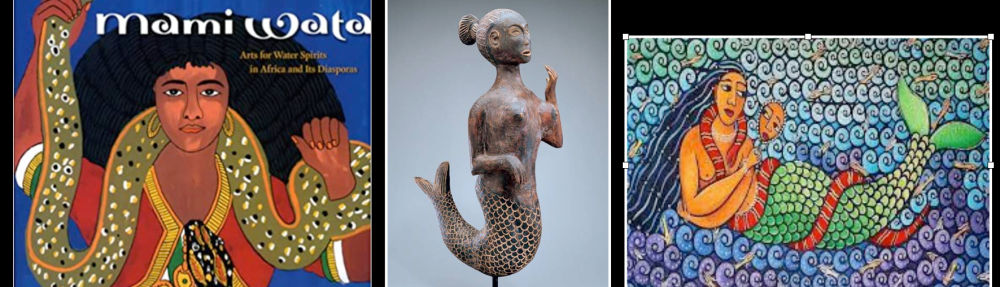
In the penguin reading for this week, “African Mermaids and Other Water Spirits”, I was very intrigued with the description of the female water spirit, Yemoja—the mother of the river spirits and thunder gods. But her role is much larger, spanning the world beyond Africa, as her legend and story spread during the transatlantic slave trade. She is referred to as “Mother of Fish” and “Mother Water” and is often “associated with family, women, motherhood, and the arts.”

This made me think about something we talked about earlier this semester in my Gender, Science, and Technology class. When we gender natural forces or just the natural world, such as calling nature female, then we can view the feminine as nurturing, but also as violent or irrational. The term “Mother Nature” is often endearing and allows us to frame the globe we live on as a gentle provider, fertile and forgiving. The same can be said for the idea of a water goddess, or “Mother Water.” A deity of great power, beauty, and fluidity. Eventually, she was used as a symbol of hope and comfort to victims of an international slave trade. A God to worship on water when the sea becomes like a battlefield.

However, it is also common for Mother Nature/Water to be seen as violent and brutal. Exploding into storms and not holding back. I guess that a God remains a God whether they are worshiped or feared. It seems that the word “mother” brings both comfort and distress. No matter what, the power of the word “mother” is very telling to the way in which we interpret motherhood and the lifeforce that women hold.

Discovery #2

strop on these goggles, I’ll guide you there myself.
It’s all subtle and submarine,
through colonnades of coral,

past the gothic windows of sea-fans
to where the crusty grouper, onyx-eyed,
blinks, weighted by its jewels, like a bald queen;

and these groined caves with barnacles
pitted like stone
are our cathedrals,

and the furnace before the hurricanes:
Gomorrah. Bones ground by windmills
into marl and cornmeal,

and that was Lamentations—
that was just Lamentations,
it was not History;

For this close reading, I aim to take a deeper look at Derek Walcott’s poem, “The Sea Is History”, particularly these five stanzas. In this passage from the poem, Walcott beautifully frames the ocean floor as its own cathedral or church of sorts. Throughout the poem, he uses the Old Testament and biblical references to equate the history of the slave trade with written religious History. At the poem’s climax, he finally confronts the irony and reshapes the Ocean into its own sacred place. Fusing the “natural” world with our perception of a divine and holy place. This passage exposes how Western historical education ignores the submerged history of the slave trade, placing written biblical tales on a higher plane than a physical archive of history, such as the ocean.  

In the very first line, Walcott writes, “Strop on these googles,” calling on his readers to look underwater and be witnesses to the concrete history hidden beneath the surface. This reminded me of a quote from David Helvarg we read earlier this semester, “More is known about the dark side of the moon than is known about the depths of the oceans.” Eurocentric education could utilize technology to uncover more about the slave trade, but it seems that when history reveals human flaws, it is often left buried, or rather, submerged. When Walcott uses phrases like “colonnades of coral” and “gothic windows of sea fans”, the imagery invokes us as readers to blend our religious practices, monuments, and architecture with the natural environment of the sea. Where our churches, propped up by columns and decorated with stained-glass windows, are our archive of time past and people lost. The sea is the same for the history of the Caribbean

slave trade. “Crusty grouper, onyx-eyed, blinks, weighted by its jewels, like a bald queen.” Perhaps this fish is a perfect metaphor for a decorated pope or priest. An integral part of this sacred submerged place. “And these groined caves with barnacles pitted like stone are our cathedrals.” The beauty of the sea and all it can create can be just as impressive and awe-inspiring as a human feat, such as the Notre Dame Cathedral. We count the days it took Michelangelo to paint the ceiling of the Sistine Chapel, but we do not tally how long it took for the caves to become “groined,” just like the ceiling of a church. And when we do discover information about the archaeological wonders that are sea caves, it is not added to our curriculum and spoon-fed to us. Just as the human church holds loss, suffering, and destruction within its history, so does the “sea church”. The sea also holds places like “Gomorrah”, a city of death and despair, destroyed for its sins. “Bones ground by windmills into marl and cornmeal.” The seafloor is a graveyard for more than just fish; the ocean acts as a cemetery for bodies, stores, and memories. There are bodies and items submerged that may never be discovered, but the story of brutality and cover-ups remains the same. Saltwater may erase physical evidence, but humans are the ones who tried to erase history first. When the education system fails to provide the proper setting and context for history, we are left with no concept of our impact off the land. The Middle Passage is taught as a transportation from one landmark to another, but what happened in between foreshadows all that follows on land. We can dig into the sparse historical accounts of the brutal, long journey, but we know that the voices drowned and all the stories silenced by pure fear are lost to history. If we can see the ocean as a physical archive of history, we could unravel the secrets hidden beneath layers of Eurocentric perspectives and written historical education.

As much as Walcott is calling on us to reframe our perspective of the ocean as a museum, literally, he is also calling us to dive into history itself. To determine the truth that lies beyond the surface of the written page. After all, there is heaps more history beyond the Bible and the moral lessons it holds. “And that was JUST Lamentations, it was not History.” This line packs the punch in this passage and really calls us to question everything we think we understand about history. In this line, we are reminded that just because something is written or material does not make it fact. With 8 years of catholic schooling under my belt, I’m no stranger to biblical texts being used as a tool for justification, as if it were almost scientific. I was taught about the stories of the Bible in a linear timeline that felt like a history class. And even in my history classes, the history of land and more importantly, “holy land” was presented as the cornerstone of my catholic education. I know that there is truth to these biblical stories just as much as I know they are riddled with myth, as I do with the environmental literature we have discussed in this class. I do believe that stories of sea creatures may be just as accurate as stories about turning water into wine. In reading this poem, I began to see the ancient stories of mermaids, sirens, and other hybrid seafolk as a kind of bible. A way to frame oceanic history through human writing. A more accessible or comprehensible way of understanding the environment that takes up over 70% of our globe. If we read these stories as cautionary tales, as we see in the Old Testament, they can also serve as a tool for teaching history. Noticing the myths and natural environment as historical truths or sites is of utmost importance.  

Overall, this group of stanzas from Derek Walcott’s Poem, “The Sea is History,” urges us to view history as more than what is written. To see the sea as a literal and metaphorical holder of earasaised histories. By illustrating the ocean as both sacred and dismal, he challenges harmful Western narratives that silence a time and place in history. This passage illuminates the fact that cherry-picked colonial historiography dictates U.S. education, ignores essential stories, and promotes a false collective memory of the slave trade.