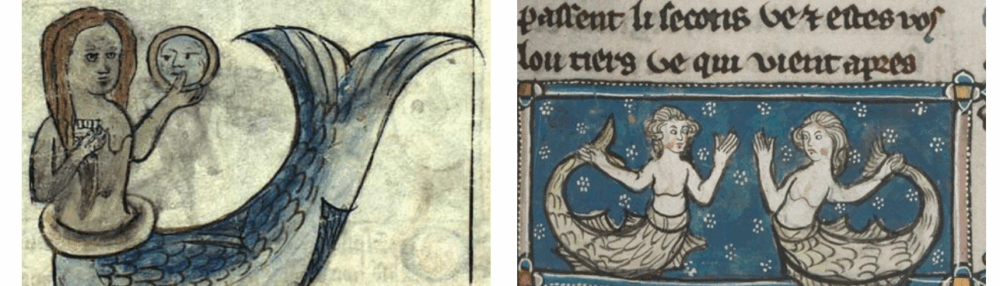
The elements of nature and their relationship with humans is explored in the story of “Undine.” Through comparison of organisms and natural forces, we visualize the connection of nature and the universe as a balanced force balance- yet the absence of human status within the elements raises the belief of humans as foreign and intrusive in the groundwork of nature – devoid of domination over the natural cycles – creating the ideology that nature is independent from human power, existing and thriving in a world unaided by mankind’s interference.
Undine, an extraordinary being herself, explains to her husband the hidden treasures and components of the Earth, hidden from human eye. Her description was as follows, “Wonderful Salamanders glitter and sport in the flames; lean and malicious gnomes dwell in the earth; spirits, belonging to the air, wander through the forests; and a vast family of water spirits live in the lakes and streams and brooks.” The unique pattern seen in this text is each earthly element has an organism to pair with it. Every component of Earth has a being responsible for keeping its stability and balance within the ecosystem. As Undine described to her husband, these “beings” remain unseen to humankind, these terrestrial organisms with deep roots within the earth.
Each and every being has a role in the cycle of life, a placement designed to control the movements of nature and the elements of earth. Without them, the air would not breeze past us, the water would not glisten and foam. We would lack sight of beautiful trees and would suffer through the cold without the glowing embers of a fire. Undine paints a narrative to reveal to us as a race that we, as humans, are at the mercy of these organisms, functioning in a world with these elements at our fingertips, due to the work of others.
And yet – within this observance, there is one component and majority of earth missing from the equation. Humans themselves. This belief system indicates to us that we are the foreign objects circulating within nature. Our presence is not a helpful stimulation for the environment we place ourselves in. In no place does Undine proclaim humans have a role in the harmony maintained within the environment. We contribute nothing – yet wish to dominate. Our goal as humans is always to control what is separate from us. The unknown enchants us in a way that promotes discovery and this discovery leads to want. Want to obtain, want to rule. However, what right do we have to obtain the command of nature to our will? In what ways do we shape the flowers or move the wind? We as a society want to believe that without us, the lower class, the “inferior,” will lack prosperity without us. On the contrary, nature itself is an independent source, separate from any intentions of our own. It grows and shifts, evolves and moves without any assistance from humankind. It existed long before us and will remain long after we are gone.
Udnie, through her description of life unknown to us, is able to convey a thought process often overlooked by us. We are not the most powerful beings in the environment.. We are not responsible for the beauty of nature and the gifts it offers. It is only through the words of Undine, a natural spirit, we even learn of the true nature of the ecosystems, given the sacred knowledge we have previously not been allowed to have. It is her nature, giving humans information and discovery, not the other way around. We only see what is given to us by nature’s allowance, not what we believe we have found through seeking. We do not hold the key, but rather, the key allows itself to be used.
What is the relationship between this observation and mermaids themselves? The connection comes from the fact of human desire for domination. In the same way humans have a desire to overpower nature, they have the desire to overpower mermaids. Mermaids themselves are part of the earth, responsible for the environmental changes and developments within the water. Humans see them as a foreign object, “a thing” to be conquered to fit an imagery they see fit in the same way they see nature. In our minds, mermaids “deserve” to be saved and assimilated by us, “exposed” to civilization and superiority in a way they would not achieve in their home land – the water. Yet, it is us who invades their space, sees them as not a being, but an extension of ourselves. We use them for our own desires and gain in the same way we exploit nature for its resources, without giving anything to either in return.
The human race’s connection with nature has been underexplained and undervalued for millennia. We expect that because we cannot hear what has to be said by the elements, we may overtake it for “the greater good.” Everything we see we believe must be ours. Even if we play no part in the cycle and pattern that has been sustained by others. The account given from Undine makes us a human race witness our own faults and manipulation of nature as a whole, exposing our greed and desires for power over the unknown. It is through nature and the environment we must learn to reflect on our race as one and separate ourselves from the idea that we be allowed sovereignty over the languages and beings we cannot understand, and gain the competence to respect the world we have been placed in. We must evolve to see ourselves not as overlords, but a branch of organism at peace and respect of the elements we are provided with.