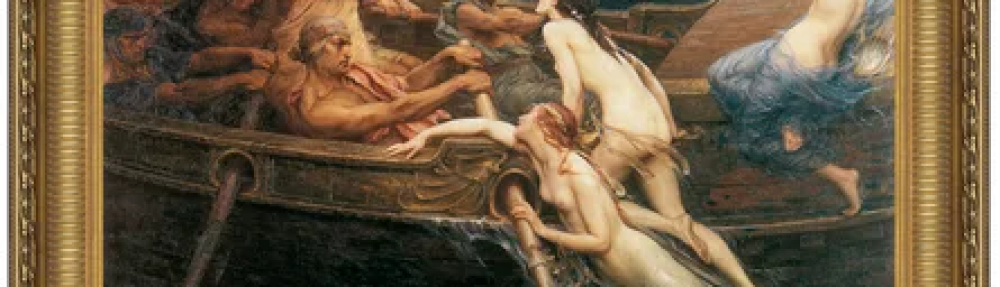
After reading “Introduction: The Stories We Tell about Mermaids and other Water Spirits”, one of the things that stood out to me when reading is when the authors said the following: “There is something deeply unsettling about a being whose form merges the human with the nonhuman. Whether they dwell in flesh or salt water, aquatic humanoids raise questions about what it is to be human and what lies beyond a human centered world” (xi).
It uneases us when aquatic humanoids, real or imagined, suspend between the human and the nonhuman. Through their very suspense, stranger like entities challenge us to reconsider the very concept of human existence. By expressing characteristics of the familiar-human faces, voices, gestures-and the aquatic traits such as scales, fins, or tails, they destabilize fixed categories such as nature and culture, human and animal, and land and sea. This ambiguity becomes crucial for there is, in fact, no way to confront the limitations of a human-centered worldview.
Aquatic creatures in tales or movies often confuse our sense of belonging and difference. By defining themselves against the opposites of civilization versus wilderness, body versus environment, and self versus other, humans create these distinctions. A mermaid or sea spirit dismantles these distinctions by existing in both realms and refusing to be neatly categorized. In this manner, with their existence, they point to our dependency on simplifications that might oversimplify the genuine complexity of being. If something can be both human and not human, then what marks the boundary of humanism itself? This question settles with immense power in an age of ecological crisis, wherein human survival is interdependent with the nonhuman world.
The image of the sea only further intensifies the presence of aquatic humanoids. Unlike the somewhat steadfast land, the ocean represents fluidity, instability, and unknowability. It diminishes the idea that humans are always in control. Aquatic humanoids living in that represents uncertainty in itself. They embody the notion of a lure into the abyss and a refusal of human-centered control. Their hybridity conveys distinctive meanings: that identity and existence require relationships that breach perceived barriers-between bodies, species, and environments.
In a wider sense, these aquatic humanoids are not just mythical creatures of fascinating creatures, they also remind us to realize the limits we have as humans.
These aquatic humanoids remind us that we humans are not the center of everything and that contemplating a life full of possibilities beyond ourselves is a consideration of a more intertwined and interdependent world.
This is a good first post, Gavin, as you are moving towards developing an argument/thesis statement. You write, “the mermaid or sea spirit dismantles these distinctions by existing in both realms and refusing to be neatly categorized. In this manner, with their existence, they point to our dependency on simplifications that might oversimplify the genuine complexity of being.” This is smart and clear, and just the kind of analytical thinking we will be pursuing this term. Nice work.
Hey there Gavin, we talked in that Tuesday class and I appreciate that you took the time to read my blog post and add onto it. As I’ve said before, aquatic creatures are literally a part of monster theory, dating back to medieval times. I think it’s interesting how you said that these creatures unease us when they “suspend between the human and non-human.” It ties in with what I thought about when looking at them through Cohen’s lenses; that they create a category crisis that makes them hard to categorize into one particular group.
Hey there Gavin, we talked in that Tuesday class and I appreciate that you took the time to read my blog post and add onto it. As I’ve said before, aquatic creatures are literally a part of monster theory, dating back to medieval times. I think it’s interesting how you said that these creatures unease us when they “suspend between the human and non-human.” It ties in with what I thought about when looking at them through Cohen’s lenses: because they border between human and monster, they are difficult to categorize within one group, which ultimately makes them fit into Cohen’s third thesis (the monster is a harbinger of category crisis).