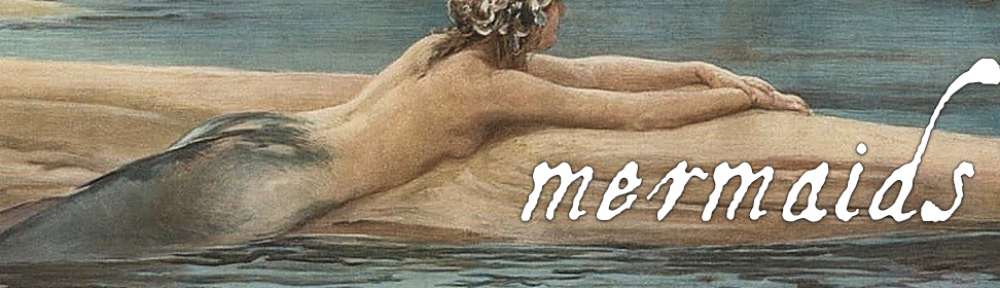
What caught my eye was the beginning of “Their Bodies, Our Anxieties,” where it discusses how we prefer our world to be well-ordered and sharply defined in categories, but it highlights the similarities between hybrid monsters and humans. They’re able to eat, sleep, and breathe like us, but seemingly hold enough distinctions for us to shy away from them. This reminded me of some recent trends in horror since at least 2014, where we take what was ‘safe,’ for example, a children’s mascot, and proceed to make it monstrous in a subtle way, for example, having the mascot act irregularly hostile towards children when it shouldn’t be. It adds to the uncanny anxiety we feel towards the subject, but it also fascinates people, myself included, as mermaids, or at least their early versions, don’t seem all that harmful. Then later, they’re made out to be temptresses whose goal is to lead men astray and consume them. When reading about the part where the text talks about the beauty of a mermaid, it got me thinking about how both halves of a mermaid show our odd interest in the known and unknown. The upper half is what we’re used to and can recognize as distinctly normal; this carries on with the lower half too, as our brains can recognize that it’s a fish. But when you put it all together, what is ‘known’ becomes a fearful yet interesting ‘unknown.’ We can recognize its not a natural thing for a woman’s upper half to be conjoined to a fish lower half, however, it still has that ‘harmless’ feel allowing later interceptions to add unsetting traits that would attract both fear AND attention. It’s interesting to know what looks harmless to us might be the most dangerous thing in the room, and it isn’t solely a modern trend but has been going on for centuries.
Category Archives: Week 3: Ancient Origin Myths
Merpeople as Bearers of Knowledge in Myth
Merpeople, specifically mermaids, have been known to be seductive sea monsters who lure sailors to their death, and that has well founded symbolism in of itself. Yet there has also been depictions of merpeople that are valued for the knowledge they bring to humans. This dichotomy of symbolism of sea creatures is beguiling and nonetheless makes sense. In The Penguin Book of Mermaids introduction, Christina Bacchilega and Mari Alohalani Brown explains “that everything we need to survive, in one way or another, depends on water, it is unsurprising that peoples across place and time have ascribed religious significance to water and developed water symbolism” (xiv). In light of this it is clear that these crosscurrent myths would have their own symbolism not just for water but for the creatures that live in it. Focusing on the merpeople whom are valued and symbolic of knowledge, myths such as “Oannes” and “Odysseus and the Sirens” depict such symbolic knowledge and concurrently portray water spirits in different lights.
“Oannes” is described as something of a messenger of knowledge, a god that educates humans; the deity was something that was praised and attractive in its mythology. Oannes knowledge and education consisted of “convers[ing] with men; but took no food at that season; and he gave them an insight into letters, and science, and every kind of art […] so universal or his instructions, nothing material has been added by way of improvement” (4). In Babylonian mythology Oannes, whether he be a messenger or a god, was not feared but revered for what he gave humans. He came to the humans and gave them his knowledge without wanting or needing anything in return. Now in Babylonian culture water often symbolized the potential for creation and order, and Oannes is an exemplary folktale of such symbolism. A literal entity that brings the humans of Babylon order and civilization amongst their chaos.
In Homer’s Odyssey, the Sirens in all technicalities are thought to be seductive, though surprisingly their alluring song is not one of destruction but one of wisdom. The book explains that “Odysseus is subject to erotic temptation more than once in the course of his homecoming, but the Sirens’ lure is of a different kind. Homer Sirens’ sing a song that promises knowledge— a wisdom that bridges worlds— instead of pleasure” (10). Thus, these sirens may be stereotypically the “monsters” originally thought to be, yet in reality they wish to provide Odysseus with a different point of view on life. Just like Babylonian mythology, Greek mythology water is symbolic of creation and transformation, The sirens knowledge may not be one of facts or educating on order, but they want to get Odysseus to stay and learn from the wisdom they have to give.
Week 3: A Mermaid’s Purpose
As I was reading “Introduction: The Stories We Tell About Mermaids and Other Water Spirits” (Penguin, ix-xxii) it made me wonder if there was a collective idea as to why the mermaids in our stories often lack agency. The introduction notes “the mermaid’s perspective is rarely presented and instead basically assumed (pg xix).” Our limited understanding of the vast deep seas leads us to shape a narrative in which humans are dominant above all creatures- even the alluring, dangerous and oftentimes otherworldly beautiful mermaid. Perhaps a mermaid’s lack of agency in these stories are not only for humans to assert their control, but to also make sense of the unknown. Historically the sea has always been difficult to understand, as so much of it hasn’t even been explored today. Over 80% remains unknown. The unknown is uncomfortable, as it is captivating. The mermaid embodies those two qualities, and as mentioned in the reading she tries her hardest to “pass” as a human on land but is never fully accepted (xvii). This “otherness” is the reason why a man has a strong desire to pursue her, and to domesticate her. Perhaps this possessiveness of the mermaid strips her from her agency, all in the name of “love” that seems more plainly like desire.
A mermaid’s lack of agency in a patriarchal sphere brings me to our reading “Sedna” (Inuit). I’ve actually read this story before for my mythology class, and was absolutely flabbergasted by her father’s sudden act of betrayal- especially since he spent so long looking for (who we all thought was) his beloved daughter. This creation story could simply just be a creation story, or it could be deciphered to have many themes. Those themes being betrayal, connection to nature, especially the spiritual connection that the Inuit people had with the sea. Still, I couldn’t help but to see Sedna’s story being patriarchal in nature. Despite her transformation in becoming a powerful sea goddess who controls the animals of the sea, it was all due to her suffering that caused this. Sedna having to be married off, then deceived by her husband followed by her being dispensable to her father. To me, this creation story showed Sedna’s lack of agency in a man’s world, only to find her power in another world- the world of the sea.

Art Credit: Sedna by Antony Galbraith
Week 3: Merpeople and Cohen
For this post I will be focusing on the introduction of The Penguin Book of Mermaids. It is very intriguing to me because I took an ECL 220 class on monster theory and how monsters reflect our anxieties, and we learned from last week’s discussion that mermaids in general (not just medieval or contemporary) are quite literally a part of monster theory.
The introduction to the Penguin Book of Mermaids presents us with some interesting info about aquatic creatures and how they reflect our cultural anxieties. What stood out to me in the “Their Bodies, Our Anxieties” section is the uncanniness that we experience when we combine a being with non-human traits with humans; Bacchilega and Brown use aquatic humanoids as an example (xi). Jeffery Jerome Cohen’s seven monster theses can be seen at play here; keywords such as “thresholds” and “anxieties” and how mermaids are described here has me thinking about them. Here is how I would connect merpeople and aquatic humanoids in general to some of Cohen’s theses, specifically I, III, VI:
Thesis I: The monster’s body is a cultural body
This thesis is referenced in the text itself: “In contemporary cultural theory, we are reminded that ‘a construct and projection, the monster exists only to be read; the monstrum is etymologically ‘That which reveals,’ ‘That which warns.”” (xii) Monsters reflect our culture’s “fear, desire, fantasy, and fantasy,” (Cohen 4) and aquatic human-creature hybrids are no exception to the monster spectrum. Merpeople are sometimes featured in maritime fantasy/fiction novels, and they are usually depicted as humans with a giant tail instead of a pair of legs. Although they could be considered human, their monstrosity stems from the fact that they live in a largely-unknown uninhabitable environment outside of human society. Because their bodies reflect our desires to explore more of the ocean and our fear of not knowing what lies there, it therefore fits Cohen’s first thesis.
Thesis III: The monster is the harbinger of category crisis
Merpeople are usually part-human and part-fish, and some portrayals give them the ability to switch between human and fish at will. Because they exist between two categories, it is difficult to categorize them into either human or fish. Their in-between existence, therefore, “questions binary thinking and introduces a crisis” (Cohen 6).
Thesis VI: Fear of the monster is really a kind of desire
The text basically says it: “Our ambivalence toward mermaids and other water spirits finds its representation in their bodies, which are often alluring, but can also be frightening.” (xii) For instance, the siren is a fearsome type of mermaid that sings a beautiful song that lures sailors to their doom. She flips the gender binary by depicting the woman as the one in power, enticing men into falling for her song and compelling them into doing what she wants. Since we live in a patriarchal society, this power, then, is what women desire most.
I think it’s interesting to see what I’ve learned from my previous ECL classes make an appearance in the readings for this class. Here’s my question: how would you apply Cohen’s monster theses to a monster that you’ve encountered/yet to encounter? It doesn’t have to be mermaids, but it’d be intriguing to see his theses applied to merpeople in particular.
Anxieties or Projections?
This week’s reading had so many interesting aspects to it, but the one I wanted to focus on was the part where it’s stated that Mermaids can, “shed the nonhuman portion of their bodies and infiltrate the human world. And the shores and banks where we come across them, like the vessels on which we cross their waters, are thresholds between our world and theirs” (xi). I wanted to focus on this part of the reading because, as we have mentioned in class already, humans are scared of the unknown. But what I like about this quote is that it puts that fear into perspective. I want to bring attention to the word “infiltrate” because of the way it makes Mermaids out to be a kind of spy, or someone or something that has sinister intentions…Kind of like humans, no? I think it’s ironic to use the word “infiltrate” when humans have done and continue to do things like this already. I don’t think humans are necessarily scared of Mermaids themselves, but are afraid that they might do to us what we would do to them. I say this because of the idea that Mermaids are part of us; they are part human, meaning they have the capacity to think and act as we do.
I love the idea of saying that humans are projecting onto mermaids, which we have mentioned in class, suggesting that we are scared of them because they are a reflection of ourselves. But it is fascinating to think about the concept that humans are technically just scared of themselves. Especially when it comes to Mermaids, when the text we read this week stated, “like the vessels on which we cross their waters” (xi), I think it’s very hypocritical. I say this because we, as humans, were terrified at the idea of Mermaids coming onto our lands, but we infiltrate their waters every day. Whether it be through boats, submarines, or even just scuba diving, we are in their home all the time. So the idea that Mermaids are scary because of their ability to “look like us” is hypocritical and even hilarious when you think about how many places make silicone/hyper-realistic Mermaid tales. I know that “back in the day” was different, but I still feel that humans projected their hated attributes onto Mermaids to better deal with themselves.
Also, I thought it would be cool to show you all a picture of the Mermaid Mural/Mosaic in my restaurant that I had mentioned on Thursday!


ALSO ALSO, a song I wanted to mention that I hope some people already know that I think is cool and fits our class is Mermaid Song by ConcernedApe. It is from a game called Stardew Valley, and I always love when this song comes on!
The Illusion of Control in Nature & Lore
Man is not an animal, at least so the stories of man tell us. The hybridity of a human with an animal in stories is often depicted as unnatural and threatening. Outside the interspecies dating element, it challenges the belief instilled in humans of a superiority on Earth compared to the other creatures that inhabit it. Reinforced within mermaid lore, the animal hybridity with humans is to be avoided or at least conquered to support this human superiority. In the introduction section of The Penguin Book of Mermaids, it is often in stories of mermaids that the human society is characterized as the ideal—being far removed the wilds of nature. This concept is a denial of humans’ own position as an animal on Earth and their part in nature, not a ruler of it.
A line from the reading that caught my attention about the distinction of animal from man is, in referencing mer-marriages, “when the wife is instead an ‘animal bride’ transformed fully into a human, the marriage fails because her domestication as a human wife and mother does not succeed in eradicating her ties with her water kin, or her desire to be in her own skin and element” (xix). To be part of the human society described in mermaid myth means to leave the natural world behind, to deny the animalistic parts of our nature that religion and social norms forbid. Any desire to stay connected to this natural world outside of society will only lead to disappointment, so it is best to avoid those who embrace the parts of themselves outside the alleged morality and ideals of man.

Attraction to this animal nature in others, that is personified in the mermaid, is not a transgression against the society on its own. Only when this desire is not reformed into human societal ways does the human admit their subservience to nature’s power. Part of humans’ development over thousands of years is to block humanity from the power of nature, but with that protection comes obligations of compliance and denial of what some think as animalistic behavior. The chaos humans interpret from their environment frames their idea that the nature of humans is capable of control over all things, that their order will withstand the power of the natural world.
How Aquatic Humanoids Challenge Our Boundaries as Humans
After reading “Introduction: The Stories We Tell about Mermaids and other Water Spirits”, one of the things that stood out to me when reading is when the authors said the following: “There is something deeply unsettling about a being whose form merges the human with the nonhuman. Whether they dwell in flesh or salt water, aquatic humanoids raise questions about what it is to be human and what lies beyond a human centered world” (xi).
It uneases us when aquatic humanoids, real or imagined, suspend between the human and the nonhuman. Through their very suspense, stranger like entities challenge us to reconsider the very concept of human existence. By expressing characteristics of the familiar-human faces, voices, gestures-and the aquatic traits such as scales, fins, or tails, they destabilize fixed categories such as nature and culture, human and animal, and land and sea. This ambiguity becomes crucial for there is, in fact, no way to confront the limitations of a human-centered worldview.
Aquatic creatures in tales or movies often confuse our sense of belonging and difference. By defining themselves against the opposites of civilization versus wilderness, body versus environment, and self versus other, humans create these distinctions. A mermaid or sea spirit dismantles these distinctions by existing in both realms and refusing to be neatly categorized. In this manner, with their existence, they point to our dependency on simplifications that might oversimplify the genuine complexity of being. If something can be both human and not human, then what marks the boundary of humanism itself? This question settles with immense power in an age of ecological crisis, wherein human survival is interdependent with the nonhuman world.
The image of the sea only further intensifies the presence of aquatic humanoids. Unlike the somewhat steadfast land, the ocean represents fluidity, instability, and unknowability. It diminishes the idea that humans are always in control. Aquatic humanoids living in that represents uncertainty in itself. They embody the notion of a lure into the abyss and a refusal of human-centered control. Their hybridity conveys distinctive meanings: that identity and existence require relationships that breach perceived barriers-between bodies, species, and environments.
In a wider sense, these aquatic humanoids are not just mythical creatures of fascinating creatures, they also remind us to realize the limits we have as humans.
These aquatic humanoids remind us that we humans are not the center of everything and that contemplating a life full of possibilities beyond ourselves is a consideration of a more intertwined and interdependent world.
Monster V. Human
As I was reading the introduction of The Penguin Book of Mermaids, something that stood out to me was the idea that humans “are strangely drawn to the other who is in part a mirror image of us and appears within reach, even if mentally ungraspable” (pg xi). There is this push and pull between humans and the unknown – where we are drawn but also fear what we cannot understand. While mermaids and other hybrid creatures have some sort of human element within them, there is also this otherness that accompanies the human aspect of the creature. Why, in turn, are humans engrossed in something that also repels them?
As humans, we crave order and organization but mermaids and other “monsters” allow us to explore the messy and untouched aspects of our identities. Living in a society that champions heteronormativity, humans often want to stay within the norm for fear of rejection if they deviate from what is supposedly normal and lose their social status. However, hybrid creatures give us insight into what could be if the limits of social norms and expectations were lifted. Specifically, mermaids can tap into the desires and lust that humans are too afraid to explore in real life. This is particularly relevant for women since society frequently looks down on women who explore their sexuality or sexual desires due to it not being seen as “ladylike.” Therefore, mermaids scare us because they may represent this element of humanity that is repressed as a response of societal norms. These creatures permit us to envision a being that is ungoverned by the stresses of society, a version of us in a primal form that is untarnished by expectations. Who are we without the rules of society governing our lives or religion telling us what is right or wrong? It is this anxiety that produces our fear of hybrid creatures, such as the mermaid, because we haven’t lived in a world without guidelines on how to be. Yet, we are fascinated and continue to come back to these creatures because humans are curious by nature – we crave to explore the unknown and the other. Subsequently, mermaids and other hybrids provide the perfect canvas to explore the messy bits of humanity that we don’t want to confront in the real world.
The Secret Life of the Mer-Wife
In this week’s reading, the concept of a “mer-wife” piqued my attention, because here we have the mermaid crossing into the human realm—the mermaid’s double life, as we have seen in many TV series or movies. These stories, the mermaid must decide between her life in the sea and life as a human; she can’t “have it all.” For the name of love, without any knowledge of the human realm outside her partner, she chooses to give up her life and marry the man she has just met. The Penguin Book of Mermaids describes the concept of the mer-wife to the desire of men: “These tales speak to the discrepancy between men’s longing for a woman unfettered by social mores and their attempt to control her by domesticating her.” (xviii). To men, the mer-wife is their perfect fantasy of an ‘untamable’ woman ‘domesticated’ by their masculinity.
I think it is interesting that once a mermaid has decided to live the ‘human’ life, they are ‘domesticated’, similar to how we describe a pet. In these stories, the mermaid giving up her life for one that will forever be controlled by the perspective of the man she marries is slightly disturbing. The concept feels disturbing because she has not developed her own thoughts and is essentially childlike. The mer-wife has a very innocent, naive perspective on the human world. Men desire an unattainable woman, and desire to be the one to teach her how to ‘live’. Similar to how a parent teaches their child how to navigate society. There is this weird undertone of infantilization towards the ‘mer-wife”.
This concept reminds me of a story told in Merpeople: A Human History about two women who found a mermaid and showed her the path of God, and saved her, essentially ‘domesticating’ her to live in the realm we humans deem ‘acceptable’. The idea that once again the ‘other’ can be conditioned and molded into living in our society. Men and women are domesticating the mermaid in the patriarchal society.
In the realm of feminism, to have women and men neglect the mermaid of choice showcases similar issues we have today. Not allowing the mermaid to choose to live both lives or have a life of her own, because a woman cannot “have it all,” demonstrates feminist issues still occurring today. The mer-wife showcases the constraints women are forced into in a patriarchal society.
Mermaids and the Environment
When I first think of mermaids I think of fantasy, danger or beauty, not the environment. However, after reading “Introduction: The Stories We Tell About Mermaids and Other Water Spirts” (Penguin) I noticed that mermaid stories are deeply tied to water and our relationship with the natural world. Mermaids are more than just a mythical being. I think they symbolize the way humans view nature as both beautiful and essential to life but also as threatening.
On pages xiv-xv the reading explains that the stories of water spirits reflect “Our fascination with and fear of female bodies and of water and our dread of predators or poisonous creatures that live in or near water” but also our dependence on water for survival. Water gives us life but it can also take it away. I think this connects to the way mermaids are portrayed. Beautiful, fascinating, but also dangerous. Just like the ocean, mermaids attract people while still having the power or capabilities to destroy them.
This reading also showed that mermaids are global. They appeared in stories from Europe, Oceania, Africa, and the Americas. On page xv, it points out that these mermaid myths were spread through colonization and trade. I think this shows how universal water is. All cultures develop different versions of mermaids or water spirits but they all share the same experience that water is something stronger than we can control.
One line that stood out to me on page xx is “Water spirits, like water, are powerful, unpredictable, and inspiring- that is, both terrifying and wonderful”. This explains why mermaids act as a symbol to remind us of water’s beauty and mystery but also of its dangers. Today, oceans are threatened by pollution and climate change. I think mermaids could become an image for environmental awareness and show that it’s our responsibility to protect it. Overall, I enjoyed this reading and it made me see mermaids as not just a fantasy creature but as a reflection of humans relationship with water.