Week 2: History via Mermaids

After reading the introduction to to Merpeople, I can say with confidence that I 100% believe in mermaids. I didn’t think that this soon into the semester, and into this class, this would be my stance on it, but I believe it. The thing that stood out to me the most was how several different cultures and religions have had their own versions and takes on merpeople, and what purpose they serve their views. From the Babylonians, to the Greeks, and inevitably, to Christians, there is a different version of merpeople. I was’t surprised to learn that Christian’s in a sense embraced the more exotic and “dangerous” side of mermaids. The way that they were portrayed as a lesson to their followers about the dangerous of love and lust is very telling. As I was reading, I couldn’t help but think of the phrase, “There is no other love like Christian hate”. Not to say or generalize that this is how Christians are, but at least at this point in history it is a direct reflection of how society was within a Christian context.

Seeing the images of sculptures and art work of mermaids within Christian worshiping spaces from the Medieval period was quite shocking as well. My own family was not very religious, although I did grow up Catholic, but I honestly wouldn’t have ever guessed that they would be portrayed in these kinds of spaces. Given that not a lot of people were able to read either during this time period, and would rely on descriptive images, I can imagine how the concept of merpeople existing was normalized like, “Oh yeah, I saw this sculpture of a mermaid in my church last week. This must mean that they exist because why would I question Christianity?” Aside from these images that I found shocking, I also had an interesting thought about how mermaids could be represented in modern day society under Medieval Christian context; Mermaids were the first feminists. Under the perspective that Christianity attempted to portray mermaids, they were here to bring the destruction of man through the inevitable lust for love, given that they were very beautiful. Not only that, but the way they were suggestive with their tail openings exposing their genital area, and being topless, this seems like a body/sex positive being. How ‘dangerous’ can they really be?

A Way out of No Way: Water Spirits

Dion Jones

Prof J. Pressman

ECL 305; Literature and the Environment

7 September 2025

The ocean is a great and mysterious path—a vast world all its own, as a result, the merfolk and water spirits of this weekend’s readings from “The Penguin Book of Mermaids” utilize certain properties of the waters around us: reflection and obscurity. The divine beast-who-is-sometimes-a-deity Oannes reflects human qualities through his teaching of art, symbolic language, and sciences (pg 5). Simultaneously, Oannes embodies obscurity through his amphibious nature, hybrid body, and his returning to the Sea at night (pg 5). His power is either internal or an extension of his connection to other deities, making him greater than humanity, yet a resource/servant for/to us. 

The story of Kāliya the Snake/Naga manifests these two properties differently. The snake king possesses human-like recognition of divine figures and the power of speech but reflects human anxieties and conflict with wildlife. Human and divine encroachment and reproduction of environments creates the opportunity  for Kāliya to take over the pools which invites conflict. The presence of venom/poison as well as the presence of many snake wives causes a hazardous situation that led to the great snake’s defeat and banishment (pg 6). This story is  an argument against the spreading/ muddying of boundaries between humans/divine figures and the natural world.

The Tuna of Lake Vaihiria differs from the previous depictions in that it uses two opposing depictions of water spirits. If you count Maui as water spirit, then water spirits can act as a positive masculine figure who embodies human moral qualities but with superhuman capabilities. The eel instead plays the role of trickster, disguising his monstrous form in order to lord over the freedom and sexuality of his human bride (pg 13). In this way, the water spirits reflect the best and worst of adult human relationships.

Week 2: Mermaids and the Church

The introduction of Merpeople: A Human History explored how mermaids became deeply ingrained in medieval European culture and imagination. The church treated mermaids not just as mythical sea creatures, but as symbols with moral purposes. Through sculptures, bestiaries, and sermons, mermaids were used to warn believers about the dangers of desire and sin. Mermaids also appeared on medieval maps and became part of local folklore. Stories like the Orford mermaid and the Harlem mermaid are used to show how Christians tried to fit these creatures into their worldview. And these stories are not just entertaining, they also reinforce the teachings of the church.

One part of the reading that caught my attention was how the Church used mermaids in sacred spaces. I was surprised to learn that cathedrals had wooden carvings of topless mermaids. But these carvings were not just for decoration, they were intended to warn the faithful about desire and vanity. I find it interesting that the Church permitted nudity in these cases, showing that female sexuality could be displayed as long as it was framed as dangerous and sinful. I thought that this reveals how carefully the Church controlled what people saw and how they thought about desire. The Haarlem mermaid story also stood out to me. In this story, a captured mermaid is clothed, taught to pray, and integrated into human society. I thought that it reflects the Church’s broader goal of controlling the wild or unknown. Even a magical creature had to be civilized to fit Christian norms. I thought this story is not only about a mermaid, but also a clear metaphor for society’s attempts to shape and discipline those who are different or threatening.

I also found it fascinating how these stories blurred the line between myth and reality. By placing mermaids in art, manuscripts, and sermons, the Church made them feel real. Once real, they could be feared, captured, and tamed, reinforcing the Church’s power over desire and imagination. This combination of fascination and fear seems to have shaped how people understood the world and even continues to influence how we see mermaids today. Overall, this reading helped me see mermaids as more than just fantasy creatures. In the medieval imagination, they served as moral teachers, cultural boundary markers, and symbols of control. It made me wonder how many other mythical figures were used in similar ways to guide people’s beliefs and behaviors.

Week 2, Mermaids between Fear and Desire

The introduction of Merpeople: A Human History made me think about many ideas, especially how it connects the question of human nature with the figure of the mermaid. I have usually thought of mermaids as half human and half fish, but I had never tried to study humanity itself through this image. While reading this part, I began to think again about the process of human evolution. We usually explain human history as starting from ape-like ancestors. But if we go further back and imagine the very first ancestors of humans, can we really say that humans and animals are completely different? Today, science has developed so much that we can compare humans and animals in many ways. In the past, however, when science was not developed, the meaning of mermaids may have been much more serious.

In societies where religion had strong power, people probably emphasized the special value of humans by saying that they were created by God. If humans were seen as the chosen beings of God, then the idea of mermaids, creatures that were half human and half animal, would have caused fear. Why did people imagine them as part fish? I think it was because the ocean was considered the most unknown and mysterious place, and fish were the main living creatures there. To people in the past, mermaids could represent the fear of the deep sea. Religion and society may have used this fear as a tool to teach lessons and control people’s actions.

As time passed and science grew, belief in the real existence of mermaids became weaker. But in the modern world, the meaning of the mermaid changed from something scary to something attractive. I think this shows a movement from fear to desire. This reminds me of Cohen’s Monster Theory, which I studied recently. One of his ideas is that monsters can represent attraction and desire. In this way, the use of mermaids today in advertising, branding, or company logos seems to come from this change. What was once a frightening monster has now become a symbol of beauty and charm. Therefore, the mermaid reflects how human imagination turns fear into fascination.

Sightings and encounters with Merpeople, Crazy or Conscientious?

From a modern, Science-based perspective, this massive influx of merpeople sightings mentioned in the introduction seems to be a kind of mass hysteria, or an obsession with grasping at the unknown. Men traveling the Atlantic and Pacific seas may have been losing their minds, but what if they weren’t? The human mind is certainly capable of creating illusions or hallucinations, but the ancient sea, which is still widely untouched, may be holding more than we may ever know. Did they see an actual human-fish hybrid? probably not, but they could have seen creatures beyond their comprehension or get crazy weird vibes off the water they were sailing. Word of mouth and drawings on maps were all they had, and influenced them in their travels. If the greatest of minds during this time period were so invested in understanding these merpeople and the New World, then why shouldn’t it be considered science?

Week 2 Readings Post

I managed to create a system for my annotations that my brain can comprehend but it might look crazy to everyone else, which often happens. I thoroughly enjoyed chapter 1 of Merepeople compared to the introduction. At the beginning of the chapter, I enjoyed the small story just showing how weak men are about keeping their emotions in check that a carving is bringing out these human natural emotions. The hypersexualization of the mermaid and his hunger / temptation makes it uncomfortable from an outsider point of view that isn’t a desperate man. I was uncomfortable with the narration while reading it, just the objectification was wild and had me cringing about how this man was acting! Unhinged deacon at its finest. I wonder if there are texts out there about a woman having sexual desire for a triton..? But, considering that Christianity and their leaders were trying their hardest to denigrate femininity, I wouldn’t be surprised that it was destroyed or hidden deep. Later in the chapter on page.51, the details were clear on how tritons were perceived, which was more conservative than their counterpart. I had this thought that popped up during our lecture this past Tuesday, that since mermaids are a reflection of humans.. Creating the narrative around mermaids is a soapbox for Christian leaders to passively ruin femininity. An indirect way of criticising women and their feminine attributes. If the church is on a mission to ruin femininity, why isn’t it a sin considering that Mother Mary is a woman too? And my last question that has been bothering me is that on page.40, why would scholars assume “vagina” as another meaning for the fish held by the mermaid? I don’t understand the reasoning for this metaphor. Like the mirror/comb, vanity, but what does the dang fish mean? 

This is how I sum up my takeaway from this week’s reading: in the name of “goodness”, there is plenty of evil doing.

Week 2: Mermaids, Illuminated

Every other page of these first two chapters of Scribner, I found something I HAD to make a post about. My mind is going off in twenty directions already. See at end of post1 a list of things I had to leave behind, but would love for someone else to pick up, if you didn’t have any particularly juicy catches of your own.

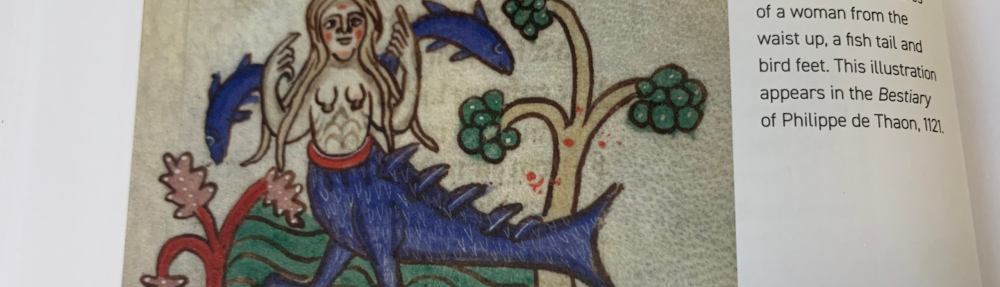
I’m deciding to focus on all the art we saw in this chapter: the early illustrations of mermaids from illuminated manuscripts. What strikes me is actually how consistent mermaids have remained; my idea of them today is not so different from the earliest depictions.
I have always loved drawing mermaids and I know I’m not alone. Possessing a long and sinuous tail, as well as often long hair unbound by gravity, and an often nude torso, makes them a really appealing subject for an artist. There are so many opportunities for creative, fluid compositions, there is the human torso for the anatomists among us to dig into, there is the deep symbolism surrounding them as closely as water surrounds them. Now, my mermaid art has been further informed by the aesthetics of illuminated manuscripts, by the Green Men, motifs which occur ubiquitously (like mermaids) and have murky origins– but unlike mermaids, do not continue to capture modern consciousness.

My pursuits, academic, creative, spiritual, professional, exist not in a single field but in an infinitely dense lattice of braided rivers and streams, and I feel that now, in my life, the undercurrent of Mermaids– a spring which arose early in my personal history– the undercurrent of Mermaids is now spreading, slowing, flowing under everything I do, informing other rivulets.

  1. – Thank you Hahnnah for bringing up music: Where are the English and Irish Ballads about Mermaids? Surface level searching returned only Child 289 , “The Mermaid”. I liked this version on spotify.
    – p8 It not a coincidence that medieval bestiaries represented real animals as “hybrid monsters”– they were drawn based on descriptions, and those descriptions could only function by referencing things people already knew (elephants having a snake on their face, rhinocerouses plated with armor, platypus with ducks bills and beavers’ tails). It’s not possible for us to comprehend anything without points of reference, things to connect them to
    – Amphitrite- I checked etymonline, and was surprised to find that they don’t attribute “-trite” to simply “triton”. Amphitrite was a bridge, in between, double-aspect (like amphibian or amphoteric or ambivalent or ambidextrous) of Triton. Being female… gave her the power… to leave the sea??
    – p 27 “To be human is to be hybrid”. Nuff said.
    – p 32-33 Note the sculpture of jonah being swallowed by the whale– the whale itself is a hybrid!
    – Scribner kind of dangerously oversimplifies the origins of Anglo Christianity in Ireland. I recommend further reading.
    – Excellent line from Thomas Cobham quoted on p 43 “Lord created different creatures… not only for sustenance… but for instruction” <- represents two crucial elements of the human relationship to the natural world in one sentence!
    – Melusine was the first transforming mermaid? Perhaps the mermaid canon I grew up with does not have origins as recent as I thought. (See also: The Orford Merman, p 55, on mermaids in captivity)
    – A line from a short story I recently read- Mkondo by Anthony Doerr- describing a fossil of an early proto-bird, which I think reflects the narrator’s unnatural dichotomous worldviews: “What a thing, half bird, half lizard, part one thing, part another, trapped forever between more perfect states”. ↩︎

Why did Christianity Exploit Mermaids?

In his first chapter of Merpeople: A Human History Scribner recounts the extensive imagery of merpeople utilized by the church to gain pagan followers while it “hoped to distance itself from the sacred feminine of the pagan past.” (para. 9) The mermaid was contrived to control the narrative of female sin. In medieval times, this era of monsters, why does the Church use merpeople, specifically mermaids, to convert pagan followers and scandalize femininity? Why not dragons, giants, ogres, or unicorns among others? In this class we have established a human fascination with hybridity, and in it an ability to reflect ourselves. Therefore, this representation of sin had to contain a human element. But why not other hybrids, such as harpies? In fact, the church purposefully went out of its way to omit harpies and depict sirens as half-woman half-fish instead as Scribner indicates in paragraph 14: “Homer’s Odyssey alluded to sirens as bird-like creatures. Christian artists diverged from the original descriptions because they no longer needed a hideous siren”. Sirens or harpies, these bird women, no matter how monstrously depicted, would be too easily interpreted as ascending to heaven. In its use of mermaids, the church is able portray beautiful women exuding lust and sin. Because their environment is beneath us, because these beings technically exist below earth, they are essentially only one step away from hell. The mermaid’s environment diminishes any chance of misinterpretation of the church’s warning.

In addition, merpeople are humanity’s attempt to control an environment that is not our own. Christianity aims to be the shepherd of this planet, yet we have only dipped a toe into the oceanic expanse that covers nearly ¾ of it. By worshipping Oannes or Ea, Neptune or Poseidon, pagan religion forges a connection with the sea. And therefore, constructs a command of the deep. Christianity is expanding on this connection, and the human governance of the entirety of Earth, by insinuating the existence of merpeople.

Lastly, I am wondering where modern mermaid stories and culture would be if the church never represented mermaids as prevalently as they did. Would we have grown up watching The Little Mermaid? Would ‘mermaiding’ be a thing? Would we even be taking this class?

Week 2: Merpeople and the Human Obsession of Hybridity

From the very start of the introduction, Scribner draws his readers in with quite an unorthodox observation: “Merpeople are everywhere” (Scribner 7). Typically, you don’t think merpeople are “everywhere,” after all, we are land-dwelling creatures, which would deprive a mermaid of living ability. And yet, Scribner notes various forms in which mermaids are seen daily: the mascot of a coffee chain, TV shows, and even “Mermaid University” programs.

This interest in mermaids isn’t new, Scribner notes, saying that this interest has always been present in humans. I find it interesting that Scribner goes on to say that “[T]hese hybrid creatures represented danger as much as hope, wonder as much as horror” (8), which makes me wonder—what is it about hybridity that humans tend to obsess over? What is it about the blending of two things we are so obsessed with? Perhaps I have a different perspective on this because I grew up in a mixed-race household—my mom being Filipino and my dad being Italian-American—but I can’t count the number of times I’ve received strange comments about my lineage: “So, what are you?” “Wow, so exotic!” “That’s so interesting.” I don’t exactly take offense to it, but there is a little bit of a sting when people (usually from older generations) have this sort of intrigued yet fascinated look when I tell them I am mixed. But the human interest in mixed things doesn’t stop at these mixed children like myself; we see it in cultural/regional fusion dishes, domesticated dog breeds (most dogs nowadays are hardly ever pure-bred), even academic disciplines (Interdisciplinary Studies?), and many more I can’t think of off the top of my head. I think humans are naturally drawn to this mashing up of two different things because we crave uniqueness and originality, with the mermaid and other hybrid mythical creatures satisfying this craving thousands of years ago to today. Scribner goes on to solidify this, writing, “Monster theory and hybrid studies are imperative for Merpeople: A Human History, especially in their ability to reveal the humanity in such seemingly foreign, incongruous manifestations of the natural world” (8).

The last thing I noted while reading this introduction was Scribner’s observations that “[W]hile mermen found their origins in a Greek God, mermaids largely originated from hideous beasts who only intended to bring man to destruction through his own lust for sex and power” (11). I find it quite interesting that this evolution—man from God, woman from beast—is likely from patriarchal structures that prevail throughout time and is reflected in our own society today. Women being placed below men on the pedestal because “Eve committed original sin.” Women being told they are too emotional to lead. Women are being told they are weaker and, thus, inferior. I don’t think these examples hailed from the mermaid coming from hideous beasts, but it is definitely related. It is yet another example of women getting the short end of the stick and often being the “root cause” of men’s problems (e.g., being the reason they get led to their doom, even though they craved sex and power). This Introduction sets up a brilliant framework for how mermaids have shaped modern society today.

The Silence of the Mermaids

In Merepeople: A Human History, Vaughn Scribner says that mermaids act as a means for symbolism for the shift in humanity and their conceptions of myth, religion, science, and capitalism (27). Mermaids perfectly reflect that change in humanity from believing in something mythical to exorting it. Mermaids were viewed as grotesque to some, simply because they’re half-human and half-animal. Whereas some mythological creatures like angels, for example, are very much also hybrid beings–half bird and half human–are symbolic in a different way; a way that is full of purity and transcendence. Mermaids were vilified while angels were, quite literally, angelic and uplifting. The stark contrast between those two hybrid beings shows how gendered interpretations chose whether a hybrid was to be celebrated or condemned.

I feel like the human half of the mermaid should’ve invited sympathy, which could’ve been symbolic in a way that allows people to connect their own experiences to life, not just on the surface, but as Princess Ariel’s good friend, Sebastian, once said, also under the sea. But instead, the difference between merepeople and humans was just too vast, and humans couldn’t relate to them, and that’s what began painting them as monstrous. Early portrayals of merepeople started with mermen, and they were associated with being strong and as a force in nature. But as religious and artistic traditions changed, women were physically and figuratively becoming the face of the merepeople. Triton’s wife, Amphitrite, and other mermaids were sexualized and defined with less autonomy and more by how they reflected a man’s anxieties and desires as time progressed.

It’s also very important to note that Christianity very much weaponized this villainization of mermaids. Christians used mermaids as symbols of sin and as a warning against feminine temptation, “A scriptural passage from the Wisdom of Sirach simply stated, ‘better the wickedness of a man than a woman doing good’. Women, for early Christian leaders, represented lust, weakness and man’s fall from grace” (37). When mermaids started to be transformed into sirens and their “siren song” epitomized the danger of a woman’s voice. Instead of letting mermaids be protectors of the ocean, they became basically a scapegoat for male weakness…I totally feel like the chance to see mermaids as a protector or guardian of the sea, and it’s marine life, was overshadowed by how they were portrayed to be dangerous seductresses. By turning mermaids into monsters, humans have definitely taken away a potential voice for the environment and the natural world.

Ultimately, mermaids show how femininity, but when connected to power or danger, their feminity has been weaponized against women themselves. I wonder if the silence of the mermaids can be changed if we tried to reimagine them as protectors of the ocean rather than something that kept people out.