Final Project Idea

For my final essay, I plan to close read Eric Paul Roorda’s introduction to The Ocean Reader: Theory, Culture, Politics which is an expand of my discovery 2. I will focus on how Roorda challenges human centered and land based thinking by defining humans as a “terrestrial species” and by capitalizing the word “Ocean.” My analysis will examine how these language choices work to shift the ocean from an object humans describe to a subject with its own history and agency. I will also explore more on how Roorda’s diction reveals the limits of human perception and the ways people have tried to name and control the sea. Through this close reading, I aim to show the important role of language that Roorda uses to reimagine the relationship between humans and the Ocean.

Final project idea

For my final essay, I am planning to close read Helen Rozwadowski’s Vast Expanses: Introduction: People and Oceans. I will explore how Rozwadowski redefines the ocean as a space shaped by human knowledge, power, and imagination rather than a neutral part of nature. My essay will focus on how she describes the ocean’s “vastness” not just as a physical quality but as an idea built through exploration, science, and stories, turning something wild and limitless into something they can name and own. I plan to analyze how Rozwadowski connects human curiosity about the sea to the desire for control, how people have tried to measure, name, and own something that resists boundaries. 

Final Proposal: Continuation on The Sea is History

My final essay is still a work in progress but it will expand on my discovery #2 argument by examining the sea as a non-traditional archive of colonial trauma. I would like to revisit the passages from Walcott’s “The Sea is History” in addition to supplementing it with John Gillis “The Blue Humanities” to contextualize Walcott’s vision within a scholarly framework that understands the ocean as a historical agent rather than just a mere set piece. Both these readings challenge the readers to recognize that history does not always appear in the typical western forms we’ve come to expect and learn to interpret environmental memories.

Thesis: In “The Sea is History”, Derek Walcott reimagines the ocean as a fluid unstable archive that preserves the many dark histories that colonial narratives attempt to erase. By positioning the sea as both a grave and record, Walcott exposes the limitations of Western historiography and compels readers to interpret history through silence, submersion, and environmental memory. When read alongside John Gillis’s concept of the Blue Memories, which also argues that oceans hold “deep histories” beyond conventional documentation, Walcott’s poem reveals how the natural world itself functions as a corrective to colonial erasure.

Wk 14

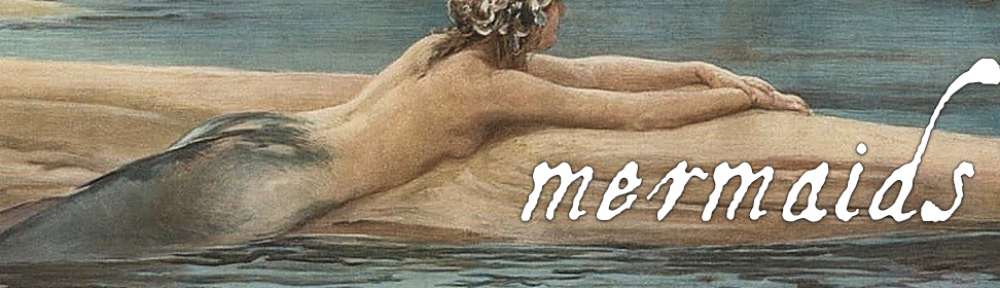
I wanted to make a creative and immersive project by creating a twine story/game, which I saw an example of in the sample project tab. I thought I might use sirenomelia to develop a type of sci-fi, futuristic mermaid’s day-in-the-life. It would culminate with her exploration of the base, and perhaps a discovery of her/and humanity’s past. Because we know so little about the mermaid, I thought I would create a storyboard that you could follow, exploring who she (you) might be and her process that leads her to explore the abandoned NATO base. I want to incorporate sound in this experience, as I was really drawn to the video’s entrancing use of sound and the exploration of space through sound.

I want to incorporate the little mermaid’s fascination with humanity, and what it might mean to the mermaid to view such a different landscape and environment. I also wanted to explore some of the prompts from Helen M Rodzadowski’s Vast Expanses: A History of the Ocean’s

“The opacity of the ocean
guarantees that we see reflected back from its surface our fears and
desires.”

“The connection forged between people
and oceans has changed both and tied their fates together. Our future
may depend on acknowledging the ocean as part of – not outside of – history”

I want to focus the mermaid’s story on these passages, as well as Rodzadowski acknowledging scientific advancement as a way that humans explored and used the ocean, thus interacting and becoming a part of the ocean’s history. The mermaid in Sirenomelia is our future, calling out to our past selves, telling us that we’ve gone about it all wrong, and that there is a wealth in acknowledging that our relationship with the ocean is not one-sided
Final paper idea

For my final project, I’d like to focus on the short film The Water Will Carry Us Home and how it greatly supports the claim that water holds history, in particular the history of the transatlantic slave trade acknowledging the often silenced side of history which is the victims side. I just know that I want to focus on that general idea, I need to fine tune it a bit more but I will certainly include film stills to help my argument. 

Week 14

As of right now, I’m still unsure what to write about for my final essay. Compared to Moby-Dick, which was a slog to get through even with a whole class, being able to close read The Deep by Rivers Solomon et al. after all of that felt like a reward. It being a much shorter story should make it easier to close read since at least it doesn’t have much going on compared to that other whale. Plus, there shouldn’t be any convoluting themes; the first few chapters seem to revolve around History and intergenerational trauma.

As I’ve said in 522, I still need to work on my writing/analysis skills since my mind defaults back to just summary instead of explication. I still think there’s room for improvement since a couple of the essay assignments I wrote for this class and the Moby-Dick class got mediocre grades because I wasn’t able to do the So What (relevance) portion of these essays that well.

I envy people who are able to make convincing arguments/interpretations/insights/whatever about a particular passage and turn them into a 750-1000+ word essay. If only I had the skills…

Final Project Idea

Honestly, I have ZERO idea of what I want to do for this final. I definitely want to do something creative, I don’t know if I want to do a kind of playlist for this course? Since I have been putting songs at the end of every post, I feel like that would be good, but I would definitely struggle with the thesis for that. I’m not sure how I would tie it into the course. I think I could also do a playlist for a specific text or video we watched. I feel like making a playlist for “The Water Will Carry Us Home” would be a good one. I feel that there I would definitely need to focus on something specific, I struggle with my essays being too broad and trying to close read and stay on one topic. I want to stick with the music aspect, because other than creative writing, music is something I have a really great interest in. So, either make a song to fit the stop motion film, or a playlist that leads you through the video. Making a song would be fun! So I definitely narrowed it down to two options while writing this so that’s great!

Final Project Research

As of now, I’m leaning towards using “The Trouble with Wilderness: Or, Getting Back to the Wrong Nature” by William Cronon for my final essay. To work on the essay, I want to research more academic texts about the creation of national parks and how they were created. This will help me gain a better understanding of the circumstances upon which they formed, to then frame the idea that “Wilderness” is based on human fantasies and ideals about what nature truly is. It highlights the notion that the perception of “Wilderness” is often on a grand scale and is seen as something that is usually out of the ordinary for most people, a place that is the antithesis of civilization and humanity.

Furthermore, I would also like to look into academic texts that explore more about how nature in urban environments helps connect humans back to “Wilderness.” I think this will help showcase that nature is truly all around us, making the idea of the wild arbitrary since the same elements of the “Wilderness” can be found in places that are seen as civilized. Nature and humans then become something that are interwoven together since they both exist in the same environment. This then complicates the idea that urban areas are simply for humans by illuminating the many ways in which nature is able to survive in places where humans exist in close proximity to nature. Researching more about nature in urban settings also helps show the importance of caring for nature in our cities since it is a sliver of the “wild” in our own backyards. Caring for the environment transforms into something that is part of daily life, making it more manageable for people to sustain and to live in tandem with the nature that surrounds them.

I also plan to reread the text to further strengthen my understanding of the reading in order to argue my point more clearly and accurately. As I read, I will also take notes so that I can close read a selected passage to the best of my ability and choose lines that will best accompany my argument.

Final Project Ideas

For my final project I have decided to do my essay on The Deep. I have really enjoyed the first four chapters and feel like there is a lot to discuss. I want to focus on history, though maybe more so on the trauma that lingers from history. I need to keep on reading to really know exactly what my thesis will discuss. With that, what I need to learn for my project is based mainly on doing the reading, as well as doing some research for the outside sources for the final project. Possibly doing research in our school online database on The Deep, as well as research on ancestral trauma from history.

Hopefully feedback on Tuesday from my peers will help me with direction and clarity on my thesis!

Final Project To Do:

I have decided my final project will be an essay about The Deep, elaborating and researching the concept of History. I want to navigate intergenerational trauma and how we tell these narratives ethically and fully, discussing how the body holds memories, trauma, and history.

First, I need to complete the novel, or at least make significant progress in the story. While reading, I must take notes to help gather information for my paper. Then, I need to search for scholarly commentary on The Deep, particularly regarding this topic, to enhance my understanding of the story and develop a claim for my essay. Finally, I need to piece together my findings and create an outline for this final paper.

I am looking forward to my peers’ feedback on Tuesday to help develop a strong Thesis to create a strong paper.