Re-gift of Life

In “The Water Will Carry Us Home” Gabrielle Tesfaye re-gifts life to women who were left for dead in the Middle Passage. She re-gifts them life when she transforms them into mermaids, but she also re-gifts them life by telling their stories. The use of animation and the fantastical theme of mermaids gives a story that is painful, and because of that overlooked, a voice. The dialogue of the atrocities of the Middle Passage is silenced because it is not something that society wants in conversation. It is common to cover up cruelty, especially in the case of mainstream society being the hand of that cruelty. The theme of mermaids and continuation of life rather than death makes it less challenging to talk about, as well as share to future generations. Share to children who should, however painful, learn their people’s history. By continuing these abandoned mother’s existence in the sea, Tesfaye continues their existence in conversation for generations to come.

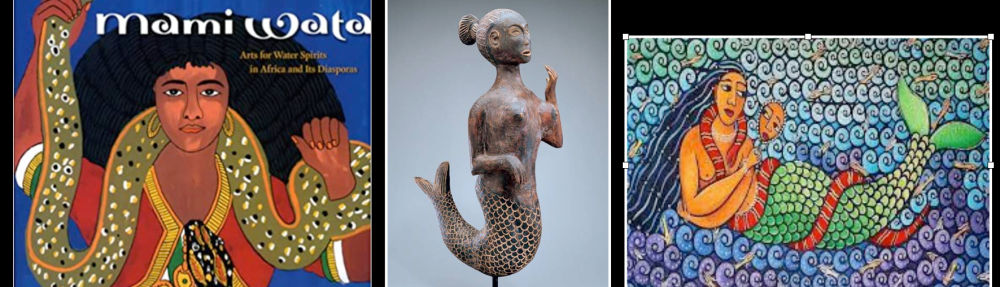
Tesfaye not only reclaims history but she reclaims mermaids. In other mermaid stories we have read, different cultures have used mermaids as warnings. Early Europe used them to warn of the dangers of women’s sexuality. They have been used to justify control of women’s bodies, environmental destruction, and even colonialism. To justify man’s dominion. But Tesfaye challenges traditional use of mermaids by using them to continue life rather than destroy it. Instead of a warning, Tesfaye’s mermaids are a representation of not just a tragedy, but a human tragedy. While our past mermaid stories have been about the other, Tesfaye’s mermaids are interconnected with human experience.

Depicting Omambala with a split tail furthers Tesfaye’s reclamation of mermaids. Split tails were generally used to negatively represent women’s sexuality. Giving a split tail to the God Omambala who renews life to these overboard women and children positively represents women’s sexuality as bearers of life.

Time and Decay

Sirenomelia is a video that shows a mermaid swimming through an old base under the Arctic, which is a place used to be full of people, machines, and noise, but now it is empty and silent. Watching the video, I felt that the film is about how time changes everything, even the strongest things that humans build eventually break down and fade away.

In the video, the base looks strong with its metal walls, pipes, and thick doors, but everything is slowly falling apart. The paint is cracked and the air feels heavy. I thought that these details show how time and nature are quietly taking back what humans made. It made me think that even though humans try to control nature with technology, time always wins in the end.

Also, I thought that the mermaid’s movement makes this feeling stronger. She moves slowly and gracefully, almost like she belongs there, even though the place was not meant for her. When she swims past the old machines, it feels like she is connecting two different worlds, the natural world and the human one. The way she moves makes the space feel softer and more peaceful. To me, the mermaid doesn’t seem sad about the ruins. Instead, she looks calm, as if she is saying that everything changes, and that’s okay. The base used to be a place for a power or technology, but it seems that for now, it has turned into something else, something quiet, still, and natural. I thought that the film shows that time doesn’t destroy, but it transforms.

In the end, this video made me think about how all the things we build are only temporary. Nature always comes back, and life continues in different forms. And I thought that the mermaid is a symbol of that change, moving through the ruins like a reminder that the world keeps going, even after us.

Sirenomelia: With or Without humans, something happens

While watching Video Art Visions: Sirenomelia, what came to mind was how we discussed in class how many people perceived the ocean as unchanging. Which by the modern age due to advancements in technology alongside a change of understanding, debunks this. The part I would like to focus on is the shot where the mermaid can be seen swimming in a canal (I think) marked with human influence. From the railings and inside the obviously man-made tunnels to it suddenly cutting to the greater ocean, devoid of anything but itself and water. It goes to show that things are happening away from human eyes. It goes on to show that with or without human influence history is still being made. Nature is an evermoving force and like time itself won’t stop. The mermaid exploring the NATO base before going into the ocean is like a view of our history.

But at the same time we humans still have a part in it. Showing the decommissioned and abandoned NATO base alongside multiple shots of the nature around it, harkens to the idea humanity and its legacy isn’t separate from nature. The ice and show blend in with the man-made things in a way that doesn’t necessarily try to cover or get rid of the constructs. Rather its like nature is accepting humanity’s creations before it eventually falls apart and rejoins with the Earth. In a similar manner to how when humans eventually die we’ll return to the same starting point once again.

Unite Human History of the Land and Ocean

In the video “The Water Will Carry Us Home,” the aspects that stand out to me in particular is the ending where she throws flowers into the ocean and ‘plugs’ her seashell headphones into the shoreline. Tesfaye’s ritual of ‘plugging’ her seashells into the ocean, allowing herself to listen and tune into the Ocean, illustrates a rhythmic bond between humans and the Ocean.

The scene of a woman tossing flowers into the ocean, as one would at a grave, illustrates the long history of human interaction with the ocean. She honors the ancestors who lost their lives crossing the ocean during the slave trade, and the mermaids welcomed their spirits. In doing so, this showcases how human history includes the ocean. Humans have bodies lying on the ocean floor, just like the ones lying in the ground. This frames our thinking about recognizing the history that lies while crossing the ocean, not just the triumph of finding land. The experience within the ship life, and around it. Discussing the ideas of politics on the ship, and the bodies that were thrown or jumped off the ship. These key details add to our relationship with the ocean. Especially during the slave trade, where people were thrown into the ocean, showcasing how humans saw the ocean as a dumping ground. The ocean floor served as a resting place for those souls, taking better care of their bodies than those ships ever would. So, the woman’s ritual of tossing flowers into the ocean is an act of gratitude for the ocean taking care of our ancestors. Her visit to the beach is a ritual to honor the history of the ocean, delicately embracing the bodies of the past.  

Then, the scene of the woman putting on and plugging the seashell headphones into the shoreline demonstrates her tuning into the ocean, allowing her to hear the voices of the ocean. This action showcases this harmonious relationship humans could establish with the ocean if they care to listen. The ocean has become a home for many human bodies to rest, so we must honor its history with ours. If humans allow themselves to sync with the ocean, grow and transform alongside it, while we exist within this present allows us to unify with the land and sea.

Transfaye’s ritual in “The Water Will Carry Us Home” honors and listens to the ocean, establishing the unification of human and ocean history, showcasing the rhythmic bond between humans and the ocean.

The Water Is Alive

In the breathtaking short film “The Water Will Carry Us Home”, we are met with the history of Africans who were brutally thrown off a slavr ship while sailing through the Middle Passage. In the film, their souls are saved by a passing mermaid; not only were the adults saved, but the unborn children they carried.

This story was absolutely amazing! Stop motion has got to be my favorite kind of filming, next to claymations. I thought the most fascinating part of the film was around 4:15, where the mermaid came into contact with the Africans who were pushed into the waters. The idea that the mermaid was able to save their souls and essentially turn them into mermaids was my favorite part. To see mermaids as this kind of “water savior” is something that really catches my interest. Especially because of what we have talked about in class with Sirens and sometimes mermaids being seen as monstrous creatures. Taking on the tale of mermaids saving lost humans and saving their souls to be one with the waters is awesome.

This short film helps further the idea that water tells a story; it’s something that encapsulates all of its own history. The mermaid in this story gave the lost people a sense of purpose and another chance at life. Almost like the water was their escape, it gave them a newfound freedom, as well as a place where they could feel they belonged. I also love that this film more accurately portrays mermaids than how we are conditioned to seeing them. This film really embodied the black history of mermaids and the tale behind the life of water. Can’t wait to talk about this in class!!

Song of the Week: Lure of the Siren by Mo Coulson, Chris Conway (This song is exactly what you’d expect, except I like the fact that it isn’t eerie, but it’s enticing in a non-threatening way if that makes sense)

The Ocean as Memory: Tesfaye Reclaiming History Through Water

Gabrielle Tesfaye’s short film “The Water Will Carry Us Home” focuses on the Igbo peoples time on a slave ship through the middle passage, and who were thrown out to the sea. Tesfaye’s depiction of this story de-centers land as the main source of history on earth, and instead portrays the ocean as an ancestral world of transformation. There is fluidity to her imagery, with floating figures, womb-like forms, and gentle water coloring creating a space of rebirth, continuity, and liberation for a people considered lost to history (3:56).

The setting in the given frame isn’t merely a backdrop but a fully lived in, active, and inhabited world. The use of water color dissolves borders and boundaries and creates something more fluid and alive, contrasting that of the static and grounded imagery associated with land. In western civilization history is written on and in monuments and borders, it is fixed and owned. Imagery in the short film rejects that, through the frame ancestry is something in motion and situated in memory rather than geography. By turning to water, Tesfaye implores her audience to “see” in a decolonized point of view. In resisting the idea that home, belonging, and history are anchored to land one remembers the history of people thrown to the sea. There are people, such as the Igbo people, whose history—usually that of migration—is tied to the ocean. In this case, the ocean is a sort of archive without any edges where spirits go to live, transform and remember. 

What is most striking in the frame is the curled, womb-like figures. Though these women’s bodies were tossed in the sea with intentions of death, the imagery of the figures suggests a sense of rebirth despite not being on solid ground of earth. These forms are untethered, they float in suspension emphasizing a weightlessness compared to a rootedness. Furthermore, many of the figures cradle their wombs; their nurture is literally happening in water much like how we are born from the water in the womb. The ocean itself becomes a symbol of the womb, a sight of gestation instead of intended destruction from Western colonizers. Western ideology often imagines birth and creation coming from solid ground, Adam from Earth and civilization from soil for example. Tesfaye shifts this land centric point of view to that of creation from the sea. This aligns more closely to African mythologies where water spirits (such as Omambala) embody life and power. The given frame, specifically, reframes the Ocean as a source giving life rather than devouring it, offering a counter narrative to that of a Westernized history. The Igbo people are depicted as a part of history that lives on instead of lost souls in the sea. 

Tesfaye’s short film invites the audience to rethink how history is written. That a terra centric history is not the only history just because it is what is most commonly taught. The enslaved people who were thrown out to sea have a history, and though it may not be on land it lives on. “The Water Will Carry Us Home” is a short film that asks people to see a history of water and the sea, one beyond Westernized ideology.

Perspective of the Mermaid

The short film Sirenomelia shows the disappearing face of nature caused by human industrialization through the figure of a mermaid. The mermaid is no longer just a mythical being but a symbol of the natural world that humans have ignored. She represents a non-human perspective that traces the remains of human activity. By making the mermaid the main focus of the film, the director allows us to step outside a human-centered way of seeing and notice how human society and nature are deeply connected.

The film begins with fragments of a military base, an artificial structure that represents both the achievements and the damage left by human civilization. The next scene shows melting glaciers collapsing into the sea, quietly revealing a cause-and-effect relationship between human-made objects and the destruction of nature. Human technology and progress have tried to control nature, but what remains are corroded ruins and the fading ecosystems around them. Through this contrast between human society and nature, Emilija Škarnulytė helps the audience feel what humans have done to the environment without using any words.

The scene that caught my attention the most is between 3:08 and 3:45. In this part, the mermaid herself does not appear, but the camera slowly moves through the underwater ruins of the base as if we are seeing the world through her eyes. When the camera looks up from under the water, the human structures above the surface appear distorted and unstable. This made me realize that although human civilization may look strong and permanent from our own viewpoint, from nature’s perspective it is fragile and temporary. This change in perspective shows how unstable the human order built upon nature really is. Nature is not a silent background or a passive victim. It carries the marks of human ambition and violence and continues to exist with those scars. Even when the mermaid is absent, her gaze seems to guide the camera and reminds us that humans are no longer the center of the story. Through this underwater viewpoint, the film breaks the boundary between humans and nature and shows a world where nature continues to live while holding the wounds left by humans.

In the end, Sirenomelia criticizes humanity’s desire to dominate nature and invites us to look at the world from nature’s point of view. It reminds us that nature is not just a resource or a background for human use but an equal presence that exists alongside us in shaping the world we live in.

Human (or) Nature

The most stand out part of Sirenomelia is the abrupt shift of visual about half-way through. While it begins on this beautiful scene of ice, although melting at the result of global warming and various human contributed factors, there’s a sudden shift once the siren, who I presumed to be Sirenomelia, appears.

The total juxtaposition of scenery really emphasizes how humanity seems to overtake everything, and the same point that has been discussed ad nauseam in class: humanity craves to be completely separate and disconnected from that around us. The arctic’s peacefulness is truly emphasized because we watch it, completely silent and still, for so long. No dialogue, no human intervention, the entire scenery truly forces humanity to recognize how abundant the environment is. Because of its distance, of its unintentional border from most human life, recognition of the arctic seems to fall out of realm of understanding. It’s known that it’s icy, that it faces extreme disaster with the recent climate crises, but beyond that, many people, especially those who don’t actually seem to care about the climate, cannot truly conceptualize any issues.

It’s almost for this reason that Sirenomelia doesn’t really appear in complete view until the shift has occurred, and feels representative of this human border drawn between the natural and the mortal. The siren, this creature that humans aim to completely separate of our experience despite being half human, cannot even be associated with anything too natural. It’s as if the human part of her will never be allowed to reach this level of absoluteness of nature, nor can she ever be entirely immersed in the capitalistic, terrestrial so she lies in this murky in between that we consider “other”. The dirty water that lies beneath bridges, that comes between random buildings and concrete fixtures far enough from society that we forget about them too.

Truly, Sirenomelia feels like yet another representation of how we desire to absolve ourselves from the idea of nature, how human behavior should be an entirely separate class because we desire wholeness when it comes to us. Time and time again, it is our selfish nature to be this top predator, to be the principle that everything must be compared to for definition, that drives this wedge between what should be apart of us, and what we are absolutely a part of.

The Ocean as a Battleground

In the short film Sirenomelia, Emilija Škarnulytė moves away from an anthropocentric view of the environment by using a mermaid to explore an abandoned military base to interlace history within the environment in which it takes place. Through this de-centering of humans, it removes human domination over historic narratives and gives other entities the agency to tell history from their point of view.

The use of a mermaid to explore the ruins of a military base from the Cold War helps rethink the notion that history is limited to humans by viewing the remnants of the base through a non-human perspective. Specifically, the scene of the mermaid swimming around structures connected to the base (Škarnulytė 3:50) showcases how human technologies often impact the environment around them. Rather than solely focusing on how human activities impact other humans, the film shifts perspective to another entity to show us that humans do not exist on the Earth alone, and that what we do is not limited to implications that just affect humans. Škarnulytė allows us to see history from a different perspective and how events like the Cold War make an impact on the environment around it. The militarization of the aquatic environment doesn’t just affect humans, but also the beings that exist in that environment, who now have to deal with the aftermath of these deteriorating structures. It is the mermaid that is in control of what the audience sees as we flow through the different settings with her. Humans become the spectators as we watch the mermaid swim through the decommissioned base, making the mermaid and the environment that surrounds her the main characters of the film. The environment is no longer a passive being as it illuminates the marks of human ambition that have been inflicted upon it.

This new perspective forces humans to reassess their ability to use the environment as they see fit since the environment and those who inhabit it are not immune to its effects. Simply because the sea has remained constant doesn’t mean that it’s not constantly changing below the waves and full of life. It’s not an endless resource that humans can utilize for their own benefit without any consequence. Having a mermaid display how nature is stamped with human domination gives the audience the capacity to rethink the belief that nature and all those who inhabit it are separate from human history and conflicts. Nature is not a submissive entity that is immune to these repercussions, as it showcases throughout the film how the human desire to pillage leaves scars on the environment and those who live within it. In turn, this complicates humans’ ability to view the environment solely as a resource because the film brings to light the idea that nature is alive, allowing it to feel the ramifications of human domination over the environment.

Remembered

In Gabrielle Tesfaye’s film The Water Will Carry Us Home the artist shows a vision of the people murdered in the Middle Passage during the slave trade as still being part of this world even after their deaths. As the ocean is often depicted as the void of Earth, the act of killing in this way left little physical evidence of the atrocities committed compared to the terrestrial that proceeded and followed the path of the Middle Passage. This film shows how those murdered are still part of Earth even when they are not part of the terrestrial plane.

Being stolen from their homes and land, Tesfaye depicted a life in the ocean where the water deities of mermaids welcome those murdered by drowning to a new home in the water. Many of the people in the film who are killed are pregnant women, with their deaths it shows the end of lineage that happened during the heinous act of enslavement.

Tesfaye included in her film not only the second or next lives of those murdered but the continuation of life in the ocean. There is love, community, and descendants; all of the things enslavers thought they ended by throwing people into the void of the ocean to cover their crimes. These murderers at the time viewed this as minor disruption to the surface world, but no matter what they believed the bodies and souls of those killed stayed in the world and are still part of it. These brutal acts are remembered and those lost are honored and live on in the world that they will always be a part of. Tesfaye also shows a person with white hair who is murdered by drowning, there is generational significance to this as elders are often the source of knowledge and explanation. Without elders’ generational exchanges, knowledge will be stopped and in turn strength in cultural understanding and beliefs. But Tesfaye shows that the knowledge was not stopped.

Tesfaye bookends this vision depicted in paintings and stop-motion with filming herself in spiritual practice, adding not only that there is a terrestrial remembrance but shifting the images away from the imagined images and grounding it in a reality that this happened to real people. She connects to the sand and water and can hear the voices of those whose next lives are within the ocean, showing the continuation that happened not only in the ocean but on land.

swallowing up