Week 10: Oceanic Abuse

Out of the reading for this week, there was something that sparked my interest in Eric Paul Roorda’s introduction. The entire introduction was honestly a lot to take in because of its scientific nature but I especially liked when he wrote, “This awareness in turn contributes to a growing consensus that we need to take concerted action to avoid the devastating consequences of having ignored the Ocean for too long” (Roorda 1).

I thought this was interesting because I feel it’s captures the bigger idea that the Ocean should not be treated as a background but as a living system, something that is entangled without our own human existence. From our talk on Tuesday it this quote got me thinking about how the human relationship with the Ocean isn’t typically something that we are aware of, it just is. It’s become something that we as humans take advantage of without even realizing, because of the fact that it’s always been there. But what if one day it isn’t, what if we have ignored it for son long like Roorda is saying in this introduction. Which makes sense in his use of the word “Terracentrism”.

Roorda’s use of “for too long” highlights the historical guilt that the world may have for abusing its relationship with the Ocean. This one sentence brings both awareness and action into one place, it does the showing and the telling all tied up with a pretty bow. It brings the right amount of devastation to the table, some kind of motivation to open the eyes of his readers. I feel this quote really ties up his entire introduction and what the rest of it entails. The combination of urgency and consciousness for our Ocean and ecosystem that it involves.

Song of the Week: Before the night by Joël Fajerman (I loved the mythical(ness) that this song brings to the ocean front. Also sorry this post isn’t super strong, I’ve been fighting sickness for what feels like weeks now and just and my body finally caved!)

Week 10: Terracentrism

According to Eric Paul Roorda’s introduction to The Ocean Reader, he emphasises the human tendency of focusing mainly on land rather than the ocean, and having skewed views of the ocean that align with our comfortable and familiar perspectives. 

First, Roorda references the term “terracentrism,” which defines the land-centered viewpoint that many humans have even surrounding the ocean. Many humans view the ocean as unchanging and without history simply because it is not the land, which we are more familiar with. This reveals a flaw in human perspectives because due to something being less unknown or discovered, we assume that there is no depth to it when in fact the ocean is ever-changing and has deep history, just more than we know. Humans long for knowledge and control, and when we reach the limitations of our current knowledge and seeming control, we tend to simply ignore or brush off the unknown, in this case the true history and importance of the ocean. We fill in the blanks of the unknown with what we know, which may be the cause of our terracentrism. 

Another aspect of this introduction that I found interesting was the capitalization of “Ocean,” which Roorda explains makes the Ocean less taken for granted. I found this detail interesting because the capitalization of words makes it into a pronoun, rather than just a noun, thus separating it from regular language. The concept of Ocean versus ocean makes the ocean feel more important and significant to learn about. For example, the word “land” is not capitalized and is a generic word for something that is not ocean, but a pronoun like “America” provides more significance to the word, making people perhaps care about it more. It reminds people more strongly of certain histories, cultures, and ideas affiliated with that pronoun rather than simply the word “land.” This definitely proves Roorda’s goal of discouraging people from taking the Ocean for granted, as it can appeal to more people’s attention.

The Sea as a Mirror

While reading “The Blue Humanities” a line that really stood out to me was “the sea became a mirror that landlubbers used to reflect on their own condition” This shows how people started using the ocean as a way to think about themselves. Instead of the ocean being seen as something distant and dangerous, the ocean became a reflection of human emotions and identities. John Gills is saying that the ocean tells us more about who we are then about the ocean itself.   

Before this idea shift people mostly saw the ocean as a scary, unknown place. A “dark dead zone” or “unfathomable abyss.” It was only a place you crossed to get somewhere else. Eventually, once fewer people worked at sea, artists and writers started to look at it differently. The text says they “turned their full attention to the sea itself”, giving it “a higher aesthetic power”. Gills calls this change the “sublimation of the sea” and it turned the ocean into a kind of emotional or spiritual place. 

When Gills calls the sea a “mirror” it connects to today’s world’s uncertainty. In our industrial and fast changing society people want something that feels steady and eternal. The text points out how the sea’s horizon represents “a steadfast future, an immutable eternity”. At the same time, the ocean’s constant movement mirrors how unpredictable and unstable life feels. This makes the ocean feel both comforting and unsettling. I think this may reflect how humans sometimes feel lost but still search for something bigger than themselves. 

Reading this text made me realize how imagination can replace direct experiences.  “Even those who never crossed the tide line,” Gill says, still used ocean language and metaphors to describe life on land. This could mean that the less people actually knew the ocean, the more it filled their stories and art. This means that the ocean isn’t just water, it’s a symbol of how humans project their own feelings onto nature. The “blue humanities” teaches us that we need to understand the ocean and maybe the entire planet itself through self reflection. In this text, the oceans become a mirror for modern life. It’s vast, changeable and full of whatever meaning we want/need it to be. 

Week 10: The Ocean Reader

One of the most crucial remarks in the introduction of The Ocean Reader: History, Culture, and Politics is: “The Ocean has appeared to us constant because the Ocean cannot be plowed, paved or otherwise shaped in the visible ways land is formed…the land has undergone tremendous changes through the centuries… In an apparent contrast, the fish populations of the Ocean and and the marine mammals that occupy it have appeared to us to be constant, inexhaustible, and impervious to onslaught of harvesters. This appears not to be the case. As this anthology suggests, the Ocean is changeable. Moreover, it has a history” (Roorda 1).

This quote challenges the common belief that the ocean is a fixed and infinite resource. The introduction positions the Ocean not as a dead stage for human activity but as a dynamic, historically contingent process that both shapes and is shaped by human action. The author highlights the fallacy of “terracentrism,” or the human habit of thinking about the world through land- bound experiences. The author suggests that this tendency has disregarded the Ocean’s significance and concealed urgent crises that are emerging in the oceans. The introduction of “aquacentric” as a perspective discusses a shift in our cultural and scholarly imaginations away from a terrestrial focus toward an oceanic orientation, and makes the point that human destinies are inextricably linked to the sea.

The passage describes the enormity of the Ocean—covering 71 percent of the earth’s surface and bigger than any continent–and its intricacy in outlining the interconnectedness of its waters, creating global implications from disturbances in Ocean systems. The text is an anthology, rather than a singular discipline or country, and varies in sources from global and diverse perspectives of maritime history, existing scientific knowledge and so on to show how we are all connected to Ocean loss. The introduction suggests the thematic structure of the text which culminates in a stern warning about the current environmental crises of overfishing, pollution and neglect to say: “The most important part is the last. It has to do with the compounding environmental disasters that are currently happening in the Ocean, and that are most often ignored. Everyone should understand this: it is important for everyone, because we are all, in one way or another, dependent on the Ocean. In short, the Ocean is in trouble” (Roorda 4).

In conclusion, the first chapter of this book contends that information about Ocean and its rich yet neglected past is important for understanding our relationship with both the past and the uncertain future. Rather, the introduction insists that in order to respond to the environmental crises of today and tomorrow, it requires humans to not just shift perspectives from a land-based worldview to an ocean-centered one, which means to see the Ocean as one of the foremost participants in world history, recognizing that it, along with its heterogeneous condition, determines all of our fates—our own future.

discovery 1

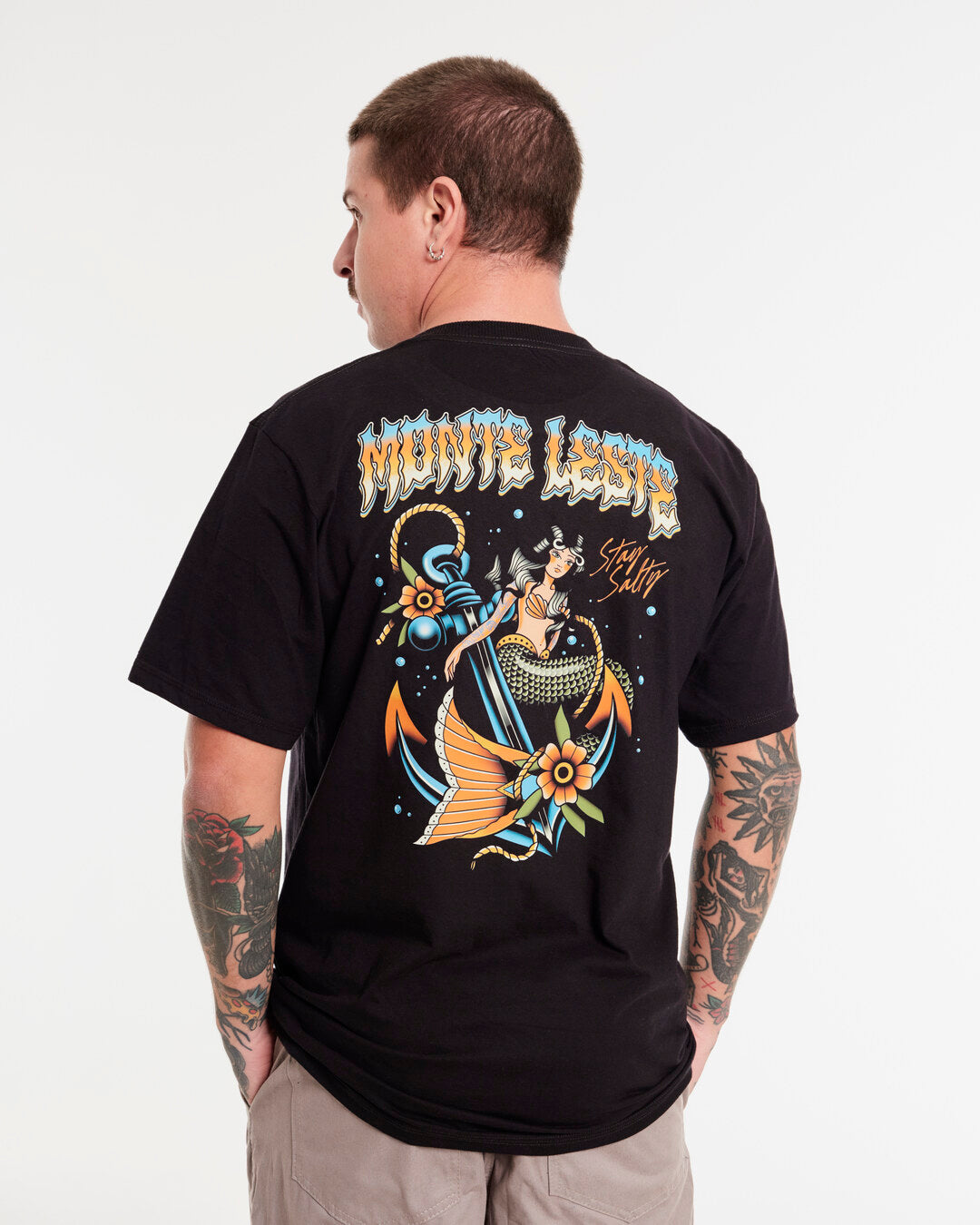
Throughout epic tales and myths there has been one creature that has captivated its audience not through their ethereal voice but their unchanging devotion. In the clothing brand Monte Leste they’ve designed a shirt in which they designed a mermaid in a modern look using a sailor tattoo art style. Monte Leste decided to depict their mermaid coiling around an anchor surrounded by sunflowers. While the mermaid is being surrounded by the flowers and being over casted by the anchor still has a provocative look almost to the point in which she is alluring a person to get closer to her. The mermaids long black curly hair although waving through the ocean seems to stay close to her body almost like it has a will of its own. The mermaid’s tale seems to wrap around the anchor almost as if it’s the object that’s holding down anchor instead of the ground below. Monte Leste decided to use the mermaid in the art style of a sailor tattoo in order to show the old superstition in which sailors would tattoo mermaids in order to be provided protections since often mermaids were associated with good luck and protection for sailors. The belief was that mermaids were potentially benevolent figures that would ensure safe voyages and perfect weather. Literary texts like the version of Chris Hans Anderson’s Little Mermaid in which an unnamed mermaid saved a prince who was sailing the ocean and was caught in a storm and later on in the story is turned into a wind spirit for her undying devotion and now controls the wind. Monte Leste pays homage to this by the mermaid coiling her tail and helping the anchor stay secured which could be seen as her benevolent nature helping an unknown ship navigator stay safe while resting for the day. Another thing that was brought to my attention was that while the anchor seems to be grounded by the mermaid it remains untied through its loop which makes this work seem as though while the while mermaid could be helping it could be bring demise to these sailors. This could be seen as the mermaids nature having a duality in which like the ocean could be a source of livelihood, but also one in which a sailor could be killed. A tale that could represent this side of their nature would be the encounter Odysseus had with mermaids in which they “hushed the loud winds, and charmed the waves to sleep” which further showed the mermaids superstition of their ability to control their environment. In Monte Leste’s case they decided to show this through the sunflowers that are blossoming in front of the mermaid as if she is the one controlling her environment where she is.The sunflower holds significance since it not only shows the beauty of the mermaid but it’s being nurtured and taken care of by the mermaid. This superstition could be seen still in this modern era through the shirt as well as in our navy personnel honor this time old tradition by tattooing this mythical creature in order to protect themselves in their voyage. Many times a person understands the risk of sailing the ocean, but they fail to realize that in earlier periods many sailors had to rely on winds to hit their sail and the ocean currents to be correct since at that time they were better terms in the hands of the environment. The belief that a mystical and powerful benevolent creature that would protect sailors would sooth these sailors into voyaging into the unknown and allow them to discover a newer and greater thing.

Melusine: the Mermaids, the Marginalized, the Merry

Dion Jones

Prof J. Pressman

ECL 305; Literature and the Environment

18 October 2025

Melusine: the Mermaids, the Marginalized, the Merry

“Then hear my request. It is that you must by all sacraments you hold holy as a Chrisitian that on each Saturday, from sundown till dawn on the following day, never—and I will say it again so there is no doubt about it—never must you try to see me in any way whatever, nor seek to know where I am.” Andre LeBey The Romance of the Faery Melusine (27).This quote gives invaluable insight into the social environments in which Melusine was concocted. The titular character offers to be both a powerful ally and resource to a man seeking power and legitimacy. This single stipulation is all-but-guaranteed to be violated. I believe that the inclusion of this quote sets up the story as a critique of the powerful and its eventual overexertion of its resources—human and otherwise.

 She Was a Faery; She Was a Hybrid. A Hybrid of What; of Who?

Following our class’s themes of mermaids and other nature/human hybrids, I seek to explore the hybridity of Melusine as part insider, part other/outsider. I accomplish this by reading Melusine as a woman of Jewish ethnic and cultural heritage and as a natural resource. The traditional Hebrew Sabbath day—day of rest and worship—is on Saturday, as opposed to its daughter faith’s Sunday. While Melusine’s Sabbath lasts only half as long, and bridges the late hours of Saturday to Sunday rather than Friday through Saturday, it strikes a parallel. Days of worship suggest the practice of rituals either public or private, allowing Melusine to adhere to her Sabbath without the prying eyes of her Christian partner—Raymondin. 

The natural world is an invaluable resource that makes life possible for itself and for those who make use of it whether they understand themselves as extensions of it or not. Melusine may act as a metaphorical representation of the natural environment, her request for the strict adherence to her personal Sabbath and boundaries may reflect the fact that wildlife, air, and water systems tend to need time to repopulate/replenish unimpeded in order to avoid the tragedy of the commons: a problem/condition where a person(s) is encouraged to act in their self-interest, depleting a shared and limited resource to the detriment of the common good of all.

How Does this Relate to Power?

The legends that inform LeBey’s story were in circulation well after the Edict of Expulsion by the English King Edward I—which expelled his Jewish subjects from the lands—and even longer after the Norman conquest of England. According to George Hare Leonard‘s The Expulsion of the Jews by Edward I. An Essay in Explanation of the Exodus, A.D. 1290, Jewish people were used by the wealthy and powerful—especially English Kings—as a source of revenue from their banking/money lending businesses due in part by non-Christians being barred from Christian guilds which controlled most other professions (104). Further, Christians were essentially barred from banking and money lending businesses due to scriptures—or assumption of surrounding them—not shared with their mother faith, creating a niche that could only be filled by members of outsider groups (Leonard 106).

Jewish people—especially the money lenders and bankers—were brought from Normandy—France—to the British Aisles by William the Conqueror as a protected class for the express purposes of enriching him and his line. Through the alienating nature of their relationship to power and the masses, antisemitism festered over the centuries, became weaponized by the powers that exploited them, and were ultimately harmed by and expelled by the non-Norman rulers who, again, benefitted from moneylending. 

I argue that this same relationship between power and the exploited is the core of The Romance of the Faery Melusine whether or not we read Melusine as an insider/outsider hybrid or as a human/nature hybrid. . Those who are powerful will form social and political contracts with more vulnerable people and extract whatever value they can. When receiving value, Christian sacraments may bind a noble, but their greed likely won’t be stopped. Melusine can give Raymondin the world, but he will always thirst for that which he cannot have. If timber builds chips and palaces, a noble will have every last tree fell if it will maintain his seat or aid in robbing another of their own. 

 Works Cited

LeBey, Andre. The Romance of the Faery Melusine. Pearson Professional Development, 2011.

Leonard, George Hare. “The Expulsion of the Jews by Edward I. An Essay in Explanation of the Exodus, A.D. 1290.” Transactions of the Royal Historical Society, vol. 5, 1891, pp.  103–46. JSTOR, https://doi.org/10.2307/3678048. Accessed 18 Oct. 2025.
Environmental Humanities: Filling the Gaps Between Art and Science

There is a common habit people tend to practice in society and said habit is the need to divide the arts and humanitarian studies, from science and arithmetic studies. Now that is not to say I have not fallen guilty of this division and classification pertaining to scholarly work since of course structure and order is crucial in the world of academia. However, literature and art pertaining to the environment and of the sort are not as separated from the science field as I previously thought it was which I began to discover after reading The Emergence of the Environmental Humanities by Robert Emmett and David Nye.

The further I delved into the reading, the more I realized that at a certain point in time, there were civilizations and groups of people that did not know fact from fiction meaning that only the people that were well-read and dedicated to their studies could critically analyze written work and separate the scientific aspect of the work from the fantasy side. But with this being said, it also adds more layers to legends and folktales considering most of them had to be created with an understanding of science regarding the environment, “The environmental humanities provide historical perspectives on the natural and social sciences, pointing to how their agendas, initial goals, and occasional failures have been affected by political ideologies and economic interests” (5). I legitimately did not realize the amount of knowledge one had to have in order to speak or write about environmental issues when it pertains to humanities but in retrospect, it is almost a given that one needs to have a substantial amount of scientific research on the topic in order to form an interpretation through literary theory.

These correlations between science and humanities is something that should be addressed and thoroughly explained to any person that is involved or is thinking about pursuing a career in STEM since it is no secret that people that enter a more science-based field of study tend to view the arts as less important which both Emmett and Nye argue against, “The open-minded, constructive approach of the environmental humanities can motivate creative cooperation between the humanities and the sciences and can assist in the interpretation of scientific results” (7). While many will continue to argue that the gaps between science and arts and humanities are still apparent, there is still no doubt that critical thinking is extremely beneficial in scientific studies and has been utilized throughout history in literature and art in general.

An Insightful tale on Environmentalism; Disguised as an Action Film

With modern films now being remakes of remakes and original stories getting neglected by major studios, this leaves films and novels to re-invent certain legendary tales. One of these relatively “modern” films is the 1995 film Waterworld. While this film’s core message displays the consequences of tampering with nature and the unknown, it also questions what it is to be human as well as demonstrates how society has progressed from shunning down diversity, to now appreciating the unique traits all beings carry.

The mid-90s film Waterworld tells the tale of a dystopian future where the Earth’s polar ice caps have completely melted, then leading to high sea levels covering every continent and leaving little to no dry land. This catastrophe then results in a form of “Darwinism” to occur where only the fittest and most innovative humans survive by building ships/boats and creating mechanisms enabling them to continue to live in essentially an aquatic desert. The main protagonist is known as “The Mariner” portrayed by Kevin Costner and excluding the evident “stereotypical virile hero archetype” he plays, the character does have depth and is in many ways an example of adaptation and assimilation in a society that is not diverse and not accepting of the unfamiliar.

Similar to previous readings involving aquatic-hybrid life and the seas, The Mariner is also misunderstood and misjudged by humans that treat him as a threat rather than as an ally with the sole motive for this unfair treatment being the fact that The Mariner has a genetic mutation. This very mutation being a pair of gills that allows him to respire underwater for long periods of time. Despite this legitimately being an advantage in a world completely submerged by the seas, as humanity tends to repeat not only in fiction but in reality as well, communities reject him and his abilities causing him to travel independently suffering countless moments of ridicule and criticism. The Mariner in instances like these can very well be a modern take on merfolk due to the hybrid attributes (e.g. fin-like phalanges and gills behind ears) he has which are subtle but impactful, but also because he is shunned from both human and and sea-life communities; not truly fitting in to either societies. Instead of uniting with a being that is accustomed to the ocean and embracing said being which will only benefit all parties involved, the survivors instead show signs of prejudice towards The Mariner displaying the societies inability to adapt themselves in an environment that is divergent from the earth they have known to live in; an anthropocentric earth.

This anti-progressive or “conservative” mentality that the survivors posses is an entitled opinion of which they have no right to believe in since the world is changing both socially and geologically which then leads one to pose a question, are humans the ones that should distinguish the normal from the abnormal when such diverse organisms exist? It is only when humans begin to understand the beauty of being unique and that adaptation is advantageous to all that we will progress as a society which is showcased in Waterworld. This ego-centrism from the survivors however slowly but surely starts to fade away with them realizing that they (the humans) are the odd ones out and that those who have begun to respect and admire the formidable power of the sea, as well as accept that society is changing just as much as the oceans currents are in perpetual motion, now have a better chance to live peacefully and blissfully, a way of thinking that all should encompass and practice in their lives to be in accordance with nature.

Undine and Humanity’s Separation From The Natural World (Discovery)

In Friedrich de la Motte Fouqué’s Undine, as excerpted in The Penguin Book of Mermaids (pp. 101–106), the fragile connection between humanity and nature dissolves through the figure of Undine, a water-spirit who enters the human world through marriage. The story captures the moment of her transformation — from elemental being to domesticated wife — as both tender and tragic. Fouqué’s rich imagery portrays not only a personal metamorphosis but a larger allegory of humankind’s estrangement from the natural world. Through Undine’s emotional shift, the subdued language of the waters, and Huldbrand’s fearful withdrawal, the story dramatizes how the human desire for control and stability severs our relationship with nature — a separation that resonates even more deeply in the modern era.

The story’s central image of loss occurs in the quiet aftermath of Undine’s wedding, when she realizes she no longer belongs to her father’s watery kingdom: “In endearing confidence, Undine walked back to the cottage, leaning on his arm; feeling now for the first time with all her heart, how little she ought to regret the forsaken crystal palaces of her mysterious father” (106). Here, Undine’s departure from the “crystal palaces”, bright, pure, and fluid, marks her surrender of the natural realm. The “mysterious father” evokes the elemental forces of the earth, incomprehensible to human reason. By contrast, the “cottage” stands for the domestic, bounded human sphere. Her newfound “endearing confidence” and the gesture of “leaning on his arm” symbolize her complete emotional investment in human life. The phrase “how little she ought to regret” captures an inner repression: she convinces herself that the loss of her origins is insignificant. Fouqué’s diction thus mirrors the human condition, our willingness to trade nature’s mystery for the safety and order of civilization.

This symbolic separation extends beyond Undine’s emotions to the environment itself. Shortly after her union with Huldbrand, Undine tells him “If you mean to reject me, do so now, and return alone to the shore. I will dive into this brook…” (105).  As Undine speaks to Huldbrand in this manner, she continues to tell her new partner she will be able to still thrive in her home environment if he is not willing to treat her properly. Knowing this, Huldbrand decides to embrace her “with the most heartfelt emotion and love”, taking her back to shore and away from the water. With this, the beginning of the end was signified as an irreparable separation was then created between Undine and the ocean. 

With this, the story transcends the romantic fairy-tale frame to offer an ecological allegory. Undine’s peaceful acceptance of her separation, her belief that she “ought to regret” little, mirrors the complacency of modern humanity, which often forgets what it has left behind. The“crystal palaces” may once have symbolized beauty and belonging, but in the human world they become unreachable myths, like the lost wildernesses of our own age. 

In The Day After the Wedding, the union of Undine and Huldbrand becomes a parable of disconnection: love binds them even as it exiles her from her origin. The story’s quiet domestic peace conceals an irreversible loss, the loss of communion with the living world. Two centuries later, Fouqué’s mermaid remains an emblem of humanity itself: longing for connection, yet estranged from the waters that once gave it life.

Why Science Alone Can’t Save the Planet

In Chapter 1 of The Environmental Humanities: A Critical Introduction, Emmett and Nye argue that “scientists excel at identifying and explaining such problems, but they alone cannot solve them. Solutions will require political and cultural expertise as well” (1). This passage makes it clear that the main idea of environmental humanities is that ecological crises are not merely scientific issues but also fundamentally cultural and ethical ones. The authors do a good job of juxtaposing the precision of scientific discovery with the failures of implementation. By using the Shanghai ecological community project, which was never built, because it ignored local farmers and scientists “studying rare birds” (2). The text reads as a confident declaration of what science can do, but then slowly turns into using words of limitation like “cannot solve” or “require”, which mirrors how knowledge without cultural context can result in the collapse of inaction.

By using examples such as “floating islands of plastic” and “garbage produced by human consumption,” Emmett and Nye evoke a vivid imagery of excess and waste for their audience, yet the moral emphasis is not on catastrophe but more so on human responsibility (1). The repetition of “we believe” throughout that same passage functions rhetorically like a creed, positioning the environmental humanities as an ethical community that is grounded in both conviction and collaboration. The authors’ use of language, using phrases like “constructive knowledge,” contrasts sharply with the rhetoric of crisis that often dominates environmental discourse. Their insistence that “humanists must offer constructive knowledge as well as criticism” redefines the role of humanities scholars from detached observers into activists in environmental problem-solving (2).

All in all, the Shanghai example used in Chapter 1 dramatizes the failure of hierarchical solutions for environmental change and highlights the need for interdisciplinarity rooted in local histories and their cultures. The text’s moral arc moves from scientific detachment to ecological empathy, further suggesting that effective environmental action must integrate a narrative, have ethics, and social understanding. In this sense, Emmett and Nye transform environmental thought from a study of nature’s decline into a humanistic question about how cultures choose to live on this planet–an intellectual and moral shift that defines the emergence of the field of environmental humanities itself.