Project Proposal

Paper plan: For my final research paper, I am planning on using my Discovery 2 post about “The Sea is History” by David Walcott where I analyzed how the poem uses extensive Biblical knowledge and references to depict the sea as containing even forgotten human history. I am planning on connecting this discovery to the week 10 reading by Eric Paul Roorda, where I wrote about terracentrism and the human tendency to base our worldviews around land-based narratives. I am planning on connecting these two works by discussing how the poem points out that human creations and history are only temporary moments in an infinite timeline, despite them seeming so strong and powerful at their time, however the ocean actually is forever, and that is the human fallacy of overestimating the greatness of land that Roorda’s work points out. Based on my feedback, I can also connect Steve Mentz’s ideas of how this fallacy is perpetuated by human’s language and way we chose to frame our worldviews.

Thesis: In David Walcott’s “The Sea is History, the poem’s extensive use of biblical allusions and oceanic imagery exposes how human history, no matter how powerful it seems, is ultimately temporary and easily forgotten on land, a claim that aligns with Eric Paul Roorda’s critique of terracentrism by revealing the human mistake of centering our worldview on land-based narratives instead of recognizing the ocean as the deeper and more enduring archive of human experience.

Final Project Idea

For my final essay, I plan to close read Eric Paul Roorda’s introduction to The Ocean Reader: Theory, Culture, Politics which is an expand of my discovery 2. I will focus on how Roorda challenges human centered and land based thinking by defining humans as a “terrestrial species” and by capitalizing the word “Ocean.” My analysis will examine how these language choices work to shift the ocean from an object humans describe to a subject with its own history and agency. I will also explore more on how Roorda’s diction reveals the limits of human perception and the ways people have tried to name and control the sea. Through this close reading, I aim to show the important role of language that Roorda uses to reimagine the relationship between humans and the Ocean.

Final Essay Idea

For my final essay, I am considering mainly focusing on The Little Mermaid by Hans Christian Andersen; more specifically on the recurring theme of the mermaid longing to be a part of another world, and how that ties into our class theme of literature and the environment. I am hoping to be able to close read and analyze text deeply as well as incorporate scholarly articles and information that can help aid in me crafting a strong argument for my final essay.

Thesis statement(final paper)

In much of the literature that we have read including recently The Deep many of the merfolk/mermaids deal with alot of traumatic life changing events.Many of the characters either reflect their stories outcomes by tragic consequences that have happened to them or life changing things such as evolving into higher beings.I would like to do research of ptsd and use of mermaids to argue the benefits of acknowledging grief and processing it.

Final Essay: Preparation and Research

After reading new pieces of literature and analyzing short films that focused on untold history and multicultural spirits (which we went over in class as well), this made me want to revisit my second discovery, and incorporate more historical information and credible sources to back up my claims and arguments. Considering my second discovery consisted of Mesoamerican water spirit Tlanchana, I would like to showcase more of the parallels between ancient societies in regards to folklore and specifically as it relates to water deities and these connections will be made by accessing the Penguins Book of Mermaids, as well as Scaled for Success: The Internationalisation of the Mermaid by Philip Hayward which speaks of this phenomenon. I am still at the part where I am trying to conceptualize the “So What?” part of my thesis but I intend for it to demonstrate the influence the environment has on humanity and how altering ones perception of the environment (introducing new theologies and forbidding previous beliefs) can result in a form of desensitization where one may slowly start losing the connection they once had with nature.

Final

To be honest, I’m not sure on what I want to write about for this final. So far I have been enjoying “The Deep” so maybe I might write about that. Perhaps after getting further into the book I will know more about what I want to base my essay on. After that, i definitely need to look into scholarly articles for the essay.

So far, I have an interest in the trauma and memories revived the body. “Rememory” as well.

Aganju and Yemaja

This story about Aganju and Yemaja shows how Yoruba mythology depicts creation as something born out of both unnatural circumstances and transformation. The story makes it clear that Yemaja’s historical significance to the Yoruba people comes from her suffering and struggles. When she resists Orungan, “she fled from the place” and her aggressor who was also her son, and it is precisely this act of oppression and violence that becomes the source of divine creation. The moment her body breaks open, the story describes how “her body immediately began to swell in a fearful manner,” a phrase that depicts her transformation not as peaceful or beautiful, but as painful and violent. This specific description supports the idea that Yoruba mythology acknowledges the reality that creation and life can emerge from hardship and rupture. Her suffering is not erased, but instead, it becomes sacred and allowed for further gods and goddesses to exist. This is an example of Yoruba representation of women and creation as well. Women go through suffering and pain to bring life into the world, just like Yamaja. The details of how the lagoons started flowing from her breasts also promote the idea of female reproduction.

The passage also reveals how the Yoruba view water as significant in their culture. Yemaja is introduced as someone who “presides over ordeals by water” and is the “mother of fish.” This suggests how water has a deeper significance than merely being a physical feature, as there are indeed “ordeals” that need to be watched over. This makes it even more meaningful how the stream that birthed so many other gods and goddesses flowed from her body. Creation is definitely an ordeal. This also portrays emotional pain as not weakness, but a creative force bringing forth something greater.

Discovery 2: Omambala: The Water will Carry Us Home

Dion Jones

Prof J. Pressman

ECL 305; Literature and the Environment

16 November 2025

Discovery 2: Omambala: The Water will Carry Us Home

What I see 

Gabrielle Tesfaye’s film “The Water Will Carry Us Home” (2018) is an afrofuturistic work featuring the ocean—as The Water Spirit Omambala—as a world and entity with agency. It first appears as an active entity at 2:13, bares the discarded enslaved women  around 4:14, and transforms them and their children into mermaids and merfolk around 4:30 before featuring the water in a supportive capacity for the remainder of its screentime. Centering the water in such an explicit way conveys a sense of significance, respect, and connection for those involved. The water is so much more than a place. 

 .

How it is Depicted: 

Water is portrayed in the film in several forms: ocean water in a two-dimensional static or stop motion format that carries people and vessels, a divine mermaid, or waves/surf in live action.  

The static form of the 2D depiction of the water is used to introduce the particular story at the heart of the film. The stop motion form of the water carries the ships and supports the historical images and sources—news paper articles—to help identify the time period. Functionally, the choice to use 2 dimensional images allows the audience to compare the film’s events both in the past and future adding to the film’s credibility in light of its religious and mythological elements. 

The inclusion of the water as the divine mermaid—Omambala—functions to honor the cultural and spiritual belief systems of West African peoples—the Igbo in particular—and allows for the film to operate as more-than-a-tragedy. The water uses its agency to save the discarded captives and restore their dignity by providing belonging. The mothers become divine mermaids themselves—with increased size to represent their increased significance—while their children school around them. Their dignity and value are weaved into the mythological, allowing them to continue differently to the terrestrially bound as actual beings of the water or as living stories in their mother culture’s long memories. 

The water in its comparatively mundane live action form rolls endlessly against both the shore and structures. The young woman in the closing scenes featuring said surf utilizes the water as medium for which to give her respects while also seeking connection. The headphones of shell and metal are plugged into the sand, presumably connecting the woman of the future to the great spirit Omamabala who ideally connects to the aforementioned living stories and merfolk across time and space.

What Does it Add?

“The Water Will Carry Us Home” challenges the audience to consider the ocean as a historical record, a home, and as an active part of the world. The film interacts with what SIRIUS UGO ART suggests as the traditional Igbo belief in Omambala—the mother of the Igbo people while also referencing the Igbo Landing of 1803 where the captive Igbo escaped the Atlantic Slave Trade via mass suicide while praying to their Omiriri Omambala, a prayer which roughly translates to the title of the film “The Water has brought us here, the water will carry us home”. While the film ends with a cliff hanger, it reintroduces mythology and spiritual belief as a valid conduit for which to interact with the world. The water is respected and centered rather than written off as a beautiful second fiddle to the typical human drama and Christian metaphysics of Undine or The Little Mermaid. It marries history, mythology, and hope into the imagination without painting the physical world as rest stop on the cosmological escalator. 

Works Cited

“Igbo African Goddess: OMAmbala by Sirius Ugo Art.” YouTube, uploaded by SIRIUS UGO 

ART, Nov 29, 2022, https://www.youtube.com/watch?v=s_z257yw17A. Accessed 

16 Nov. 2025.

Tesfaye, Gabrielle. “The Water Will Carry Us Home – Official.” YouTube, uploaded by Gabrielle 

Tesfaye, Jun 24, 2021, https://www.youtube.com/watch?v=dGlhXhIiax8. Accessed 

16 Nov. 2025.
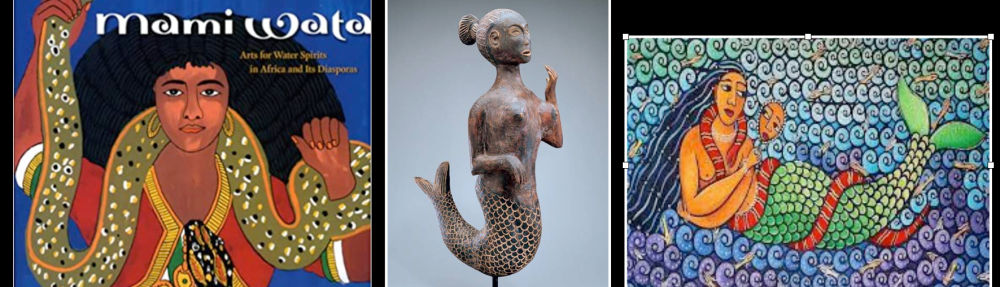
Week 13: African Mermaids and Other Water Spirits

I find it interesting how even throughout the transatlantic slave trade, water deities such as Yemoja/Yemaja were still worshiped throughout rough historical times for Yourban people. It would make sense how throughout slavery like this that occurred throughout different coasts that a figure closer to the water would seem fitting to pray and worship to during a time like this. But not only that, the trade and spread of this water diety was shared with other places like, “[…] Brazil, Uruguay, the Dominican Republic, Cuba, and the United States” (Pg. 166), which I could only assume is how other forms of Yemoja developed association with similar beings like Mami Wata.

Reason being why this stood out was considering how consistently throughout history there are different takes on sub-human creatures, Mermaids, or water dieties based on the social and religious need of society during that time. For example, the Christianity’s need to portray mermaids in a hyper sexual way to warn off men from giving into lust and desire, or in this case, slaves search for a sense of comfort from Yemoja during there transatlantic moves.

Look Past The Land and To The Sea (Discovery #2)

Derek Walcott’s “The Sea Is History” is a beautiful piece of work with an urgent lesson that the sea is not background scenery; it is an archive that holds and speaks history. Walcott teaches this by shifting among voices and by turning physical seascape details into evidence. Listening to the ocean, and to the people who know it, becomes a method for doing history, which is exactly the work environmental humanities asks us to do.

The first voice in the poem sounds like an official examiner: “Where are your monuments, your battles, martyrs?” The question treats history as something that can be pointed to in stone or on paper. Walcott then flips the power dynamic with a second voice, a local answer that is calm and exact: “Sirs, in that grey vault. The sea. The sea / has locked them up. The sea is History.” Notice the steps in that reply. “Sirs” politely resists the authority of the examiner. “Grey vault” renames the ocean as a protected archive, not a blank horizon. The short, repeated sentences, “The sea. The sea.”—slow the rhythm and force the reader to look. Finally, “has locked them up” suggests both safekeeping and imprisonment, raising a hard truth: the ocean preserves the past, but it also keeps it out of easy reach. This exchange shows how multiple voices matter. The examiner’s narrow demand produces a local correction, and the lesson becomes clear: if you only look for statues, you will miss the records written in water, salt, and tide.

Walcott then backs the claim with material evidence. The poem does not just say the sea remembers; it shows how it remembers: “Bone soldered by coral to bone.” The verb “soldered” is precise and unsettling. It is a workshop word, a human technique for fusing metal, now applied to bodies under pressure and time. Coral, usually a sign of life, acts here as the binding agent. In one short line, Walcott compresses human remains, marine growth, and craft vocabulary. The image does three things at once: it proves that the environment is a physical ledger; it rejects clean, heroic versions of the past; and it makes the reader feel the cost in the very texture of the reef. A close reading of this line is enough to see the poem’s lesson: the ocean carries the archive in its own living matter.

Finally, the poem turns from claim to practice through a guiding voice: “strop on these goggles, I’ll guide you there myself.” The imperative “strop” (to sharpen) does double duty. It literally prepares a tool and metaphorically sharpens perception. “Goggles” make the method explicit: if the records are underwater, then research requires gear, time, and humility. The promise “I’ll guide you” also matters. It centers local knowledge and embodied learning over distant judgment. Rather than staying with the examiner’s demands, the poem puts the reader in the water, where careful looking replaces abstract debate. In other words, Walcott doesn’t just argue that the sea is an archive. He hands us a method for reading it.

Across these moments, one message threads the poem: history is co-authored by environment and people, and we can hear it only by honoring more than one voice. The examiner teaches us what a narrow standard looks like. The local reply teaches us where to look instead. The imperative to “strop on these goggles” teaches us how to look closely, physically, with guidance. This is not just a poem about the ocean. It is a set of instructions hiding in plain sight. If we follow them, reefs become records, shorelines become shelves, and currents become witnesses. That is the poem’s lesson and its challenge: to practice a history that listens to the sea that has been keeping the files all along.