Week 3 Reading Reflection

My main takeaway is from pg.xiii from The Penguin Book of Mermaids and how René Magritte painted a mermaid with the upper body of a fish and lower body of an exposed human woman’s legs. Forewarning, I do go off on a small tangent about something that my mind couldn’t stop thinking of later on.. So here we go! 

I searched up the image and golly, it doesn’t seem right. But, that’s because we’ve been fed this whole other image that encapsulates beauty. Meanwhile, this art piece seems abnormal and uncomfortable to look at. Naming it “The Collective Invention” is diabolical, because of how surreal this image looks.It feels sarcastic as like the artist is giving a wake up call for the public to question their own acceptance of mermaids as a common concept in society. Maybe, from a physical characteristic standpoint of why mermaids were accepted other than men are perverted and strongly dislike women. Is that all the mermaids I’ve seen so far have a human face.. familiarity feels safe enough to have some guard down and have clouded judgement on what is considered normal. Just as how Christianity adopted some pagan beliefs to attract / convert pagan followers. Hence, having a bigger following is to gain more power over people and the environment. 

Another theory I have as to why mermaids are portrayed as women from their waist upwards other than already having a merman existing,and human nature with the attraction to female anatomy. Why, for the most part, do mermaids have a woman’s torso and long luscious locks? Encapsulating the breast and hair is widely significant because that is a part of the mermaid’s identity according to society. This question puts me back to how the Christian churches went out of their way to disintegrate femininity but didn’t want to ruin the image of Mother Mary. Is it because she brought comfort and is the mother of Jesus Christ? Is she a hidden reason to have mermaids be shaped the way they are? Why were we told sirens have an enchanted voice? Surely, their voice isn’t the only feature that held the attention of humans? Is it because women bring a sense of comfort to men? Of course, I don’t have the answer but this concept just rattles my brain because disregarding the sexual urges from men regarding mermaids/merepeople and male merepeople already existing .. Why else are mermaids shaped the way they are? Someone tell me why!?! 

Anyways, if you’ve made it this far, I appreciate you for your time! <3

Chapter 1 introduction to Mermaids and humans

In this chapter where it introduces how does society works with people who are Mermaids and Humans have differences and what they about this is usually through the Human perspective is only one people pay attention to. I personally didn’t really know how seperate they are as mythical creatures. The fact that hybridity is the balance between both mythological and scientific camps.

Hawaii does it best with Mo’o

I will admit that my complete knowledge of mermaids before taking this class consisted of Ariel and her underwater fish friends; I don’t even know what the true plot is. But using this, my understanding of mermaids has mainly been that they are all just pretty girls with nice hair who want to know what it’s like to be human. Contrary to this previous belief, it has come to me that mermaids/merpeople are historically considered extremely vain, evil, and vicious by many. In the Penguin Book of Mermaids, these beliefs are further elaborated, as it is stated that the framework of the belief in merpeople is “strongly patriarchal, and in some, it is also heavily Christianized, so that the (water) serpent is reduced to a demonic symbol of evil” (xix). The consideration of merpeople or even just ocean hybrid creatures being evil further pushed through the use of the siren luring traveling men in to torture or kill them. As this evil is the traditional thought within many European spaces, it is common for the stories of the merpeople to either get lost or not ever be created at all as no one cares to consider the stories of evil/monstrous beings. Although these common beliefs tend to paint a horrific picture in peoples minds, an aquatic Hawaiin water character by the name of Mo’o may help repair the disdain people harbor towards hybrid ocean beings.

The Mo’o is a reptilian water deity in Hawaiian mythology, commonly depicted through encounters with human men. While this is still a patriarchal creation of ideas, it is a much more positive one. It is more positive in the way that it completely counters the common notion of “sirens and mermaids being notorious for their seductive songs that drive sailors mad with longing”, but instead “mo’o are renowned for their loveliness” (xix). So, as these creatures are revered as being lovely and free from domestication, the underlying sense of misogyny in other stories is completely absent in tales of mo’o. Europeans even adopted tales of mo’o filled with lessons of self-control, respect, and divinity. Stories of mo’o are not used to scare audiences, but instead are used to make them aware of supernatural beauty and feminine powers, making it known that these creatures are not ones than can be nor should ever be captured/domesticated. I feel hybrid water beings are made much more approachable through the sharing of mo’o as there isn’t the inherited sense of fear or danger present with many stories of evil mermaids/sirens. So far, the introduction to the Penguin Book of Mermaids has me hooked, and already thinking of the infinite new ways to think about these intricate hybrid beings of water. I can’t wait!

A Way out of No Way: Water Spirits

Dion Jones

Prof J. Pressman

ECL 305; Literature and the Environment

7 September 2025

The ocean is a great and mysterious path—a vast world all its own, as a result, the merfolk and water spirits of this weekend’s readings from “The Penguin Book of Mermaids” utilize certain properties of the waters around us: reflection and obscurity. The divine beast-who-is-sometimes-a-deity Oannes reflects human qualities through his teaching of art, symbolic language, and sciences (pg 5). Simultaneously, Oannes embodies obscurity through his amphibious nature, hybrid body, and his returning to the Sea at night (pg 5). His power is either internal or an extension of his connection to other deities, making him greater than humanity, yet a resource/servant for/to us. 

The story of Kāliya the Snake/Naga manifests these two properties differently. The snake king possesses human-like recognition of divine figures and the power of speech but reflects human anxieties and conflict with wildlife. Human and divine encroachment and reproduction of environments creates the opportunity  for Kāliya to take over the pools which invites conflict. The presence of venom/poison as well as the presence of many snake wives causes a hazardous situation that led to the great snake’s defeat and banishment (pg 6). This story is  an argument against the spreading/ muddying of boundaries between humans/divine figures and the natural world.

The Tuna of Lake Vaihiria differs from the previous depictions in that it uses two opposing depictions of water spirits. If you count Maui as water spirit, then water spirits can act as a positive masculine figure who embodies human moral qualities but with superhuman capabilities. The eel instead plays the role of trickster, disguising his monstrous form in order to lord over the freedom and sexuality of his human bride (pg 13). In this way, the water spirits reflect the best and worst of adult human relationships.

Week 3: Merpeople and Cohen

For this post I will be focusing on the introduction of The Penguin Book of Mermaids. It is very intriguing to me because I took an ECL 220 class on monster theory and how monsters reflect our anxieties, and we learned from last week’s discussion that mermaids in general (not just medieval or contemporary) are quite literally a part of monster theory.

The introduction to the Penguin Book of Mermaids presents us with some interesting info about aquatic creatures and how they reflect our cultural anxieties. What stood out to me in the “Their Bodies, Our Anxieties” section is the uncanniness that we experience when we combine a being with non-human traits with humans; Bacchilega and Brown use aquatic humanoids as an example (xi). Jeffery Jerome Cohen’s seven monster theses can be seen at play here; keywords such as “thresholds” and “anxieties” and how mermaids are described here has me thinking about them. Here is how I would connect merpeople and aquatic humanoids in general to some of Cohen’s theses, specifically I, III, VI:

Thesis I: The monster’s body is a cultural body

This thesis is referenced in the text itself: “In contemporary cultural theory, we are reminded that ‘a construct and projection, the monster exists only to be read; the monstrum is etymologically ‘That which reveals,’ ‘That which warns.”” (xii) Monsters reflect our culture’s “fear, desire, fantasy, and fantasy,” (Cohen 4) and aquatic human-creature hybrids are no exception to the monster spectrum. Merpeople are sometimes featured in maritime fantasy/fiction novels, and they are usually depicted as humans with a giant tail instead of a pair of legs. Although they could be considered human, their monstrosity stems from the fact that they live in a largely-unknown uninhabitable environment outside of human society. Because their bodies reflect our desires to explore more of the ocean and our fear of not knowing what lies there, it therefore fits Cohen’s first thesis.

Thesis III: The monster is the harbinger of category crisis

Merpeople are usually part-human and part-fish, and some portrayals give them the ability to switch between human and fish at will. Because they exist between two categories, it is difficult to categorize them into either human or fish. Their in-between existence, therefore, “questions binary thinking and introduces a crisis” (Cohen 6).

Thesis VI: Fear of the monster is really a kind of desire

The text basically says it: “Our ambivalence toward mermaids and other water spirits finds its representation in their bodies, which are often alluring, but can also be frightening.” (xii) For instance, the siren is a fearsome type of mermaid that sings a beautiful song that lures sailors to their doom. She flips the gender binary by depicting the woman as the one in power, enticing men into falling for her song and compelling them into doing what she wants. Since we live in a patriarchal society, this power, then, is what women desire most.

I think it’s interesting to see what I’ve learned from my previous ECL classes make an appearance in the readings for this class. Here’s my question: how would you apply Cohen’s monster theses to a monster that you’ve encountered/yet to encounter? It doesn’t have to be mermaids, but it’d be intriguing to see his theses applied to merpeople in particular.

Explanations of origin

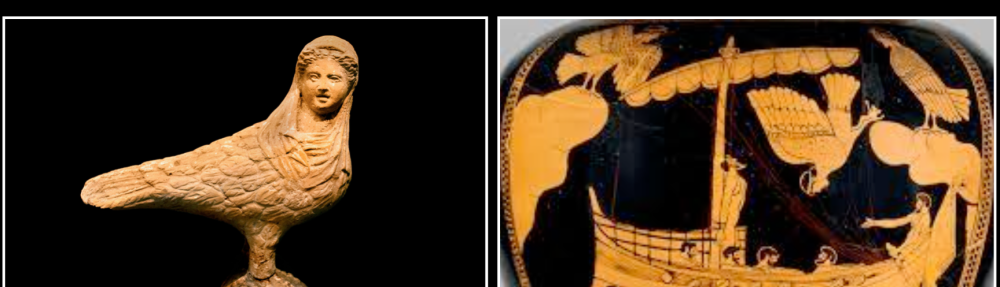
I remember from class that we discussed that some mermaids that we read in stories may not seem like mermaids at first glance but are such as the story of Odysseus where he was attacked by sirens which flew but held a figuire closer to that of a mermaid.In this case the story of kaliya and the serpent are similar to that in which while the serpent isnt the mermaid itself but what the outcome of the story allows for the creation of mermaid.I had also found it interesting how throughout the story they focused primarly on the use of fire as a description.I also had found it interesting as the use of the word fire which primarly is used as a method of cleasing and rebirth in many other stories.In the story when they talk about the serpent they describe the flailing of the snake when confronted by krsna as “they burst at once into flame smitten by the wind and carried by water burning by that snakes evil fiery poison”. I felt that this quote was important because during that time I believe that there may have been fires in the area and they were being carried across the area by the wind in which they were only put out by the raining season.After the snake was defeated the snakes wife had begged for mercy,but what I had found interesting was the description of the wifes.In the story they described the snakes wifes as “adorned with fetching necklaces,who were beautiful with jangling necklaces” which I felt is a description of a mermaid by their sexuality and how they were described attractive which is usually a main characteristic of a mermaid.It was also interesting as they had adorned the mermaids with man made objects like necklaces and jewlery Which I only know of one thing to use jewelry which is us humans.I believe that the reason why they had to make clear that they were adorned with jewelry is in order for them to be closer to humans and make us the reader have pity not only for the snake but the wives as well.The end of the story was also interesting because the snake spoke and stated that he “was defeated and asked for mercy” which was given due to him not doing anything on purpose and was then cast to the ocean from the river with his ancestors and wives.I found this interesting as well for the reason that when we think of the location of mermaids we think oceans or by the beach which is where they were cast to after being defeated.It then further deepens the story by leaving the story open ended by stating that they were not killed but the snake,wives,and children presumably still alive continuing their lineage within the ocean.

How Aquatic Humanoids Challenge Our Boundaries as Humans

After reading “Introduction: The Stories We Tell about Mermaids and other Water Spirits”, one of the things that stood out to me when reading is when the authors said the following: “There is something deeply unsettling about a being whose form merges the human with the nonhuman. Whether they dwell in flesh or salt water, aquatic humanoids raise questions about what it is to be human and what lies beyond a human centered world” (xi).

It uneases us when aquatic humanoids, real or imagined, suspend between the human and the nonhuman. Through their very suspense, stranger like entities challenge us to reconsider the very concept of human existence. By expressing characteristics of the familiar-human faces, voices, gestures-and the aquatic traits such as scales, fins, or tails, they destabilize fixed categories such as nature and culture, human and animal, and land and sea. This ambiguity becomes crucial for there is, in fact, no way to confront the limitations of a human-centered worldview.

Aquatic creatures in tales or movies often confuse our sense of belonging and difference. By defining themselves against the opposites of civilization versus wilderness, body versus environment, and self versus other, humans create these distinctions. A mermaid or sea spirit dismantles these distinctions by existing in both realms and refusing to be neatly categorized. In this manner, with their existence, they point to our dependency on simplifications that might oversimplify the genuine complexity of being. If something can be both human and not human, then what marks the boundary of humanism itself? This question settles with immense power in an age of ecological crisis, wherein human survival is interdependent with the nonhuman world.

The image of the sea only further intensifies the presence of aquatic humanoids. Unlike the somewhat steadfast land, the ocean represents fluidity, instability, and unknowability. It diminishes the idea that humans are always in control. Aquatic humanoids living in that represents uncertainty in itself. They embody the notion of a lure into the abyss and a refusal of human-centered control. Their hybridity conveys distinctive meanings: that identity and existence require relationships that breach perceived barriers-between bodies, species, and environments.

In a wider sense, these aquatic humanoids are not just mythical creatures of fascinating creatures, they also remind us to realize the limits we have as humans.

These aquatic humanoids remind us that we humans are not the center of everything and that contemplating a life full of possibilities beyond ourselves is a consideration of a more intertwined and interdependent world.

Week 2 Blog: Merpeople

I think the introduction and Chapter 1 of Merpeople by Vaughn Scribner was very interesting and provided a new, deeper perspective on the symbol of mermaids. I find it unsurprising that mermaids were originally used to represent women in a negative, sexual light in order to perpetuate and uphold the power dynamic between men and women. Mermaids are seen as seductive, not to be trusted, and monstrous while mermen are seen as powerful leaders, even resembling gods like Posiden. I find it interesting how men felt the need to portray women in such a negative way while trying to repress them, however they did portray them in a way that is meant to be feared, which makes me wonder what they were so fearful of? I also had thoughts about the hybridity of mermaids: woman and fish. I remember from class some early Greek examples of woman hybrids included harpies, woman and bird alongside sirens, woman and fish. I find it interesting that when referencing Greek images, later men decided to expand upon and popularize the fish imagery. In comparison to the bird, the fish is much less free and more full of mystery since it is confined to the ocean which is largely unexplored. It also tends to have more negative connotations since it has to do with the dark depths and “below” land. The bird, on the other hand, is much more free and can fly as high as it wants while also enjoying land. Perhaps they chose the mermaid imagery to emphasize more to reinforce the control on women that they wanted.

The Perception and Ambiguity of Creatures from the Deep

While we may have just started the topic of Merpeople and we can already make some assumptions of what is to be expected as we expand our knowledge of these sea deities (or monsters), the truth is that this just the surface and of course an introduction. However, what seems to be a motif in the subject of mermaids is the fact that these “creatures” tend to instill an extreme feeling in others whether that be a feeling of displeasure (Homers version), or a completely opposing feeling pertaining to femininity and the dangers of lust (Christian Church version that borrows from Pagan views).

Delving further into Merpeople: A Human History by Vaughn Scribner, it describes the appearance (or more so the descriptions) of deities and religious figures in Paganism consisting of androgynous features and attributes. This to me also goes to show how humanity is always interested in the topic of hybrid creatures or hybrid characteristics in humans, which is prevalent in pop culture with superheroes having animal powers while still remaining in their human state superficially as well as in myths such as the Minotaur, and now after completing this weeks reading, a mixture of female and male features, “Even more interestingly, because pagan gods could be both male and female” (Scribner 30). Not only does this further prove that civilizations no matter how ancient or where they originated, there will always be a common interest between cultures regarding animal-human hybrids, as well as mixed features in general.

Image is everything to most societies and it still is to this day, but one thing that is certain is that this way of thinking can lead to misunderstanding which is clearly apparent in mermaids. With their appearance showing the downsides of lust and sex, it explains why civilians where advised to not sing “with a maiden voice” to not lure any dangerous creatures (Scribner 44). Although the sea is vast, diverse, and majestic, there is no doubt that the sea is also mysterious and will continue to be for the rest of time.

Week 2 Readings Post

I managed to create a system for my annotations that my brain can comprehend but it might look crazy to everyone else, which often happens. I thoroughly enjoyed chapter 1 of Merepeople compared to the introduction. At the beginning of the chapter, I enjoyed the small story just showing how weak men are about keeping their emotions in check that a carving is bringing out these human natural emotions. The hypersexualization of the mermaid and his hunger / temptation makes it uncomfortable from an outsider point of view that isn’t a desperate man. I was uncomfortable with the narration while reading it, just the objectification was wild and had me cringing about how this man was acting! Unhinged deacon at its finest. I wonder if there are texts out there about a woman having sexual desire for a triton..? But, considering that Christianity and their leaders were trying their hardest to denigrate femininity, I wouldn’t be surprised that it was destroyed or hidden deep. Later in the chapter on page.51, the details were clear on how tritons were perceived, which was more conservative than their counterpart. I had this thought that popped up during our lecture this past Tuesday, that since mermaids are a reflection of humans.. Creating the narrative around mermaids is a soapbox for Christian leaders to passively ruin femininity. An indirect way of criticising women and their feminine attributes. If the church is on a mission to ruin femininity, why isn’t it a sin considering that Mother Mary is a woman too? And my last question that has been bothering me is that on page.40, why would scholars assume “vagina” as another meaning for the fish held by the mermaid? I don’t understand the reasoning for this metaphor. Like the mirror/comb, vanity, but what does the dang fish mean? 

This is how I sum up my takeaway from this week’s reading: in the name of “goodness”, there is plenty of evil doing.