Water and Other Worlds

Dion Jones

Prof J. Pressman

ECL 305; Literature and the Environment

14 September 2025

Water and Other Worlds

This weekend’s readings from “The Penguin Book of Mermaids” as well as Steve Mentz’s “Blue Humanities” and “Deterritorializing Preface” focus on other worlds and re-centering our thoughts with that in mind. Current, Water, Flow, Ship, Seascape, distortion, and Horizon each shift language. It alters our perceptions through changing our relationships with/monitoring the relationships our adjusted centers have and the expectations related to them. 

The comparison between terra—the familiar, land centered—and “oceanus”—the “alien”, water centered—connects to ideas of periphery and otherness that have been prevalent in previous readings (Deterritorializing xv). Merfolk—tritons, mermaids—marked new worlds as beings that acted as extensions of alien places for Europeans amidst the ‘age of discovery’.

Week 4 reading

Focusing on poem verse 6 on page 11 of “Odysseus and the Sirens”, the carefully cultivated song (with a rhyming scheme of ABAB) to catch Odysseus attention with his greatest desires and fluffed up ego had worked to the point where his crew mates had to tighten Odysseus binds before he escaped and went towards the sirens. Not a sexually charged lure was used in this scene, instead the offer was about having rich knowledge and becoming a more powerful being.

Odysseus is an arrogant warrior and how did the sirens manage to catch his attention? “O pride of Greece!” (line 1) and “Blest is the man ordain’d our voice to hear,”(line 3) are great hooks that captured Odysseus ear. Who wouldn’t want to play a closer ear to someone complimenting them? The sirens praising him for being the extraordinary warrior he is and acknowledging how lucky he is to be hearing their “lay”(line 2). Odysseus knows that the sirens have bad intentions, hence why he’s bounded to his ship and his crew mates have wax stuffed in their ears. The supernatural beings that sirens are and have access to infinite knowledge helped gain their case for how to lure Odysseus their way.

The “Celestial music warbles from their tongue”(pg.11, verse 5, line 3) has me associating sirens as the harbingers of death. These supernatural creatures have sweet songs that convince humans to end their lives for whatever deep desire they have in their souls that isn’t for safe keeping while you’re around them. They know your vulnerabilities and use them against you.

This scene showcases how often humans are tempted to go the wrong route in life that will bring a heavy hand of pain. Or, fight through those intrusive and compelling thoughts and stay true to oneself. The choice is ours.

Taking The Conversations Off Land: Normalizing Ocean-speak

Steve Mentz’s “Deterritorializing Preface” is a short excerpt that makes a striking argument for the switching of codes from terra-centric vocabularies to ocean-centric vocabularies. At the very beginning of the preface, Mentz states, “our bodies and imaginations register the shift from familiar Terra to alien Oceanus” (1). As he refers to the ocean as “alien,” an idea of the ocean being mysterious, intriguing, and universally unknown is placed and confirmed inside the reader’s mind. So, with the terrestrial language including words such as field, ground, and landscape, which are such strict terms, it is almost essential for us to explore the unknown and expand our vocabulary to become more dynamic, just as the ocean is.

Mentz’s suggestion to change the universal term of the field to “current” is a highly intriguing point, especially as this topic was briefly discussed in class. The term’ field’ seems so stationary and flat, so to use the term “current” as one to suggest flow and change is a positive step in the right direction. To understand the ocean, we must first accept that our minds and ideas need to flow like a current instead of remaining in a constant pasture. Next, we must recognize that the Earth is mostly blue to fully understand and appreciate “Blue Humanities”. To relate to the Earth being mostly water, we must allow our minds and metaphors to float up to the surface and recycle rather than remain on the ground floor and never take off. Lastly, to build on the idea of our language changing as well as our ideas, we must be able to also let go of linear visual thinking related with the term landscape. Instead, we should resort to the term seascape, as nothing is ever so clear in the ocean for us humans, and is always left up to interpretation, such as is most of our lives. Adopting more dynamic language related to blue humanities may prove beneficial to society as it creates open, ever-changing, and therefore constantly learning minds.

This brief reading from Steve Mentz was thoroughly enjoyable and allowed me to open my own mind to re-interpret what blue humanities might be. This type of constant flow-state of thinking, especially relating to everyday language, is one that I have never truly thought about, and I am appreciative of Mentz’s writing.

Siren’s Song between Knowledge and Temptation

The most impressive part of reading “Odysseus and the Sirens” in The Penguin Book of Mermaids was the lyrics of the Sirens’ song. The Sirens tried to tempt humans by using intellectual power and pulling them toward the sea. At this point, I wondered why they used “knowledge” instead of something else as the reason for temptation. In modern society, honor or money might be seen as more powerful temptations. However, after thinking more, I realized that both honor and money usually come from knowledge. Human beings also tend to admire those who have greater wisdom than themselves. For this reason, I think knowledge could be the strongest and most universal form of temptation.

Still, I felt a contradictory emotion because this knowledge was offered not by a holy or noble figure but by the Sirens, who are monstrous beings. Normally, people imagine knowledge as a sacred gift from wise or divine figures, such as gods, prophets, or respected teachers. But here, the Sirens lead humans to death while giving that knowledge. This mismatch makes us feel stronger fear and uneasiness. Their song is both a promise of enlightenment and a trap that ensures destruction. This duality creates a sense of confusion asking ourselves should knowledge always be trusted, or can it sometimes be dangerous? At the same time, the Sirens’ beautiful voices produce desires to hear them, while their dangerous nature causes fear. This combination results in powerful ambivalent feelings. Odysseus’s action of trying to listen to the music while being tied shows that human beings often try to experience temptation while at the same time creating limits to protect themselves. In this way, the scene reflects the human struggle between curiosity and survival.

In particular, the fact that the Sirens have a half-human shape makes the boundary between humans and monsters unclear. This blurring of boundaries projects suppressed human desires onto the Sirens and makes the emotions of the readers even more complex. It suggests that the dangers we fear most may not come from the outside but from within ourselves, from desires we cannot control. The Sirens’ song is memorable not only because of its beauty but also because it reveals the paradox of knowledge, temptation, and human weakness. It teaches us that even the most valuable gifts, such as wisdom, can also carry danger.

Sirens Temptation of Divine Knowlegde

In this week’s reading of “Odysseus and the Sirens” in The Penguin Book of Mermaids, the mermaids are painted to be tempting creatures because they promise wisdom and knowledge, which lures men to crash their boats and lead to their unfortunate death. During the Odyssey, Circe helps Odysseus plan against being tempted and warns him against the Sirens. Now this begs the question, why? What were they warning? The sirens in the Odyssey were symbols of knowledge of the truth, and the fear mongered around them was the fear of knowing too much and becoming too powerful.

If I recall the Odyssey accurately, his city was destroyed after a war, which often raises questions about power afterward. The warning against mermaids was used to maintain people’s trust in the ruler and served as propaganda to keep them fearful of knowledge. Specifically, the line “we know whate’er the kings of mighty name, Achieved at Ilion in the field of fame” demonstrates that the mermaids were superior to the mighty; their knowledge was stronger than that of the current ruler (11). So, this effort to prevent people from gaining knowledge is a strategy to keep them uneducated and easy to control. There is also a claim to “fame” with knowledge. 

This raises questions about the misuse of knowledge. Those who use their knowledge maliciously to exploit people. Which would reveal the truth of power held towards the top of the hierarchy. The warning against the mermaids is also a warning against greed. To be greedy of knowledge that destroys the people around you and eventually yourself, almost like an ‘evil crazy scientist’. The never-ending cycle of always having a desire for more will be one’s ultimate demise. So, the sailor’s unfortunate death caused by the mermaid would be just the cause of their death, which would just be a consequence of their own personal sin. 

Overall, the depiction of Sirens is very interesting, as they are monsters of temptation through their promise of otherworldly wisdom. The more knowledge someone has, the harder they are to control, and the desire for more only grows.

The oldest Hit

As I read the Odysseus I found it interesting as how the text was written first and foremost as most of the literature we read was told as stories and this one was written as a song.I can visually see this story being told in a tavern in which one had come home from a long day and needed something to keep their mind distracted or entertained.I saw this in the first stanza in the story in which they say “o friends o ever partners of my woes” it seems to get the people to feel invested in this story as its sung.I was also wondering as to why they were using quotations within stanza 2,3,4,5,6 but I found it very interesting that they wouldnt close the quotation until stanza 6.I was thinking when they wouldnt finish a quotation in which i can see it as a pause in which the speaker catches their breath and tries to rile their audience and try to get banter from them.Stanza six could be seen as a way for the speaker to finish the story by getting the audience to finish the story as if they expect the audience to already know of the story.within the text I found evidence in which they would use exclamation points every so often in order to emphasize a revelation or a action.while the story itself I didnt feel was impactful it was the use of their description and world building that had me going through the story in which “flowery meads the sportive sirens play” not only did I find this as the only description I needed of the mermaids of the story It had me thinking how they defined the feminity of mermaids indirectly in which they described the mermaids to be laying in a beautiful field of flowers.

The Flow of Language: Perception Sets the Seascape

Perception is how we see the world, how we understand it, how we explain it –– but it’s also how we create our world. In Steve Mentz’s “Deterritorializing Preface” for Ocean, he calls for the reader to adapt their territorializing perceptions with adjusting the language we use. Mentz offers seven words to adjust, one I found particularly interesting was flow instead of progress. Mentz states, “thinking in terms of cyclical flows rather than linear progress makes historical narratives messier, more confusing, and less familiar. These are good things” (xvi). I find with changing language to flow there is less emphasis on an outcome than progress, reframing expectations and allowing for developments outside of the perimeters of anticipated progress.

Here’s why I think it matters, words carry weight and word choice frames perception. How we perceive the world is limited within the words we choose. If the attributes of a word are rigid we will accept what is being described as being rigid and incapable of flexibility. This might and often is not true, but the language and habit of that language limits the approach and the ability to change it.

For example, in the Westerner perception a term that is used often when describing non-white people is “minority”. This frames the Western perception (and dare I say myth) of a white majority. While it may be true in some areas it is not an encompassing truth and should not be passed off as one. Adding to that in our political and cultural understanding a majority is the “leading” group, this sets a dangerous precedent that influences behavior and opinions. What of instead of minority we used the term global majority? The frame of reference changes when considering the entirety of the planet and not just one corner or current of it.

As Mentz points out with his word adjustment, it changes the narrative. In the context of a minority and majority, understanding humans only inhabit a small portion or minority of the planet it reframes our perception of humans’ place on it. This awareness and could influence the decisions we make as a territorial minority to the seascape. As we could breach into uncharted waters that reframe our approach and attitudes, perhaps there will be more caution and discernment. Perhaps there will not be one understanding but an acceptance of how we are all in common water. Maybe then we can create our world not in the rigidity of territories and borders, but in the flow of the environment we exist in.

Week 4: Deterritorializing Preface Thoughts

Thesis: Mentz’s preface challenges us to shift our mindsets beyond what we are familiar with

Steve Mentz’s preface to Deterritorializing challenges and invites readers to think beyond the typical land-based metaphors and instead explore in further depth the ocean’s fluidity as a framework for the way we think. Mentz references Deleuze and Guattari’s idea of deterritorialization, and he reframes the ocean as not just a physical environment but also a philosophical medium. It is unstable and constantly changing, redraws boundaries, and provides new possibilities for reimagining culture, politics, and history from a more open, less structured perspective.

Something that stands out to me most is Mentz’s emphasis on language, more specifically shifting away from land terms to ocean terms. His seven proposed terms of current, water, flow, ship, seascape, distortion, and horizon help readers to reshape their perspectives away from the typical, comfortable “land” themes. “Fields” and “ground” suggest permanence, while “currents” and “water” imply motion and uncertainty. The word “ground” also means stabilizing as a verb while “current” means movement as a verb. By shifting our vocabulary, we shift the way we view knowledge, progress, and even political structures. It allows us to feel more comfortable with shifting ideas rather than being trapped in one worldview. This is not just language but a form of intellectual reorientation. Additionally, it reflects the larger goals of the “blue humanities,” to remove land as the dominant metaphor and to recognize the ocean’s vast role in shaping life as we know it, from geography to culture.

Personally, I find Mentz’s reason behind using “ship” particularly interesting to me. Thinking of politics in terms of ships meeting at a port by the sea where they would trade and interact with other vessels, the word captures the relational and often unstable interactions between diverse cultures more realistically than the previous verbage of a “state.” Similarly, Mentz’s mention of distortion resonates with how perception itself changes in an water-like, fluid environment. Instead of seeking perfect clarity and 100% hard truth, Mentz suggests that distortion is not a flaw but simply a different, new perspective when viewed through water. This idea challenges widely accepted assumptions about knowledge, truth, and perspective.

Ultimately, Mentz encourages us to re-evaluate not only how we talk about the ocean but also how we engage with the world. Deterritorialization pushes us to accept instability, different perspectives, and allow for movement in thought. If we can change our metaphors and the way we think through something as simple as the verbiage we commonly use, Mentz argues, we may begin to change our imagination and with it, begin to make larger changes in the world.
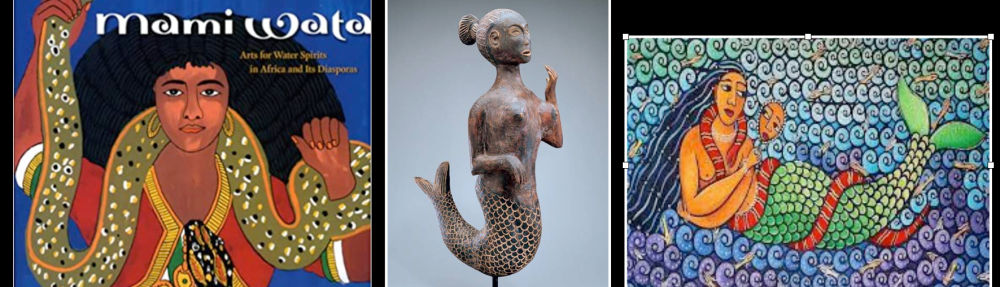
Week 3: Mermaids and Views on Love

A passage that caught my eye in the introduction of The Penguin Book of Mermaids was “These [mermaid] tales speak to the discrepancy between men’s longing for a woman unfettered by social mores and their attempt to control her by domesticating her” (xvii). This sentence is an illumination on how in folklore, mermaids stories often reflect the patriarchal desire to fold unruly femininity back in the bounds of the control of men.

I find Bacchilega’s word choice rather intriguing as “domesticating” suggests the taming of a wild creature, stripping it away from what makes it free in favor for instilling more desirable traits. Even the attraction to a “woman unfettered” is more about the alluring fantasy that ultimately ends in the mermaids containment. It goes to show the discrepancy that the very freedom that men desire is not one they would allow to persist.

Later in the introduction, the author then goes on to state how “when the wife is instead an ‘animal bride’…the marriage fails because her domestication as a human wife and mother does not succeed in eradicating…her desire to be in her own skin and element” (xix). This passage exemplifies the limits of patriarchal control and how suppression cannot erase identity.

With these two passages, it shows how mermaid tales are a reflection of men’s fear and fascination of women’s autonomy. This reading makes clear that these tales are a mirror of the patriarchal urge to domesticate these “free women”, however yet, they also portray the enduring spirit of these women in not fully erasing their identity