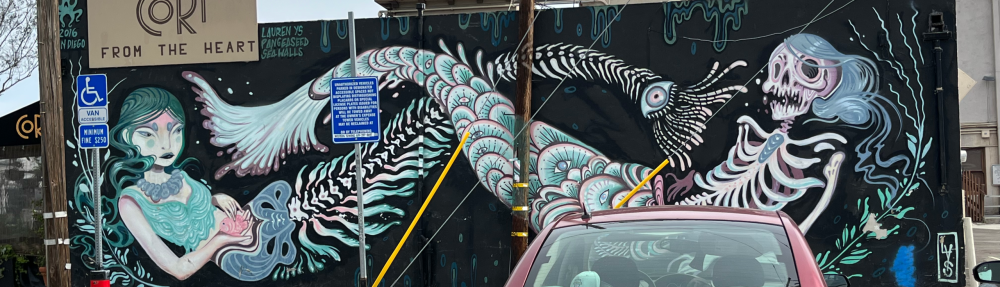
Final Essay: We’ve always been curious about the ocean

For context this an essay that is an expansion of my first discovery alongside close reading on the blue humanities.

Humanity has an obsession with power, and this perception has not changed since people were able to tell stories. It comes in different forms such as control, when early American Christians rewrote the earlier concept of mermaids. From winged humanoids offering knowledge, to sinful temptresses as a way of controlling women. However, mankind has a unique yet complicated relationship with nature and the environment when it comes to power. Nowhere is this more strong than with the ocean. Because they cannot control it, this leads to reverence and fascination. In many cultures, like Greek mythology’s Poseidon, people created these mythical stories to explain natural disasters and phenomena. A modern incarnation of this is the work of Ao Hatesaka’s one-shot manga, ‘Galaxias’. Where dragon attacks are the stand-ins for natural disasters, but more importantly, they are the stand-ins for the human desire to know more about the ocean. This shows even to the modern age people are still trying to make sense of the ocean through human-based understanding. That there was and always has been a burning desire to understand the deep sea. Not just in the modern age. 

Some explanation is in order. In The Ocean Reader: Theory, Culture, Politics, “It has always been difficult for humans to think of the Ocean as a place. Those who have considered the watery majority of the planet on its own terms have often seen it as a changeless space, one without a history. Because the Ocean can’t be plowed, paved, or shaped in ways the eye is able to discern, it has seemed to be a constant, while the land has changed drastically over the centuries” (Roorda 1). 

This comes from human perception in a similar manner to how we determine who is guilty of a crime and who is innocent. Visual evidence. There were limited methods to explore under the surface of the deep sea, and any attempt before the modern age was met with failure. If a tree falls in a forest and no one is around to hear it, does it make a sound? The same applies with the ocean but more so since humans themselves cannot affect it. The reason we’re so focused on land is not solely because the ocean is more dangerous to explore compared to land. Land exploration while ‘mastered’ and mapped out was still difficult and risky for early humans. So why do we have a hard time thinking about the ocean as a place back then? Because humanity wasn’t able to project their power onto the ocean in a way that we understand. More specifically, we couldn’t do anything to change it. Land became divided up and labeled as territories for many countries, people were able to assert their power over others but more importantly over the land. Taking resources, building on top of it, and expanding. They couldn’t do that with the sea until centuries later during the modern age. Territorial waters have only become a concept created by humanity since at least the 17th century. Which was further developed and contextualized in the proceeding centuries (as recent as the Geneva convention and sometime in 1988).  

Expanding on the idea of resources, the sea offered very little in terms of what it could be used to benefit people. On land one would have the wood and rock needed to craft tools, build homes and farms. Mine the metals needed to create weapons for defence and conquest. In a way all of this was more easily accessible on land than anything the ocean could’ve provided besides food. That’s to say if a community happened to be near an ocean. 

In the article “The Blue Humanities” by John R. Gillies, “Before the nineteenth century, attitudes toward the oceans were more utilitarian than aesthetic. The sea was portrayed as dangerous and repellant, ugly and unfit for literary or artistic representation. Oceans were explored as a means to reach distant lands, and little attention was paid to the waters themselves. It has been said that “the deep sea made hardly any impression. . . . Even oceangoing explorers were more land than ocean oriented; they used the sea merely as a highway to get to the next landfall.” This was a discovery more by sea than of the sea”. 

The article continues to push the idea that early humans didn’t think much of the ocean for two main reasons. We couldn’t affect the ocean directly AND it didn’t have much to give in terms of benefits. When a literary author did make their piece about the deep sea, it was in pursuit of unknown knowledge, like in Odysseus and the Sirens. Or written in a way that is still land and human bias, Hans Christain Andersen’s The Little Mermaid for example. However, these stories and myths exist because of a curiosity with the ocean. While back then the ocean was deemed unfit for literary or artistic representation, it did not stop the curiosity and attempts for writers to do so. All of this was based on what understanding they knew about the land. Thus they projected what power of understanding they had onto the ocean to try and make sense of it. Because, all this uncertainty the ocean has over humans is a form of power in of itself. This brought fascination and reverence but also a clear desire to understand that power. In the same article, “Beginning in the late eighteenth century, people began to come back to the sea in search for a quality they felt to be missing in the new industrial environment, that something called wilderness. The desire for an experience of untamed nature originated in the eighteenth century among a small group of European aesthetes, for whom the awesome power of the sea, as witnessed from the safety of land, was a powerful emotional and mental stimulant”. 

Even in the modern age where interest in the ocean has exploded, the ocean’s possible benefits and uses have been greatly expanded upon. From just being seen as a way to get from point A to B. It has become a place where we’re able to learn more about humanity’s ancient past. The environment’s history contained within the vault called the sea, and so much more. The perspective here is now that everything’s been mapped out on land, we can now fully turn our attention to the waters that surround our planet. The ocean has been an untamed environment for centuries. The two stories I’ve mentioned earlier have been small cinders of desire used as kindling for the bigger flame of curiosity that ignited in the modern age. Serving as inspiration for modern incarnations to come into play. 

That these stories may have been human attempts to both satisfy the always present curiosity. They could’ve been a way to cope with the power nature and therefore the ocean has over humanity. Recycled curiosities that we don’t have the answers to but are made again and again to remind us of it. Stories like Ao Hatesaka’s one-shot manga, ‘Galaxias’

GALAXIAS is a Japanese one-shot manga illustrated and written by Hatesaka Ao. It was published in Kodansha’s shōnen manga magazine Weekly Shōnen Magazine on June 22, 2022. The one-shot version of their work follows protagonist Neraid, a recently made orphan who lives on an island nation plagued by commonly occurring dragon attacks. Creatures he has come to loathe for the power they possess. 

The setting of ‘Galaxias’ was inspired by Japanese culture. Within the setting, dragons exist and attack the island nation on which the story takes place regularly. Similarly, tsunamis and earthquakes often hit Japan, where it has become a part of life for the people living there. Like in Japan, the people of Galaxias’s setting have formed countermeasures in dealing with them. Displaying the need for control over this immense force. But also has a way to assert power over this natural force. Humans have reasons for their power as discussed earlier. For the sea? There is no reason it can give us that we as humans can use to understand.

In real life, natural disasters aren’t inherently malicious or target humans specifically. But back then, that wasn’t the mentality; natural disasters were often interpreted as humans somehow angering local deities, spirits, or mythical creatures. This was seen as them being punished for some misgiving. Already showing the desire to know ‘why’. Something about the ocean just invokes this feeling. It may be why as John R. Gillis puts it in his article, “They turned it, as never before, into a place of spiritual and physical recreation”. Paving the way that people project human understood values onto the ocean. Making something like a tsunami: that’s destructive and randomly occurring, have meaning. 

Meaning that will lead to understanding able to satisfy human curiosity. In the above panel, Neraid is angry but displays the desire to know why. He questions the logic behind the attacks. Displaying the reason for stories like this to be created—to make sense of the power difference and imbalance nature possesses. When there’s no true answer. The dragon being represented in this way as an unresponsive, mysterious being that does things with no rhyme or reason perfectly represents how we feel about the ocean. It allows the reader to feel the same way Neraid does, making them also question it. It reminds the reader there is still a ton about the world we still don’t know. But also how humans continue to separate themselves from nature, yet are unable to. All because of a lingering curiosity able to give birth to various interpretations that leaves us fascinated. With the need to know more because the ocean (and by extension the greater ability of nature and the environment) is able to have us reflect on ourselves on a deeper spiritual level. 

Neraid’s statements about the dragons being powerful to the point, logically, they shouldn’t have any need to bother and interfere with humanity. But this couldn’t be any more false. As stated all the way at the beginning of the essay, humans are obsessed with power. Power that is often more or less used in various ways. We want to use and know about nature’s power in some shape or form. Every story and myth, modern and ancient, uses the ocean’s power in some way to create a meaning we’re able to digest and understand what we’re feeling. Neraid is not just angry at the dragon for literally causing him pain and suffering in life. It’s also a representation of how he would’ve used the power the dragon possesses. To not interfere or bother with what he considers ‘bugs’. It’s in a similar manner to how a lot of people don’t bother themselves with actual insects. Unless they become a problem. Again. That ancient reason why various deities, spirits, and monsters are born. To punish humans in some way. To just know why.

Stories like Galaxias still being made are a testament to humanity’s still lingering curiosity. The possible reason why we can’t truly connect ourselves with nature, yet at the same time we can’t separate from it fully. There’s the constant power clash between humans and nature when it comes from our desire to influence and display it against the natural force that helped give birth to us. That humans may be trying to become equal to nature/the ocean.

Sources

Eric Paul Roorda, The Ocean Reader: Theory, Culture, Politics (Duke UP, 2020). ‘Introduction” (pgs. 1-4)

John Gillis, “The Blue Humanities” (Humanities: The Journal of the National Endowment for the Humanities. Web. 2013)

Ao Hatesaka, “GALAXIAS”

Redefining the Ocean: The Power of the Language

For a very long time, human beings have looked at the Ocean simply as a background space for human activity, and we have rarely tried to understand it as something more than that. On maps, we divided the sea according to our own standards and gave it names that made sense only from a human point of view. Throughout thousands of years of history, the Ocean was mainly used as a route or pathway that helped people achieve their own goals, such as travel, trade, or exploration. However, this way of thinking limits the vast and complex space of the Ocean to something that exists only within the boundaries of human vision. It ignores and even erases the independence, depth, and long history that the ocean itself has always possessed.

In relation to this problem, Eric Paul Roorda, in his essay The Ocean Reader: Theory, Culture, Politics, argues that the human habit of defining and restricting the Ocean is actually a product of an anthropocentric, or human-centered, worldview. By pointing this out, Roorda invites us to reconsider our narrow perspective and to reflect on how we have been understanding the sea. Roorda describes humans as essentially land-based creatures and intentionally chooses to write the word “Ocean” with a capital O. Through this linguistic choice, he encourages readers to recognize the Ocean as an equal partner in the relationship between humans and the natural world. His focus on language reminds us that the words we choose can shape the way we think and the way we value different parts of our world.

Therefore, this essay will explore how Roorda’s linguistic strategies help break down the anthropocentric viewpoint that humans have long taken for granted. It will also examine how this shift in language allows us to see the Ocean as a space with its own history, identity, and agency. By analyzing Roorda’s sentence structures and vocabulary choices, I aim to show how his writing encourages readers to change the way they think, and how language itself becomes a tool for understanding the world in a deeper way. In addition, this essay will consider how Roorda’s linguistic transformation reconstructs the dominant power relationship between humans and the Ocean, leading us to recognize once again that the two are mutually dependent and deeply connected.

Roorda explains the purpose of his essay by saying that he hopes “to avoid that natural bias predominating among our terrestrial species and replace it with a steady focus on the Ocean and on events that take place offshore” (Roorda, p.1). In this moment, he does not simply use the common word “human” to refer to people. Instead, he chooses the expression “terrestrial species.” This linguistic strategy encourages readers to rethink and reposition the status of human beings. Normally, when we use the word “Human,” it gives us the feeling that humans are unique creatures who exist above or outside other categories of life. However, by defining humans as a “terrestrial species,” Roorda shakes the foundation of this assumption and asks us to let go of a sense of privilege that we may have taken for granted.

Through this choice of wording, he redefines humans not as beings standing outside of nature or ruling over the sea from an elevated position, but as equal participants who exist in a mutual relationship with the Ocean. In other words, Roorda’s terminology challenges the hierarchy that humans have built between themselves and the sea, and demonstrates his intention to place both entities on equal ground. By calling humans a “terrestrial species,” he emphasizes that human life is limited to land and that our perspective is shaped and restricted by this fact. He also uses the word “predominating” to show that such biased thinking has been dominant for a long time and has continued almost automatically through long-standing habits.

This act of naming does more than simply change where humans are placed in the world. It also raises questions about the limitations of the way humans interpret and understand reality. Roorda reveals that human perception is never neutral or universal, even though we often assume it to be so. Just as Roorda’s term “terrestrial species” suggests that human viewpoints arise from life on land, Donna Haraway also argues in her essay that all knowledge and perspectives are shaped by a person’s specific environment and position. In Situated Knowledges, she writes, “I am arguing for politics and epistemologies of location, positioning, and situating, where partiality and not universality is the condition of being heard to make rational knowledge claims. These are claims on people’s lives” (Donna, p. 589).

Haraway’s argument closely connects with Roorda’s linguistic strategy. Both scholars emphasize that the way humans see the world is determined by their past experiences and conditions. Because humans have lived their entire history on land, it is natural that they developed a “terrestrialism,” a land-centered way of thinking. Therefore, Roorda’s use of selective vocabulary to reposition humans can be understood as an attempt to practice Haraway’s idea of “epistemologies of location,” but from a specifically ocean-centered perspective.

Ultimately, Roorda’s naming technique is not just a simple word choice but a critical intervention into the way humans understand their own viewpoint. His linguistic strategy pushes humans to recognize that they are no longer the absolute interpreters of the world, but beings with limited and situated perspectives. In other words, he reconstructs the relationship between humans and the Sea not as observer and observed, but as two relational subjects who coexist.

Furthermore, this linguistic re-positioning becomes the foundation for understanding Roorda’s next strategy which is writing “Ocean” with a capital letter. Without first revealing the limits and biases of human perspective, it would be difficult for readers to accept the Ocean as an independent entity with its own agency and history.

After redefining the position of humans as a “terrestrial species,” Roorda continues his project by redefining the Ocean not as a simple natural background but as a unique entity with its own history. In his essay, he states, “To capitalize Ocean is to challenge the conventional wisdom that the seas can be taken for granted. They cannot” (Roorda, pp. 3–4). By using the word “challenge,” Roorda clearly shows that his linguistic transformation is meant to resist long-standing assumptions based on human-centered thinking. Even though he changes only one letter in the word ocean, this shift allows us to perceive the sea in a completely different way. When we write the word with a capital letter, Ocean, we begin to see it as a proper noun, and this linguistic shift helps us understand what Roorda means when he says that “the Ocean has a history” (Roorda, p.1). Instead of reducing the sea to a space used only for human needs such as trade or navigation, the capitalized Ocean becomes a space that holds its own agency, one that changes, moves, and interacts with human history while also developing independently.

Furthermore, the capitalization of Ocean works as a form of resistance against the human habit of simplifying the sea’s complex ecosystems and deep histories. By naming it as a proper noun, Roorda suggests that the long tradition of dividing the sea into seven parts, known as “the Seven Seas,” is no longer acceptable. In other words, the sea cannot truly be divided or easily named according to human convenience. It exists as an independent and continuous whole. This linguistic shift encourages readers to reflect on the ways humans have interpreted and treated the sea based only on their own perspectives. It also pushes us to reconsider the sea as a constantly changing, richly layered environment with its own ecological rhythms.

This perspective is supported by Leposa and Knutsson in their essay Framing Matters for Ontological Politics of the Ocean. They explain, “While epistemology denotes how we understand the world and ontology describes the existence of the world, the way political practices shape a particular ontology and how different realities interact with each other can be embraced by the term political ontology” (Leposa & Knutsson, p. 753). Their argument emphasizes that the way we frame and describe the sea directly influences how the sea is defined. In other words, the sea can appear in completely different forms depending on how humans name it, narrate it, and structure it through language. This discussion shows how powerful human language can be in constructing reality and why it is important to question and rethink the linguistic frameworks that have shaped our understanding of the sea.

For this reason, Roorda’s decision to capitalize Ocean becomes especially meaningful. It demonstrates that language does not only define and describe objects in the world but also shapes the perspective from which we see them. When we begin to write the sea as Ocean, we naturally start to view it as something much broader, more complex, and beyond full human control or explanation.

In conclusion, Roorda’s capitalization strategy breaks the long-established habit of framing the ocean within human linguistic systems and urges us to read the Ocean as an independent subject. This reframing moves us away from the idea that the sea exists only to serve human purposes and helps us recognize that the Ocean has its own rhythms, movements, and history. His linguistic shift functions as a critique of human-centered worldviews and opens a new possibility for understanding the sea not as an object but as a subject with whom humans must renegotiate their relationship.

Roorda’s use of the term “terrestrial species” and his decision to capitalize the word Ocean represent more than simple linguistic choices. They function as a critical challenge that shakes the foundation of how humans understand the world. Through this linguistic shift, Roorda removes humans from the imagined center of nature and places them on the same level as the sea, encouraging readers to recognize the Ocean not as a passive background or a resource, but as a subject with its own unique history and agency. This transformation in language exposes how deeply human-centered thinking has shaped our perspectives and reminds us that our ways of seeing the world are always shaped and limited by the words we use. Roorda’s strategy also invites us to view the sea as something that cannot be simplified, divided, or easily controlled according to human purposes, offering a new perspective in which the Ocean can be understood as an independent and meaningful presence.

Furthermore, Roorda’s work shows that rethinking the Ocean is closely connected to rethinking humanity itself. Humans are no longer portrayed as owners or controllers of the sea, but as beings who share and co-create the world alongside it, forming histories through continuous interactions. His linguistic intervention plays a central role in restoring this relational way of seeing, encouraging readers to reconsider the connections between humans and the natural world. The capitalized Ocean is therefore not just a typographical change, but a symbolic gesture that represents a shift in thought toward reimagining the relationship between humans and nature. Ultimately, Roorda’s approach becomes an important starting point for reading the sea differently, reflecting on the limits of human perception, and fostering a broader and more inclusive understanding of the world around us.

Penetration in the Romance of Melusine

https://expositions.bnf.fr/contes/grand/008_3.htm

In this 15th century painting by an unknown author titled Mélusine en son bain, épiée par son époux, or its English title Melusine’s secret discovered, a human (center) stands near a structure with a wooden door with a peephole, hiding a beautiful human-fish hybrid (right) on the other side. This painting is a part of an illuminated manuscript of the Roman de Mélusine; a Medieval French story by Jean d’Arras of which André Lebey’s modern retelling The Romance of the Faery Melusine is based on. In the Romance, Raymondin falls in love with a water spirit named Melusine, who, unbeknownst to him, is “cursed with turning into a half snake, half woman every Saturday … and makes it a condition of their marriage that Raymondin must not see her on Saturdays.” (Penguin 85). As the story progresses, Raymondin’s desire for knowledge eventually culminates in a “breach of faith” (Penguin 87) in his contract to never see his loved one on a Saturday–the very scene that the painting depicts. Through a comparative analysis of the painting in relation to André Lebey’s version of the Romance, the story of Melusine becomes a story about penetration. This penetration of the female body and her privacy, with regard to literature and the environment, critiques how we understand (and use) the natural world, as knowledge involves penetration, and therefore, infiltration.

In the painting, Raymondin is meticulously positioned between the outdoors and Melusine’s room, sheltered from humanity. Raymondin is facing away from the door, looking at a guardsman with a spear on the left. This can be interpreted in different ways: either Raymondin is protecting Melusine from the human world by forbidding everyone from seeing her cursed form, or Raymondin is making sure no one else is looking so that only he can see what Melusine looks like, despite his promise to never see her on a Saturday. His position in the center is also important because it places him in a space between the open and closed; the public and private; the light and dark; the natural and supernatural. He is looking back at his own world before peering into a private space where a woman can be herself.

On the right, Melusine is in her half-serpent form, naked and bathing in a small tub and quite clearly enjoying herself. Compared to the outside, the room she is in is very small and has no windows, symbolizing that she finds joy in her own secret space, sheltered from the outside world. However, she still has a risk of discovery due to the door’s peephole. The peephole is an important detail because it is situated between a public and private space. Should anyone peek through it, they would penetrate that space, illustrating how creating ways of entry into someone else’s private life would lead to a violation of privacy; or, in Melusine’s case, her hidden secret being discovered.

André Lebey’s Romance of the Faery Melusine features a more colorful interpretation of Melusine’s discovery as shown in the painting. In chapter 19, titled “Betrayal,” the wooden door that separates Raymondin and Melusine is more of a rigid boundary between the human and non-human: “Enormous ironwork across [the door’s] width passed into the wall as if to seal it. So tightly that the stone on each side of the door, like the wood between, could not be opened or raised.” (Lebey 122) Here, Lebey fortifies the door to Melusine’s room, sealing it with “enormous ironwork” instead of a lock and thus adding more security to her safe space. Instead of it being out in the open like in the painting, it is located at the top of a tower–a place far away from society where “neither [Raymondin], nor anyone, except [Melusine]” have ever been before. (121) There are no easy entry points, and there is no mention of a peephole to peek through–only a small crack “between two of the thick polished planks of which the door was made.” (122) This fissure, this imperfection in the boundary, is what makes the curiosity-driven Raymondin create a method of entrance into her chamber:

“The blade entered [the door] a little, so slowly that he almost began to despair. But he forbade himself to think what he would do next, for he could not, he saw, fully part the adjacent boards. But he might make a crack wide enough to see through! He would soon find out something, no matter how!” (Lebey 122)

This moment in the book can be seen as a moment of sexual frustration. Instead of looking through a peephole as seen in the painting, Raymondin is forced to violently peel away at the barrier separating him from Melusine, “forbad[ing] himself to think” about the morality of such an action. He uses his blade in an act of penetration, prying the boards open in the hopes that “he might make a crack wide enough to see through” the boundary he is not meant to cross. Lebey turns this heartbreaking, yet non-violent “breach of faith” (Penguin 87) into an act of sexual aggression. As Raymondin drives his blade deeper into the door, he is intentionally violating Melusine’s personal space just to discover her secret, “no matter how” violent he has to be.

Compared to the painting, the small room in which Melusine enjoys herself is much larger and fits more with her supernatural nature. After Raymondin forces himself into Melusine’s room, Lebey describes it as “quite large, with high bare walls pierced high and low with little niches which shone through interlaced branches of coral. Thousands of shells in unknown forms … were reflected irregularly in the thick glass of an immense rough window of uniform colour … [The window] was like a sheet of water, a sort of plane detached from the sea, then solidified, and through which passed the light of the shining moon outside, veiled, as if supernatural.” (Lebey 123-124) By expanding the room, Lebey creates “another world” for Raymondin to explore and Melusine to inhabit, using phrases like “large,” “high,” and “immense” to show scale. As a result, the “immense” scale of her room renders Raymondin as an inferior “other”. Lebey themes Melusine’s room around water through the “branches of coal” and the “[t]housands of shells in unknown forms.” There is something unnatural about this place, as evident in the imagery of the window looking like “a sheet of water, a sort of plane detached from the sea, then solidified.” The use of “supernatural” implies that Raymondin is not meant to be in her sacred space. It is outside the normative space, and he is an alien to Melusine’s world just as she is to the human world. This difference in portraying Melusine’s room is important because in the painting, we see Raymondin invading the only space within the human world where Melusine can be herself. Lebey expands on this invasion of space by depicting Raymondin as invading her own “supernatural” world where she is herself. Because the room is so large compared to the artwork, the entry into Melusine’s room can be interpreted as a penetration into the female body/space as a sperm, a microscopic being “in another world” where the female is unaware of its existence.

In conclusion, close-reading the 15th century painting Melusine’s secret discovered with regard to André Lebey’s version in The Romance of the Faery Melusine reveals that the Romance can be read as a story about penetration. While the discovery involved Raymondin peeking into Melusine’s room and feeling heartbroken over his “breach of faith” in the original manuscript, Lebey takes the discovery of Melusine and turns it into violation of not just privacy, but of the female body. As we have discovered this semester, stories and their adaptations reflect our relationship with nature. In the case of Melusine, it reminds us that we too have been penetrating and violating the environment in order to uncover its secrets.

Works Cited

Mélusine en son bain, épiée par son époux. Roman de Mélusine par Jean d’Arras, c. 1450-1500. Bibliothèque nationale de France, https://expositions.bnf.fr/contes/grand/008_3.htm. Assessed December 13, 2025.

Lebey, André. The Romance of the Faery Melusine. Translated by Gareth Knight, United Kingdom, Skylight Press, 2011, pp. 119-125.

Bacchilega, Cristina, and Marie Alohalani Brown. “Legend of Melusina.” The Penguin Book of Mermaids. New York, New York, Penguin Books, 2019, pp. 85-88.

Gothic Liminality and Marriage in Undine: Final Essay

In Friedrich de la Motte Fouqué’s gothic fairy-tale novella, Undine, the supernatural in this story isn’t just for decoration, nor does it function as a simple allegory or moral instruction. Instead, it operates as a Gothic aesthetic in which instability, fear, and liminality become visible. Nowhere is this more apparent than in “The Day After the Wedding,” from Undine, a chapter within The Penguin Book of Mermaids, that unsettles the apparent harmony of marriage through nightmares, silence, repetition, and a delayed revelation. While the chapter gestures toward future tragedy, its main function is not straightforward foreshadowing. Rather, it actually exposes the Gothic anxiety produced by proximity to a being who exists between two worlds–human and nonhuman, a familiar and unknowable. This anxiety is seen almost immediately in the chapter’s atmosphere of “wonderful and horrible dreams” (102) and the uneasy quiet that follows the wedding night.

Fouqué’s “The Day After the Wedding” uses the Gothic aesthetics of dream imagery, temporal disruption, monstrous transformation, liminal space, and supernatural knowledge in order to externalize anxieties that can’t be articulated within the rational discourse of marriage or of humanoids as paradigmatic liminal beings. The chapter can be placed within a broader Romantic Gothic tradition. In his text, the supernatural doesn’t explain emotion or stabilize this romantic union, but instead dramatizes the instability that comes with being human and attempting to contain what resists fixed boundaries. This function of the supernatural aligns with what Gothic theorist, Catherine Spooner, identifies as the genre’s defining impulse in “Unsettling Feminism: The Savagery of Gothic,” she explains how Gothic “acts as an unsettling force,” not to resolve contradiction, but to expose the fractures and aporias behind these systems that claim coherence (129).

One of the most striking Gothic strategies in “The Day After the Wedding” is Fouqué’s manipulation of time. The title itself shows that there is a disruption instead of a resolution after this holy unity. Marriage, conventionally imagined to be a moment of culmination and stability, is displaced by what comes after. The phrase “the day after” suggests a belated reckoning, a temporal lag in which consequences emerge indirectly rather than being resolved at the moment of ritual completion. Gothic anxiety is thus located not in the wedding night but in what lingers beyond it. Huldbrand’s terror unfolds in the liminal hours between night and morning. The “fresh light of morning” (102) awakens the newly married couple, yet daylight does not banish his fear. Instead, it reveals what is left of the darkness. Huldbrand’s dreams stay vivid, the images clinging to him as his consciousness returns. The Gothic that is seen here is how it refuses the restorative promise of daylight; fear persists even as the night recedes. This temporal overlap collapses the boundary that is between the unconscious fantasy and waking life, suggesting that the anxieties staged by the dream are not confined to sleep but embedded in the reality that the marriage between Undine and Huldbrand has produced. The displacement aligns with Gothic conventions that put horror not at the moments of climax but in the aftermath. Marriage should prove Undine’s status as a wife and human being, yet the morning after intensifies ambiguity. Stability becomes an illusion when it should have been secure. The Gothic, therefore, comes not as an interruption but as an afterimage, revealing the insufficiency of social rituals to resolve that ontological uncertainty. To be clear, the Gothic is not defined by terror alone, but by its capacity to expose the instability of categories–human and nonhuman, reason and emotion, order and excess–that the social rituals like marriage attempt to secure.

Gothic literature locates its deepest anxieties in liminal bodies, and in Undine, this anxiety is clear about the impossibility of fully domesticating a being that exists between human and elemental worlds. As Cristina Bacchilega observes in The Penguin Book of Mermaids, “we humans do not deal well with betwixt and between–liminality makes us anxious” (xi), and Merepeople: A Human History by Vaughn Scribner also enhances that same argument by saying “hybrid creatures represented danger as much as hope, wonder as much as horror” (8). This insight gives a lens for understanding Undine, whose existence undermines the stability that marriage is meant to guarantee. Undine’s marriage to Huldbrand represents her attempt to resolve her liminality through Christian ritual and being recognized by society. The elemental spirit she is is transformed into a wife, seemingly now as a part of society. Yet Gothic logic resists such containment. The day after their union doesn’t confirm harmony; instead, it introduces disturbance. Huldbrand awakens from his “wonderful and horrible dreams,” haunted by spectres who disguise themselves as beautiful women before suddenly assuming the face and bodies of dragons (102). The nightmare stages this anxiety visually, allowing Huldbrand to project what he cannot consciously acknowledge, since Gothic convention enables the rational subject to cast off its “horrifying and fascinating others in monstrous form” (Spooner 130). Beauty now collapses into monstrosity, exposing the fragility of appearances and the instability behind these social forms. The dream aestheticizes liminality itself. This fear of collapse aligns with Scribner’s observation in Merpeople: A Human History that such hybrid beings were understood as “they were unnatural manifestations of a realm that humans did not fully understand,” capable of drawing humanity into “a strange, disorderly world of confusion and destruction” (8). The supernatural has not been domesticated; it continues to exert pressure upon the social order. Undine’s body, her origin, and relation to humanity remain a mystery, and Huldbrand’s nightmare gives way to this instability to flourish into its grotesque visual form. Marriage attempts to render Undine legible within social order, yet her presence resists such containment, for Gothic hybrids are “disturbing” precisely because their incoherent bodies “resist attempts to include them in any systematic structuration” (Spooner 136).

Dreams occupy a privileged position in Gothic and Romantic literature because they make way for forbidden or unacknowledged fears to surface. In “The Day After the Wedding,” Huldbrand’s nightmare functions as a Gothic disclosure, translating unspoken anxiety into a spectacle. The spectres that haunt him do not appear as overtly supernatural beings, but instead they “grin at him by stealth,” masquerading as beautiful women before revealing their monstrous faces (102). There is this oscillation that is seen between beauty and horror that mirrors Undine’s liminal status and destabilizes the reliability of perception itself in Huldbrand’s view. The dreams that he has, the most disturbing feature isn’t the violence of it all, but it’s the structure of the transformation from a beautiful being to a monster. The spectres are not immediately monstrous; their monstrosity emerges through sudden collapse. The women’s faces become dragons without transition, evoking medieval Christian iconography in which dragons signify deception and spiritual danger. In mermaid traditions, hybridity itself is frequently aligned with the demonic–not because the creature is morally corrupt, but because it resists the fixity required by Christian moral systems. Huldbrand’s dream draws upon this symbolic logic, staging the terror of an unfamiliar being rather than betrayal. Most importantly, the dream does not end upon waking. Pale moonlight floods the room, collapsing the boundary between dream and reality. Huldbrand looks at his wife, Undine, who still lies “in unaltered beauty and grace,” yet terror persists (102). Nothing about her has changed; what has changed is his perception of her. The dream has attached the possibility of monstrosity to Undine’s presence, showing the Gothic fear that beauty conceals monstrosities. 

The transformation of women into monsters within Huldbrand’s dream aligns with a long Gothic tradition in which femininity becomes something of a site for projected anxieties. It is not male bodies that mutate but female ones, reflecting cultural fears surrounding female otherness and autonomy. As Cristina Bacchilega notes, such narratives oftentimes reveal “the discrepancy between men’s longing for a woman unfettered by social mores and their attempt to control her by domesticating her” (xviii). Undine embodies this contradiction. Her difference makes her desirable, yet once bound within marriage, that same difference becomes threatening. Huldbrand’s attempt to master his fear–reproaching himself for doubt and pressing a kiss upon her lips–exposes the tension between rational self-discipline and irrational anxiety. The Gothic does not resolve this tension; it sustains it, revealing the limits of reason in the face of liminality. Undine’s response intensifies uncertainty. She sighs deeply and remains silent, offering no verbal reassurance. In Gothic literature, silence marks the presence of what cannot yet be safely articulated. Her quietness reflects not innocence but opacity, reinforcing the sense that she cannot be fully known or contained. 

Undine’s silence following Huldbrand’s apology is one of the chapter’s most theologically charged moments. She communicates forgiveness through gesture rather than speech, holding out her hand and offering a look of “exquisite fervour” (102). In Gothic terms, silence marks the presence of knowledge that goes beyond what can be fulfilled by a spoken language. The scenes that follow Huldbrand’s apology attempt to reassert social and spiritual order: within himself and his wife. The priest prays inwardly, the foster parents observe Undine attentively, and the household waits for confirmation that the supernatural has been successfully domesticated. Undine appears to fulfill this hope. She performs idealized domestic virtues, becoming “quiet, kind, and attentive, at once a little matron and a tender bashful girl,” yet this very perfection still comes with unease. Those who have known her longest expect at any moment to see some “whimsical vagary” to burst (103). Stability feels unnatural, sustained only through vigilance and restraint. Gothic tension operates here through anticipation rather than action. Domestic order is revealed as performative rather than natural, a fragile illusion rather than a secure resolution.

Gothic anxiety is further reinforced through the repetition and return within the chapter. Huldbrand repeatedly awakens from terror, reassures himself, and falls asleep again, only to be disrupted by new visions. This cyclical pattern undermines the idea that rational correction can dispel fear. Anxiety does not disappear when confronted; it only recurs in an altered form. Spatial repetition mirrors this psychological pattern. When Undine asks Huldbrand to carry her to the island, he recalls that this is the same island from which he first carried her to the fisherman’s cottage. Progress is revealed as circular rather than linear. Marriage does not inaugurate a new beginning but reactivates unresolved tensions rooted in liminal spaces. The island now functions as a Gothic threshold, a place of judgment rather than safety. Undine insists Huldbrand sit opposite her and read his answer in her eyes before his lips speak. Her insistence reflects a Gothic epistemology in which “vision precedes language,” marking a knowledge that cannot yet be safely articulated within humans (Spooner 135). This insistence reflects mermaid past that an interaction with them tests men; in this case, it isn’t through vow but through recognition and whether he can truly see Undine for who she is–a hybrid of both land and sea.

Water imagery saturates “The Day After the Wedding,” functioning as a central metaphor for Gothic instability. The forest stream, once wild and swollen, now flows gently, appearing temporarily subdued. Yet this calmness is explicitly framed as transient. By morning, Undine notes, the stream will be dry, enabling Huldbrand’s departure. Stability is provisional, dependent on fluctuating natural environmental forces. Undine’s ability to glide effortlessly through water contrasts with Huldbrand’s need to carry her, highlighting their ontological difference. Though he carries her body, he cannot contain her essence. Like the transformations of the nightmare, water refuses fixity. It shifts from obstacle to passage, restraint to release. The Gothic emerges not through overt threat but through the constant motion that undermines permanence, revealing marriage itself as a provisional structure rather than a stable resolution of liminality. This instability reflects a broader Gothic tradition in which, as Scribner suggests, “humankind has always grappled, humanity maintains a tenuous balance between wonder and order, civilization and savagery” (9).

Undine’s revelation of her elemental nature shifts the Gothic from implication to articulation. She situates herself within a parallel cosmology of salamanders, gnomes, spirits of air, and water beings, decentering human existence entirely. This knowledge destabilizes Enlightenment assumptions of mastery and hierarchy. Her explanation of soullessness intensifies this disruption that is seen. Elemental beings, she explains, vanish entirely at death, lacking immortal souls. The acquisition of a soul–often treated as a triumph–is framed instead as a burden that brings suffering, fear, and vulnerability. Gothic inversion is at work here because spiritual elevation gives exposure rather than transcendence. Huldbrand’s “strange shudder” and inability to speak register the epistemological shock of this revelation (105). He is confronted not with a monster but with a being whose suffering now depends upon his fidelity. Gothic anxiety arises not from threat but from responsibility.

Although the episode concludes with Huldbrand’s vow never to forsake his wife, Undine, this declaration offers emotional reassurance rather than ontological certainty. The anxieties revealed by the nightmare–fear of transformation, instability, and loss of control–remain unresolved. Fouqué is not merely depicting a husband’s fear of his wife. Rather, he uses Gothic aesthetics to interrogate the limits of social institutions themselves. Marriage, religion, and reason attempt to impose order, yet the supernatural exposes the fragility of that order by embodying what exceeds it. 

“The Day After the Wedding” from Undine uses the Gothic aesthetics of dream imagery, temporal disruption, monstrous transformation, silence, repetition, water imagery, and supernatural revelations to dramatize the instability inherent in attempts to contain liminality within human social structures. Huldbrand’s nightmare is not simple foreshadowing but an aesthetic event that externalizes anxieties surrounding categorization, control, and transformation. When the chapter is read alongside mermaid scholarships, The Penguin Book of Mermaids by Cristina Bacchilega and Marie Alohalani Brown, and Merpeople: A Human History by Vaughn Scribner, the chapter reveals how supernatural female figures function within Gothic literature as sites of cultural and psychological projection. Fouqué’s supernatural does not resolve conflict or explain emotion; it illuminates uncertainty. In doing so, Undine demonstrates the power of the Gothic not to soothe Romantic-era anxieties, but to render them visible and inescapable. In this way, Undine reveals that Gothic literature does not merely reflect anxiety but produces it deliberately, forcing readers to confront the limits of social, religious, and epistemological systems meant to protect them from uncertainty.

Works Cited

Bacchilega, Cristina, and Marie Alohalani Brown. “The Day After the Wedding from Undine.” The Penguin Book of Mermaids. New York, New York, Penguin Books, 2019, pp. 101-106.

Bacchilega, Cristina, and Marie Alohalani Brown. “Their Bodies, Our Anxieties.” The Penguin Book of Mermaids. New York, New York, Penguin Books, 2019, pp. xi-xiv.

Bacchilega, Cristina, and Marie Alohalani Brown. “Plots, Gender, and Human-Nonhuman Relations.” The Penguin Book of Mermaids. New York, New York, Penguin Books, 2019, pp. xvii-xx.

Spooner, Catherine. “Unsettling Feminism: The Savagery of Gothic.” The Gothic and Theory: An Edinburgh Companion, edited by Jerrold E. Hogle and Robert Miles, Edinburgh University Press, 2019, pp. 129–46. JSTOR, www.jstor.org/stable/10.3366/j.ctvggx38r.10.

Scribner, Vaughn, and Reaktion Books. Merpeople: A Human History. London, Reaktion Books, 2020.

Curiosity and the Refusal of Uncertainty

Human relationships with nature often begin with curiosity. People want to see what is hidden, understand what feels mysterious, and explain what resists easy meaning. However, In literature or environmental history, curiosity rarely stays harmless. Again and again, the desire to know turns into a desire to define, control, or dominate. This shift appears across different genres and time periods, suggesting that the problem is not curiosity itself, but how humans respond to what they cannot fully understand.

In The Romance of the Faery Melusine, Andre Lebey presents a story where curiosity toward the natural and supernatural leads to destruction rather than understanding. Raymondin’s need to know Melusine’s hidden identity pushes him to violate boundaries that once protected love and balance. Also, In Vast Expanses: Introduction: People and Oceans, Helen Rozwadowski traces a similar process on a historical scale, showing how human curiosity about the ocean slowly transformed it from an unknowable force into something measured, named, and controlled. William Cronon’s The Trouble with Wilderness also helps clarify this shift by revealing how nature itself becomes masked by cultural ideas that make human influence invisible. Together, these texts suggest that human curiosity becomes dangerous at the moment it refuses uncertainty and demands control. This essay will talk about how curiosity is not harmful on its own. Instead, when people feel fear or cannot tolerate uncertainty, curiosity turns into a desire for control. Through The Romance of the Faery Melusine, Vast Expanses, and The Trouble with Wilderness, these texts show how nature, from the supernatural to the ocean, becomes something humans feel they must explain, manage, or dominate. Lebey shows this shift most clearly in the moment Raymondin decides to spy on Melusine. The narrator describes his movement, “He climbed quickly in his eagerness to strike, his heart pumping under his coat of mail as he climbed the narrow winding stair, steeper and steeper, to the very top” (121). This sentence frames Raymondin’s curiosity as violent. The phrase “eagerness to strike” is especially striking because it appears before Raymondin even sees Melusine. Knowing has already become an act of attack. Lebey does not describe curiosity as gentle or patient, instead, it is aggressive and physical. Raymondin’s heart “pumping under his coat of mail” links emotional intensity to armor, suggesting that his desire to know is already defensive and hostile. Curiosity is no longer about closeness, it is about power. Also, the structure of the sentence reinforces this obsession. The repetition of “climbed” and the phrase “steeper and steeper” stretch the moment, pulling the reader into Raymondin’s fixation. The climb becomes symbolic, the higher he goes, the further he moves away from trust and intimacy. Lebey ends this moment by emphasizing the place, “There where he had never been before. Neither he, nor anyone, except her – and – who else?” (121). These broken phrases mirror Raymondin’s unstable thoughts. The space is defined by exclusion, it belongs to Melusine alone. By entering it, Raymondin crosses a boundary that should remain intact. His curiosity becomes intrusion, much like humanity’s repeated entrance into natural spaces that resist explanation. Before this intrusion, Lebey presents Melusine as part of a balanced natural environment. Raymondin first hears her before he sees her, “He heard not far away, in a place that he could not yet see, a strange sound of splashing water” (123). This sentence delays vision and prioritizes sound. The water announces presence without revealing form or meaning. Melusine exists without being defined. Lebey allows the natural world to remain partially unknowable, suggesting that mystery itself is not a problem. And when Melusine is finally described, Lebey writes, “A tail of green scales stretched under the water made the water lilies move” (125). This sentence places Melusine in direct relation with her environment. Her body does not dominate the space, it moves with it. The water lilies respond naturally, without fear or disruption. At this point, curiosity has not turned into control yet. The scene shows humans and nature existing together, not one dominating the other. The tragedy begins when Raymondin feels the need to know and control everything, which destroys this balance.

Rozwadowski talks about a similar shift, but from a collective and historical perspective. In Vast Expanses, the author explains how the ocean gradually became something humans believed they could understand. She describes how people learned to see the sea as “an environment that could be studied, mapped, and known.” This sentence is important because of its verbs. “Studied,” “mapped,” and “known” suggest order and containment. The ocean, which is physically vast and unstable, becomes conceptually manageable. Curiosity leads people to create systems of knowledge that aim to control the world. Rozwadowski’s language shows that this change is not neutral. When humans turn the ocean into an object of knowledge, they begin to separate themselves from it. The sea becomes something outside of humans, something they study and control. This is similar to Raymondin’s gaze. Once Melusine is treated as something to be understood, she can no longer exist as an equal partner. In both cases, curiosity creates distance rather than connection. William Cronon also helps explain why this transformation often feels harmless. He writes, “Wilderness hides its unnaturalness behind a mask that is all the more beguiling because it seems so natural” (7). This sentence exposes how cultural ideas disguise human influence. The word “seems” is important, since it suggests appearance rather than truth. Nature looks untouched not because it is, but because humans have learned to imagine it that way. The mask allows people to believe their curiosity is innocent, even as it leads to control. Across these texts, there is a pattern. Curiosity becomes dangerous not when humans ask questions, but when they refuse limits. Raymondin cannot accept not knowing. Explorers cannot accept unmapped seas. Modern culture cannot accept nature without explanation. In each case, the desire to know becomes the desire to dominate. The cost of this transformation is the loss of balance, trust, and responsibility.

Furthermore, If curiosity becomes controlled, there question remains about what prompts that shift. Across The Romance of the Faery Melusine, Vast Expanses, and The Trouble with Wilderness, the turning point is not simple desire to know, but discomfort with uncertainty. These texts suggest that humans struggle to live alongside what they cannot fully explain. When uncertainty threatens identity, authority, or emotional security, curiosity hardens into domination. In Lebey’s story, Raymondin’s transformation is driven less by discovery than by fear. After hearing Melusine’s mysterious sounds, he imagines betrayal and danger before seeing any proof. Lebey describes Raymondin’s mental state just before the revelation, “His imagination, inflamed by jealousy, had already created horrors which reason could not control” (124). This sentence reveals that the true source of violence is not Melusine’s secret, but Raymondin’s imagination. The phrase “created horrors” shows that uncertainty leads to fear. Instead of accepting that he does not know, Raymondin makes up explanations. At this point, curiosity is no longer about understanding, but about feeling safe. Also, the order of the sentence matters. Fearful imagination comes first, and reason fails to follow. Lebey shows that when fear enters curiosity, rational limits disappear. Raymondin’s desire to see Melusine’s true form becomes an attempt to stabilize his own anxiety. Knowledge seems to promise safety, but it instead leads to destruction. This moment shows when curiosity turns into control, when knowledge is used to protect oneself rather than to respect others. And when Raymondin finally sees Melusine, Lebey does not use dramatic language. Instead, the scene is quiet and tragic, “She was there, in the bath of clear water, her long body half hidden, her green tail gleaming softly beneath the surface” (125). The sentence emphasizes that Melusine is only partly visible, using phrases like “half hidden” and “beneath the surface.” Even at this moment, she is not fully revealed. Lebey suggests that nature cannot be completely known without harm. The problem is not what Raymondin sees, but that he cannot accept incomplete knowledge. Once he sees her, their relationship collapses. Curiosity demands full access, and this demand destroys what it tries to understand.

Rozwadowski describes a similar process on a global scale. Rozwadowski explains that early modern explorers first approached the ocean with awe, but this feeling quickly turned into anxiety. She writes that because the sea was unpredictable and difficult to control, humans tried to turn it into “a space that could be ordered, classified, and made legible.” This phrase is important because “legible” means more than understanding, it means forcing the ocean to fit into human systems of reading and control. What cannot be made legible is seen as threatening. Rozwadowski shows that mapping and measuring the sea did not eliminate fear, it disguised it. The drive to classify ocean currents, depths, and species reflects a desire to eliminate uncertainty. Curiosity turns into control at the moment when humans decide that mystery itself is unacceptable. Like Raymondin, explorers could not tolerate partial knowledge. The ocean had to be fully explained, or at least appear to be. Cronon’s work also helps explain why this change seems justified rather than violent. He writes, “The more wilderness seems pristine, the more it appears to be untouched by human hands, the more it offers itself as a place for escape” (8). This idea shows how imagination can turn domination into something that looks innocent. When wilderness is described as “untouched,” humans hide their own role in shaping it. As a result, control becomes hard to see. Curiosity appears harmless because its effects are hidden by cultural stories about exploration and progress. Cronon’s use of the phrase “offers itself” is also important. This wording suggests consent, as if nature willingly invites human control. This rhetorical move is similar to Raymondin’s reasoning. He convinces himself that he has the right to know Melusine’s secret because it affects him emotionally. In both cases, personal desire is reframed as entitlement. Once curiosity becomes a right rather than a question, control becomes unavoidable. Across these texts, fear plays a crucial role. Fear of betrayal, fear of danger, fear of the unknown. But rather than confronting fear, humans attempt to eliminate it by redefining nature as something manageable. Rozwadowski notes that scientific knowledge did not replace wonder, it replaced vulnerability. To know the ocean was to believe one could survive it. And to see Melusine was to believe one could possess her truth. These attempts, however, always fail. Raymondin ultimately loses to Melusine. Explorers exploit the ocean until it collapses under human pressure. Cronon warns that many modern environmental crises come from the same belief that knowledge equals control. Together, these texts show that the real problem is not curiosity itself, but the refusal to accept limits. Also, his refusal has ethical consequences. Lebey shows that crossing boundaries destroys relationships. Rozwadowski shows that trying to control the sea erases histories and labor, especially of people who lived with the ocean rather than above it. Cronon shows that hiding human influence allows environmental harm to continue under the idea of preservation. Together, these writers suggest that environmental destruction begins not with direct violence, but with a mindset that cannot accept not knowing.

Moreover, I will discuss how these texts suggest a different way of relating to nature, one based on humility rather than control. By examining how loss functions in each work, I will talk about how learning to live with uncertainty is the ethical response these texts call for. Across The Romance of the Faery Melusine, Vast Expanses, and The Trouble with Wilderness, the shift from curiosity to control leads not to understanding, but to loss. Each text shows a different kind of loss, love, balance, trust, or ecological stability, but has a similar pattern. When humans cannot accept uncertainty, they try to gain mastery instead. Together, these texts suggest that environmental harm begins not with exploitation itself, but with the belief that everything must be known, explained, and controlled. In Lebey’s narrative, the cost of this belief is immediate and personal. After Raymondin exposes Melusine’s secret, Lebey describes her final departure in restrained, sorrowful language,  “She uttered one long cry, full of pain and tenderness, and vanished into the air” (129). The sentence is brief, but heavy with meaning. Melusine does not accuse Raymondin, she does not curse him. Instead, her cry combines “pain and tenderness,” suggesting that loss is mutual. Yet she is the one who must leave. The human impulse to know does not simply reveal truth, it forces nature to withdraw. I also think the word “vanished” is important. Melusine does not die, she disappears. Lebey implies that nature does not retaliate against domination, it retreats. This withdrawal mirrors modern environmental crises, where ecosystems collapse quietly after prolonged control and exploitation. Raymondin’s tragedy is not that he learns too late, but that learning itself arrives only after irreversible damage. Knowledge comes last, not first.

Rozwadowski also describes a parallel loss on a historical scale. Rozwadowski explains that as the ocean became more thoroughly studied and managed, it also became abstracted from lived experience. She writes that modern societies began to treat the sea as “a space defined by charts, measurements, and data rather than by human encounter”. This sentence highlights the emotional cost of control. By replacing encounters with data, humans distance themselves from responsibility. The ocean becomes something that can be used without being truly known. Rozwadowski does not reject science, instead, questions the belief that scientific knowledge alone produces ethical relationships. Rozwadowski’s argument suggests that when knowledge is pursued without humility, it becomes extractive. Like Raymondin’s desire to see Melusine, the desire to know the ocean completely produces separation rather than connection. What disappears is not ignorance, but intimacy. Cronon’s essay makes this loss clear. He writes, “We are no less likely to destroy nature when we idolize it as wilderness than when we exploit it for raw materials” (13). This statement changes how environmental harm is understood. Damage does not come only from greed, but also from idealization. When humans place nature on a pedestal, they remove themselves from responsibility. Wilderness becomes something distant and separate from everyday life, just as Melusine becomes other once her difference is revealed. Cronon’s warning explains why mastery is so dangerous, it often presents itself as respect. Raymondin believes he deserves to know the truth. Explorers believe they deserve knowledge. Modern societies believe they deserve control. In each case, domination is justified as progress. This illusion of innocence allows harm to continue without accountability.

What unites these texts is not a rejection of curiosity, but a critique of certainty. They suggest that ethical relationships with nature require accepting limits, limits to knowledge, access, and power. Melusine’s tragedy occurs because Raymondin cannot accept that some truths are not his to possess. The ocean’s exploitation occurs because societies cannot accept that not everything can be mapped or owned. Wilderness is destroyed because humans cannot accept themselves as part of it. Together, these works propose humility as an alternative ethic. Humility does not mean ignorance or passivity. It means understanding that knowledge does not equal ownership, and curiosity does not justify control. To be humble before nature means accepting partial understanding and recognizing our mutual dependence. Lebey points to this ethic through absence. After Melusine leaves, Raymondin is left with knowledge he cannot use. Rozwadowski shows it through history, demonstrating how domination has repeatedly failed to create sustainability. Cronon points to it through language, urging readers to abandon the fantasy of purity and separation. By reading these texts together, it becomes clear that the environmental crisis is not only ecological but also epistemological. It starts with how humans view nature, what they think knowledge is for, and who it serves. When curiosity seeks reassurance rather than connection, it becomes destructive. When knowledge tries to eliminate uncertainty instead of accepting it, it becomes violent. This final insight changes how we understand the role of literature and environmental history. These texts do more than describe nature, they reveal the assumptions that shape how humans interact with it. Through the reading, we can see how small narrative moments, one glance into a bath, one chart of the sea, or one metaphor of wilderness, expose deeper ethical problems.

Ultimately, The Romance of the Faery Melusine, Vast Expanses, and The Trouble with Wilderness ask readers to rethink what it means to know the world. They suggest that the greatest danger is not curiosity itself, but the refusal to live with uncertainty. In a time of increasing environmental damage, these works remind us that learning when not to know, to pause, to listen, and to respect limits, represents a more ethically responsible understanding of knowledge.

Final Project – Essay

In The Deep by Rivers Solomon, intergenerational trauma surfaces as a living archive, revealing how bodies carry and transmit historical memory. Through Yetu’s anguish, showcased in her collapse under the weight of Remembrance, reveals how bodies become living repositories of history.  By examining the ethical responsibilities of narrating such inherited pain, this essay argues that the novel redefines history not as a fixed record but as an embodied, collective experience shaped through storytelling, silence, and survival. 

In the novel, the weight of History of the Wajinru is placed upon Yetu, where she must relive the narrative of her ancestors to be able to tell their story. Earlier in the novel, before the Remembrance is conceptualized to the audience, Yetu is described as having been “withering away” (3). Yetu’s emotional burden is transformed into physical deterioration, illustrating that intergenerational trauma is carried in the body. The verb “withering” evoked the image of a plant losing life, shrinking, drying, and collapsing inward. This metaphor underscores that the historian’s role does not merely tire Yetu but literally erodes her from within, as though the accumulated weight of ancestral grief drains her life force. Her body became evidence of the community’s unresolved past. The use of past progressive “had been withering away” also showcases duration. This is not a sudden collapse but a slow, ongoing unraveling, mirroring how generational trauma operates over time, lingering, cumulative, and inherited. Then, it’s introduced how Yetu would go through a ritual described as “Remembrance,” where she would “relive the wajinru’s history all at once” and “put order and meaning to the events, so others could understand” (9). This description of Remembrance in which Yetu must “relive the wajinru’s history all at once” foregrounds the bodily intensity of inherited trauma. The phrase “relive..all at once” suggests not a distant or intellectual engagement with the past but a total overwhelming re-experiencing. To rely is to undergo something again in the present tense; the verb collapses historical time into the immediacy of sensation. Rather than consulting documents, Yetu’s body becomes the site through which generations of suffering return, situating her collapse not as weakness but as evidence of how intergenerational trauma saturates physical being. The requirement that she “put order and meaning to the events, so others could understand” reveals the ethical burden placed on the one who carries communal memory. The verbs “put order” and “meaning” indicate that the historian’s task is no neutral recording but a transformative interpretation: she must shape raw pain into narrative. The phrase “so others could understand” underscores that Remembrance is not only an act of recall but an obligation to translate trauma for the collective. The ideas arise on what narratives are told and to what extent to make History understandable and digestible to the majority. What pieces of history are cut off because they hurt too much to retell, or there is fear of making another feel uncomfortable?

In Yetu’s experience during the Remembrance, she experiences the outward expression of the wajinru people, noticing that rememory is just as physical as it is emotional. She describes this observation as “they knew things in their bodies, bits of the past absorbed them and transformed into instincts” (11). This line collapses the distinction between memory and physicality, suggesting that knowledge of the past is not learned intellectually but embodied. The verb “knew” paired with “in their bodies” implies that wajinru’s history circulates through muscle memory, sensation, and reflex rather than through conscious recollection. Thus, showcasing intergenerational trauma functions as a living archive, one stored not in written record but in the flesh itself. The phrase “bits of the past absorbed them” illustrates that the past is not something they retrieve but something that literally enters them, seeping into their physical being. The word “absorbed” evoked osmosis, permeability, and involuntary intake. It positions the body as porous to history, unable to choose what it takes in. This echoes Yetu’s experience in Remembrance, where inherited trauma overwhelms her body, demonstrating how the past is not simply remembered but imposed. The line “transformed into instincts” reveals how trauma becomes behavioral, shaping how the wajinru move through the world. Instincts are automatic pre-conscious responses; they bypass deliberation. By describing historical memory as transformed into instinct, Solomon shows how intergenerational trauma becomes habitual and self-perpetuating, guiding the community’s actions even when they do not actively recall the sources of their fear or cation This transformation also races ethical questions: if the past shapes instinct, then history is not a neutal inheritance but a force that molds the body’s responses, often without consent. This showcases that history in The Deep is not simply carried but embodied, absorbed, and enacted; the novel reconceives history as an intimately physical collective experience shaped by storytelling, survival, and the silent workings of the body.  Yetu also embodies this weight and pressure as the historian internalizing “her people’s survival was reliant upon her suffering” exposes the ethical and bodily stakes of historical memory (15). The phrase frames Yetu’s pain not as incidental but as structural, a requirement for the community’s continued existence. The noun “survival” evokes the most fundamental of needs, suggesting that memory is not simply important to the wajinru but essential to their identity and cohesion. Yet this survival is sustained through “her suffering,” a phrase that isolates Yetu as the singular vessel who must bear the collective’s inherited trauma. The choice of the word “reliant emphasizes dependency and imbalance. It signals that the community has built an entire cultural system on the extraction of Yetu’s bodily and emotional well-being. The burden of remembering of carrying the living archive is not evenly shared but placed disproportionately on one body. The fact that their “survival hinges on her physical and physiological deterioration shows that memory is not external but enacted through the body. Her suffering becomes the mechanism through which that past is preserved. The health of the community necessitates the breaking down of the individual, further illustrating how trauma takes material from in Yetu’s body. Ultimately, the wajinru’s need to remember and the violence of making on body hold that memory. It encapsulates the ethical dilemma of how storytelling, the preservation of history, demands sacrifice, and how that sacrifice becomes inscribed on the body of the historian. 

Towards the end of the novel, the existence of Yetu herself is an external archive; her life brings the narrative of her ancestors alive.  She has an inheritance of the intergenerational trauma being wajinru, claiming “All the memories of those who’ve come before, they lived inside me” (94), demonstrating the novel’s central claim that history is not an external archive but an inhabiting force, one that takes up residence within the body. The phrase “lived inside me” is especially powerful because it gives memory agency; memories are not static objects but living presences that occupy Yetu’s internal world. By describing them as “living,” the text emphasizes that the past is active, animate, and continual, aligning directly with intergenerational trauma in The Deep functions as a living archive rather than a closed, completed record. The shift from “those who’ve come before” to “inside ne” collapses the boundary between ancestors and the self. The collapse shows that Yetus’s identity has been overtaken by the historical suffering she carries; she contains multitudes not metaphorically but literally. Memory here is spatial; it fills crowds and occupies her, revealing the overwhelming nature of inherited trauma when it is borne by a single body. At the same time, the sentence’s simplicity conveys the emotional exhaustion behind it. There is no ornamentation, only the stark truth that Yetu has endured. This clarity reinforces the ethical stakes when history “lives inside” a person; it becomes impossible to maintain emotional distance. The line foregrounds the cost of being the historian. Yetu becomes the place where past and present merge, where the community. This quote encapsulates the novel’s redefinition of history as an embodied, collective, and ethically fraught experience. It demonstrates how storytelling and survival intertwine, how silence becomes both refuge and danger, and how the body becomes the ultimate vessel for ancestral memory. In affirming that the past “lives within her, Yetu articulates the novel’s final insight, that history is not something we stand outside of, but something that inhabits us, shapes us, and must ultimately be renegotiated to allow both individual healing and communal continuity. 

In Walcott’s poem “Sea is History”, Walcott’s question “where is your tribal memory?” (line two) functions as both accusation and lament, pointing to the erasure of African and Afro-diasporic history through colonial violence. The pointed ‘where’ carries a tone of loss, implying that what should have been preserved has been scattered, submerged, or forcibly obscured. This question mirrors the central concern of The Deep: how people whose pasts have been ruptured by atrocity can reconstruct a sense of identity when their archives have been destroyed. Memory becomes embodied, stored in Yetu’s collapsing body because no external repository remains. Waltcatt anticipates this idea that if “tribal memory” cannot be found in books or monuments, it must exist elsewhere, often in the body itself, through inherited pain, silence, and survival. The question, therefore, underscores the fundamental problem both texts confront: how to locate a history that has been drowned, suppressed, or never written down. Both texts ultimately suggest that history does not disappear; it migrates into new forms. Further down in the poem, Walcott creates an image of the middle passage: “then came the men with eyes heavy as anchors who sank without tombs” (line 26). This imagery of “men with eyes heavy as anchors” evolved from the Middle Passage, where enslaved Africans were thrown or forced overboard, their bodies sinking to the sea floor. The simile “heavy as anchors” gives their eyes a weight beyond physical gravity, emotional, historical, and symbolic. Their eyes carry the burden of what they have seen: violence, rupture, and dislocation. This weight parallels the unbearable load carried by Yetu, whose role as historian forces her to hold within her collective trauma of her people. The phrase “who snake without tombs” speaks to historical erasure and the violent denial of memorial space. These men have no graves, no monuments, nor records, echoing the absence of written history that haunts the wakinru. Their bodies become their tombs; their descent into the sea becomes an archive. Walcott thus transforms the ocean into a repository of unmarked trauma, directly aligning that history survives through embodied, submerged, and non-traditional form. In The Deep, the submersion is literal: the wajinru originate from pregnant Africans thrown overboard. Their entire existence emerges from the very bodies that “sank without tombs”. Yetu’s suffering as a historian reenacts their descent;  the weight of remembrance threatens to drown her. Walcott’s anchors and Yetu’s collapse are parallel metaphors for how violence enters the body and remains there, shaping future generations. Overall, Walcott’s imagery of drowned men and lost “tribal memory” amplifies that history is never fixed or safely archived; it is bodily, fragile, collective, and continually reshaped by those who bear its weight. 

In The Wake: On Blackness and Being by Schritina Sharpe discusses the power of rememory. Sharpe asserts, “in the wake, the past that is not past reappears, always to rupture the present” (9). The assertion “the past that is not past” powerfully captures the concept of intergenerational trauma as a force that refuses containment within historical time. The repetition embedded in the phrase “past that is not past” disrupts linear chronology and insts that certain histories, particularly those shaped by racial violence, remain ongoing. This resonates directly that trauma in The Deep operates as a living archive, lodged in embodied rather than isolated in a distant, completed moment. Sharpe’s language of “reappears” highlights that the past resurfaces involuntarily and unpredictably, much like the wajinru’s ancestral memories surge through Yetu’s body during Remembrance. The verb emphasizes return and haunting, echoing Yetu’s experience of being repeatedly overwhelmed by memories that are not hers alone but inherited, communal, and unresolved. Both Sharpe and Solomon depict the past as active, a force that continually intrudes upon the present rather than a stable record that can be stored away. The phrase “to rupture the present underscores the violence of this reappearance. The word “rupture” connotes a breaking, tearing, or shattering, highlighting the destabilizing impact of historical trauma on contemporary life. This aligns with Yetu’s physical collapse under the weight of Remembrance reveals how bodies become sites where historival trauma interrupts and overwhelms the self. Her fractured sense of identity, pulled between her own desires and the collective memory she carries, embodies the rupture Sharpe names. The present is not allowed to remain intact; it is continually split open by what came before. Finally, Sharpe’s framing of living “in the wake” connects to The Deep at the level of metaphor and origin; the wajinru emerge from the wake of the slave ship, from the literal waters that hold the dead of the Middle Passage. Their very existence is shaped by this ongoing past that never stops reappearing. Yetu’s struggle to carry their history mirrors the condition Sharpe describes, living with a past that insists on being felt, witnessed, and re-narrated even as it wounds.

Ultimately, The Deep positions trauma not as a distant inheritance but as a living, embodied archive that demands ethical reckoning. Through Yetu’s sole role as bearer of communal memory and her eventual recognition that history “lives inside” Solomon, the text exposes the violence of isolating collective pain within one body. Memory in the novel is not safely and comfortably contained in records or monuments; it circles through flesh, instinct, and suffering, shaping identity and survival in what cannot be ignored. Historical remembrance is a practice to teach and for us to listen. Intergenerational memory as a living archive, Solomon challenges readers to confront the violence embedded in acts of remembrance while also imagining new forms of collective care and shared responsibility. No one should hold the weight of their trauma solely on their own. It is very important to hear history from the perspective of those who truly lived. We have to be open to the truth, the real traumas, and pain they experienced. When people tell their narratives, they should not feel they need to leave out details in fear of making the listener uncomfortable. This novel affirms that healing does not come from forgetting the past, but from renegotiating how it lives with us, so that survival no longer requires the quiet drowning of those who remember. 

Works Cited

Academy of American Poets. “The Sea Is History by Derek Walcott – Poems | Academy of American Poets.” Poets.org, 2019, poets.org/poem/sea-history.

Sharpe, Christina. In the Wake: On Blackness and Being. Durham, Duke University Press, 2016.Solomon, Rivers. The Deep. Saga Press, 2019.

Solomon, Rivers. The Deep. Saga Press, 2019.

Final Project – The Seas Will Sing

My final essay and my project based on the concept from The Deep and Derek Walcott’s poem 🙂

The exact number of deaths during the Middle Passage is unknown, and I wanted to convey it artistically, with literature and numbers. The sea keeps all of this as archived, even if we don’t want to know it.

The Recipe for a Hero (Final Essay)

In the chapter titled “The Great Old Hunter” from The Romance of the Faery Melusine, André Lebey creates a symbiotic relationship between humans and nature when describing nature as being “menacing and dangerous” because it is “full of the unknown” (Lebey 11). The dangerous quality of nature then formulates the need for heroes to protect the townsmen who are “huddled for comfort against their wives” as the dangerous creatures lurking in nature infiltrate the nearby village (Lebey 11). By intertwining nature and humanity, the text critiques the idea humans are separated from nature since the heroic persona and human virtue is built in the context of an environment that forces it to overcome threats and danger.

From the start of the chapter, Lebey begins to build the relationship between humans and nature when revealing that “They lived close to nature in those days, even in towns,” since the “Fields came right up to the walls and the forest was close by” (11). Right at the beginning of the story, nature is already becoming an integral part of the narrative through its close proximity to what is deemed as civilization. In this section, nature is not a faraway entity, but is a being that is interwoven into life within the village by explicitly stating that people “lived close to nature” and that it “came right up to the walls” of the town. It is not something that the villagers can easily ignore since the town is on the threshold of the forest. Whether it is for good or bad, the villagers develop in conjunction with the forest’s inhabitants because of their proximity. Here, the reader can see that every action of the townspeople or forest beings ends up directly impacting the livelihood of one another. Nature is then characterized as a neighbor to the town, as they exist alongside each other. Through this weaving of humans and the environment around them, Lebey is then able to create the perfect surroundings for someone like Count Aimery to exist. As a result of living so close to nature, Count Aimery is able to naturally become a hunter because he has direct access to nature on a daily basis. Count Aimery can then evolve and go on hunts due to the setting that Lebey places the town in, where humans live in a space woven with nature. One can then see how his life is shaped by his entanglement with nature since it gives him the basis to foster his skills to become “a great hunter” (Lebey 11). This forces the reader to take into consideration how nature influences the actions of those in that specific environment. Constructing the forest “close by,” the town transforms into a way for Lebey to showcase how influential nature can be in one’s life. It is not merely a place; rather, it is a force that can ultimately create the structure of a human life.

Knowing that the forest is nearby the village, Lebey then positions the forest and all those who inhabit it as “[…] menacing and dangerous, full of the unknown, concealing the surprising and the supernatural” (11). Before he even truly begins the story of the hunter, the forest is specifically defined as a place where evil lurks. By using words such as “menacing” and “dangerous” to convey the characteristics of this environment, it becomes something for the townsmen to fear and creates a sense of tension within the village since they live adjacent to the forest. Nature is not characterized as a passive being that simply exists, and instead is given a role as a perilous environment that is able to harbor these “unknown” and “supernatural” beings. The employment of the term “supernatural” also becomes vital since it creates the notion that not only is the village under threat, but it is under increased threat because the forest is essentially beyond the realm of this world. The reader then knows to be wary of this environment because it is being presented as an entity that can cause damage to the village and those who live there, since the actions of nature have an effect on those who live by its borders. Through the utilization of a hostile tone when describing the forest and the individuals that occupy it, the author leaves no doubt that nature is an evil force within the village because of the conflict it has created for them. In turn, when Lebey notes in the subsequent lines that “All along the bushes by the pathways the eyes of the lynxes burned, watching the old women, bowed under kindling” (Lebey 11), he continues to reinforce this threat of unearthly creatures on the community. Rather than the lynxes watching the old women, Lebey explains that their eyes were “burning” to evoke a sense of mysticism since it feels as if they have a fire behind their eyes that is not normally present within these creatures. The reader is now able to recognise the danger the villagers are in, knowing that these may not be normal creatures since the “burning” eyes of the lynxes are a mark of their “supernatural” qualities. Nature then transforms into the villain in the narrative by being an ever-present danger and frightening those who are merely trying to live their lives in town. It looms over the town as the townspeople are being watched by the “burning” eyes of creatures who call the forest their home.

Within the essay, “The Trouble with Wilderness: Or, Getting Back to the Wrong Nature,” author and historian William Cronon reveals the danger in thinking that humans are detached from nature. In particular, Cronon describes how it “embodies a dualistic vision in which the human is entirely outside the natural,” which then “[reproduces] the dualism that sets humanity and nature at opposite poles” (17). Cronon is directly mirroring what can be seen in Lebey’s narrative as they both seek to combine humans and the environment around them. Rather than seeing nature as something that is removed from civilization, both Cronon and Lebey  “embody” a line of thinking that places nature as something that is part of everyday life. Even early literature, such as the Bible, often depicts the wilderness as a grand fantasy where one must venture away from civilization and towns to be truly in nature. The environment then becomes this awe-inspiring entity that is devoid of any perceived human elements or interaction. In turn, it may create this detached feeling from this form of nature because it is outside the scope of what is deemed as civilized, since it is viewed as being formulated by “nature” itself. However, Cronon notes that this idealistic view of nature “gets us into trouble only if we imagine that this experience of wonder and otherness is limited to the remote corners of the planet” (24), illustrating how we do not need to actively seek out nature since nature can be as simple as a tree in a backyard or a flower in a garden. Subsequently, the separation between nature and humans is blurred when we realize that the wilderness is all around civilization. Applying this thinking to The Romance of Faery Melusine, one can then see that Lebey moves away from “dualistic thinking” about nature and humans by highlighting how close the villagers live to nature. The forest is not simply a backdrop for the story, but plays a pivotal role in the lives of the people living in the town. The constant danger nature presents because of its close proximity to civilization forces humans to interact with nature as they try to fend off any lurking danger. Instead of positioning nature as a distant entity, Lebey brings it to the forefront through its influence on the villagers’ daily life. Here, one can see how Lebey showcases the “wonder and otherness” of nature at the village’s doorstep as the forest’s creatures dangerously seep into the town. The close proximity of the forest to the village then heightens the intertwining of humans and nature that is depicted in Cronon’s essay, since these two entities are forced to interact within their daily lives. Thus, both texts serve to erase the boundaries between humans and the environment by illuminating how much these two entities interact with each other.

Towards the end of the passage, Lebey then explains that because of the evil nature of the forest, it is a chance to showcase heroic virtues since “[…] evil reigned only if heroes failed to confront its dangers. It seemed that one existed to give rise to the other, for humans do not show their mettle if left to themselves” (Lebey 12). Through these lines, Lebey takes on a more optimistic view of the forest by claiming that it was created to “give rise” to heroes as a way to protect the community and dominate over evil. He is then cementing the intertwining relationship between humans and the natural world through the idea that they cannot exist on their own. This highlights the idea that human heroics depend on the presence of evil because it forces them to play the role of the hero in order to protect the town and the “townsmen huddled for comfort against their wives” (Lebey 11). The fear of the creatures from the forest drives people from the village to step up and defend the villagers from these otherworldly beings. The reader then understands that having nature as a threatening force is not an inherently bad thing because it is a critical force in building human character. Without the dangers that the forest presents, there might not be an opportunity for humans to display their superiority since nature gives them something to fight against due to its evil characteristics. If everything is always safe, then there would be no need for heroes to protect people or showcase their might. In turn, Lebey essentially points out that it is a good thing that the villagers live so close to danger because they are able to showcase their “mettle” that would otherwise be hidden away. Despite the turmoil and anxiety that the forest brings to the village, it is this exact evil that allows for humans to embody the persona of a hero and showcase their excellence that would not present “if left to themselves.”

In the section “The Emergence of Environmental Humanities” from The Environmental Humanities: A Critical Introduction, Robert S. Emmett and David E. Nye highlight this very thinking when explaining how “a disconnected and isolated ‘thing’ or object does not and cannot exist. Rather, every object and being is defined by its relationships,” meaning that “It is part of networks and only has meaning in relation to its surroundings” (9). In essence, this dismantles the idea of a dichotomy between humans and nature by positing the notion that an entity does not exist alone as an “isolated thing,” but in tandem with its surroundings, since it only exists within the context around it. When using this perspective to look at the forest and village presented in Lebey’s story, it becomes impossible to see these two entities as separate from one another, since they do not exist as solitary individuals. Every action that these “supernatural” beings from the forest take directly impacts the lives of those living in the village. Lebey’s depiction of the forest as a threat is then dependent on its ability to destabilize the lives of the people living in the town bordering the forest. As a result, the forest is defined as “dangerous” because of its close proximity to the village. Much like Lebey, Emmett and Nye situate nature as a place where human personas can be formed and harbored since “Human beings are not independent of the natural world, but are part of it” (9), making them “an active part of nature” (8). It is through their relationship with the forest that allows humans to rise as “heroes” because of the direct threat that the forest and its creatures present to the townspeople. Therefore, Emmett and Nye help further cement the belief that someone like Count Aimery is not necessarily born a hero, but is molded to be a hero because of the circumstances that force him to rise up and defend the town from the beings that lurk around the borders and spill into the town.

The weaving of humans and nature throughout this chapter of The Romance of the Faery Melusine then serves to move away from the idea that they can exist separately, since the heroic identity is founded within the connection between humans and the environment around them. As opposed to thinking that humans form their identities in isolation without any exterior forces, Lebey asks readers to rethink this notion by formulating the idea that it is through this “menacing” and “dangerous” environment that Count Aimery and others are able to reveal their greatness by hunting these dangerous creatures. The same forest that is home to all things “unknown” and “supernatural” can also be the place where virtue and nobility is born. Subsequently, humans may not know the extent of their superiority without the presence of danger threatening their livelihood. The forest becomes integral to humans because through these experiences with evil and danger, it gives them the space to prove their worthiness.

Works Cited

Cronon, William. “The Trouble with Wilderness: Or, Getting Back to the Wrong Nature.” Environmental History, vol. 1, no. 1, 1996, pp. 7–28.

Emmett, Robert S., and David E. Nye. “The Emergence of Environmental Humanities.” The Environmental Humanities: A Critical Introduction. MIT Press, 2017, pp. 1-21.

Lebey, André. “The Great Old Hunter.” The Romance of the Faery Melusine. Translated by Gareth Knight, Skylight, 2011, pp 11-22.

Better Ways to See History in Rivers Solomons The Deep

In Rivers Solomon’s novel The Deep, they use an extended metaphor of empty spaces (such as cavities and vessels) to depict the Wajinrus’ forgotten history as a literal void carved into its people. This is clearest in Yetu, whose role as historian turns her body into a sort of container for communal memory, one that is filled and emptied at a great cost. Solomon uses this metaphor to urge their audience to see the trauma of historical loss as not merely just emotional but constitutional; it shapes who a person becomes through a history that they must hold (in Yetu’s case) or the history they lack (in the Wajinru’s).  

In chapter one of The Deep, Amaba says:

One can only go for so long without asking ‘who am I?’, ‘where do I come from?’, ‘what does all this mean?’, ‘what is being?’, ‘what came before me and what might come after?’. Without answers there is only a hole. A hole where a history should be that takes the shape of an endless longing. We are cavities (Solomon 8).

Solomon uses repetitive anaphoric rhetorical questions—“Who am I? What does this all mean? What is being?” This repetitive structure creates momentum and rhythm creating a feeling of longing and searching in order to emphasize the uncertainty and human need for understanding oneself. Most prominent is the imagery of the “hole” and “cavities.” These words visually create a picture of emptiness and loss due to a past, or in this case, history, that has been erased. The “hole where a history should be” is an absence of ancestry, a lost and forgotten origin. The “hole” in this case would be a symbol of a void left from the disconnection from heritage and identity. Amaba’s last words, “we are cavities,” extend this metaphor of a “hole” in history as a way to describe how trauma and loss quite literally shape people. There isn’t merely just a “hole” in history; the people most impacted by that “hole” become empty and hollow—like a cavity. In Pauline Alexis Gumbs article “Undrowned: Black Feminist Lessons from Marine Mammals,” Gumbs discusses what it means to Remember, and in reference to what she has been deprived of, the people and things she has lost, she states: “I’ve come back for all the names I’ve never known since you were stolen. And I am never far away from you in fact. I am creator and creation. Right here, the source of all love ever” (Gumbs 35). Gumbs phrase “names I’ve never known” parallels how the Wanjinru’s historical trauma creates gaps in identity. Which, in turn, connects back to Solomon’s metaphor of “holes,” these losses that exist not because the past doesn’t exist but because it was violently taken from them. Furthermore, when Gumbs says “I am never far away from you,” she resists the idea of total absence of what is lost. The Wajinru’s past and history, for most of the novel, is just out of reach, leaving them structurally hollow, rarely able to access the past that shapes them. On the other hand, the rememberings are literally “never far” from her as her role as historian. Yetu becomes the vessel of collective memory defined by what she holds. While the Wajinru, stripped of that history, become cavities defined by what they lack and are hungry for. Further, the line “I am creator and creation” suggests that the act of remembering, as well as recalling history, is an act of survival and identity. Yetu, and the Wajinru as a whole, are “created”  and are self made (creator) by the lack of their history, though that history does not just fully disappear; rather, it restructures bodies and identities through its absence.  

In succession to the first quote, Amaba believes that Yetu wouldn’t understand what it’s like due to her being the “historian.” Though Yetu thinks to herself that she “did know what it was like. After all, wasn’t cavity just another word for vessel?” (Solomon 8). The Oxford Dictionary defines cavity as “an empty space within a solid object, in particular the human body,” and a vessel is described as “a hollow container, especially used to hold liquid, such as a bowl or a cask.” A vessel, in Yetu’s case, is just another sort of cavity. Yetu is a vessel (cavity) made to hold the past and ancestors for the Wajinru people, then, when the time comes, those are scooped out of her and poured into the cavities of her people. And a cavity left untreated, left unfilled, can lead to pain and infection in a person, much like a cavity in one’s tooth. Solomon’s use of “cavity” and “vessel” is evocative of Gumb’s understanding of identity formation, where she explains: “I think about repetition and code, and when we prioritise what communication and why. And how we ever learn our names in this mess. And the need that makes us generalise and identify. Become specific and vague” (Gumbs 31). Repetition and code parallels Solomon’s repeated metaphor, depicting how history is encoded into one’s body, not simply just told through language. The pondering of “when we prioritise what communication and why” reflects the  Wajinru’s having a Historian hold all the memories of their people, then only annually placing those memories into the people. This form of communication of the Wajinru people depicts how when history is communicated, or withheld, is just as important in shaping one’s identity as the history itself. Gumbs goes on to describe the movement between “generalizing” and “identifying,” which corresponds with how Solomon depicts the Wajinru’s collective versus Yetu’s individual identity. For the Wajinru people, their trauma is shared or “generalized,” while Yetu’s is so individual to her as a hyper-specific vessel of memory. Gumbs’ insight to identity becoming specific and vague exemplifies Solomon’s cavity and vessel paradox. The Wajinru’s identity is vague because of how removed the past has been from them. Whereas Yetu’s is painfully specific due to holding all the ancestral memories, which overwhelm her body. Gumbs quote reinforces Solomon’s metaphor that history is constitutional and how the distribution of the past and memories is determinant in how whole or hollow someone becomes. 

In chapter five of the novel, after Yetu has left the Wajinru and her role as historian, she meets two legs and finds herself irresolute without the rememberings. Suka (one of the two legs) holds out her hand, sparking a lost memory in Yetu, but “when she reached out for the past, nothing was there. The emptiness inside her stretched far and wide in every direction like a cavern. It was lonely. She had thought herself unmoored when she was the historian, but this did not compare. She was a blip” (Solomon 78). For the first time, since before she was about fourteen, Yetu is experiencing what the rest of the Wajinru’s lives are like. As she tries to find where or what this memory is “the emptiness inside her stretched far and wide in every direction like a cavern,” there is yet another metaphor/simile for this emptiness that Solomon describes—cavern. A cavern, according to Merriam Webster, is a cave, one of large or indefinite extent. This simile expands Solomon’s metaphor from that of something that holds (cavity) or carries (vessel) to something that is an expansive, inhabitable absence. Comparing the lost memories to a cavern is as if to say that Yetu was living in a space of absence. Solomon describes this absence, ending the quote with a fragment: “she was a blip.” Now that she is unable to reach for those memories, she has a diminished sense of self. Like the Wajinru, without her history, she is a “blip,” there is a certain insignificance and impermanence to her identity. In Helen Rozwadowski’s book Vast Expanses: A History of the Ocean, Rozwadowski discusses the sea as a cultural, environmental, and geopolitical historical archive. To evolve our relationship with the ocean, she declares that “we must transform our understanding of the sea, to one bound with history and interconnected with humanity. Such a new vision, with new metaphors, can form the foundation for positive change” (Rozwadowski 227). Rozwadowski’s claim that the sea is “bound with history and interconnected with humanity” aligns with the Wajinru’s connection to memory, where their trauma originates in histories that are submerged, not erased. Additionally, Rozwadowski mentions this need for “new metaphors,” which we see Solomon depict in the Wajinru, especially Yetu, where memory is something physically carried in the body. Solomon’s metaphor pushes forth the “foundation for positive change” that Rozwadowski calls for; the metaphor of void spaces replaces abstract notions of history being intangible, with bodily constitutional consequences. Essentially, what Rozwadowski means is that metaphors shape ethical outcomes, hence Solomon’s metaphor demonstrating the conceptualization of history as something detachable at the cost of one’s identity and wholeness. For example, when Yetu becomes “a blip” without the rememberings, Solomon affirms the danger of a worldview that disconnects humanity from its histories, as warned by Rozwadowski.

By the end of the novel, in chapter nine, Yetu realizes a better way for her and her people to hold and carry history. As Amaba begs for her to not bear it all alone, Yetu ponders for a moment, “usually, after the remembrance, the historian waited nearby, empty of memories, but what would happen if they stayed? […] could they live out their days all sharing the memories together?” (Solomon 148). The historian being “empty of memories” continues Solomon’s extended metaphor of the body as a void to be filled or left hollow, thus reinforcing memory and history as being housed within. The phrase “empty of memories” also treats memory and history as something tangible that can occupy space. Yetu then rhetorically poses the questions “what would happen if they stayed?… sharing memories together?” This line of questioning invites the reader, as well as Yetu, to imagine an alternative structure of sharing history and memories. This communal language of “they” and “together” raises the possibility of distributed memory, challenging the isolation of the historian’s role and the Wajinru’s emptiness and longing for the past. By posing this question of a new way of sharing memories, Solomon urges their reader to consider the moral costs of isolating trauma to a single body, along with the trauma to one’s body of not having any history to hold. Rozwadowski, too, acknowledges the importance of knowing and understanding the past, especially the past in relation to the ocean: “Many environmental narratives lapse into tales of inevitable decline. Until we recognize the ocean’s past, and our inextricable relationship to it, we will not make much headway in changing that relationship for the better” (Rozwadowski 227). Both Rozwadowski and Solomon emphasize this “inextricable relationship” to the past, whether that be ecological or cultural. There is an emphatic importance to understanding that history, or memory, is not something that is merely disposable but deeply entwined to humanity. When Yetu proposes the idea of a shared remembrance, she too rejects the narrative of “inevitable decline” by suggesting that a collective reconnection to history can reform a people’s suffering. Solomon and Rozwadowski implore their audience to heal by refusing narratives of inevitability and embracing shared responsibility for history and its trauma. It is through this shared responsibility that one’s relationship to their environment can change for the better. 

Solomon’s overarching metaphor solicits their audience to understand the dangers and harm that a loss of history and ancestry causes a person. It leaves them filled with questions and uncertainty, and a hole that is hard to fill. By using this metaphor throughout the novel, Solomon implores one to think about how history is told, how history is held, and better ways of sharing history. The novel portrays the real human costs of the erasure of histories and an urge to imagine the advantages of shared history, especially histories that are often (and quite literally) lost to sea; histories that need shared “remembering” to enable healing rather than prolonging trauma. 

Works Cited

Gumbs, Alexis Pauline. “Undrowned: Black Feminist Lessons from Marine Mammals.” Soundings (London, England), vol. 78, no. 78, 2021, pp. 20–37, https://doi.org/10.3898/SOUN.78.01.2021.

Rozwadowski, Helen M.. Vast Expanses : A History of the Oceans, Reaktion Books, Limited, 2019. ProQuest Ebook Central, https://ebookcentral.proquest.com/lib/sdsu/detail.action?docID=5631456.

Solomon, Rivers. The Deep. Saga Press, 2019. 

Final Project: The Myth of (Human) Superiority

In the stories of Hans Christian Andersen’s The Little Mermaid, Agnieska Smoczynska’s film The Lure, and André Lebey’s version of Melusine the characters embark on journeys away from their home environments with aspirations of establishing their lives in new homes and bringing the talents they possess to benefit their new community as immigrants, but they are unable to bridge the social barriers of their new environment because of all they must sacrifice to assimilate. In these stories this rejection from their chosen environments with their designation of “other” preserves the power of hierarchical systems and serves as an allegory of outsiders and immigrants being a threat.

In Hans Christian Andersen’s The Little Mermaid, for the title character “there was nothing she delighted in so much as to hear about the upper world. She was always asking her grandmother to tell her all she knew about ships, towns, people, and animals” (109). The little mermaid idealized and revered the human world like immigrants who dream of joining another community. Her interest in the world above water predated her interest with the prince, making the human world her first infatuation and aspiration. The little mermaid impatiently waits for her access to this land of her dreams and is further enthralled on her first visit to the surface by seeing the human experiences of celebration and mortality. The prince’s birthday party shows new experiences that the little mermaid has not encountered such as dancing and fireworks, “large suns were throwing out sparks…and all these wonders were reflected in the calm sea below” (Andersen 114). This comparison shows how the little mermaid sees the brightness and life of the human world that does not reach into her world.  She stays late into the night, not wanting to let go of this experience and inadvertently becomes entangled in the lives of humans.   

When the prince almost drowns during the storm, she remembers humans’ inability to survive under water like her. This is when the first of her abilities benefit the human world. Not only in the single life of the prince, but also the kingdom he reigns over. The little mermaid’s choice to save him and carry him to shore more than likely saved a kingdom’s power in the political world. The little mermaid saves the prince as an individual, not as a political act but she soon sees in the land-based rescue of him contributing to the happiness of the community around him. “And the mermaid saw that the prince came to life again, and that he smiled on all those around him. But he did not send her a smile, neither did he know she had saved him, so she felt quite afflicted” (Andersen 116). She understands her contribution, how she has added value to the human world, but because she is separate from the space of humans, her contributions are not recognized by the population she hopes to be considered equal to. 

In Andersen’s story the little mermaid believes the possession of an immortal soul is another quality of humans that puts them in higher position than mermaids. Her grandmother explains to her that only the love of a human and a Christian marriage would grant her the same status as a human, “But this will never happen! Your fish’s tail, which is a beauty amongst us sea-folk, is thought to be a deformity on earth…” (Andersen 119). This additionally deepens the little mermaid’s belief that her form and species is beneath humans, making her willing to reject her world to be part of the human world that is depicted as superior.

The cost of having human legs is the little mermaid’s voice, as a stranger to a new land this immediately puts her at a disadvantage. She cannot assert her personality or identity without a voice and much like her grandmother had explained a tail was a deformity, her absence of speech will also be considered another type of deformity to humans. As Pil Dahlerup states, “but, being mute, she, who in her former element was the foremost singer in the whole world of land and sea, cannot express her feelings of love and longing, and her exquisite looks and expressive dancing turn her into a mere pet for the prince” (413). The little mermaid even after having crossed the boundary between being an inhabitant of water and then of land is still considered inferior to the humans around her. Her lack of voice is similar to what immigrants experience in their chosen homes as language and political standing prohibits their participation in the environment around them.

The little mermaid understands the importance of a voice and knows that her voice is one of the talents she could bring to the world of humans, she will have to relinquish not only her tail that made the rescue possible but the voice that is a unique talent. When the Sea Witch asked for it as payment, the little mermaid answers, “but if you take away my voice…what have I left?” (Andersen 122). She is told by the Sea Witch that her new human body will be all that she needs to complete her task and obtain an immortal soul. The human form and status are set up as the ideal that can conquer all obstacles, both to reader and the characters of the story.

When the human form does not negate the little mermaid’s payment of the talents she sacrificed, she is presented with a new moral problem. Through the further sacrifices of her sisters, the little mermaid can choose to resume her own life as a mermaid by killing the prince that rejected her or die herself. With being underestimated by humans in what they determined to be her inferior state she has access to the prince and can easily kill him while he sleeps. This exemplifies the threat some see of the “other” in their community, that the unassuming and subordinate people from outside can cause substantial harm to the people in the community they join.

In The Lure (dir. Agnieska Smoczynska) the threat of the “other” is more evident because unlike the little mermaid, the mermaids in the film do not have to sacrifice their tails to participate in the human world. The mermaids Silver and Golden in the film bounce back and forth between being considered dangerous animals and innocuous sexual objects by the humans around them. They are suspected to be threats and kept in dependent positions in their life and work. Even after their talents have brought money and success to the band they join on land, they are kept under a restricting level of the human’s control. Silver confronts the humans saying, “we can’t go to restaurants or bars. We work, but we don’t get any money,” (The Lure 53:37). The response from the character of a Krysia, a mother-figure and vocalist of the band, infantilizes the mermaids by replying, “You’re still kids. Kids can’t have everything they want” (The Lure 53:50). The treatment and approach to Silver and Golden by humans in the film does not reflect an opinion of the mermaids being kids, but because of their unfamiliarity with the human world they have started to make their lives in, the human band members are able to exploit them with presumed authority.

Reducing them to children makes the humans feel superior to the mermaids, while also being terrified of them. This and other physical impediments make the human world experience muted for the mermaids. Mietek, the love interest of Silver tells her “to me you’ll always be a fish, an animal,” (The Lure 33:59). This causes Silver to see herself through a perspective of not being worthy of the human world. Silver wants to participate fully in the human world so she can enjoy it in the same way as other humans. Golden wants to maintain her mermaid nature as she plans for their current home to be just a visit not a new home. For Golden, the talents her and Silver have of singing and enchantment are a way for them to access the human world, not become members of it. Golden still hunts humans and uses the oceanic language with Silver without the concern of how uncomfortable it makes humans, even after it leads to violence against them.

With this divergence of their approach towards the human world it shows the challenges of maintaining identity in new surroundings with people who do not trust them for being outsiders. Silver hides her power and tries to share it with humans to be accepted while Golden refuses to deny her power or abilities. Golden is considered more of a threat for her unwillingness to accept humans as being superior, reflecting that the “other” or immigrant who does not assimilate is a threat to the community they are residing in.

Visiting the human world does not mean a mermaid has to give up being a mermaid. It is a temporary state that they have the power to flow in and out of, but to assimilate they must cut off their tail like the little mermaid. In the world of the film there are several mermaids on land, all of them aware and most believing that “…if you cut off your tail, you’ll lose your voice” (The Lure 1:09:13). This creates an experience of not being able to truly assimilate into the culture of humans they are living around because they lose their strength and talent to be there. Cutting off a tail isn’t about participating or having a presence in the human world, it’s about joining the human world permanently and cutting themselves off from their mermaid world. It is a transition from visitor to resident. When immigrants are forced to reject or cut off their connection to the lives they lived before, it becomes a loss in identity and truly a loss for the new places they have decided to call home.

Silver choses to cut off her tail so she can be with her lover Mietek, but it comes at the great sacrifice of her voice. Her interactions in the world become strained and as a singer it does take away her ability to participate in all the things she enjoyed as just a visitor. The operation makes her disabled both physically and professionally, without these talents her worth in the community she has joined is diminished. She is unable to bridge the transition to being part of the human world because she had to give up all the talents that granted her entry to the human world. Soon after her transition to human, her lover rejects her and marries a human. This puts Silver in mortal danger as it was for the little mermaid, and she must choose her life or Mietek. 

Silver makes the same choice as the little mermaid. Believing her rejection is justified, she sacrifices herself for a human, keeping the hierarchical system of human superiority over all others in place. While Silver is reduced to sea foam, her sister Golden who did not endorse the system of humans, kills Mietek before returning to her home in the water. The threat of the unassimilated visitor is portrayed as a scarier risk in this story because it is resilient to propaganda of ranked systems. It relies on exclusion to bring a sense of inferiority, pressuring the visitor to commit to the ways and structures of the land they occupy and become the subordinate to the structure or leave. The story in The Lure shows how the “other” or immigrant who does not conform to the model of being inferior can lead to disruption and danger in a new chosen environment. 

In the story of Melusine she is able to bridge the barriers of the human world for a longer span of time than the little mermaid or the mermaids of The Lure. This is in part because she maintains her talents in the human world and is protected through her marriage to Raymondin. Having her talents of magic and political understanding she can create her own secure territory. He gives her residency in the human world with his position as a lord over land and she has more protection with this marital commitment than the other stories’ mermaids. Though eventually her position as an “other” and immigrant ruling over land puts her in the position of a political target when her power is challenged. 

On the first meeting of Melusine and Raymondin he comes to her in a position of weakness. Raymondin “too broken to have any pressing need for the unknown” (Lebey 23). He has killed a family member and fears the retribution of his family, leaving him isolated and ready to flee his homelands. Perhaps becoming an immigrant to different lands himself and understanding his loss in position in the human world. Melusine offers him an alternative to this fate by joining in a marital alliance with him, promising “without me, without my counsel, you cannot escape being accused of murder…if you listen to me, and take account of what I say, I promise to make you the greatest lord of your line and the wealthiest” (Lebey 25). She is offering a partnership that will not only save him from the consequences of his actions but also improving on the position he held before the crime he committed. The little mermaid, Silver, and Golden could not offer this level of power to their suitors because of what they had to give up being in the land of humans. In return Melusine asks for a marriage between her and Raymondin as well as his acceptance of her maintaining a boundary of her body and time. Melusine acts with the power she knows she possesses “these tales offer a catalogue of behaviors that exemplify the power that husbands wielded over their wives and how they were prepared to use it… These are notmutually exclusive desires as both could co-exist, but the presence of the pact shows that the fairy woman did not seek belonging at any cost” (Shaw 113).

When Raymondin does agree to her terms, unlike when he first meets her “he began to feel a man again, full of vigour” (Lebey 26). This alliance has strengthened him, not only in his mind but in his position in the world. Both he and Melusine understand the hierarchical system of humans and place themselves at the top so they may rule and not be subject to it. Instead of believing in a lesser position as an immigrant to the human world like the little mermaid and Silver, Melusine does not subscribe to non-humans being subordinate though most around her will.

Melusine does keep her promise of the alliance. Raymondin and the heirs she births into the world accomplish and conquer many things, pursuing their own journey of the unknown and placing themselves in positions of power around the land. Her talents build and preserve their castle Lusignan, a neutral space. “In Melusine’s case, while she appears to create a third space protected by ownership, once these boundaries are secured, she introduces alternative ways of thinking that trouble traditional understandings of ownership and the boundaries upon which they depend” (Shaw 119). Melusine secures for herself and the people of the land a place where she is not the “other” but connector of community.

Her upholding of their alliance benefits both as well as their family. Still the marriage is not without problems as the children of the ruling couple have various forms of deformities, but Raymondin is still made happy by the marriage and the success it has given him. This shield of power covers both members of the marriage; he does not need to be beholden to any other power, and she maintains the image of being human like her husband and thus not suspected as an “outsider” threat.

Though as time passes Raymondin grows too comfortable in this position of power and forgets the position he once occupied which his wife secured for him with her talents and resources. He has conquered parts of the world as has his sons, which he is reminded of while reading a letter from them before he breaks the boundaries of his wife’s territory. This coupled with the suggestion of his family member about Melusine reignites this desire to conquer unknown territories, because Melusine with her boundary was not entirely his possession like he hoped for when they first met. His family member reminds him of this inadequacy, setting off the events that will lead to the destruction of the marital alliance. As the beginning of The Romance of the Faery Melusine implies humans often go looking for fights when idle, “it seemed that the one existed to give rise to the other, for humans do not show their mettle if left to themselves” (12). With no new lands to conquer Raymondin sets out to prove his dominion over Melusine. 

The power of Melusine’s autonomy was also her weakness, as it conflicted with the human hierarchal system that places husbands in power over their wives. While Lusignan is a neutral space she built, in it are people from other backgrounds that uphold the systems of inequality. When Raymondin is confronted with her Saturday-serpent form, Melusine’s “otherness” erases the image he has held for her for years. “But then saw her husband lying there at her with a look of hatred” (Lebey 138). Raymondin then retroactively blames Melusine for all the lives and actions of their children, “serpent always…you are only a phantom, and so is your fruit! None of those who have come from your cursed womb know how to come to a good end, because of the sign of reprobation with which you have marked them by you sin” (Lebey 139). Now Raymondin has the opportunity to blame the “outsider” for any misfortune as he has now separated his feeling that they were “themselves one” (Lebey 121). This translates to the threat of Melusine or any outsider bringing the pollution of her “otherness” to be inherited down to her children who will inherit the land and position of their father.

This is the perceived ultimate threat of the “other” and immigrant, a continuation in the community containing an outside influence in the form of future generations. Inclusion results in the loss the structure that thrives on categorizing and establishing superiority. In the stories of Hans Christian Andersen’s The Little Mermaid, Agnieska Smoczynska’s film The Lure, and Melusine mermaids joining the human world is a clear reflection of how human communities require the sacrifice of identity and talents to gain access to their environment because they fear their self-designated importance being challenged. The little mermaid was stripped of all the things that made her distinctive and exceptional for the promise of a body that was portrayed as the pinnacle of lifeforms on land and sea, only to be treated as an inferior. Silver had power that was used by others, while they still demeaned her non-human qualities until they shamed her into giving up her advantages so she would be as mediocre as the humans that surrounded her. Melusine shared and used her talents with the support of humans as long as it put them at an advantage, but the first time her magic could not protect she was expelled from the world she had built. These stories demean and vilify the outsider or immigrant as threats to give justification for the exclusion and mistreatment a hierarchal system is designed to prosper on. Assimilation is presented as way to bridge the regulated barriers of inclusion, when it only provides support to the concept of inequality that is built within the myth of human superiority.

Works Cited

Anderson, Hans Christian. “The Little Mermaid”. The Penguin Book of Mermaids, edited by Bacchilega, Cristina, and Marie Alohalani Brown. Penguin Books, 2019. 

Dahlerup, Pil, et al. “SPLASH!: SIX VIEWS OF ‘THE LITTLE MERMAID.’” Scandinavian Studies, vol. 62, no. 4, 1990, pp. 403–29. JSTOR, http://www.jstor.org/stable/40919202. Accessed 14 Dec. 2025.

Lebey, André, and Gareth Knight. The Romance of the Faery Melusine. Skylight, 2011. 

The Lure. Directed by Agnieska Smoczynska, Janus Films, 2015.

 Shaw, Jan. “Belonging in the Borderlands: Narrative, Place-making, and Dwelling in Jean d’Arras’s Mélusine.” Exemplaria, vol. 36, no. 2, 2 Apr. 2024, pp. 109–130, https://doi.org/10.1080/10412573.2024.2406698.