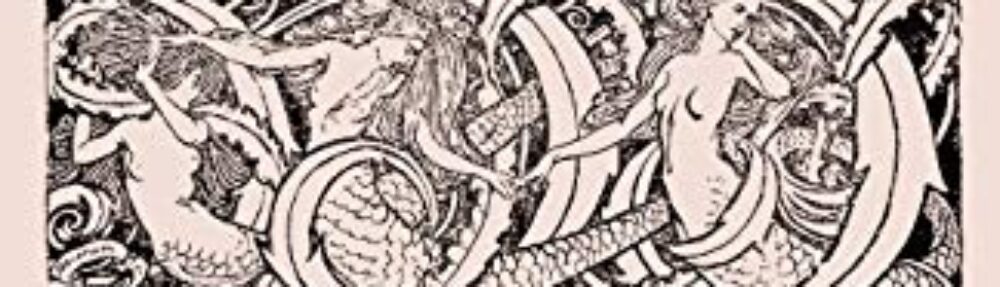
The first thing that struck me and intrigued me in Hans Christian Andersen’s The Little Mermaid was the motif of tears and one’s ability, or lack there of, to cry. When the little mermaids’ sisters rise “up arm-in-arm through the water, the youngest would stand alone, looking after them, and felt ready to cry; only mermaids have no tears, and therefore suffer all the more” (113). Symbolically the absence of tears represents the mermaid’s separation from humanity, or what makes something human. Though she can internally feel sorrow and longing she cannot externally express those emotions. Furthermore, there is an irony to her environment; the sea, which is made of endless water, surrounds her and contrasts her inability to cry tears. Externally, she is surrounded by water, yet lacks inner “water” of empathy or a soul. Andersen uses this moment to depict that suffering without expression (tears) is cursed pain, and it is with this awareness of her lack of tears (emotional expression) that the little mermaid starts to yearn for a soul.
By the end of the story the little mermaid is able to transcend with the daughters of the air, marking the turning point in her journey. As one of the daughters of the air welcomed her as an “aërial spirit,” “the little mermaid lifted her brightening eyes to the sun, and for the first time she felt them filled with tears” (130). Her tears are now symbolic of her “true” humanity and capacity for moral and emotional depth. As she looks up at the “sun” she becomes spiritually enlightened, the sun represents her transcendence to having a divine soul. Suggesting that emotional pain, when expressed and understood, is the way to immortality. Her tears are a literal presentation of her invisible soul.
Moreover, the daughters of the air explain that “when [they] see an ill-behaved or naughty child, [they] shed tears of sorrow, and every tear adds a day to the time of [their] probation” (130). The story ends with the tears not just being a representation of having a moral soul or a pathway to immortality, tears now carry a moral consequence. Andersen’s motif of tears is used to define humanity. Tears, in this case, transform ones suffering into a sort of salvation, without tears or the ability to cry there is no hope of such salvation.
