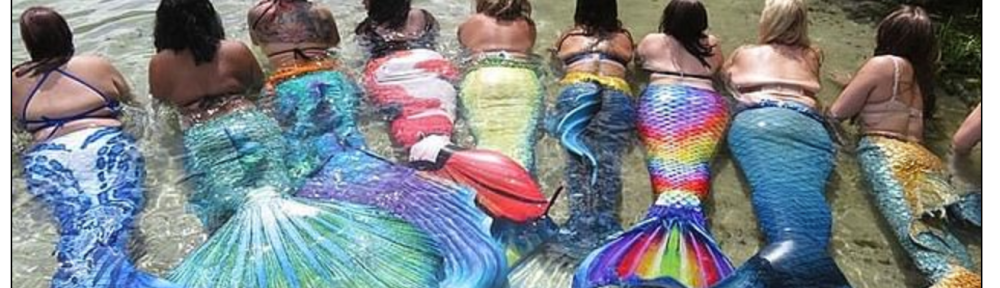
Week 7: Chapter 4 of Merpeople

“Westerner’s approaches to merpeople between 1800 and 1830 remained tethered to Enlightenment notions of science and wonder” (Schribner 129). Chapter 4 of Merpeople described the previously commonly accepted culture and knowledge surrounding merpeople within a past era. Many of these beliefs were seen as normal back then, but would be absurd now. For example, the existence of mermaids was seen by many as a scientific fact and studied and pursued by actual scientists of the time. Nowadays, a scientist would be stripped of all credibility and mocked if they were to try and prove the existence of the mythical merpeople. Additionally, the fact that people were fooled by newspapers and stories about mermaids would also be an embarrassment nowadays, but was considered normal then. They also popularized freak shows for people’s entertainment, similar to a circus. Back in the day, freak shows consisted of more than just mermaids but anyone deemed “different” or intriguing, like people with disabilities or people from other countries. This connects to the problematic view of mermaids people had that extends beyond sexuality and gender, but rather capitalizing off of others.

This prompted me to think of things that we as a society do today that would be considered strange or “dumb” to future members of society. If back then mermaids seemed as real as the sky, who is to say what scientific facts we “know” today are actually true or not? The quote from the chapter on page 129 above made me realize how throughout history, people’s ideas of science and wonder are connected to the same ideas of the previous generation because everything builds on top of one another. What if the era prior to us was wrong about their scientific facts, creating a paradigm that is not completely true? Additionally, things that were socially acceptable then, like freak shows, are not acceptable now, making me wonder what we as a society do now that will later on become unacceptable (or maybe the other way around?). Another example I realized is how that people back then were easily fooled by word of mouth and newspapers about the sightings of mermaids. Nowadays, people are very easily fooled by AI, especially with how realistic and convincing the videos may be. I thought that maybe in the future, people would laugh at how gullible we seem today.

Week 4: Chapter 1 of The Great Old Hunter Reflection

In Chapter One of The Great Old Hunter, the author describes a traditional culture where hunting was not simply an act of survival or sport, but a practice deeply integrated within cultural, spiritual, and social life. Knight creates a scene which shows how hunting shapes identities, reinforces hierarchies, and even connects humans to supernatural and divine forces. The hunter is not an ordinary person, but he embodies courage, skill, and the ability to connect with both the natural and supernatural worlds. By portraying hunting alongside nature, falcons, stags, and other mythic animals, the chapter tells us that nature itself is charged with meaning and filled with themes of danger, which emphasizes the hunter’s prestige and skill by braving the forest and hunting. One theme that stood out to me is the two-sided nature of reverence and domination in terms of nature. The forest is depicted as sacred, mysterious, and to not be underestimated, however it is also depicted as a place or domain where humans try to assert power over animals through acts of hunting for example. The capture of rare creatures like the white stag or the falcon is described as a big accomplishment with ritual significance and is often tied to prophetic or mythical events. This narrative reveals that hunting was never only about food or survival, but rather it was about reinforcing social order, proving masculinity, and creating a complex description of humanity’s relationship to control and nature. If society recognizes nature as something to be revered, then men trying to “conquer” it through hunts reveals a side of humanity that longs to be in control of the uncontrollable and in power. I also liked how the descriptions also show the way gender and class intersected with hunting culture. Male lords and nobles set up elaborate hunts as a part of maintaining their social status, while women only appear as figures of beauty, inspiration, or prophecy tied to hunting myths. Even so, women are shown flying falcons, highlighting a space where women participated more so symbolically in the hunts alongside men, but in a different way. This reminded me of culture today, where men are the ones expected to actively be doing things, but women’s roles are more to be simply supportive and emotional rather than physical. So, the chapter showed me a worldview in which nature was not something to be ignored or seen as passive, but alive with spiritual meaning and the foundation of certain cultural aspects. Animals carried symbolic meaning, the land held power, and every hunt was more like performance of status and belief rather than for survival.

Week 4: Deterritorializing Preface Thoughts

Thesis: Mentz’s preface challenges us to shift our mindsets beyond what we are familiar with

Steve Mentz’s preface to Deterritorializing challenges and invites readers to think beyond the typical land-based metaphors and instead explore in further depth the ocean’s fluidity as a framework for the way we think. Mentz references Deleuze and Guattari’s idea of deterritorialization, and he reframes the ocean as not just a physical environment but also a philosophical medium. It is unstable and constantly changing, redraws boundaries, and provides new possibilities for reimagining culture, politics, and history from a more open, less structured perspective.

Something that stands out to me most is Mentz’s emphasis on language, more specifically shifting away from land terms to ocean terms. His seven proposed terms of current, water, flow, ship, seascape, distortion, and horizon help readers to reshape their perspectives away from the typical, comfortable “land” themes. “Fields” and “ground” suggest permanence, while “currents” and “water” imply motion and uncertainty. The word “ground” also means stabilizing as a verb while “current” means movement as a verb. By shifting our vocabulary, we shift the way we view knowledge, progress, and even political structures. It allows us to feel more comfortable with shifting ideas rather than being trapped in one worldview. This is not just language but a form of intellectual reorientation. Additionally, it reflects the larger goals of the “blue humanities,” to remove land as the dominant metaphor and to recognize the ocean’s vast role in shaping life as we know it, from geography to culture.

Personally, I find Mentz’s reason behind using “ship” particularly interesting to me. Thinking of politics in terms of ships meeting at a port by the sea where they would trade and interact with other vessels, the word captures the relational and often unstable interactions between diverse cultures more realistically than the previous verbage of a “state.” Similarly, Mentz’s mention of distortion resonates with how perception itself changes in an water-like, fluid environment. Instead of seeking perfect clarity and 100% hard truth, Mentz suggests that distortion is not a flaw but simply a different, new perspective when viewed through water. This idea challenges widely accepted assumptions about knowledge, truth, and perspective.

Ultimately, Mentz encourages us to re-evaluate not only how we talk about the ocean but also how we engage with the world. Deterritorialization pushes us to accept instability, different perspectives, and allow for movement in thought. If we can change our metaphors and the way we think through something as simple as the verbiage we commonly use, Mentz argues, we may begin to change our imagination and with it, begin to make larger changes in the world.

Week 2 Blog: Merpeople

I think the introduction and Chapter 1 of Merpeople by Vaughn Scribner was very interesting and provided a new, deeper perspective on the symbol of mermaids. I find it unsurprising that mermaids were originally used to represent women in a negative, sexual light in order to perpetuate and uphold the power dynamic between men and women. Mermaids are seen as seductive, not to be trusted, and monstrous while mermen are seen as powerful leaders, even resembling gods like Posiden. I find it interesting how men felt the need to portray women in such a negative way while trying to repress them, however they did portray them in a way that is meant to be feared, which makes me wonder what they were so fearful of? I also had thoughts about the hybridity of mermaids: woman and fish. I remember from class some early Greek examples of woman hybrids included harpies, woman and bird alongside sirens, woman and fish. I find it interesting that when referencing Greek images, later men decided to expand upon and popularize the fish imagery. In comparison to the bird, the fish is much less free and more full of mystery since it is confined to the ocean which is largely unexplored. It also tends to have more negative connotations since it has to do with the dark depths and “below” land. The bird, on the other hand, is much more free and can fly as high as it wants while also enjoying land. Perhaps they chose the mermaid imagery to emphasize more to reinforce the control on women that they wanted.

Week 1: Intro

Hi everyone! My name is Megan Jue and I am so excited for this class! I am a sophomore at SDSU am I am double majoring in Economics and Finance and also have an honors minor! I am from the Bay Area. I didn’t know they offered fun classes like this so I am glad I have the opportunity to take it right now! I did not really know that this course was about mermaids but it was a very fun surprise that definitely made my day and made me 100% want to keep this course in my schedule. As someone who always loved the beach and ocean being from California I also always loved nature and the mythology that surrounds it! Some hobbies of mine include traveling (My favorite places are Monaco and New York) and going to concerts (I recently saw Zach Bryan, Parker Mccollum, and John Summit). I have a dog, Monty, and two cats, Nova and Clover who are my favorite living beings in the whole world. I also love Formula 1 and am planning on attending the Las Vegas Grand Prix for my birthday this year. My favorite store is Brandy Melville and my favorite show right now is the Summer I Turned Pretty because it rage-baits me and pisses me off but I need some adrenaline in my life!