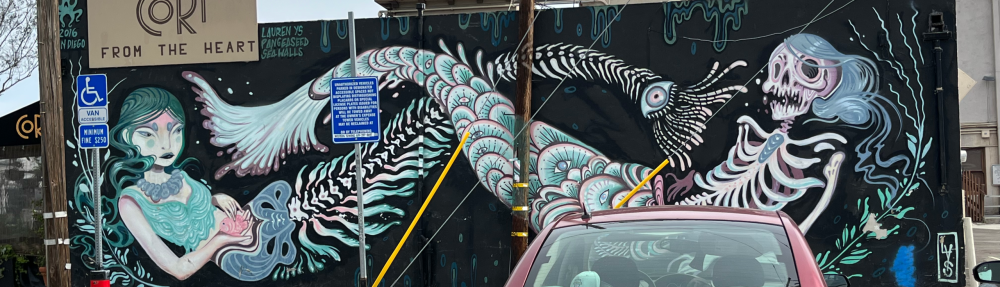
Week 5: A Curse between Us and Them

The Legend of Melusina is a heartbreaking story about a fairy whose curse, brought on by her mother, has led to a tragedy between us (humans) and them (non-humans). Although the curse can stem from one side, it will often have undesirable effects when the afflicted come in contact with a being from the other side. As seen in Melusina’s curse and her marriage with Raymond, the legend uses the curse as an outside force, whether natural/unnatural or in/outside the person, that can disturb or even devastate both sides of the equation.

Melusina’s rejection comes from her curse–which she cannot control–that turns her into a half-serpent every Saturday, which is lifted under a condition that a man who would marry her should “never [see] her on a Saturday, and should keep his promise.” (Penguin 86) If you know the context, she brought the curse upon herself by planning with her sisters to punish their father (on the “us” side) as “revenge” and confessing what they had done to their mother (on the “them” side). Because she was the one who carried out the plan in the first place, it is no wonder why she had the most severe punishment compared to her sisters. The curse forces her to live outside of society, “in search of the man who was to deliver her.” Raymond, a man who “accidentially” killed his uncle, meets her and swears to not see her on a Saturday.

Despite her curse, she is quite an able and powerful woman, as demonstrated in her ability to build castles and other majestic places “out of her great wealth” for Raymond, as seen in page 87 of the Penguin Book of Mermaids. However, their marriage would quickly crumble when her curse–and destiny–results in “the deformity of the children born of one that was enchanted” and Raymond’s cousin “exciting him to jealousy” and making him believe that his wife is retiring on Saturday. The curse has done more than just curse her body; it has tainted their marriage, and she’s sharing it with Raymond.

In the last parts of the legend, you may be wondering: why was Raymond hiding in Melusina’s room? It’s simple: the curse deceived him. The force from the other side has “afflicted” him, leading to him breaking his promise of never seeing his wife on a Saturday and the curse rubbing it in by making his son murder his brother. These events have led to Raymond seeing Melusina’s cursed form not with horror, but with heartbreak that he broke his promise. And because this curse has led to the death of his son Freimund, he yells at the accursed fairy to get out of his sight while calling her a “pernicious snake and odious serpent! thou contaminator of my race!” (87)

Raymond believes that Melusina was the one responsible for the misfortunes that happened in their marriage, as he is now fully convinced that she has “contaminated” him with the curse that will follow him until his death as a hermit. Melusina had found a man perfect for her to break her curse, but at what cost?

Week 4: The Siren’s Song

From our previous discussions, we learned about how mermaids (and aquatic creatures in general) existed in medieval times and will continue to exist in the modern age. In The Penguin Book of Mermaids, there is one creature we have encountered/yet to encounter, called the siren.

The siren is a creature in Greek mythology, usually depicted with a mermaid-like tail but with other appendages like wings or feet. As seen in a portion of Homer’s Odyssey, these creatures sing a seductive song in an attempt to lure sailors to their doom. In the stanza below, we see how their songs affect Odysseus:

“Thus the sweet charmers warbled o’er the main;
My soul takes wing to meet the heavenly strain;
I give the sign, and struggle to be free;
Swift row my mates, and shoot along the sea;
New chains they add, and rapid urge the way,
Till, dying off, the distant sounds decay;
hen scudding swiftly from the dangerous ground,
The deafen’d ear unlock’d, the chains unbound.” (12)

These songs have an ability to captivate (paralyze) sailors into listening to their songs, and it is so powerful that it is near impossible to break from the song alone. The siren attempts to lure Odysseus, a knowledgeable man, by promising “new wisdom.”

What can we make from this? A desire to exploit a man’s strength and render them vulnerable by promising what they seek? To feast on knowledge like how vampires are to blood? Since we are given the information that “sirens and mermaids are both symbols of dangerous femininity,” (9) we can see masculinity being reinforced through methods of resisting temptation: Odysseus’ crew stuffed wax into their ears to prevent themselves from hearing the siren’s song. Odysseus himself had to be bound to the mast so he wouldn’t be physically able to approach the siren. We can infer through the crews actions that we should always be mindful of what we seek, and sometimes it is better to resist these urges of knowing the unknowable.

Knowlege isn’t always what we seek.

Week 3: Merpeople and Cohen

For this post I will be focusing on the introduction of The Penguin Book of Mermaids. It is very intriguing to me because I took an ECL 220 class on monster theory and how monsters reflect our anxieties, and we learned from last week’s discussion that mermaids in general (not just medieval or contemporary) are quite literally a part of monster theory.

The introduction to the Penguin Book of Mermaids presents us with some interesting info about aquatic creatures and how they reflect our cultural anxieties. What stood out to me in the “Their Bodies, Our Anxieties” section is the uncanniness that we experience when we combine a being with non-human traits with humans; Bacchilega and Brown use aquatic humanoids as an example (xi). Jeffery Jerome Cohen’s seven monster theses can be seen at play here; keywords such as “thresholds” and “anxieties” and how mermaids are described here has me thinking about them. Here is how I would connect merpeople and aquatic humanoids in general to some of Cohen’s theses, specifically I, III, VI:

Thesis I: The monster’s body is a cultural body

This thesis is referenced in the text itself: “In contemporary cultural theory, we are reminded that ‘a construct and projection, the monster exists only to be read; the monstrum is etymologically ‘That which reveals,’ ‘That which warns.”” (xii) Monsters reflect our culture’s “fear, desire, fantasy, and fantasy,” (Cohen 4) and aquatic human-creature hybrids are no exception to the monster spectrum. Merpeople are sometimes featured in maritime fantasy/fiction novels, and they are usually depicted as humans with a giant tail instead of a pair of legs. Although they could be considered human, their monstrosity stems from the fact that they live in a largely-unknown uninhabitable environment outside of human society. Because their bodies reflect our desires to explore more of the ocean and our fear of not knowing what lies there, it therefore fits Cohen’s first thesis.

Thesis III: The monster is the harbinger of category crisis

Merpeople are usually part-human and part-fish, and some portrayals give them the ability to switch between human and fish at will. Because they exist between two categories, it is difficult to categorize them into either human or fish. Their in-between existence, therefore, “questions binary thinking and introduces a crisis” (Cohen 6).

Thesis VI: Fear of the monster is really a kind of desire

The text basically says it: “Our ambivalence toward mermaids and other water spirits finds its representation in their bodies, which are often alluring, but can also be frightening.” (xii) For instance, the siren is a fearsome type of mermaid that sings a beautiful song that lures sailors to their doom. She flips the gender binary by depicting the woman as the one in power, enticing men into falling for her song and compelling them into doing what she wants. Since we live in a patriarchal society, this power, then, is what women desire most.

I think it’s interesting to see what I’ve learned from my previous ECL classes make an appearance in the readings for this class. Here’s my question: how would you apply Cohen’s monster theses to a monster that you’ve encountered/yet to encounter? It doesn’t have to be mermaids, but it’d be intriguing to see his theses applied to merpeople in particular.

Introduction

Hi all, I’m Jesmond. I am a Lao-American in their fourth year of majoring in English. There’s not much to this post since I am a quiet person and not really experienced in writing long posts but I’ll try to introduce myself as best as I can.

I am a neurodivergent person (austistic) who loves to read and game. I used to read a lot of books in middle school and high school, and I am especially interested in monsters such as vampires, zombies, and ghosts.

Now, what got me into monsters (and this class?) To put it simply: fear drives curiosity. According to one of Jeffery Jerome Cohen’s seven theses of monster theory, “fear of the monster is really a kind of desire.” Monsters are the personification of our fears and anxieties, yet there is something about them that makes us want to learn more about them. This curiosity inevitably leads us to create more monsters, until eventually we become the monsters others want to learn about.

It was only a few semesters ago when my fascination with monsters started. First, I took a class about monsters and was first exposed to Cohen’s theses. Next, I analyzed a children’s literature novel on vampires and expounded on the concept of the other and “othering”. And last, I applied Cohen’s theses for a comparative analysis on vampires in media with the help of my classmates.

That is why monsters, especially literary monsters, fascinate me.

As for this class, I didn’t know what to expect since it was simply listed as “Literature & the Environment,” but when I got an email from the professor that it was going to be about mermaids, I knew I was in for a ride. Mermaids are a type of monster to be expected in media, although some mermaids may not be classified as monsters. Mermaids can represent our desires to explore the depths, but they can also represent what we sacrifice. Our freedom, our legs, our way of life–what will we give up for ocean life?

That is all for now. I am looking forward to hearing you all and getting to know you more.