The True Source of Fear: Internal and External

While reading Legend of Melusina, I thought that this story shows a tragic ending created by the conflict between two kinds of fear. Melusina lived with the fear of having her true form discovered, while Raymond was afraid of the social pressure and judgment directed at him. In the end, this fear led Raymond to reveal Melusina’s secret to society, and interestingly, he finished his life as a hermit. To me, these fears seemed like a conflict between external fear and internal fear. This opposition made me reflect deeply on what is truly frightening for human beings.

Melusina’s strange appearance may cause discomfort to the eyes, but it did not actually harm anyone. She used her abilities to build castles, bring wealth, and raise a large family, which shows that her appearance had no evil intent. Raymond, on the other hand, allowed his inner fear to dominate his judgment. His fear of shame and doubt pushed him to expose his wife’s secret, destroying both their relationship and his own peace of mind. In the end, human internal fear overcame Melusina’s external fear. I believe this tragic ending makes us question whether true fear comes from a monster figure or from humans themselves. In my view, the true source of fear in this story is not Melusina’s form but the mistrust and betrayal created by humans.

I also think this story has something in common with Odysseus and the Sirens, which we studied earlier. In both stories, human curiosity is strongly emphasized. Odysseus’s intellectual curiosity led him to listen to the Sirens, an action that almost endangered the lives of his sailors. In Legend of Melusina, both Raymond and even Elinas caused tragic outcomes because of their curiosity and impatience. From this, I learned that human curiosity has both pros and cons. On one hand, curiosity has led to scientific development, new discoveries, and the advanced society we live in today. On the other hand, curiosity can also become destructive when it breaks trust or puts others in danger. In conclusion, instead of fearing other beings only for their physical differences, I believe we should recognize that the more dangerous fear is the mistrust and prejudice that come from within ourselves. True fear is not the monstrous body we see, but the destructive choices born from the human mind.

Siren’s Song between Knowledge and Temptation

The most impressive part of reading “Odysseus and the Sirens” in The Penguin Book of Mermaids was the lyrics of the Sirens’ song. The Sirens tried to tempt humans by using intellectual power and pulling them toward the sea. At this point, I wondered why they used “knowledge” instead of something else as the reason for temptation. In modern society, honor or money might be seen as more powerful temptations. However, after thinking more, I realized that both honor and money usually come from knowledge. Human beings also tend to admire those who have greater wisdom than themselves. For this reason, I think knowledge could be the strongest and most universal form of temptation.

Still, I felt a contradictory emotion because this knowledge was offered not by a holy or noble figure but by the Sirens, who are monstrous beings. Normally, people imagine knowledge as a sacred gift from wise or divine figures, such as gods, prophets, or respected teachers. But here, the Sirens lead humans to death while giving that knowledge. This mismatch makes us feel stronger fear and uneasiness. Their song is both a promise of enlightenment and a trap that ensures destruction. This duality creates a sense of confusion asking ourselves should knowledge always be trusted, or can it sometimes be dangerous? At the same time, the Sirens’ beautiful voices produce desires to hear them, while their dangerous nature causes fear. This combination results in powerful ambivalent feelings. Odysseus’s action of trying to listen to the music while being tied shows that human beings often try to experience temptation while at the same time creating limits to protect themselves. In this way, the scene reflects the human struggle between curiosity and survival.

In particular, the fact that the Sirens have a half-human shape makes the boundary between humans and monsters unclear. This blurring of boundaries projects suppressed human desires onto the Sirens and makes the emotions of the readers even more complex. It suggests that the dangers we fear most may not come from the outside but from within ourselves, from desires we cannot control. The Sirens’ song is memorable not only because of its beauty but also because it reveals the paradox of knowledge, temptation, and human weakness. It teaches us that even the most valuable gifts, such as wisdom, can also carry danger.

Week 2, Mermaids between Fear and Desire

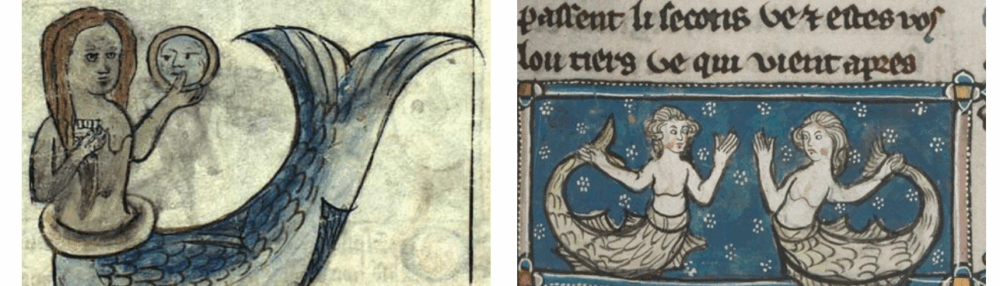
The introduction of Merpeople: A Human History made me think about many ideas, especially how it connects the question of human nature with the figure of the mermaid. I have usually thought of mermaids as half human and half fish, but I had never tried to study humanity itself through this image. While reading this part, I began to think again about the process of human evolution. We usually explain human history as starting from ape-like ancestors. But if we go further back and imagine the very first ancestors of humans, can we really say that humans and animals are completely different? Today, science has developed so much that we can compare humans and animals in many ways. In the past, however, when science was not developed, the meaning of mermaids may have been much more serious.

In societies where religion had strong power, people probably emphasized the special value of humans by saying that they were created by God. If humans were seen as the chosen beings of God, then the idea of mermaids, creatures that were half human and half animal, would have caused fear. Why did people imagine them as part fish? I think it was because the ocean was considered the most unknown and mysterious place, and fish were the main living creatures there. To people in the past, mermaids could represent the fear of the deep sea. Religion and society may have used this fear as a tool to teach lessons and control people’s actions.

As time passed and science grew, belief in the real existence of mermaids became weaker. But in the modern world, the meaning of the mermaid changed from something scary to something attractive. I think this shows a movement from fear to desire. This reminds me of Cohen’s Monster Theory, which I studied recently. One of his ideas is that monsters can represent attraction and desire. In this way, the use of mermaids today in advertising, branding, or company logos seems to come from this change. What was once a frightening monster has now become a symbol of beauty and charm. Therefore, the mermaid reflects how human imagination turns fear into fascination.

Introductions!

Hello! It’s great to meet you all in this class. I’m an exchange student from South Korea, and being here in San Diego has been so much fun! I actually studied in California when I was 11, but it has been seven years since I last visited the U.S. Experiencing both the Asian and American education systems has shown me how important interaction with professors can be. In our first class, I was surprised at how active and lively the discussion was. I hope this exchange experience helps me become more extroverted and gain many new perspectives by talking and sharing ideas with all of you.
I also really enjoy learning new languages! These days, I’m interested in Japanese and Spanish. I believe language has a lot of power, especially being able to communicate with others in their own language is truly wonderful. When I travel, I can feel the difference between knowing and not knowing the local language, and I think it opens the door to various opportunities. It also allows me to connect more deeply with a culture and understand better and embrace its differences.
I’m especially happy to be in San Diego, where I can use my English, even if it’s not perfect. I love hearing different stories from people of various cultures, and I think that is what really helps me expand my knowledge and perspective. The weather here is also amazing and I’m so jealous! In South Korea, summers are so humid that it sometimes feels hard to breathe. One big difference I’ve noticed between South Korea and the U.S. is that in America, people seem less concerned about what others are doing. I think that’s why it feels easier to just be yourself here, which I find really impressive.
Finally, I should mention that I love music so much! I grew up listening to Taylor Swift, and she’s still one of my favorite artists today. Music is such a big part of my life that I almost always have my AirPods in. I hope we can share some great songs with each other and have many interesting conversations throughout this semester!