Redefining the Ocean: The Power of the Language

For a very long time, human beings have looked at the Ocean simply as a background space for human activity, and we have rarely tried to understand it as something more than that. On maps, we divided the sea according to our own standards and gave it names that made sense only from a human point of view. Throughout thousands of years of history, the Ocean was mainly used as a route or pathway that helped people achieve their own goals, such as travel, trade, or exploration. However, this way of thinking limits the vast and complex space of the Ocean to something that exists only within the boundaries of human vision. It ignores and even erases the independence, depth, and long history that the ocean itself has always possessed.

In relation to this problem, Eric Paul Roorda, in his essay The Ocean Reader: Theory, Culture, Politics, argues that the human habit of defining and restricting the Ocean is actually a product of an anthropocentric, or human-centered, worldview. By pointing this out, Roorda invites us to reconsider our narrow perspective and to reflect on how we have been understanding the sea. Roorda describes humans as essentially land-based creatures and intentionally chooses to write the word “Ocean” with a capital O. Through this linguistic choice, he encourages readers to recognize the Ocean as an equal partner in the relationship between humans and the natural world. His focus on language reminds us that the words we choose can shape the way we think and the way we value different parts of our world.

Therefore, this essay will explore how Roorda’s linguistic strategies help break down the anthropocentric viewpoint that humans have long taken for granted. It will also examine how this shift in language allows us to see the Ocean as a space with its own history, identity, and agency. By analyzing Roorda’s sentence structures and vocabulary choices, I aim to show how his writing encourages readers to change the way they think, and how language itself becomes a tool for understanding the world in a deeper way. In addition, this essay will consider how Roorda’s linguistic transformation reconstructs the dominant power relationship between humans and the Ocean, leading us to recognize once again that the two are mutually dependent and deeply connected.

Roorda explains the purpose of his essay by saying that he hopes “to avoid that natural bias predominating among our terrestrial species and replace it with a steady focus on the Ocean and on events that take place offshore” (Roorda, p.1). In this moment, he does not simply use the common word “human” to refer to people. Instead, he chooses the expression “terrestrial species.” This linguistic strategy encourages readers to rethink and reposition the status of human beings. Normally, when we use the word “Human,” it gives us the feeling that humans are unique creatures who exist above or outside other categories of life. However, by defining humans as a “terrestrial species,” Roorda shakes the foundation of this assumption and asks us to let go of a sense of privilege that we may have taken for granted.

Through this choice of wording, he redefines humans not as beings standing outside of nature or ruling over the sea from an elevated position, but as equal participants who exist in a mutual relationship with the Ocean. In other words, Roorda’s terminology challenges the hierarchy that humans have built between themselves and the sea, and demonstrates his intention to place both entities on equal ground. By calling humans a “terrestrial species,” he emphasizes that human life is limited to land and that our perspective is shaped and restricted by this fact. He also uses the word “predominating” to show that such biased thinking has been dominant for a long time and has continued almost automatically through long-standing habits.

This act of naming does more than simply change where humans are placed in the world. It also raises questions about the limitations of the way humans interpret and understand reality. Roorda reveals that human perception is never neutral or universal, even though we often assume it to be so. Just as Roorda’s term “terrestrial species” suggests that human viewpoints arise from life on land, Donna Haraway also argues in her essay that all knowledge and perspectives are shaped by a person’s specific environment and position. In Situated Knowledges, she writes, “I am arguing for politics and epistemologies of location, positioning, and situating, where partiality and not universality is the condition of being heard to make rational knowledge claims. These are claims on people’s lives” (Donna, p. 589).

Haraway’s argument closely connects with Roorda’s linguistic strategy. Both scholars emphasize that the way humans see the world is determined by their past experiences and conditions. Because humans have lived their entire history on land, it is natural that they developed a “terrestrialism,” a land-centered way of thinking. Therefore, Roorda’s use of selective vocabulary to reposition humans can be understood as an attempt to practice Haraway’s idea of “epistemologies of location,” but from a specifically ocean-centered perspective.

Ultimately, Roorda’s naming technique is not just a simple word choice but a critical intervention into the way humans understand their own viewpoint. His linguistic strategy pushes humans to recognize that they are no longer the absolute interpreters of the world, but beings with limited and situated perspectives. In other words, he reconstructs the relationship between humans and the Sea not as observer and observed, but as two relational subjects who coexist.

Furthermore, this linguistic re-positioning becomes the foundation for understanding Roorda’s next strategy which is writing “Ocean” with a capital letter. Without first revealing the limits and biases of human perspective, it would be difficult for readers to accept the Ocean as an independent entity with its own agency and history.

After redefining the position of humans as a “terrestrial species,” Roorda continues his project by redefining the Ocean not as a simple natural background but as a unique entity with its own history. In his essay, he states, “To capitalize Ocean is to challenge the conventional wisdom that the seas can be taken for granted. They cannot” (Roorda, pp. 3–4). By using the word “challenge,” Roorda clearly shows that his linguistic transformation is meant to resist long-standing assumptions based on human-centered thinking. Even though he changes only one letter in the word ocean, this shift allows us to perceive the sea in a completely different way. When we write the word with a capital letter, Ocean, we begin to see it as a proper noun, and this linguistic shift helps us understand what Roorda means when he says that “the Ocean has a history” (Roorda, p.1). Instead of reducing the sea to a space used only for human needs such as trade or navigation, the capitalized Ocean becomes a space that holds its own agency, one that changes, moves, and interacts with human history while also developing independently.

Furthermore, the capitalization of Ocean works as a form of resistance against the human habit of simplifying the sea’s complex ecosystems and deep histories. By naming it as a proper noun, Roorda suggests that the long tradition of dividing the sea into seven parts, known as “the Seven Seas,” is no longer acceptable. In other words, the sea cannot truly be divided or easily named according to human convenience. It exists as an independent and continuous whole. This linguistic shift encourages readers to reflect on the ways humans have interpreted and treated the sea based only on their own perspectives. It also pushes us to reconsider the sea as a constantly changing, richly layered environment with its own ecological rhythms.

This perspective is supported by Leposa and Knutsson in their essay Framing Matters for Ontological Politics of the Ocean. They explain, “While epistemology denotes how we understand the world and ontology describes the existence of the world, the way political practices shape a particular ontology and how different realities interact with each other can be embraced by the term political ontology” (Leposa & Knutsson, p. 753). Their argument emphasizes that the way we frame and describe the sea directly influences how the sea is defined. In other words, the sea can appear in completely different forms depending on how humans name it, narrate it, and structure it through language. This discussion shows how powerful human language can be in constructing reality and why it is important to question and rethink the linguistic frameworks that have shaped our understanding of the sea.

For this reason, Roorda’s decision to capitalize Ocean becomes especially meaningful. It demonstrates that language does not only define and describe objects in the world but also shapes the perspective from which we see them. When we begin to write the sea as Ocean, we naturally start to view it as something much broader, more complex, and beyond full human control or explanation.

In conclusion, Roorda’s capitalization strategy breaks the long-established habit of framing the ocean within human linguistic systems and urges us to read the Ocean as an independent subject. This reframing moves us away from the idea that the sea exists only to serve human purposes and helps us recognize that the Ocean has its own rhythms, movements, and history. His linguistic shift functions as a critique of human-centered worldviews and opens a new possibility for understanding the sea not as an object but as a subject with whom humans must renegotiate their relationship.

Roorda’s use of the term “terrestrial species” and his decision to capitalize the word Ocean represent more than simple linguistic choices. They function as a critical challenge that shakes the foundation of how humans understand the world. Through this linguistic shift, Roorda removes humans from the imagined center of nature and places them on the same level as the sea, encouraging readers to recognize the Ocean not as a passive background or a resource, but as a subject with its own unique history and agency. This transformation in language exposes how deeply human-centered thinking has shaped our perspectives and reminds us that our ways of seeing the world are always shaped and limited by the words we use. Roorda’s strategy also invites us to view the sea as something that cannot be simplified, divided, or easily controlled according to human purposes, offering a new perspective in which the Ocean can be understood as an independent and meaningful presence.

Furthermore, Roorda’s work shows that rethinking the Ocean is closely connected to rethinking humanity itself. Humans are no longer portrayed as owners or controllers of the sea, but as beings who share and co-create the world alongside it, forming histories through continuous interactions. His linguistic intervention plays a central role in restoring this relational way of seeing, encouraging readers to reconsider the connections between humans and the natural world. The capitalized Ocean is therefore not just a typographical change, but a symbolic gesture that represents a shift in thought toward reimagining the relationship between humans and nature. Ultimately, Roorda’s approach becomes an important starting point for reading the sea differently, reflecting on the limits of human perception, and fostering a broader and more inclusive understanding of the world around us.

Final Project Idea

For my final essay, I plan to close read Eric Paul Roorda’s introduction to The Ocean Reader: Theory, Culture, Politics which is an expand of my discovery 2. I will focus on how Roorda challenges human centered and land based thinking by defining humans as a “terrestrial species” and by capitalizing the word “Ocean.” My analysis will examine how these language choices work to shift the ocean from an object humans describe to a subject with its own history and agency. I will also explore more on how Roorda’s diction reveals the limits of human perception and the ways people have tried to name and control the sea. Through this close reading, I aim to show the important role of language that Roorda uses to reimagine the relationship between humans and the Ocean.

Water: Union of Humanity and Nature

The story of Yemaja in “Aganju and Yemaja” explains the origin of the world through the female body. Her body functions not only as a physical form but also as a channel that creates the world and gives birth to gods. In other words, her body becomes a medium that connects the boundary between humans and nature. The physical violence toward Yemaja is described as, “The streams from Yemaja’s breasts joined and formed a lagoon, and from her gaping body came the following…” (p.169). Her body, though wounded, becomes another passage through which the natural order is born.

The phrase “streams from her breast” contains both maternal and natural images. The breast is not simply a part of the body but a means through which life is sustained. However, in this passage, the breast goes beyond its human function of nurturing to become the source of the natural ecosystem itself. The streams flowing from Yemaja’s breast represent the life force of nature, and water becomes a central image of creation. Water is essential not only for the survival of human beings but also for maintaining the balance and circulation of the natural world. Therefore, the water flowing from her body shows that human life and the ecosystem share the same origin. Through this, Yemaja’s body can be read as a medium that connects the worlds of humans and nature.

Moreover, the gods born from her body, such as “Dada (god of vegetables), Shango (god of lightning), Ogun (god of iron and war), and Olokun (god of the sea)”(p.169) symbolize the fundamental principles of nature. In this sense, her body is not merely a site of birth but functions as nature itself, organizing the order and life of the world. Especially as the ‘Mother of Fish’(p.168), Yemaja represents the circulation of water and the source of life. The water that flows from her body symbolizes the ongoing movement of nature and the continuous renewal of life.

Ultimately, Yemaja’s body bears traces of violence yet simultaneously embodies natural vitality and order. Her body becomes a sacred space where destruction and creation coexist that shows a symbol of origin in which the worlds of humans, nature, and the divine are united.

Capitalizing the Ocean: Power of the Language

In The Ocean Reader: Theory, Culture, Politics, Eric Paul Roorda presents the ocean not as something that can be limited or fully understood by human sight, but as an independent and living entity. He criticizes how humans have always viewed the ocean through a human-centered and land-centered perspective, treating it only as a background for human life. Roorda points out that this bias comes from the fact that humans see themselves as the center of existence. By calling humanity a “terrestrial species,” he challenges that view and repositions both human beings and the ocean. As he writes, “This book aims to avoid that natural bias predominating among our terrestrial species and replace it with a steady focus on the Ocean and on events that take place offshore” (Roorda, p.1). Through this statement, he reminds readers that humans are not the entirety of the Earth but creatures who depend on a limited space called land.

This change in perspective also appears in Roorda’s language. He explains, “To capitalize Ocean is to challenge the conventional wisdom that the seas can be taken for granted” (Roorda, pp.3–4). The act of capitalizing the letter “O” becomes a symbolic gesture of resistance. The word “challenge” shows that this is not a simple stylistic choice but a conscious effort to question and overturn traditional thinking. By writing “Ocean” instead of “ocean,” Roorda transforms the sea from a natural object into a proper noun, a subject with its own identity and agency. The ocean, in his view, is not a romantic or divine figure but a historical and ecological force that shapes life on Earth. As he writes, it “has a history” (Roorda, p.1) and possesses its own ecosystem that moves and changes beyond human control.

Roorda also draws attention to how human language has limited the ocean’s meaning. He observes, “It has always been difficult for humans to think of the Ocean as a place” (Roorda, p.1). Here, the phrase “think of” reveals the human tendency to define the ocean only as an idea or a location within human knowledge. Humans have tried to map it, name it, and divide it into “the Seven Seas” (Roorda, p.1), reducing a vast and dynamic being into measurable space. Roorda sees this as a kind of linguistic violence. By confining the ocean to human concepts, people forget that it moves, circulates, and exists beyond human understanding. Therefore, capitalizing the word “Ocean” is not only a visual change but also an attempt to transform human perception. It is a linguistic strategy that aims to rebuild the relationship between humans and the natural world.

Through this shift, Roorda encourages readers to see the ocean not as a tool for human industry or tourism but as an independent being that creates its own history. He shows that the history of the Ocean and the history of humanity are deeply connected and interdependent. The Ocean has influenced migration, climate, and trade long before humans began to write their own history. Thus, the Ocean and humanity exist as equals, not as master and servant. The capitalized “Ocean” reminds us that the sea is not owned or defined by humans but coexists with them.

In this sense, Roorda’s decision to call humans a “terrestrial species” becomes even more meaningful. The phrase exposes the limited position of humankind. It suggests that humans are not the rulers of nature but one of many beings sharing this planet. Recognizing ourselves as terrestrial species forces us to step away from the illusion of superiority and toward a relationship based on coexistence. Humans must see themselves as part of nature, not above it.

In the end, Roorda’s “Ocean” becomes a symbol of linguistic and intellectual transformation. By changing one letter, he invites readers to rethink the way language shapes our view of the world. The capitalized Ocean is more than a geographic concept; it is an act of reimagining. It reminds us that naming is a form of power and that words can either limit or liberate how we understand the world around us. Roorda’s essay is not simply about the sea. It is about how humans can learn to see nature as an equal companion rather than a background or a resource. His “Ocean” is not only a body of water but a doorway to a new way of seeing, one that allows us to recognize the world as alive, interconnected, and beyond human control.

Perspective of the Mermaid

The short film Sirenomelia shows the disappearing face of nature caused by human industrialization through the figure of a mermaid. The mermaid is no longer just a mythical being but a symbol of the natural world that humans have ignored. She represents a non-human perspective that traces the remains of human activity. By making the mermaid the main focus of the film, the director allows us to step outside a human-centered way of seeing and notice how human society and nature are deeply connected.

The film begins with fragments of a military base, an artificial structure that represents both the achievements and the damage left by human civilization. The next scene shows melting glaciers collapsing into the sea, quietly revealing a cause-and-effect relationship between human-made objects and the destruction of nature. Human technology and progress have tried to control nature, but what remains are corroded ruins and the fading ecosystems around them. Through this contrast between human society and nature, Emilija Škarnulytė helps the audience feel what humans have done to the environment without using any words.

The scene that caught my attention the most is between 3:08 and 3:45. In this part, the mermaid herself does not appear, but the camera slowly moves through the underwater ruins of the base as if we are seeing the world through her eyes. When the camera looks up from under the water, the human structures above the surface appear distorted and unstable. This made me realize that although human civilization may look strong and permanent from our own viewpoint, from nature’s perspective it is fragile and temporary. This change in perspective shows how unstable the human order built upon nature really is. Nature is not a silent background or a passive victim. It carries the marks of human ambition and violence and continues to exist with those scars. Even when the mermaid is absent, her gaze seems to guide the camera and reminds us that humans are no longer the center of the story. Through this underwater viewpoint, the film breaks the boundary between humans and nature and shows a world where nature continues to live while holding the wounds left by humans.

In the end, Sirenomelia criticizes humanity’s desire to dominate nature and invites us to look at the world from nature’s point of view. It reminds us that nature is not just a resource or a background for human use but an equal presence that exists alongside us in shaping the world we live in.

Rethinking of the Ocean

The most important passage in the introduction of The Ocean Reader: Theory, Culture, Politics is as follows. In the beginning, Roorda writes, “This book aims to avoid that natural bias predominating among our terrestrial species and replace it with a steady focus on the Ocean and on events that take place offshore” (pg.1). This sentence shows the main idea that the book tries to discuss. Roorda explains that human ways of thinking are strongly based on human centered ideas, which are described through the term ‘terracentrism’.

In this passage, Roorda does not call us simply “humans” but instead defines us as a “terrestrial species.” This phrase breaks the traditional boundary between humans and other living beings. By calling humans one kind of species among many, it offers a opportunity for us to change how we see ourselves. We are no longer a special or superior being but a part of the same ecological system as all other creatures. Through this, we can see human society and the natural world as parts of one connected space. It also makes clear that humans are not rulers standing above others. The word “terrestrial” warns us about the “natural bias” that leads us to understand the sea only from the point of view of land. For example, people have divided one connected ocean into seven parts for their own convenience. Unlike the land, where change is easy to see, the deep ocean hides many ecosystems that we tend to ignore simply because we cannot see them. Roorda shows that the root of these problems lies in terracentrism, which makes humans view the world through their own limited ideas and language.

Roorda argues that we must move beyond this terracentric perspective and keep a “steady focus” on the Ocean. This means that the ocean should not be seen as a temporary or distant object of observation, but from its own point of view. The change from the usual lowercase “ocean” to the capitalized “Ocean” shows an effort to “challenge the conventional wisdom that the seas can be taken for granted” (pg.3-4). Using the lowercase word “ocean” makes the sea sound like something humans can define or own. Such naming leads people to believe that the sea belongs to them. However, by changing just one letter, it reminds us that the Ocean is an independent being with its own history and ecosystems.

In conclusion, this book does more than remind us of the importance of the sea. It calls for a change in how we think. Roorda encourages readers to move away from the belief that everything exists for human use and to remember that humans are only one of many species on Earth. When we recognize this, we can begin to understand the world of the Ocean more clearly. To see the world as it truly is, we must change our point of view and learn to see ourselves as part of it. This change must begin within us.

Potion as Separation and Transcendence

Hans Christian Andersen’s The Little Mermaid focuses on the theme of transformation into a human. The most important element in this process is the role of the potion. In the story, the potion works as a medium that allows the mermaid to enter human society. However, this transformation is not described as an easy or beautiful process. To gain the potion, the mermaid must give up her voice. Her change into a human is not shown as a magical or pleasant experience, but as one filled with pain. Andersen writes, “The little mermaid drank the sharp and burning potion, and it seemed as if a two-edged sword was run through her delicate frame,” showing the physical suffering she must endure to become human.

The moment when she loses her voice emphasizes this meaning even more. The sea witch says, “You have the loveliest voice of all the inhabitants of the deep, and you reckon upon its tones to charm him into loving you. Now, you must give me this beautiful voice.” When the mermaid accepts this deal, it can be seen as the moment she loses her sense of self. A voice is what allows people to express their thoughts and emotions. By giving up her voice, the mermaid loses her way to express herself and falls into silence. This can be understood as a kind of social restriction that comes when one tries to change themselves to fit into human society. Therefore, her pain is not only physical but also represents the loss of her inner identity.

In the story, the mermaid can also be seen as a symbol of nature. Andersen describes her as “Her skin was as clear and delicate as a rose leaf, and her eyes as blue as the deepest sea,” connecting every part of her body to natural elements. Through this description, the reader understands that she is a part of nature itself. When she drinks the potion and enters the human world, the connection between her and nature is cut off. This separation can be interpreted as a symbol of the broken relationship between humanity and the natural world.

However, Andersen’s story does not only describe this separation as something tragic. At the end, the little mermaid turns into sea foam, but soon after, Andersen writes, “The little mermaid saw that she had a body like theirs, that kept rising higher and higher from out the foam.” She is reborn as one of the daughters of the air. This is not a simple death, but a transformation into another form of being. It shows a new way of connection between the human world and the natural world. The mermaid, who suffered physical pain and the loss of her voice, finally gains a higher kind of freedom by leaving her body behind. Andersen shows that by going through pain and loss, humans can still reach spiritual growth even after separating from nature.

From this point of view, the potion can be understood as both a symbol of separation and a bridge to transcendence. The moment the mermaid drinks it, she moves beyond being a natural creature and enters a moral and spiritual journey that includes pain, choice, and redemption. Her suffering is not only a sacrifice to adapt to human life, but also a process of purification and self-realization. Through this story, Andersen shows that even though humans have moved away from nature, they can still find a sacred connection with it. In the end, the mermaid’s transformation becomes a symbolic journey that explores the boundary between nature and humanity, body and soul, pain and salvation.

The Separation Between Nature and Humanity

While reading The Little Mermaid, I focused on how the mermaid’s life changes throughout the story. She falls in love with a human prince at first sight and gives up her voice to the sea witch in exchange for a potion that allows her to obtain human legs. I believe this story is not just a tragic love tale but a description of how the mermaid, as a part of nature, goes through a painful process to enter human civilization. Among all the elements in the story, the potion plays the most important role in this transformation.

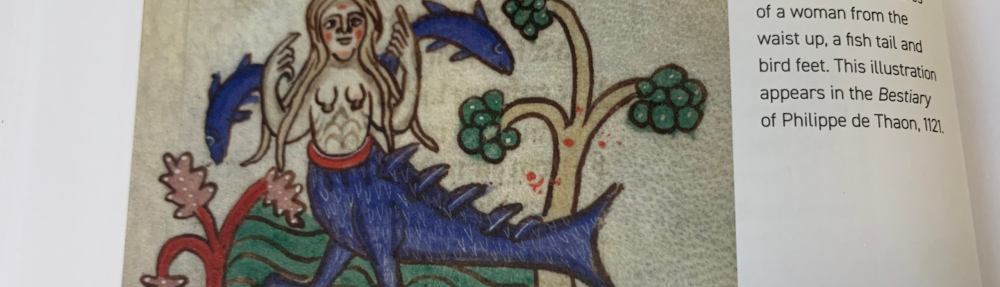
At the beginning of the story, Andersen describes the sea where the mermaid lives as “Far out at sea, the water is blue as the prettiest cornflowers, and as clear as the purest crystal.” Through this line, the author portrays the sea as a pure and peaceful place, an environment untouched by human desire. However, the mermaid does not remain in that serene world. Instead, she tries to reach the human world. When she visits the sea witch to obtain the potion, the witch warns her, “Your tail will then disappear, and shrivel up into what human beings call neat legs. But mind, it will hurt you as much as if a sharp sword were thrust through you.” This scene reminded me of the traditional image of ancient mermaids who were often drawn with two split tails. In old depictions, such mermaids held their tails apart, showing both temptation and natural vitality. Yet in Andersen’s story, the splitting of the mermaid’s tail shows the painful moment when a natural being is separated from nature and absorbed into human civilization. In this way, the story highlights the growing distance and tension between humans and the natural world. In the end, the mermaid sacrifices herself to save the prince. This final act shows that nature ultimately yields to humanity and that their relationship is far from equal or balanced.

In conclusion, The Little Mermaid can be read as more than a love story between the mermaid and the prince. It shows a relationship between humanity and nature that is maintained through the sacrifice of one side. The story criticizes the human desire to dominate nature and reveals how that ambition destroys nature’s purity and harmony.

The Soul as Awareness

While reading The Day after the Wedding, from Undine, I was able to explore what it truly means to be human. In this story, Undine reveals her identity and says, “Hence we have also no souls,” explaining that her kind was born without souls. However, when she later speaks about how Huldbrand’s love has changed her, she says, “I am now possessed of a soul, and my soul thanks you, my inexpressibly beloved one, and it will ever thank you, if you do not make my whole life miserable.” The most important theme of this story is the question of the “soul.” Whether one has a soul or not becomes the standard that decides who can be considered human. Undine claims that she came to understand the emotion of “love” only after she gained a soul. Therefore, I interpreted the “soul” in this story as a symbol of self-awareness, a unique ability that only human beings possess.

It cannot be said that only humans have emotions. Animals such as chimpanzees also feel basic emotions such as fear or joy. Yet the ability to recognize, classify, and reflect on those emotions belongs only to humans. Undine imitated human behavior, but without Huldbrand, she could never have become a being who is truly aware of her emotions. In this story, the soul that she gains represents the power to awaken such emotional awareness within her.

Based on this, I began to think that emotions can be divided into different levels. There are emotions that exist only as forms, and there are emotions that contain meaning. Emotions in their simple form are instinctive and shared by all living creatures, whether human or animal. Such emotions arise naturally, but they do not include awareness of the situation or the reason behind them. However, emotions given meaning through awareness involve understanding why those emotions appear and how they transform one’s sense of self. This process of becoming conscious of emotion seems to create the uniqueness of being human.

Ultimately, human beings are not merely creatures that feel emotions but ones that understand, remember, and find meaning within them. Undine, by gaining a soul that allowed her to give meaning to her emotions, could finally be reborn as a true human being.

Human’s Fragility and Betrayal

When reading Melusine, what impressed me most was the husband Raymondin’s choice. He faced two conflicting duties, protecting and remaining loyal to his wife on the one hand and maintaining his social honor under the constant pressure of noble society and the Church on the other. Raymondin had to decide whether to keep Melusine’s secret and preserve their love while losing his reputation, or betray his wife by revealing her identity to escape suspicion. In the end, he chose betrayal, and by blaming her “you have dragged me down in your fall and I am lost”(139), this decision destroyed his household. What is most striking, however, is that his choice did not save him. He lost his wife, and at the same time never fully regained trust among the nobles. Since Melusine’s supernatural power no longer protected the family, he lost not only personal love but also the prosperity and stability of his lineage. Thus, his attempt to free himself from social pressure led only to greater instability and isolation. The irony of his situation shows how human weakness collapses under the weight of public judgment.

It also becomes clear that Melusine could never fully belong to human society. As a faery, she could remain only through her husband’s promise. Once that promise was broken, the community immediately rejected her. The images of water and wings in her departure scene symbolize her being pushed outside social order. The text therefore suggests that society inevitably excludes those who do not conform to its norms.

Reading this made me reflect on the fact that humans, as members of society, cannot ignore the gaze of the community. Raymondin could not abandon his honor, and for this he sacrificed both love and trust. All tragedy here begins with dependence on and obsession with social judgment. Melusine kept her promise but was expelled, while Raymondin surrendered to pressure and lost everything. In this way, humans seem weaker than other creatures because Melusine preserved her identity outside society, but Raymondin collapsed within it.