There was once a law concerning mermaids. My friend thinks it a wondrous thing — that the British Empire was so thorough it had invented a law for everything. And in this law it was decreed: were any to be found in their usual spots, showing off like dolphins, sunbathing on rocks — they would no longer belong to themselves. And maybe this is the problem with empires: how they have forced us to live in a world lacking in mermaids — mermaids who understood that they simply were, and did not need permission to exist or to be beautiful. The law concerning mermaids only caused mermaids to pass a law concerning man: that they would never again cross our boundaries of sand; never again lift their torsos up from the surf; never again wave at sailors, salt dripping from their curls; would never again enter our dry and stifling world.
Miller crosses many threads in this short prose poem. Imperialism favors uniformity. In the first half of this poem, he sets up Mermaids as a symbol of the other among us; the human/nature which western colonial empires have sought to distance, separate, draw boundaries between, and ultimately, control, exploit. In the second half of the poem, he theorizes a form of resistance; if the surface of the sea has been drawn as a boundary between the man and the nonhuman world– mermaids can relinquish their terrestrial halves and escape the imperialist machine. The implications of this twenty first century poem about a (possibly fictional) centuries-old law are critical; now that human colonization and extraction has moved below the sea surface, instead of merely occurring on top of it, is there any place on earth where the “mermaid”– the other among us– can retreat to?
There are three individuals known to have survived infancy with Sirenomelia. They are the stars of inspirational documentaries, the subjects of research publications, and featured on blogs dedicated the the macabre. It goes without saying; humans are fascinated by disease, deformity, and abnormal morphology. We see these anomalies through various lenses; as symbols of strength in the face of adversity; as demonstrations of the state of medical technology, or merely as perversely, fascinatingly, bizarre. In any case, individuals with physical abnormalities are monsterified. They take on that role; non-human emblems, culturally imbued, figures which demonstrate something, make us aware of something, make us uncomfortable, demand our attention.
In one extreme, these real live Monsters are stripped entirely of their humanity– their individuality, their dignity. “Freak shows” are an example– the people responsible for the profits were often unpaid, especially if they were people of color, and, to the public, unnamed (The Bearded Lady, The Elephant Man)– treated as animals. In some cases, even, they become inanimate objects– the human value of respect for corpses does not extend topreserved specimens of monsters, such as these fetuses presenting Sirenomelia, preserved in the Medical Museum of Copenhagen. Preserved collections of biological specimens can be critical to studying and understanding disease. But these specimens are stored and displayed as curiosities; these prenatal humans were too strange to be buried. 1
Bringing the name of a medical condition this loaded into a short film representing a fantasy mermaid is a powerful choice. Škarnulytė portrays a graceful mermaid with a glittering tail, swimming powerfully through water barely above freezing. Her mermaid is not disabled, she is not a medical miracle, and she is not a guest on Oprah. But– she is also a monster. She operates to show us our world from a different angle– in fact, through this mermaid’s eyes, our “normal” world becomes as strange and fascinating as abnormal physiology. This defamiliarization (or distortion! 1:11) of things like satellite dishes (1:51), roads (2:43), and bridges (3:32) has a powerful effect; it allows us to bring everything to a level playing field– the human and nonhuman, the terrestrial and aquatic. Icebergs are as strange as ice-cutting ships. Trees are as strange as tunicates (3:14). From this new perspective, we see, briefly, unburdened by our associations, biases, our values, and our deeply programmed sense of “normal”. From this perspective, for a moment, we might see infants born with sirenomelia not as monsters, not as objects, but as babies, as strange and fascinating as all babies are.
Our instincts to collect, cultivate, categorize, and understand are powerful traits of our species. Those instincts are responsible for our technology. Our ability to form cultural values has allowed the unification of our societies. Our extreme sensitivity to “normality”, evidenced by the uncanny valley effect, the narrow threshold between normal and abnormal, is an artifact of remarkably powerful brains, capable of processing incredible amounts of information. Whether or not we assign positive or negative value to these human traits, we cannot escape them; they are part of being human. However– every once in a while, we benefit from lifting those blinders; Sirenomelia is an opportunity for us to release the need to categorize, to pathologize, to separate water and air, to understand.
What might different spiritual practices say about the fates of their souls, due to the lack of burial ritual? Undine, Melusine, and the Little Mermaid were born without souls, and ultimately each failed to acquire one. Do souls come from a pair of legs? ↩︎
Do not be fooled by their static nature! Images have the power to play with time as well as space. It’s easy to dismiss still images as limited in their ability to interact with stories— but here is an example that says otherwise. In this 1912 painting, Heinrich Vogeler calls on cultural knowledge of the famous story of Melusine to tell a new story, in a single image, through the compositional manipulation of recognizable elements; a shining example of the power of visual art in interaction with stories.
In order to discuss how Vogeler manipulates and communicates with literature, we have to demonstrate that the painting is recognizable as Melusine to a viewer familiar with the story. The central figure– almost perfectly, in fact, centered in the middle panel– is a young, white woman, sitting contemplatively nude on a rock in an edenic forest scene. Our first hint to her identity is that her legs are blue and scaly, ending in fins which dip into a pool of water. So far, this figure might represent any number of semiaquatic characters– an Undine or a naiad, perhaps. It’s the other humanoid figure in the scene that identifies Melusine– Raymondin, only a third of her size in the image, peers from the forest background, divided from her by a river. He holds the tools of hunting: a spear and a crossbow. His clothing, similar to a medieval kirtle and bycocket hat, is reminiscent of Robin Hood, placing this image contemporary with Melusine in human history.
However, the identification of the figures as a medieval hunter and a scaly-tailed woman ends the direct allusion to the familiar story. After the revelation of the characters’ identities, the viewer will realize that the scene in this image never occurs in the story of Melusine. The forest setting, and Raymondin’s hunting garb, call to mind the beginning of the story, when Raymondin and Melusine meet for the first time in the forest. Critically, when they meet, Melusine is fully human. Her hybridity is a secret, a secret which (we know), is responsible for her tragic end. However, in Vogeler’s painting, she displays her hybridity fully at the first meeting. Her comfort in her mermaid form, her peaceful contemplation, believing herself alone and not knowing she’s being watched– not holding a mirror, but perhaps looking at her reflection in nearby water– is reminiscent of another iconic scene in the story: the final scene, when, after a life of love and service, Raymondin breaks his vow to Melusine and discovers her hybridity.
How can a painting illustrate the first scene and the climactic scene of a story in one composition? How is the story still recognizable, despite this distortion of plot and time? The painting is, after all, a triptych; if Vogeler wanted to paint the beginning and end of the story, couldn’t he have done it on two separate panels? And what does his choice to compress the two scenes into one do to the viewer’s mind?It is questions like these that demonstrate the ability of paintings to interact with stories beyond simply representing snapshots of the action.
There is much to be said about how Vogeler’s choices respond to the story of Melusine. The convergence of the beginning and end of Melusine’s story offers the viewer the opportunity to completely rewrite it. As we know her story, the span of Melusine’s interactions with the human world, her actions to shape it, her building of castles, her delivery of powerful sons, happens after she meets Raymondin (as a human) and before he discovers her “curse”. In the well known version, the reader might ask themself whether the arguable success of her foray into the human world is worth the (arguably) inevitable tragic end. In Vogeler’s version, though, her secret is apparently revealed before Raymondin even speaks to her. The viewer might ask instead– who would Melusine have been, without Raymondin? (The implied inverse, “what might Raymondin have been without Melusine”, is certainly minimized by his diminutive stature in the painting). There is not a single built object in this scene. The Melusine of legend is known for having left an immortal mark on the earth in the form of the castle of Lusignan; Vogeler’s Melusine appears as if her influence on the world may begin and end at her relationships with the short-lived woodland creatures surrounding her. Another, more “romantic” line of thinking asks whether the “fate” that brought Melusine and Raymondin together would still connect them if Raymondin had happened to commit manslaughter on a Saturday. Is the value of their relationship only that it resulted in a powerful ruling family– or do they have a compelling romance on their own, in the forest? Does this premature discovery, in fact, offer a solution to the tradegy– could Raymondin have still taken her as his wife if she had no secret?
There is actually something unique about the power of a still image to compel us to look deeper. Film, or music, or even literary fiction, which we can progress through in linear time, which calls our attention constantly to something new, boast the ability to create immersive worlds that we can feel part of. But still images move only as quickly as our minds; we cannot travel through a painting on a set path, we experience all of its elements in whatever order they catch our eye. In this way, paintings are a singularly compelling form of storytelling. Written and spoken word can tell us things, but paintings invite us to ask our own questions.
Cronon’s “Trouble with Wilderness” begins to tear apart the “man/nature” false dichotomy; Emmet and Nye’s “A critical introduction” sets up a parallel dichotomy; “Science/Humanities”. In order to dismantle the first— the “dangerous dualism that sets human beings outside of nature” (Cronon, 17) we need to break down the second; “the nature/culture dichotomy that was common during much of the nineteenth and twentieth centuries” (Emmet & Nye, 9).
One of my best friends in middle school was a textbook ecofascist; he would admit with little prompting that he believed it would be for the best if the cancer of humanity were wiped from the earth. He would describe how cancer grows in a body. The conclusions were obvious to him. My other best friend (who had actually survived cancer and had no interest in being exterminated) put human rights above all other concerns. He would ask me how I could be worried about sea otters when people were dying of curable diseases. He was really invested in the repeal of prop 8, although we were twelve and obviously not getting married.
I can not condemn in either for their adolescent zealotry— indeed, I admired (and still do) their philosophical fervor, impressive in people barely past puberty. However, their campaigns put them at fierce odds; one believing wholeheartedly in the necessary demise of humanity, to protect a wounded planet, and the other committed to human rights to the exclusion of environmental concerns. Their rivalry is a perfect embodiment of these paradoxical polarities. As a twelve year old, I was perplexed; I couldn’t side with either friend against the other. Of course, I believed in the value of humans and human creations, and that human life and liberty was worth preserving— but I also believed in the value of old growth forests, of undiscovered marine life, of polar bears. Was it really possible that these two things existed in opposition to each other? That to save the planet was to doom humanity, and vice versa?
My friends were not stupid. Their opposition mirrored one that has existed at least as long as this country. It took me years to form the understanding that these two “sides”, the rivalry between the Human and the Nonhuman, was a construct; these opposing ideas were created and pitted against each other by some force, and were not always mutually exclusive.
It took me years after that to realize that neither scientists nor humanitarians could work alone to effect the change either “team” wanted— that “scientists excel at identifying and explaining such problems, but they alone cannot solve them. Solutions will require political and cultural expertise as well,“ (Emmet & Nye, 6).
I hope you can all forgive me a lapse in close reading this week; the texts we’re discussing represent the foundation of my career and life’s work, and I am compelled to speak personally to them, since I cannot begin to unfold their neatly wrapped theses. As a “scientist”, I believe that my study of the humanities is indispensable to the success of my work— because my work is centered around eliminating the veil between the human and natural world. My first goal is to show people that they are a part of the “natural” world; that ecology is everyones business. I mean– it happens inside of us! I want to show people that highly complex life exists on all scales and in all the spaces we occupy, that it is beautiful and cannot be escaped. My second goal is to demystify science, and make it less intimidating to the layperson; to take it from an exclusive institution, “Science with a capital S”, to science, a practice/process which anyone can be involved in, and most people are. My third goal is to always advocate for the value of human life, culture, and civilization; and to show the world that human society is simply another natural, ecological process on this planet. It follows the same rules as bacterial colonies and insect colonies and vast ecological systems. We have much to learn about how our society functions; we can learn that by observing different kinds of life; and, through this power of observation, we may be able to escape the natural selection process that might otherwise eliminate our lineage.
—
I regret I didn’t stay close enough to those two friends from middle school to know where they stand now. They were, for the record, very well rounded people— their rivalry was not one between a Scientist and a Sociologist, but between two intelligent people. Together we went down rabbit holes of etymology, immunology, the history of warfare, of music, botany, disability politics, rare diseases. But I want to credit them most of all for being so utterly convicted of what was important in the world that they inspired a philosophical crisis in me which shaped the rest of my life.
The 1989 Little Mermaid exhibits a trait shared by many of the classic Disney Princess movies. Ariel must be exceptional to be the main character; she must outshine the other female characters– her sisters, and certainly the female villain. Belle must be contrasted against Gaston’s three admirers. Cinderella must be contrasted against her stepsisters and stepmother, even Tiana, in 2009 The Princess and the Frog must stand out against her silly blond best friend. I’m not sure what this trope means– the systematic elimination of competition from stories centering on young women– and Hans Christen Anderson’s The Little Mermaid, though removed by time and genre, is no exception. His little mermaid is “the prettiest of them all” (108) and separated by her quiet and thoughtful nature, and her disinterest in collecting shipwreck treasures. However, I was struck by a key role given to her sisters, and associated young women. When the little mermaid loses track of her prince after rescuing him from the shipwreck, her sisters come to her aid;
“At length she could resist no longer, and opened her heart to one of her sisters, from whom all the others immediately learned her secret, though they told it to no one else, except to a couple of other mermaids, who divulged it to nobody, except to their most intimate friends. One of these happened to know who the prince was.” (116)
Besides being comedy gold, complete with subversions of expectations, tone shifts, and a rule of three– this passage struck me as surprisingly respectful to the institution of gossip as a critical information network among women. Although it could have been treated as inconsequential, or used as a parable warning against the dangers of secrets or gossip– it is a key vector in the plot, connecting the little mermaid to her lost love.
I have two distinct topics to address this week, which I wasn’t able to connect.
1
Eames’/Barnum’s mermaid specimen was exhibited in 1945, and by 1950 newspapers (according to Scribner) had moved on from wonder to scorn– publicly, officially, mermaids were a hoax. In 1959, Charles Darwin published his Origin of Species, one of the most important works in Natural History since Linnaeus’s Systema Naturae 100 years earlier. I was fascinated by a paragraph from the newspaper article based on one of Barnum’s staged letters, reproduced in Penguin p. 241 (“The Mermaid“). The third paragraph provides support for the plausibility of mermaids by presenting similar examples of recently discovered “hybrid” animals; the orangutan (“ourang outang”) “linking” animals and humans; bats and flying squirrels “linking” quadrupeds and birds, the flying fish “linking” aquatic animals and birds. I wonder how much this editorial reflects actual scientific thought at the time, and how much it is a layman’s interpretation, a fundamentally distorted perception of scientific consensus, the way popular science news is even today. Either way, it seems to represent an interpretation of the diversity of life somewhere between Linnaeus’s mostly arbitrary groupings (he was far better with plants than he was with animals) and Darwin’s “tree” of life. This idea of distinct groups of animals being connected by hybrids, or “links”, brings to mind a diagram not like a tree– but a web.
2
One line of Scribner’s chapter on Mermaids in the 19th century stuck with me
“… belief in merpeople still held stock in certain areas, as did the lingering hope that these creatures might exist.” (128)
This chapter discusses the movement of mermaids in Western culture from a frontier of scientific exploration (held equal in plausibility to the recently discovered platypuses and dinosaurs) to a debunked myth, but Scribner maintains the thread of human interest in mermaids, whether they believed in them or not. This line stood out to me especially because it expresses something I believe to be true– whether we accept or argue about the existence of mermaids– or, I’d posit, the modern equivalent, extraterrestrial life– there exist many of us who have a personal emotional stake in their existence. My theory? It has something to do with us not wanting to be alone.
I enjoyed our reading last week so much that I spend 13.45 US Dollars on shipping to buy a copy of Knight’s translation directly from the publisher. My post last week was a reading of LeBey’s character through his writing; before I start this week, I want to pay more respect to the beautiful translation by Gareth Knight. Did you know that Gareth Knight (who passed in 2022) was a blogger? Or that he was a practicing occultist? After only a brief foray into his personal and academic history, I am forced to credit a significant portion of my enjoyment of this translation to the translator. Knight was a scholar of Christian mysticism, Arthurian Legend, Celtic Myth, and Tolkein. His work on Melusine is some of his later work. His research into the topic began in 20011, and he wrote two other books on the topic– Melusine of Lusignan and the Cult of the Faery Woman, and The Book of Melusine of Lusignan in History, Legend and Romance (including translations of two other French versions!) as well as the translation we’re reading now (published in 2010). Information about him and his writings proved difficult to detangle– in my mind, signs of a mad genius at work. Also, a brief aside; I discovered in my reading that although the famous d’Arras text, one of the earliest transcriptions of Melusine, was published in 1393, Lebey wrote this retelling exactly 100 years ago– in 1925! I’m sure there is more to extract from the knowledge that this story came both on the heels of the industrial revolution and World War I. I don’t know enough about the sociocultural climate of France in this era to draw conclusions!
Abstract This week I’m exploring the assertion made by the quote I used as my title. What really is the difference between a woman and a siren? My theory is that the existence of mermaids in Western mythology is a reflection of the fact that men refuse to see women as members of their own species. A man looks at a woman and sees something so indecipherable, so foreign to himself that she might as well be a fish. At the end I’d like to touch on the other side of this coin. Men see women as mermaids because they’re alien and foreign; why are women– and especially girls– drawn to mermaids? What do we see of ourselves in them?2
I’m sure many of us were drawn to the first use of the word “siren” in the text we read.
“And so she accepts, just like a woman, that which is but should never be! … Ah Siren! … or woman? What does it matter? Women do not know, know nothing of what we call Honour!” (Lebey, trans. Knight, 138)
What a damning line… for Raymondin! I want to dissect my interpretations of this passage. Context: Melusine has attempted to comfort her husband after one of their sons has killed another. Raymondin, already poised in suspicion and jealousy, poisoned by his brother’s intimations, can receive no comfort from her, as he has positioned her in his mind as someone who’s already betrayed him. Melusine’s attempts to comfort backfire– Raymondin can see only the worst in her now– her acceptance of their son’s death is another betrayal to him. CRITICALLY, in the same breath as rejecting her offered reassurance, he attributes her faults to her femininity. There is hardly a single word that allows us to transition from his perception of Melusine as a person and confidant, to a perception of her as a woman. And Raymondin reveals, when he attributes her (ascribed) worst qualities to her womanhood, how little he thinks of women. This makes me think– has Melusine ever been a person to him? When he loved her, was it in spite of her being a woman? Is this what love is, in this time, in this place– infatuation with something you don’t respect and don’t trust? Doesn’t that sound familiar? Women have an irresistible draw– but conceal myriad dangers? Isn’t this man’s relationship to the ocean (as we have read it so far)? The next part of the line sets itself up. Siren… or woman. What does it matter? To Raymondin, they are the same. In fact, to Men, they are the same. As has been reinforced by the Christian church by the very use of mermaids, women are beautiful but dangerous, and most importantly, they are other, they are alien. I want to inspect the last part of this quote for one, specific, tiny word that reinforces the point of women being alien– “Women… …know nothing of what we call Honour”. We. They… and we. “We”, here, to Raymondin, is humanity. Honor is a human trait. It is one of those shining godly qualities that separates humans from the supernatural, the animal, the forest, the sea3. And humans… does not include women. Women are they, women are supernatural, women are animals, women are the forest, women are the sea. Conclusion Even today, as far as feminism has come in the last hundred years, I see this attitude towards women everywhere– I see it in male friends, in self described feminists, in men who make significant effort to treat women respectfully but seem unable to accept that men and women are part of the same species. In fact, humanity, in the Western world, has almost speciated by gender, and Maleness is still the dominant cultural group, which means that even if we have progressed beyond treating women as property, or children, they are still not “human”, because “human” is man. Where this leads me– how do women see themselves? And critically for our Class— how do women see mermaids? It’s the topic of a longer work, but I want to note in case I haven’t already that after the first two chapters of Scribner’s Mermaids: A Human History, he presents imaginative narratives from the perspectives of men in different historical settings encountering mermaids. Certainly, the male gaze and the male perception of femininity through mermaids is important, and we have a lot to learn from it– but the next step of this inquiry for me is to examine the female perception of mermaids
Interview on Knight’s blog from July 4 2011, in which he mentions that he’s been researching Melusine for ten years. ↩︎
I appreciate your grace letting me fluidly interpolate my life experience as a woman with my current existence as a man. I think of myself as a girl who grew up into a man, and I still see my inner child as a girl 🙂 ↩︎
My mom studies traditional folk ballads. She is part of a global community continuing the oral tradition of English/Irish and American music1. The songs she sings have kept certain stories alive for centuries and across continents. Thanks to recorded history we have hundreds of versions of these songs now, and we can see how much they change regionally and over time. While the stories overall reflect the ethos of the cultures they were performed in, the individual tellings always reflect the philosophy of the singer. I see this in real time, as my mom tends to cherry pick for versions or specific verses that empower women and uplift humanity. That’s not an erasure of history– that’s how oral tradition works, and we are seeing it this week in André LeBey’s retelling of Melusine.2 In this short collection of quotes I am not investigating how the story of Melusine reflects the culture it came from, but how this retelling of that story reflects the man who wrote it.
From two chapters of Melusine, I have developed the distinct impression that LeBey loves women. As some of you have been pointing out3, it’s a kind of love that is very hard to extricate from control, possession, domination. The story of Melusine, as Penguin pointed out, hinges on Raymondin’s utter infatuation, to the point of blind trust; I’d argue that this kind of “love” is more universally human- and more beautiful- than a strictly patriarchal reading will reveal. To LeBey, women are a source of comfort; “townsmen huddled for comfort against their wives,” (11). He presents human men, men capable of fear, men capable of drawing emotional support from companionship. I appreciated, also, the treatment of legendary female figures. Hildegarde, (12) is described as a “warrior”, saving the life of a man, equal to him, at least in that moment, in dignity, agency, and power. Queen Dido (13) is… mentioned. LeBey’s description of the female practice of falconry (13) was ennobling as well; although he provides a very clear binary of the sexes (men as ‘big, strong, and majestic’, and women as ‘small, capricious, and fantastic’) he dignifies women as renowned birders. After all, the “simple daughter of a tradesman” could train and tame a famously well-disposed hawk. This also presents a less damning interpretation of the sirens’ songs; to LeBey, women, with their gentle voices and golden brown transfixing eyes are tamers in their own right; it is as respectable for a man to be tamed by a woman as it is for a bird to be tamed by a man. Another line that struck me as almost worshipful of the institution of womanhood; “Women… told stories… like threads of gold spun from their distaffs… sparkling through the fatigue of their work,” (23)– a refreshing alternative to the demonization of womens’ stories in the promises of Odysseus’s Sirens.
By the time Melusine appears, I am not surprised to see her feelings treated with equal respect to Raymondin’s. On page 25, “it [gives] her pleasure to repeat his name”. And Raymondin’s love is complex. Yes, he above all wanted to possess her (27). But “it was always she, indeed, who led” (29) and he followed her- “he listened to her as if to a living poem”(28).
This collection of lines is only one half of a thesis on LeBey’s Melusine; I would love to explore first his attitude towards women, and then his complex entanglement of love and possession.
To come full circle– from personal, to academic, to personal– I was deeply moved by this text. I believe that the human desire to change that which we love exists outside of patriarchal control of women; I believe it can be seen in the domestication of plants and animals, in the production of art, in the eighteen years we spend raising our children in this country, in the “I can fix him” meme. This is a delicate subject to unravel; I don’t mean to endorse the impulse to control or possess, I think it’s led humanity in dark directions. But I also think that it’s deeply human, and LeBey’s writing– his palpable love for the world– is untangling the edges of this paradox.
She mostly performs unrecorded for other ballad-singers, but she is on Spotify↩︎
Inspired by our discussion with Steve Mentz and some of my classmates’ posts to bring the personal into the academic 🙂 ↩︎
A certain line from the introduction of the Penguin Book of Mermaids clung to me like seagrass tangled in hair today.
“At stake in these stories is the female merbeing’s existence between worlds… …her ability to cross the threshold into the world of humans and “pass” there as human while never fully belonging.” Penguin Book of Mermaids, Introduction (p xviii)
I will root my appreciation of this line in Embodied Practice and personal life history– specifically, my thoughts today snorkeling in La Jolla Cove, and my existence as a transgender man.
I feel that the transformation becomes more complete every time I enter the water. I feel the rubber fins become more a part of my body; either I am shaping to them or they to me– my feet no longer chafe, my calves no longer cramp. I feel my skin adapting as well– adjusting to the salt, no longer drying. I feel my ears grow more adept at shedding or accepting water, or air, my sinuses equalizing with less and less effort. In a light wetsuit in warm, sunlit water, I am completely unaware of my body temperature, or the energy I am expending to maintain it– I wonder if it is possible to experience homeostasy as cold-bloodedness (a misleading name; ectotherms have warm blood as often as cold, they just don’t control it). A part of me feels painfully aware that I am experiencing only a shadow of the aquatic state. My fins are only prosthetic; when I take them off to lend them to a friend I feel amputated, halved. Though I’m adept now at expending very little energy in the ocean, I realize that without my snorkel I would tire quickly, the two hours I spent today might have been quartered. As advanced as I am in my transition, no surgery can change my chromosomes. I will always be a hybrid.
“We humans do not deal well with betwixt and between- liminality makes us anxious,” Penguin Book of Mermaids, p xi
Still, I am transfixed by the damning assessment of a proto-avian dinosaur fossil in a short story I read last week– “What a thing, half bird, half lizard, part one thing, part another, trapped forever between more perfect states”Mkondo, Anthony Doerr
At first I asked myself– is it truly so terrible to be not a man and not a woman. To be in the water but not a fish. Then I asked myself– is it truly a natural state? To be un-hybrid. I feel myself, like the dinosaur, between the initial embryonic femaleness of every human and the eventual maleness of some of them. Between the aquatic past of tetrapods and the eventual aquatic present of some mammals.
Mermaids may be a construct, but hybridity is not. Being of two worlds– that is the natural state. The idea that there are dichotomous, segregated, discreet “perfect” states of existence– that is a construct as well.
Every other page of these first two chapters of Scribner, I found something I HAD to make a post about. My mind is going off in twenty directions already. See at end of post1 a list of things I had to leave behind, but would love for someone else to pick up, if you didn’t have any particularly juicy catches of your own.
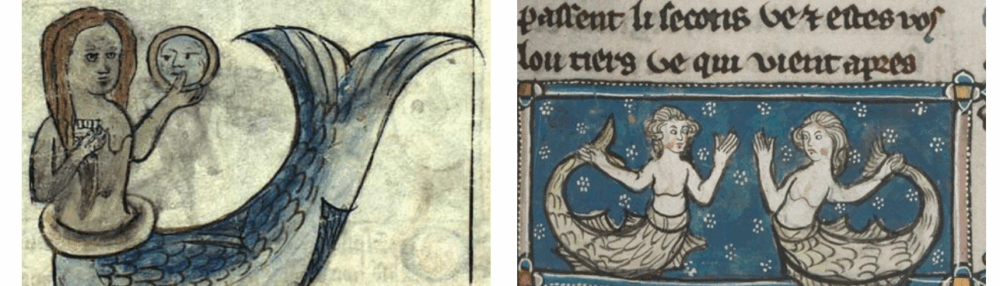
I’m deciding to focus on all the art we saw in this chapter: the early illustrations of mermaids from illuminated manuscripts. What strikes me is actually how consistent mermaids have remained; my idea of them today is not so different from the earliest depictions. I have always loved drawing mermaids and I know I’m not alone. Possessing a long and sinuous tail, as well as often long hair unbound by gravity, and an often nude torso, makes them a really appealing subject for an artist. There are so many opportunities for creative, fluid compositions, there is the human torso for the anatomists among us to dig into, there is the deep symbolism surrounding them as closely as water surrounds them. Now, my mermaid art has been further informed by the aesthetics of illuminated manuscripts, by the Green Men, motifs which occur ubiquitously (like mermaids) and have murky origins– but unlike mermaids, do not continue to capture modern consciousness.
My pursuits, academic, creative, spiritual, professional, exist not in a single field but in an infinitely dense lattice of braided rivers and streams, and I feel that now, in my life, the undercurrent of Mermaids– a spring which arose early in my personal history– the undercurrent of Mermaids is now spreading, slowing, flowing under everything I do, informing other rivulets.
– Thank you Hahnnah for bringing up music: Where are the English and Irish Ballads about Mermaids? Surface level searching returned only Child 289 , “The Mermaid”. I liked this version on spotify. – p8 It not a coincidence that medieval bestiaries represented real animals as “hybrid monsters”– they were drawn based on descriptions, and those descriptions could only function by referencing things people already knew (elephants having a snake on their face, rhinocerouses plated with armor, platypus with ducks bills and beavers’ tails). It’s not possible for us to comprehend anything without points of reference, things to connect them to – Amphitrite- I checked etymonline, and was surprised to find that they don’t attribute “-trite” to simply “triton”. Amphitrite was a bridge, in between, double-aspect (like amphibian or amphoteric or ambivalent or ambidextrous) of Triton. Being female… gave her the power… to leave the sea?? – p 27 “To be human is to be hybrid”. Nuff said. – p 32-33 Note the sculpture of jonah being swallowed by the whale– the whale itself is a hybrid! – Scribner kind of dangerously oversimplifies the origins of Anglo Christianity in Ireland. I recommend further reading. – Excellent line from Thomas Cobham quoted on p 43 “Lord created different creatures… not only for sustenance… but for instruction” <- represents two crucial elements of the human relationship to the natural world in one sentence! – Melusine was the first transforming mermaid? Perhaps the mermaid canon I grew up with does not have origins as recent as I thought. (See also: The Orford Merman, p 55, on mermaids in captivity) – A line from a short story I recently read- Mkondo by Anthony Doerr- describing a fossil of an early proto-bird, which I think reflects the narrator’s unnatural dichotomous worldviews: “What a thing, half bird, half lizard, part one thing, part another, trapped forever between more perfect states”. ↩︎