Seeing the Mask of Nature

In The Trouble with Wilderness, William Cronon questions the common idea that wilderness is a pure and untouched place separate from humans. At first, I thought wilderness just meant beautiful nature far away from cities, but Cronon made me realize that this idea is actually created by people. He writes, “Wilderness hides its unnaturalness behind a mask that is all the more beguiling because it seems so natural.” This line really stood out to me because it shows how the image of wilderness is like a performance, it looks real, but it’s made by us.

The word mask made me think a lot. A mask covers something but also shows a chosen image. When Cronon says wilderness wears a mask, I thought that this means that what we see as natural is actually shaped by human imagination. People want to believe there is still a place free from human influence, so we treat wilderness as something sacred. But Cronon reminded me that even the idea of untouched nature comes from culture and history. It’s interesting because it means that the more we try to escape civilization, the more we reveal how much we are part of it.

Cronon’s point also made me reflect on how people treat cities and everyday spaces. He says we can find wildness “in the cracks of a Manhattan sidewalk, even in the cells of our own bodies.” I really like this image because it changes how I think about nature. It’s not only in national parks or forests, it’s also around us all the time. Cronon’s idea feels realistic because it doesn’t ask us to think about pure nature but to live responsibly in the places we already are.

I think that Cronon’s essay isn’t against wilderness, it’s about balance. If we only see nature as something distant and pure, we ignore our duty to take care of the world close to us. His essay made me think that environmental awareness starts not with escaping from human life, but with seeing the wild side of it. From this, I thought that the real task is not to find wilderness somewhere far away, but to notice it and protect it right where we live.

Fearing What Cannot Be Controlled

In Andre Lebey’s The Romance of the Faery Melusine, the conflict between Raymondin and Melusine is not only about love or trust, it is also about humanity’s fear of nature. This story shows how people try to control what they don’t understand. Raymondin’s growing suspicion toward his wife reflects how humans often react to nature, by fearing and trying to dominate it. His imagination does not just destroy his relationship but also represents a deeper idea about how humans separate themselves from the natural world.

When Raymondin breaks his promise and climbs the stairs to see Melusine, Lebey writes, “he climbed quickly in his eagerness to strike, his heart pumping under his coat of mail as he climbed the narrow winding stair, steeper and steeper, to the very top. There where he had never been before. Neither he, nor anyone, except her – and – who else?” (121). The words “strike” and “heart pumping” create a sense of aggression and tension. He is not moving with love or curiosity, but with the same mindset people have when they want to conquer something unknown. The place “where he had never been before” can be read as more than a room, it symbolizes the natural world that humans are not meant to control. Melusine’s private space becomes a kind of sacred natural environment, one that Raymondin violates out of fear and jealousy. By doing this, he repeats what humans have done for centuries, entering spaces that should remain untouched, just to prove their control over them.

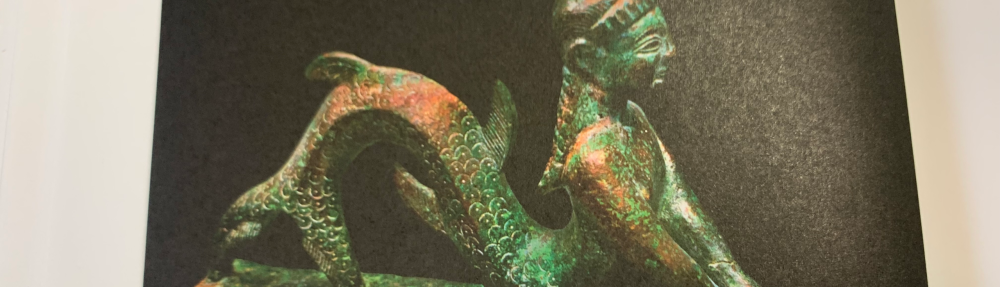
Raymondin’s fear of Melusine’s true form reflects a larger pattern of how people view nature as dangerous or monstrous when it resists control. Melusine, being half human and half water spirit, represents the connection between the human and natural worlds. Instead of seeing her hybridity as something beautiful or balanced, Raymondin sees it as a threat. His imagination turns her into something unnatural and terrifying, showing how easily humans misinterpret what they cannot explain. Through him, Lebey suggests that the real monster is not the creature in the water but the human who cannot coexist with it.

Lebey’s use of sound and movement strengthens the theme of human intrusion into nature. When Raymondin secretly enters Melusine’s hidden space, “he heard not far away, in a place that he could not yet see, a strange sound of splashing water” (123). This soft, rhythmic sound contrasts with his tense and fearful state, showing how calm the natural world is before human interference. As he looks closer, the description of “a tail of green scales stretched under the water made the water lilies move” (125) links beauty and motion, emphasizing the harmony between Melusine and her environment. Yet this harmony disappears the moment Raymondin appears. The sound of water and the movement of lilies reflect the balance of nature that he cannot understand. By entering this quiet, living space, Raymondin’s curiosity and fear turn natural peace into disturbance. Lebey’s language connects his emotional tension with environmental imbalance, reminding us that when humans invade what they cannot comprehend, they destroy both mystery and harmony.

At the end of the story, Melusine disappears back into the air and water, returning to the world she came from. This moment can be read as a form of restoration. She escapes the control and misunderstanding of human society and becomes free again. Raymondin, left alone, represents humanity’s loneliness after separating itself from nature. Lebey’s retelling of Melusine reminds us that when people fear what they can’t control, they end up destroying both their relationships and the natural world that gives them life.

Voice, Sacrifice, and Humanity

While reading The Little Mermaid, the moment that stood out to me was when the little mermaid gives her voice to the sea witch in exchange for human legs. I thought that this part of the story shows how her desire to gain a human soul and to love the prince requires her to lose her most important part, her ability to speak and express herself. The sea witch says, “You have the loveliest voice of all the inhabitants of the deep, but you must give it to me.” By giving up her voice, the mermaid loses her identity and becomes silent in the human world. She cannot express her feelings or tell the prince the truth that she is the one who saved him. The pain she feels when she walks“as if she were treading on sharp knives”represents the price of her dream. From this, I thought that the author connects her physical pain with the emotional and spiritual suffering that comes from wanting something beyond her world.

Even though she is silent, she is not weak. Her silence becomes a kind of strength. She continues to love and care for the prince without expecting anything in return. When she has a chance to save herself by killing him, she refuses and chooses to die instead. I thought this moment shows her true humanity, not through words, but through compassion and sacrifice. In contrast, the prince remains unaware of her feelings and her pain. From this scene I thought that the author seems to suggest that real humanity is not about power or recognition, but about kindness and moral choice. At the end, when she becomes one of the “daughters of the air,” the story turns from tragedy to hope. She does not get the prince, but she gains something more meaningful, which is a chance to earn a soul through doing good for others. I thought her transformation shows that love and suffering can lead to spiritual growth and redemption.

Through the mermaid’s silence and sacrifice, I thought that the author explores the idea that being human is not only about having a body or a voice, but about empathy and the courage to choose good, even when it hurts. The story reminds me that sometimes the path to becoming truly human requires loss, pain, and understanding.

Ontological paradox of the conditional soul

I thought that ‘The Day after the Wedding, from Undine’ is not simply a romantic tale but a story about the transformation of existence and the conditions that come with it. When Undine reveals her true nature to Huldbrand, her marriage gives her a soul but also places her in a fragile and painful state. Through this moment, I thought that the author shows a paradox: gaining humanity means becoming vulnerable.

In her confession, Undine explains that as a water spirit, she once lived joyfully but without a soul. Because of that, she could not feel true emotion or hope for salvation. Through her marriage to a human, she finally receives a soul, but not in the Christian sense of free grace. Instead of being a divine and unconditional gift, her soul depends entirely on Huldbrand’s human love and faithfulness. She tells him, “my soul will ever mean to you, if you do not make my whole life miserable.” This shows that her soul is not guaranteed by divine grace but is based on a fragile human promise. It is almost like a contract rather than a blessing. Undine trades her harmless immortality as a spirit for the chance to experience human love, and, at the same time, human suffering. Her new soul allows her to love deeply, but it also makes her open to heartbreak, jealousy, and fear. This condition also gives Huldbrand a heavy spiritual responsibility. He is no longer only a husband but the one who must keep her soul alive through his devotion. If he fails her, it is not just a personal betrayal, it is a spiritual tragedy. When he proudly calls himself “happier than Pygmalion,” the statement becomes ironic. Pygmalion’s statue was perfect and could not change, but Huldbrand is human, which means that he can be weak, emotional, and easily swayed. His love gives Undine life, yet his imperfection is what threatens her very soul.

In the end, I thought this story challenges the traditional Christian idea that a soul is a permanent blessing given by divine grace. In Undine, the soul becomes conditional, it must be sustained by loyalty and love, not by God alone. This makes the story less about salvation and more about the instability of human existence. Undine’s tragedy suggests that to gain a soul is not to escape suffering but to embrace it fully. I thought that in this story, it tells that being human means living within that tension, where love and loss are inseparable.

Suspicion Over Trust

In Chapter 14, Betrayal, what caught my attention was not only what Raymondin eventually sees, but what happens before he opens the door. The text explains how he armed himself with “one of the short swords… a well-tempered spike, a round dagger… a way to deal with whoever had ravished his honour” (p.119). This shows that even before confronting Melusine, Raymondin already imagined that some kind of threat or betrayal was waiting for him. I found this interesting because the real danger here is not an outside enemy but his own suspicion. By preparing weapons, Raymondin is treating the situation as if it were a battle. It made me think that the betrayal began in his thoughts, long before he actually looked at Melusine. The way he arms himself reflects his fear and insecurity more than any real evidence of wrongdoing.

The narration also describes his approach in detail. He does not rush, but “slid slowly forward” (p.120). This slow movement gives the scene a sense of hesitation and tension. To me, it feels like he is torn between wanting to know the truth and being afraid of what he might discover. Instead of showing strength, this moment highlights his weakness and his inability to trust.

When he finally spies on Melusine, the shocking image of her half-serpent body (p.121) is less surprising to me than the fact that he chose to look in the first place. His preparations and his cautious approach show that he was already expecting something that would justify his doubt. In that sense, what he finds is almost created by his own imagination.

Reading this scene made me think about how fear can push people to destroy their own relationships. Raymondin’s suspicion turns into action, and that action cannot be undone. I thought that this chapter shows about how suspicion, once it takes hold, can become more powerful than love or trust.

Broken promises and the limits of trust

In Chapter 1, “The Great Old Hunter,” we are introduced to Elinas, the King of Albany. He meets a mysterious woman, Presina, in a fountain while hunting. Just like many fairy-tale encounters, it begins with love at first sight. But the relationship only moves forward when Elinas agrees to her one condition: he must never look at her during childbirth or while she nurses their children. At first this feels like a simple magical rule, but for me it showed how fragile trust can be when it depends on promises that test human weakness. What struck me while reading was how Elinas genuinely seemed to love Pressina, yet he still couldn’t resist breaking his promise. This made me think about how often people say yes to conditions without really understanding the weight of them. I feel like the story is less about magic and more about human behavior: it’s hard for people to accept limits, especially when curiosity or pride gets in the way.

I also noticed how this broken promise sets the stage for the rest of the story. Because Elinas fails, Pressina leaves with their daughters, and this is how Melusine’s story begins. In a way, Melusine inherits the consequences of her father’s weakness. I thought about how often in real life, children end up carrying the results of their parents’ mistakes. It doesn’t feel fair, but it happens often. That made me feel sympathy for Melusine before her story even started. Also, what I found interesting too is how the hunting scene contrasts with the fountain. Elinas is powerful and dominant in the forest, chasing animals, but at the fountain he becomes vulnerable, enchanted by Pressina. It feels like the story is saying that no matter how strong someone is in the outside world, love, and secrecy can still make them powerless.

Reading this chapter made me reflect on how promises in relationships work. It’s easy to say to others that we will respect your boundaries, but when the moment comes, it can be really hard to follow through. I think that’s why this chapter still feels relevant: it’s about the difficulty of respecting another person’s space and the big consequences when that respect is broken.

Rethinking water and the lessons of distortion

In both “A Poetics of Planetary Water” and ”Deterritorializing Preface”, Steve Mentz mentions that water is not just a background detail. Instead, it is something active that shapes human life and the way we think.

About “planetary water”, he says we should include not only the ocean but also rivers, lakes, glaciers, and even vapor in the air. He explains, “Human bodies and cultures form themselves in encounters with water in all three physical phases, liquid, solid, and gas.” This made me realize how often I do not realize or think about water in my daily life. I drink water and walk in the rain, but I don’t usually think about how those small moments connect to bigger systems like glaciers or oceans. Dickinson’s poem about the sea as “Everywhere of Silver” shows how water can be beautiful and scary at the same time, and Whitman’s poem about swimming in the surf reminded me of my own summers at the beach. Reading Mentz made me see those memories as part of something larger, not just small personal experiences.

In the “Deterritorializing Preface”, Mentz suggests “seven new words” to help us think differently. The one I found most interesting was “distortion” instead of “clarity.” Since water bends light, what we see through it is never fully clear. When I read this, I connected it to my own experience in school. I often feel pressure to give clear and correct answers, as if learning always has to be perfect. But the truth is, learning is rarely that simple. Sometimes it is confusing, and sometimes I don’t fully understand things right away. Mentz’s idea of distortion reminded me that confusion is not always failure, it can be part of the process. Like water, knowledge changes depending on where you stand and how you look at it. I thought that if we accept distortion, we can see value in shifting perspectives. It means knowledge is not fixed, but flexible and moving like water. This makes me think differently about learning, and it also makes me less afraid of uncertainty.

Changing one word, clarity to distortion, might not sound like much, but it really does change my thinking about knowledge. It suggests that instead of chasing perfect answers, we should pay more attention to movement, change, and growth. And that feels much more realistic, and also more human.

Week 2: Mermaids and the Church

The introduction of Merpeople: A Human History explored how mermaids became deeply ingrained in medieval European culture and imagination. The church treated mermaids not just as mythical sea creatures, but as symbols with moral purposes. Through sculptures, bestiaries, and sermons, mermaids were used to warn believers about the dangers of desire and sin. Mermaids also appeared on medieval maps and became part of local folklore. Stories like the Orford mermaid and the Harlem mermaid are used to show how Christians tried to fit these creatures into their worldview. And these stories are not just entertaining, they also reinforce the teachings of the church.

One part of the reading that caught my attention was how the Church used mermaids in sacred spaces. I was surprised to learn that cathedrals had wooden carvings of topless mermaids. But these carvings were not just for decoration, they were intended to warn the faithful about desire and vanity. I find it interesting that the Church permitted nudity in these cases, showing that female sexuality could be displayed as long as it was framed as dangerous and sinful. I thought that this reveals how carefully the Church controlled what people saw and how they thought about desire. The Haarlem mermaid story also stood out to me. In this story, a captured mermaid is clothed, taught to pray, and integrated into human society. I thought that it reflects the Church’s broader goal of controlling the wild or unknown. Even a magical creature had to be civilized to fit Christian norms. I thought this story is not only about a mermaid, but also a clear metaphor for society’s attempts to shape and discipline those who are different or threatening.

I also found it fascinating how these stories blurred the line between myth and reality. By placing mermaids in art, manuscripts, and sermons, the Church made them feel real. Once real, they could be feared, captured, and tamed, reinforcing the Church’s power over desire and imagination. This combination of fascination and fear seems to have shaped how people understood the world and even continues to influence how we see mermaids today. Overall, this reading helped me see mermaids as more than just fantasy creatures. In the medieval imagination, they served as moral teachers, cultural boundary markers, and symbols of control. It made me wonder how many other mythical figures were used in similar ways to guide people’s beliefs and behaviors.

Introduction

Hello! My name is Bomin Kim, and I am from Seoul, South Korea. I am currently an exchange student at San Diego State University (SDSU). I am a sophomore, and I am Korean, but my home university is in Japan. At my home university, my major is Intercultural Communication, but here at SDSU, I am studying Psychology. I decided to explore psychology during my exchange program because I am interested in human behavior, how people think, and how cultural backgrounds shape our minds. I believe that this learning can help me better understand human interactions in a globalized world.

I really love animals, and dogs are definitely my favorite. I also have a dog named Byeol, which means star in Korean, and he has been an important part of my life since I was around 13. Also, in my free time, I enjoy spending time with friends, whether it’s hanging out, exploring new places, or trying new foods together. At the same time, I also love having quiet days at home to relax and recharge. Another thing I really enjoy is listening to music. One of my favorite songs is Daydreamin’ by Ariana Grande, which I never get tired of listening to. I also enjoy learning new languages. Right now, I speak Korean, Japanese, and English, and I’m currently studying Chinese. It’s challenging, but also very fun and exciting for me.

The reason I chose to study abroad is not only to improve my English skills but also to broaden my worldview. I believe that stepping out of my comfort zone and living in different countries will help me for a future career where international cooperation and understanding are essential.

Thank you for reading my introduction, and I am really looking forward to learning more and sharing thoughts!

Screenshot