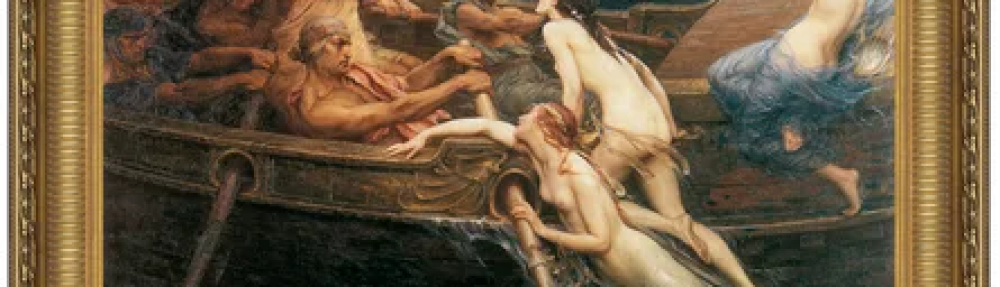
Lebey is extremely playful in his interpretation of the story of Melusine. As Raymondin is approaching his wife during the culmination of his betrayal, Lebey describes “He slid slowly forward… And in the moonlight that made his coat of mail glisten, he had the appearance of a strange serpent with iron scales.” How ironic, this image of Raymondin, serpent-like, slithering towards his own despair. Here, our author coils around the infamous, biblical origin story of human sin. Maybe Eve bit the apple, but Adam was the snake. Lebey continues to meander this inverted narrative in the next chapter. First with the reversal of the typical mermaid narrative: “Deceived, as women are and always will be, by your handsome body, your honest face, your sweet appearance, I did not suppose you capable of treason…” Contrary to mermaid lore that focuses on the human’s narration, Melusine’s point of view upends the lure of the beauty of the hybrid. To Melusine it is Raymondin who lured her in with his stoic stature, his handsome innocence. Digging deeper, giving a voice to Melusine not only upends the typical mermaid lore, but transposes the legend of Adam and Eve. “If you had not broken your word” Melusine tells Raymondin “I could have remained in this world and been saved from torment and misery in the other.” The notion of women blaming men for eternal damnation is a role reversal of sin. Lebey’s reimagination of the story of Melusine is an upheaval of man’s dominion. The depiction of unruly nature, the serpentine likeness of Raymondin, the sensual luring of Melusine, the interpretation of betrayal. All contribute to dislodge the concept of man’s supremacy. Lebey plays with the contortion of societal narrative. After all, this is a time for social reform. The Parisian lost generation of the post-war 1920s, struggling to find their footing on a war-torn continent. Lebey takes a story used to assert the lordship of men and instead tears down their dominion.
Author Archives: Ashley Sims
The Fury of Female Knowledge
Man’s dominion. A desire that has not been fully capitalized in this story of Melusine written by Andre Labey. Men did not yet rule the earth as they think they do now, no, “They lived close to nature in those days.” Close to a forest characterized as “menacing and dangerous, full of the unknown, concealing the surprising and the supernatural.” Common men cowered to the beasts who raided their town, “huddled for comfort against their wives… as they heard the scampering of clawed feet on paving stones.” This diabolical depiction of nature leads to a dichotomy of good vs evil. The God-fearing men pitted against vicious, depraved beings of the forest. This is the rhetoric of imperialists. The ideology of justification for tying the earth with fences. Nature is not the only thing that has yet to be seized by men’s dominion. It is women too that are still presented with a layer of autonomy or capability. They are depicted as hunters, as contenders of falconry, and knowledgeable, as we see in Melusine. What is notable about Melusine’s knowledge is that it is not yet feared. Raymondin is not deterred by Melusine’s divine knowledge, but mesmerized by it. For “it was always she, indeed, who led.” Melusine divulged information that had yet to be known, alongside promises of wealth and honour. Raymondin ceased mourning after one look at her. Is this a case of desire presiding over faith? But Melusine is as Christian as Raymondin. What it all keeps coming back to is women beholding knowledge. Divine knowledge. Desire coupled with divine knowledge that continuously leads to undesirable circumstances. There is the root of our sinful sirens. Man’s dominion over knowledge. Because knowledge in the hands of women is knowledge in the hands of beauty. And what man could compete against beauty and brains:
“What minstrel can describe the irresistible power of feminine beauty when it gets under a man’s skin? None can, and that is no doubt how things will remain till the end of the world.”
“Yet all through the land, evil reigned only if heroes failed to confront its dangers. It seemed that the one existed to give rise to the other, for humans do not show their mettle if left to themselves.”
These quotes are the source of female anguish. Evil reigns if heroes fail to confront its dangers. The irresistible power of feminine beauty combined with divine knowledge is more detrimental to the conquests of men than the diabolical packs of wolves scavenging the paving stones.
Mer-interpretations
“The mermaid is a hybrid beast.” Unlike other forms of mythological hybridity, humans have split crossroads when it comes to interpreting these beasts. Do they impart knowledge? Are they friendly? Deadly? Sexual? Unassuming? Just curious? In an interesting analysis, Steve Mentz finds that interpreting shape-shifting clouds “essentially follows a hybridizing theory of interpreting forms of water… about how vaporous forms assume multiple meanings… The challenge is devising a language to understand their forms”. As hybridized water beings, mermaids are vaporous. That is, they are vague, and lacking in clarity. Like hazy clouds, interpretation of mermaids shape-shift throughout time and place. Their soaked and shrouded dwellings cultivate a sense of mystery. We humans are apt to judge. Clothes, cars, houses. We gain a sense of constancy knowing what kind of person we encounter based on their address. So, an ability to construct mermaids into a coercing presence comes from their watery lodgings; able to assume multiple meanings. The church can depict them demonically or hyper-sexualized, myths can represent beings to overcome or avoid, pop culture can take their voices. These representations help push an agenda that is difficult to object when we are wrestling to grasp an interpretation of water, let alone an interpretation of these hydrobeings. Furthermore, examining Mentz’s grappling with the interpretation of the forms of water, he states: “The challenge is devising a language to understand their forms.” Mentz has faced this challenge head on in his preface to his book Ocean. He impels to manipulate the use of terracentral language: changing the word field to current, or state to ship. When we use these words, among others, we stop tethering ourselves to land. Water, in all its forms, becomes less threatening and more of an everyday interaction. This change of language changes our relationship to planetary water, consequently, changing our relationship to the beings that inhabit it. I can’t help wondering, what our merbeing myths would hold now if we had the relationship we have with water today, hundreds or even thousands of years ago.
Mermaids and Mo’o
In an introduction to The Penguin Book of Mermaids Christina Bacchilega and Marie Alohalani Brown define monsters etymologically as “That which reveals, that which warns”. Going on to say that “Biform are signs, then, that often serve as admonition for humans not to cross borders and incitement to do so.” (xii) This definition reveals our classroom perception of mermaids represented on maps. Easy to perceive as a place to stay away from, or a place to colonize, to humanize.
In their collection of mermaid mythology our authors notice that duplicity and demonization are most prevalent in European societies and reflect an anthropocentric worldview. Furthermore, these tales exhibit a society’s relationship with water.
As it does between nations, races, and religions, always being depicted as the other, as the permeating being, inherently demonizes. Concealing a merperson’s environment strips the capability of sympathy and relatability of their circumstance, “the experience is conveyed as a disappearance form the human world—the only proper social world—into an abyss that is not described. This silence in the narrative furthers the perception of the captivating mermaid as monstrous.” (xix) Not only are these European tales monsterizing the mermaids but they are monstering the ocean itself.
In contrast, Hawaiian myths of the mo’o “renowned for their loveliness” offer a reflection of a society with an animistic world view. “there are no tales of men who try to tame their mo’o partners, because the mo’o, like the features of water they embody, cannot be contained or domesticated.” (xx) Hawaiian water deities display a respect for the ocean and for “nonhuman life”.
A European, monstrously depicted mermaid reveals a fear of the other as well as a fear of the ocean. And what lies beneath the ocean, a fear of the unknown. On the other hand, a respect towards water deities, like mo’o, embodies respect towards the ocean and therefore respect for life itself, no matter the form.
Why did Christianity Exploit Mermaids?
In his first chapter of Merpeople: A Human History Scribner recounts the extensive imagery of merpeople utilized by the church to gain pagan followers while it “hoped to distance itself from the sacred feminine of the pagan past.” (para. 9) The mermaid was contrived to control the narrative of female sin. In medieval times, this era of monsters, why does the Church use merpeople, specifically mermaids, to convert pagan followers and scandalize femininity? Why not dragons, giants, ogres, or unicorns among others? In this class we have established a human fascination with hybridity, and in it an ability to reflect ourselves. Therefore, this representation of sin had to contain a human element. But why not other hybrids, such as harpies? In fact, the church purposefully went out of its way to omit harpies and depict sirens as half-woman half-fish instead as Scribner indicates in paragraph 14: “Homer’s Odyssey alluded to sirens as bird-like creatures. Christian artists diverged from the original descriptions because they no longer needed a hideous siren”. Sirens or harpies, these bird women, no matter how monstrously depicted, would be too easily interpreted as ascending to heaven. In its use of mermaids, the church is able portray beautiful women exuding lust and sin. Because their environment is beneath us, because these beings technically exist below earth, they are essentially only one step away from hell. The mermaid’s environment diminishes any chance of misinterpretation of the church’s warning.
In addition, merpeople are humanity’s attempt to control an environment that is not our own. Christianity aims to be the shepherd of this planet, yet we have only dipped a toe into the oceanic expanse that covers nearly ¾ of it. By worshipping Oannes or Ea, Neptune or Poseidon, pagan religion forges a connection with the sea. And therefore, constructs a command of the deep. Christianity is expanding on this connection, and the human governance of the entirety of Earth, by insinuating the existence of merpeople.
Lastly, I am wondering where modern mermaid stories and culture would be if the church never represented mermaids as prevalently as they did. Would we have grown up watching The Little Mermaid? Would ‘mermaiding’ be a thing? Would we even be taking this class?
Hello Everyone! I’m Ashley
I am an English and Comparative Literature major in my junior year. I just transferred in from Mesa College. Although it is my first year since transferring, it is not my first year at SDSU. Years ago (longer than I care to admit) I attended SDSU fresh out of high school. I dreamed of being a writer. Unfortunately, a lack of self-confidence, combined with the pessimistic attitude of an 18-year-old led me to drop out. Now, after five years of chipping away at an AA in English, I have returned with a sense of optimism and a true desire to learn. In other words, I am SO excited to be here. We’ll see how I feel in the middle of the semester though.
Anyways, a little bit about the non-academic side of my journey, I was born and raised in San Diego. Specifically, the Pacific Beach community. I grew up surfing, playing tons of sports, and just always at the beach. My upbringing has made the ocean like a second home to me, sometimes even a first, and I am tremendously grateful for that. Whenever my sister and I go for a swim she asks me: “wanna go play mermaids?” And no, she’s not six years old, she is an adult. So you can imagine the first person I told after I registered for this class. I have recently discovered a passion for doing triathlons, which may be evolving into a love for open water swimming. Overall, I am existing in a realm of self-discovery right now and absolutely loving it. Oh, for work, I’m in the restaurant industry. Bartender, server, barista, you name it, I’ve even worked the line. If you’re ever in PB you can usually find me at Kono’s Coffee cart. I’ll make you a pretty good coffee.

