The Boundary Between Sea and Land in ‘The Little Mermaid’

In Hans Christian Andersen’s The Little Mermaid is built in a world full of boundaries–between sea and land, voice and vision, loss and desire– is built. The story of the mermaid carries emotional power that lies not only in its romance but in its fixation on its land crossings. From the opening description of the ocean floor being “as clear as the purest crystal. But it is very deep–so deep…no rope could fathom it” (108), Andersen establishes a paradox that moves the story; transparency does not mean it’s accessible. If a boundary is visible, it doesn’t always need to be crossed. The mermaid’s world glitters with boundaries, thresholds that she can see but cannot touch, like amber windows, marble steps, and water so clear it hides nothing yet conceals everything.

Every transition in the tale costs something. The mermaid’s ascent from sea to surface allows her to see the human world, but she remains unseen, able to save the prince only by disappearing before he wakes. Her second crossing–from sea to land–turns her body into a painful border. The sea witch’s warning that every step will feel “like treading upon such sharp knives” (121) transforms any bodily movement itself into a form of self-sacrifice. Losing her voice is another boundary breached; in losing her voice, she gains access to the human world. The prince reads her “speaking eyes” (122), but his interpretation fails, and she’s now seen as a human but fundamentally misrecognized.

Andersen repeatedly shows that language falters at the surface. The mermaid’s sisters sing above the waves, but sailors hear only noise from the storm–sound that is distorted by the border she tries to cross (112). The story’s build reinforces this pattern through a concept of half-space, like balconies over canals, and staircases leading into water, but they never merge. Even the prince’s ship becomes a literal threshold between belonging and exile.

In the end, the mermaid’s transformation and joining with “the other children of the air” (130) traces back to the mermaid’s longing for desire, which always comes with sacrifice. Each ascent–from sea to land to air–brings both a vision and loss. Andersen’s lasting sadness comes from this paradox that his heroine lives always at the glass between worlds, where beauty and pain both coexist. Fulfillment comes not through breaking boundaries, but through the long, slow softening of them.

The Fear of the Unknown and Dream Imagery in “The Day after the Wedding”

In this week’s reading of “The Day After the Wedding, from Undine” from The Penguin Book of Mermaids, Hulbrand’s strange dreams serve as both psychological foreshadowing and also as a symbolic reflection of his unconscious fears of his newlywed. The narration describes how, during the night, he had “wonderful and horrible dreams had disturbed [his] rest; he had been haunted by spectres” and he describes these “spectres” to be “grinning at him by stealth, and had tried to disguise themselves as beautiful women, and from beautiful women they all at once assumed the faces of dragons” (102). This shifting imagery of women turning into monsters does a great job capturing the unstable boundary between danger and beauty, which seems to be an important theme in the story. Hulbrand’s dream functions as a warning that beneath Undine’s enchanting exterior lies a mystery that he doesn’t understand. The transformation from female beauty to a monstrous dragon symbolizes his anxiety about the power and unpredictability of the feminine being, especially within the sacred institution of marriage.

This moment also shows the reading audience that there is a larger Romantic fascination with the supernatural, and is used as a reflection of inner emotion. The “pale and cold” moonlight that is present when Hulbrand awakes blurs the line between dream and real life, which makes the domestic space feel haunted by this unseen presence. His fearful glance at Undine–who is lying beside him in an “unaltered beauty and grace”–shows how quickly love can give way to doubt. Yet his attempt to rationalize this fear–seen when he “reproached himself for any doubt…”–reveals that his struggle is not only against supernatural forces, but also within himself. He wants to believe in her purity and grace, but his subconscious continues to be a force of resistance against that trust.

By beginning the morning with this vision, our author, Fouqué, prepares the reader and foreshadows the later revelation of Undine’s true identity. The dream dramatizes Huldbrand’s deepest unease–that the woman he loves might not be entirely human–and successfully foreshadows the tension between human reason and the supernatural. Through this reading, the story of Undine explores how fear and fascination can coexist in love, and how the supernatural becomes a mirror for the human psyche’s hidden anxieties.

Serpent or Secret? Raymondin’s Obsession and the Ruin of Trust

In this week’s reading, Chapter 19, “Betrayal,” focuses on Raymondin’s discovery of Melusine’s secret, which dramatizes how mistrust can turn reason into a destructive obsession while also reflecting medieval anxieties about secrecy and female power. At first, his pacing and restlessness show his inability to keep his suspicions and his grief that Melusine could possibly be betraying him, which mutates into this violent intent where he takes his dagger to arm himself against not an enemy but against the mystery of his own wife. The spiral staircase he ascends represents the inward collapse within himself, because with each step his judgment narrows until “reason had become unreason, and unreason his only reason” (120), emphasizing that his search is no longer guided by rationality but by the distorted logic of his mistrust and jealousy.

The imagery we see of the hidden chamber truly highlights the stakes of his choice not to trust his wife. The room glimmers with golden sand, coral, and fallen stars, while a great glass wall suggests that an otherworldly boundary between human and supernatural realms. The setting recalls the wonders that are described in Urian’s letter about their son’s adventures abroad, putting Melusine in a realm of strangeness and mystery rather than somewhere with domestic normalcy. By entering this chamber, Raymondin is not only violating his promise to her–never to see her on a Saturday–but he’s also intruding on a world that demands reverence rather than suspicion. His failure lies not in Melusine’s ‘serpent’ form but in his refusal to accept the limits of his knowledge.

The revelation itself–Melusine as a half woman and half serpent–combines beauty and terror, making it obvious the anxieties that underlie Raymondin’s mistrust. Medieval culture often framed women as both necessary and dangerous; they’re sources of lineage and wealth but also of secrecy and disorder. By confirming his suspicion, Raymondin destroys the foundation of trust that allowed his marriage to Melusine to thrive. His collapse into the sand, “face fallen into the fine sand…his open mouth” (125), dramatizes how curiosity that stems from suspicion and jealousy leads not to truth but to pain and ruin. The chapter overall suggests that the danger lies less in Melusine’s supernatural nature than in Raymondin’s inability to honor secrets/mysteries, showing the readers how broken oaths and mistrust can unravel both love and loyalty.

Human Identity and it’s Connection to the Natural World in ‘The Great Old Hunter’

In this week’s reading in Chapter 1, “The Great Old Hunter,” the author showed readers from the start of the story that this was a natural world being depicted as both menacing and awe-inspiring. Wolves, foxes, and wildcats stalk on the borders of human life, threatening children and livestock: “God help any child left playing on the doorstep, forgotten of an evening. On winter nights, in times of famine, packs ran through the streets, howling under the cold moon,” (11). Here, nature is not romanticized but is read as a force of hunger and violence that is used for conflict in fragile, weak towns. The “howling” wolves and the “diabolic” rustling of packs are described with words that border almost the supernatural, especially with the mention of the smell of sulphur, evoking literal Hell itself. The type of language that is used shows how the imagination of medieval people is often combined with the physical dangers of the environment, with moral and spiritual threats.

Yet, the forest and its creatures are not merely destructive. These animals also become the proving ground for, I suppose we can call it, “human greatness.” The narrator states that “evil reigned only if heroes failed to confront its dangers. It seemed that the one existed to give rise to the other, for humans do not show their mettle if left to themselves,” (12). In other words, the danger of nature is necessary because it brings out the courage, heroism, and even piety in humans. Aimery’s hunts are not seen as a simple sport but also as acts that extend human power into the world and reaffirm that divine order. When Aimery slays a boar, that isn’t a victory over an animal, but it’s a symbolic triumph over the Antichrist. Hunting becomes this sacred labor, an almost ritualized confrontation with the wild that we can see both disciplines nature and sanctifies humanity.

Overall, this passage suggests to us that in Aimery’s world, human identity comes from its relationship with the natural world–a world that constantly threatens, tempts, and tests humans, but also gives us opportunities for glory and grace. To live near the forest is to live near both the Devil and God, to be reminded that danger and sanctity often come from the same dark woods.

Odysseus and the Deadly Temptation of the Sirens

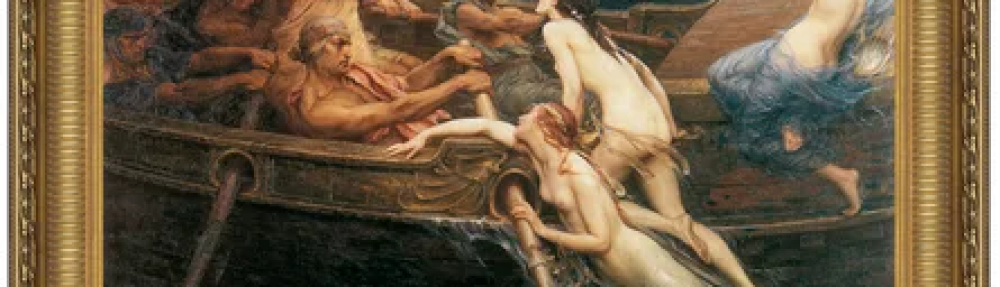
In this week’s reading of “Odysseus and the Sirens” in The Penguin Book of Mermaids, it recounts Odysseus’ encounter with the Sirens, which, if I remember correctly, is one of the most symbolically charged episodes in his journey home. The Sirens, like mermaids, embody the trope of dangerous femininity: they are creatures who enchant men with beauty and song only to lead them to their dooms. What distinguishes this episode is not only the deadly temptation Odysseus faces but also the preparation he brings, having been warned by Circe. Unlike other moments of erotic or sensual temptation in his other travels, the Sirens’ lure is on a different level of danger. It is an intellectual and spiritual seduction that can be tied to the desire for knowledge.

This story carefully shows the tension between control and surrender. Odysseus asserts his authority from the beginning, instructing his men to bind him fast, “Me, me alone, with fetters firmly bound, / The gods allow to hear the dangerous sound” (10). His insistence that chains be “added band to band” reveals an awareness of his own vulnerability. He desires to hear the Sirens but also knows the peril of indulging in their song unrestrained. The physical imagery of bondage that is seen only dramatizes the paradox: Odysseus gains access to the Sirens’ knowledge only through restriction. In this way, the passage uses wisdom as something that can be achieved only by resisting desire, even when that resistance comes through force.

The Sirens’ song itself highlights the danger. They promise Odysseus not sensual pleasure but “new wisdom from the wise” (11), appealing to his heroic identity as a seeker of knowledge. Their words use knowledge as a form of transcendence: “thy soul shall into raptures rise!” Yet the framing of this knowledge is also destructive. By offering the totality of human experience–“Whate’er beneath the sun’s bright journey lies”– the Sirens promise an omniscience that no mortal should claim. Their music is a portal, one that tempts him toward a dimension beyond human limits, where the cost of knowledge is death.

Odysseus’s struggle to break free during the Sirens’ song, despite having planned for this exact moment, shows the seductive power of their mystical, ethereal promise. His men, immune with wax-stopped ears, remain safe because they are locked out of this ‘knowledge.’ The tension between Odysseus and his men shows the danger of intellectual temptation. Odysseus, the seeker, is drawn to the perilous edge, while his men embody the wisdom of ignorance.

Overall, the passages’ reading dramatizes the precarious balance that lies between curiosity and survival. By escaping, Odysseus affirms his self-control, but the scene that is depicted reminds us of that fine line between knowledge that empowers and the knowledge that destroys.

A Mermaids Body is the Blame for Male Insecurity

The part of this week’s reading that interested me the most was a part of the section titled “Their Bodies, Our Anxieties,” which essentially covers how, throughout history, humans have always been “deeply unsettled” by mermaids and the liminality between humans and mermaids, which is what creates that anxiety. The book makes a great point about how humans’ anxieties about mermaids originate from our attraction to them. As I continued to read, we approached the issue of gender within the merefolk community. In early modern British culture, “a woman who oversteps the boundaries…[is] defined as monstrous” (xiii). It is ironic because then we see how in Odysseus’ interactions with the Sirens, he is considered a manly man who is heroic and strong for not falling prey to them. These stories that we will read about the merefolk will definitely bring up our expectations about gender within their community.

What I found to be the most bizarre is the interpretation of a mermaid’s tail when deciphering whether they were “available” or not. If they are “represented as having a single fishtail marking them as having some control of their bodies,” and “having two tails, perhaps suggesting sexual availability,” (xiii). Again, absolutely insane. The idea that something as arbitrary as the number of tails could be a coded message about a woman’s chastity or their sexual “openness” shows how much these myths and stories were shaped by patriarchal anxieties. People projected their fears and desires onto mermaids and ultimately reduced their bodies into a code to be deciphered and enjoyed by male viewers. Mermaids could have been represented as a symbolic or purely fantasical form, and they’re not; it’s very disturbing to realize that creatures as fascinating as they are were not exempt from being sexualized and categorized based on their supposed virtue. In a modern analysis of the situation of one or two tails is almost as demeaning as being asked, “How many bodies do you have?” That is quite literally what was being asked of mermaids..

The reading this week shows how different storytelling has continuously reinforced these cultural norms about gender and sexuality, it was normalizing the surveillance of women’s bodies and their behaviors through the most fantastical imagery; their literal tails. By placing such messages in myths and stories, societies have been hiding misogyny under the guise of such entertainment in storytelling.

The Silence of the Mermaids

In Merepeople: A Human History, Vaughn Scribner says that mermaids act as a means for symbolism for the shift in humanity and their conceptions of myth, religion, science, and capitalism (27). Mermaids perfectly reflect that change in humanity from believing in something mythical to exorting it. Mermaids were viewed as grotesque to some, simply because they’re half-human and half-animal. Whereas some mythological creatures like angels, for example, are very much also hybrid beings–half bird and half human–are symbolic in a different way; a way that is full of purity and transcendence. Mermaids were vilified while angels were, quite literally, angelic and uplifting. The stark contrast between those two hybrid beings shows how gendered interpretations chose whether a hybrid was to be celebrated or condemned.

I feel like the human half of the mermaid should’ve invited sympathy, which could’ve been symbolic in a way that allows people to connect their own experiences to life, not just on the surface, but as Princess Ariel’s good friend, Sebastian, once said, also under the sea. But instead, the difference between merepeople and humans was just too vast, and humans couldn’t relate to them, and that’s what began painting them as monstrous. Early portrayals of merepeople started with mermen, and they were associated with being strong and as a force in nature. But as religious and artistic traditions changed, women were physically and figuratively becoming the face of the merepeople. Triton’s wife, Amphitrite, and other mermaids were sexualized and defined with less autonomy and more by how they reflected a man’s anxieties and desires as time progressed.

It’s also very important to note that Christianity very much weaponized this villainization of mermaids. Christians used mermaids as symbols of sin and as a warning against feminine temptation, “A scriptural passage from the Wisdom of Sirach simply stated, ‘better the wickedness of a man than a woman doing good’. Women, for early Christian leaders, represented lust, weakness and man’s fall from grace” (37). When mermaids started to be transformed into sirens and their “siren song” epitomized the danger of a woman’s voice. Instead of letting mermaids be protectors of the ocean, they became basically a scapegoat for male weakness…I totally feel like the chance to see mermaids as a protector or guardian of the sea, and it’s marine life, was overshadowed by how they were portrayed to be dangerous seductresses. By turning mermaids into monsters, humans have definitely taken away a potential voice for the environment and the natural world.

Ultimately, mermaids show how femininity, but when connected to power or danger, their feminity has been weaponized against women themselves. I wonder if the silence of the mermaids can be changed if we tried to reimagine them as protectors of the ocean rather than something that kept people out.

Introduction :) !

Hello all! I’m Alyssa 🙂 I’m a fourth-year English and Comparative Literature major, and I’m currently pursuing a minor in Political Science, and I’m a second-year transfer student from Mt. San Jacinto. After I graduate from SDSU, I look forward to pursuing my Master’s in either English or Political Science.

This may sound cliché, but the main reason why I was so excited for this course is that I loved The Little Mermaid growing up. I remember when I was younger and going to Disneyland with my family, I would always run up to take photos with Princess Ariel. My Dad says I always took my hair out of a ponytail so she and I would “look alike!”

Growing up, my family and I would go to Disneyland so often when passes were more affordable, and because I grew up in Orange County so Anaheim was only 15-20 minutes away from our house! My parents have definitely raised me to be a Disney adult.

Some more things about me besides my love for Disney and mermaids are that I live in Menifee–which is north of Temecula–so I commute to and from San Diego for school. Fortunately, my boyfriend does live 10 minutes from SDSU, so staying with him and his family has helped me out getting to my classes these last two years. Anndddd I really, really love going to concerts! I went to my very first one in 2022, and since then, I’ve been to over 10 different concerts! I think my top three favorite concerts I’ve seen were Sabrina Carpenter, Cage the Elephant, and Hozier. I also have 4 dogs! I love them all so much, even if they don’t like me sometimes. I had a 5th dog, but he passed a couple of years ago. This is Cotton! He was the cutest dog ever.

Anywho, I’m very excited to learn more about mermaids and their mythological origins. I’m interested in learning how different cultures have represented mermaids as well! I’ve always loved Greek mythology growing up, so taking a class about mermaids is really going to make younger me so happy.